
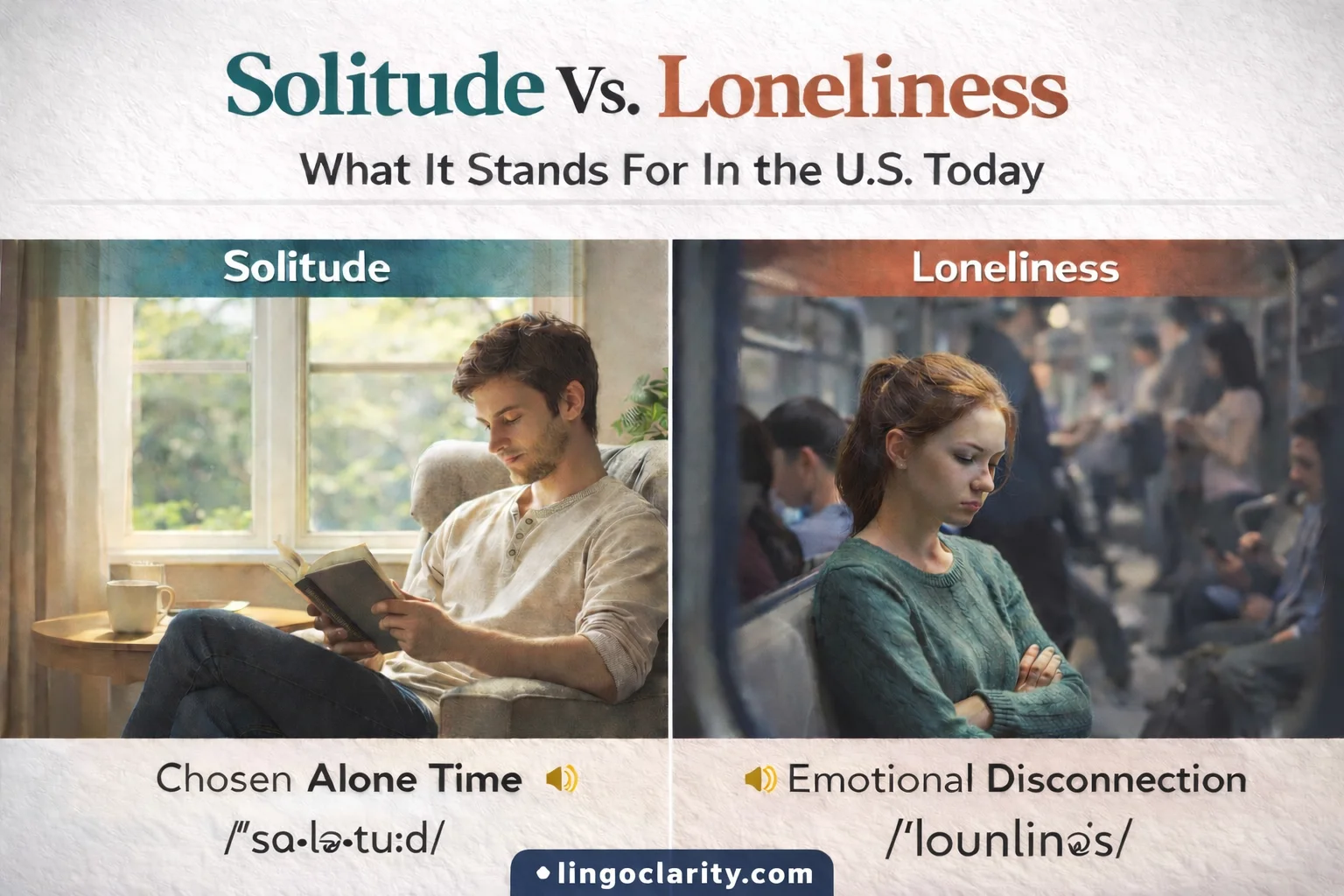
“Solitude” and “loneliness” both describe experiences connected to being apart from others, but they are not the same. In modern US English, solitude usually refers to welcome, chosen, or peaceful time alone. Loneliness refers to the painful feeling of being emotionally disconnected, unseen, or cut off from the connection you want.
That difference matters in real writing because the wrong word changes the tone immediately. One suggests calm, privacy, or reflection. The other suggests hurt, emptiness, or lack.
For most readers, the safest rule is simple. Use solitude when the point is quiet, personal space, rest, or reflection. Use loneliness when the point is sadness, isolation, or missing human connection. That basic distinction is the heart of Solitude vs. Loneliness and the reason these words are not interchangeable.
Quick Answer
Here is the clearest practical rule:
Use solitude for alone time that feels peaceful, intentional, private, reflective, or emotionally neutral.
Use loneliness for the painful feeling of disconnection, emotional absence, or unmet need for companionship.
A quick test helps. When the person wants the time alone or feels restored by it, solitude is usually the better choice. When the person feels hurt by the absence of closeness, loneliness is the better word.
What Solitude Means
Solitude names a state of being alone, but in modern American English it often carries a calm or thoughtful tone. The word regularly appears in contexts involving reading, writing, prayer, recovery, meditation, nature, creative work, or a break from constant noise.
Consider these examples:
“She wanted an hour of solitude before the day started.”
“He finds real solitude on early hikes.”
“The cottage offered peace, quiet, and solitude.”
In all three cases, the person is alone, but the emotional tone is not painful. The emphasis falls on space, stillness, and freedom from interruption.
Context still matters, though. Solitude does not always sound warm or uplifting. In some settings, it can suggest seclusion, remoteness, or long separation. Even so, it usually sounds more neutral or more dignified than loneliness.
What Loneliness Means
Loneliness is not just being by yourself. It is the emotional experience of feeling cut off, unseen, unsupported, or disconnected. Someone may feel loneliness while living alone, but the feeling can also show up in a marriage, at work, during a move, or in the middle of a crowded room.
Look at these examples:
“After the move, loneliness hit him hard.”
“She felt loneliness even at busy social events.”
“Retirement brought an unexpected loneliness.”
Each sentence focuses on emotional pain rather than physical separation. That is the central difference in Solitude vs. Loneliness. One word points mainly to a condition. The other points mainly to a feeling.
Solitude vs. Loneliness At A Glance
The easiest way to separate these words is to ask what the sentence emphasizes.
Solitude emphasizes being alone.
Loneliness emphasizes feeling disconnected.
Solitude often sounds calm, reflective, private, or intentional.
Loneliness often sounds painful, empty, sad, or emotionally exposed.
Solitude is often chosen or welcomed.
Loneliness is usually unwanted.
That is the core distinction behind Solitude vs. Loneliness in everyday US English.
Why People Confuse These Words
Confusion happens because both words relate to aloneness. On the surface, they seem closely linked. In real usage, however, they describe different experiences.
Many people also blur three separate ideas: being alone, feeling lonely, and choosing quiet time. Those ideas can overlap, but they are not identical.
A person can sit alone at home and feel peaceful. Someone else can attend a packed event and feel deeply disconnected. Another person can spend a quiet afternoon alone without feeling especially positive or especially sad. In that case, the plain word alone may be more accurate than either solitude or loneliness.
Being Alone Is Not The Same As Feeling Lonely
This distinction is one of the most useful parts of Solitude vs. Loneliness.
Alone describes a condition.
Lonely describes a feeling.
Compare these two sentences:
“She was alone in the apartment.”
“She was lonely in the apartment.”
The first sentence tells you where she was and that nobody else was there. The second tells you how she felt.
Now compare another set:
“He enjoys being alone.”
“He enjoys solitude.”
“He enjoys loneliness.”
The first two sound natural. The third sounds wrong in ordinary usage because loneliness usually implies suffering, not enjoyment.
Tone And Connotation
Tone is where word choice matters most.
Solitude often sounds more thoughtful, composed, and reflective. It can suggest independence, depth, privacy, maturity, or relief from social pressure. Because of that, the word appears often in essays, serious lifestyle writing, spiritual writing, and personal reflection.
Loneliness sounds more emotionally direct. It names a feeling plainly, which is why it appears so often in conversations about relationships, grief, mental health, aging, moving, or social disconnection.
A useful contrast is this: solitude sounds like space, while loneliness sounds like lack.
That is why “I need some solitude” sounds natural. By contrast, “I need some loneliness” sounds wrong.
When To Use Solitude
Choose solitude when the sentence is about quiet, privacy, focus, rest, or chosen time alone. The word fits best when being apart from others feels welcome, useful, or emotionally neutral.
Common contexts include:
- reflection
- writing or creative work
- prayer or meditation
- stepping away from stress
- enjoying quiet nature
- recharging after social activity
Examples:
“She uses early-morning solitude to plan her day.”
“After a week of meetings, he wanted solitude.”
“The painter worked in solitude all afternoon.”
“They moved to the countryside for more solitude.”
Each sentence presents alone time as beneficial, deliberate, or restful.
When To Use Loneliness
Choose loneliness when the sentence is about hurt, disconnection, absence, or unmet emotional need. This word works when the focus is not privacy but pain.
Common contexts include:
- grief after loss
- missing companionship
- social dislocation
- feeling unseen
- emotional distance in relationships
- struggling to connect in a new place
Examples:
“The loneliness after graduation surprised her.”
“He felt loneliness during his first winter in the city.”
“Behind her smile was a deep loneliness.”
“Even in a busy office, she felt loneliness she could not explain.”
These examples show why Solitude vs. Loneliness is more than a vocabulary issue. The emotional core of the sentence determines the right choice.
When One Word Sounds Wrong
Writers often choose the wrong word because they focus on the physical setting instead of the emotional meaning.
Take this sentence: “I enjoy my loneliness.”
In most cases, that sounds unnatural. If the real meaning is that the speaker likes quiet time alone, solitude is the better choice.
Now take this one: “She sat in solitude and felt abandoned.”
That sentence is possible, but it pulls in two directions. If the pain is the point, loneliness is clearer and more direct.
Here is another example: “The loneliness of the woods.”
That phrase can work in literary or poetic writing. In plain modern American English, however, “the solitude of the woods” usually sounds more natural when the idea is remoteness, stillness, or peace rather than emotional suffering.
Solitude Is Not Always Positive
Writers sometimes oversimplify Solitude vs. Loneliness by treating solitude as automatically good. Real usage is more nuanced.
In many contexts, solitude does sound positive. It can suggest recovery, self-possession, freedom, and mental clarity. Yet context can shift the tone. Forced separation, prolonged seclusion, or unwanted withdrawal may still be described as solitude, even if the experience is not pleasant.
Compare these examples:
“She welcomed the solitude after a noisy week.”
“Months of solitude began to wear on him.”
The same noun appears in both sentences, but the emotional effect changes because the surrounding context changes.
Even with that nuance, solitude still usually sounds less painful than loneliness.
Loneliness Can Happen In A Crowd
This point is essential because it explains why loneliness is emotional rather than purely physical.
A person can feel profoundly lonely while surrounded by other people. That happens when the company feels shallow, strained, unsafe, or emotionally distant. Presence alone does not create connection.
Examples:
“She was rarely alone, but often lonely.”
“The noise around him made his loneliness feel sharper.”
“He felt lonely at the celebration despite knowing everyone there.”
This is one of the strongest reminders that Solitude vs. Loneliness is not really about counting how many people are nearby. It is about the quality of the experience.
Common Mistakes To Avoid
One common mistake is using solitude whenever someone is physically alone. If the sentence is really about sadness or emotional deprivation, loneliness is the more accurate word.
Another mistake is treating solitude and loneliness as perfect opposites. They are related, but they are not mirror-image terms. One describes a kind of aloneness. The other describes a painful emotional state.
Some writers also assume that solitude always sounds elevated or poetic and that loneliness always sounds dramatic. In practice, both words are simple and natural when they fit the sentence.
A final mistake is choosing either word when alone would do the job better. Sometimes the neutral option is exactly what the sentence needs.
Compare these:
“He was alone in the office.”
“He was lonely in the office.”
“He enjoyed the solitude of the office.”
“The office deepened his loneliness.”
Each version says something different. Accuracy depends on choosing the sentence that matches the experience.
Natural Everyday Examples
Examples make Solitude vs. Loneliness easier to feel at the sentence level.
“She needs solitude to think clearly.”
“The loneliness after the breakup caught him off guard.”
“He finds solitude in gardening.”
“Her weekends looked peaceful, but they were full of loneliness.”
“I like being alone, but I do not like loneliness.”
“The retreat promised silence and solitude.”
“He felt lonely even with messages coming in all day.”
“For her, solitude was a way to reset.”
Each example works because the word matches the emotional tone of the moment.
Grammar And Usage Notes
Both solitude and loneliness are nouns.
In standard usage, solitude is usually treated as a noncount noun.
Likewise, loneliness is usually treated as a noncount noun.
Common phrases with solitude include:
- seek solitude
- enjoy solitude
- moments of solitude
- peace and solitude
- welcome solitude
Common phrases with loneliness include:
- feel loneliness
- deep loneliness
- a sense of loneliness
- chronic loneliness
- combat loneliness
At the adjective level, the most useful contrast is often alone versus lonely.
Examples:
“She is alone tonight.”
“She feels lonely tonight.”
That difference may look basic, but it is central to using Solitude vs. Loneliness correctly.
A Simple Shortcut For Choosing The Right Word
Try this practical test when you are unsure.
When the sentence fits naturally with words such as peaceful, private, quiet, reflective, or intentional, choose solitude.
When the sentence fits naturally with words such as painful, sad, empty, isolated, or disconnected, choose loneliness.
Another helpful check is to ask what the person wants. If the person wants the space, the idea usually leans toward solitude. If the person suffers from the absence of connection, the sentence usually calls for loneliness.
Which Word Should You Use?
Use solitude when the point is chosen space, privacy, stillness, rest, or reflection.
Use loneliness when the point is emotional pain, lack of closeness, or social disconnection.
If your meaning is strictly factual and emotionally neutral, alone may be the better choice than either noun.
That simple framework will solve most real cases of Solitude vs. Loneliness without making the decision feel complicated.
FAQ
Can solitude and loneliness overlap?
Yes. A period of solitude can become loneliness when time alone stops feeling restorative and starts feeling emotionally painful. The overlap is real, but the words still point to different parts of the experience.
Is solitude usually a positive word?
Usually, yes, or at least more neutral than negative. In modern US English, solitude often suggests calm, privacy, and chosen time alone. Context can make it sound harsher if the separation is forced or prolonged.
Is loneliness always about being physically alone?
No. A person can feel lonely in a crowd, in a relationship, at work, or during a family gathering. Loneliness is about emotional disconnection, not just physical separation.
What is the difference between alone and lonely?
Alone describes a state. Lonely describes a feeling. Someone can be alone without feeling lonely, and someone can feel lonely without being alone.
Which word sounds more natural in everyday writing?
Both sound natural when used correctly. Solitude works best for peaceful or chosen aloneness. Loneliness works best for painful disconnection.
What is the safest rule to remember?
For modern American English, use solitude for welcome time alone and loneliness for the pain of missing connection.
Conclusion
The clearest modern distinction is straightforward: solitude usually means chosen or peaceful aloneness, while loneliness means painful disconnection.
That is the real meaning of Solitude vs. Loneliness and the reason these words should not be treated as synonyms. One emphasizes space. The other emphasizes hurt. One can feel restorative. The other usually feels like lack.
When the sentence is about quiet, privacy, reflection, or rest, solitude is usually the right word. When the sentence is about sadness, emptiness, or the absence of meaningful connection, loneliness is the better choice.

1 thought on “Solitude vs. Loneliness: Meaning, Tone, and Correct Use”
Comments are closed.