
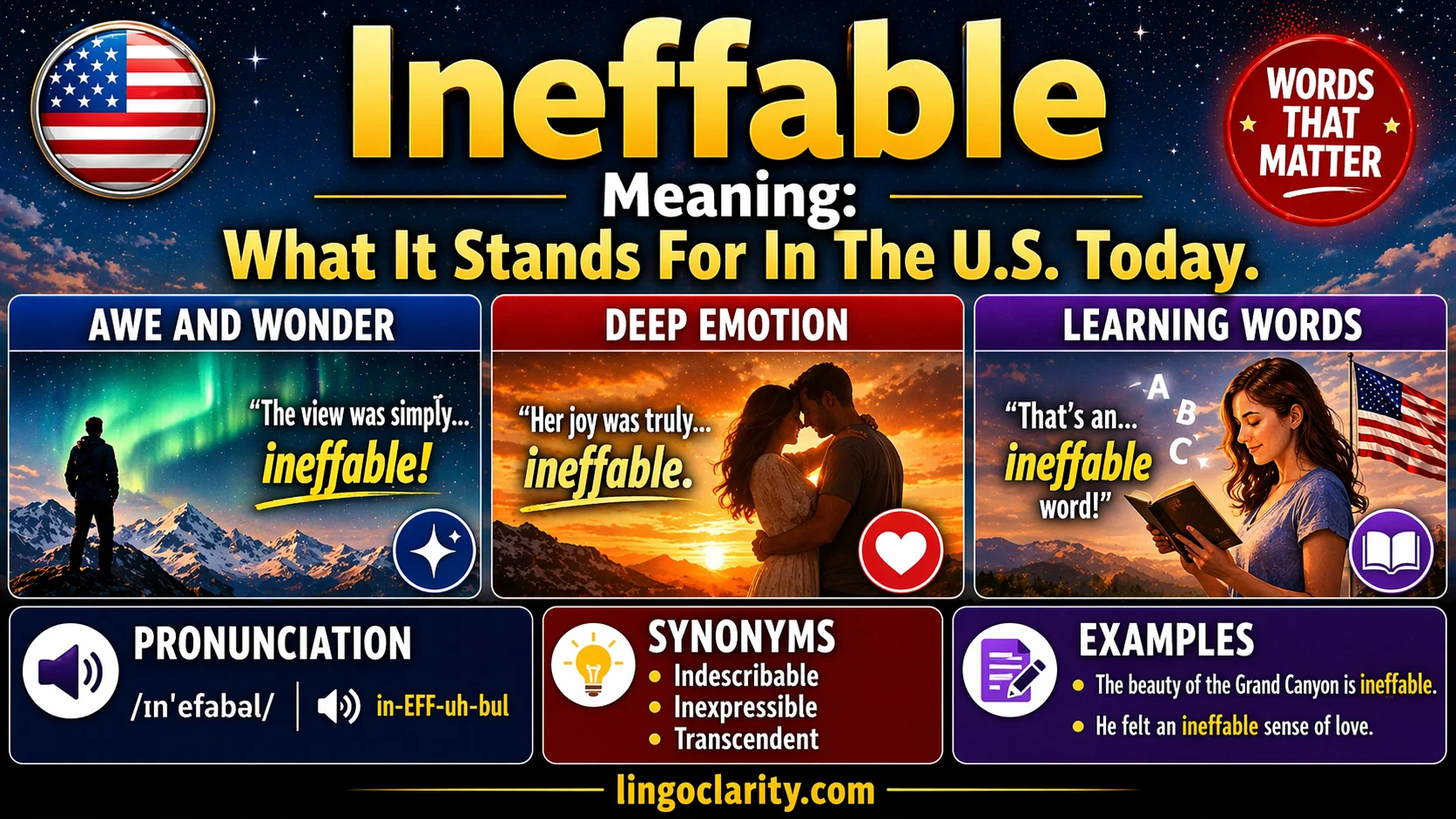
If you want the plain meaning fast, ineffable means too great, deep, intense, or sacred to be fully expressed in words. In modern English, it usually describes beauty, joy, awe, grief, or a feeling that seems bigger than language. Dictionaries also preserve an older, narrower sense: something too sacred to be spoken aloud.
What Ineffable Means In Plain English
In plain English, ineffable means words are not enough. You understand the feeling or experience, but normal language feels too small to capture it.
That is why people use the word for moments such as standing in front of a canyon at sunset, holding a newborn baby, hearing devastating news, or feeling a kind of spiritual awe that does not fit into an ordinary description. The point is not just that something is “very good” or “very emotional.” The point is that language seems to fail.
A good shortcut is this:
- Amazing means impressive.
- Beautiful means attractive or moving.
- Ineffable means so powerful that explanation feels incomplete.
How To Pronounce Ineffable
In American English, Cambridge gives /ˌɪnˈef.ə.bəl/, and in British English it gives /ɪˈnef.ə.bəl/. A simple spoken guide in US English is in-EFF-uh-buhl. The stress falls on EFF.
If you want it to sound natural, do not over-pronounce every syllable. Say it smoothly:
in-EFF-uh-buhl
That is the version most American readers will recognize immediately. Britannica also reflects the same core spoken shape.
Part Of Speech And Word Forms
Ineffable is primarily an adjective. It describes a noun or follows a linking verb. Authoritative dictionary entries also list the related forms ineffably and ineffability.
Use it in patterns like these:
- ineffable joy
- ineffable beauty
- ineffable sadness
- The moment felt ineffable
- The silence after the ceremony was ineffable
The related forms work like this:
- ineffably: adverb
She spoke ineffably tender words after the reunion. - ineffability: noun
The poem tries to capture the ineffability of grief.
When Ineffable Sounds Natural
This word is usually marked as formal, and that matters. Cambridge labels it formal, Oxford labels it formal, and Britannica also frames it that way.
That means ineffable sounds most natural in:
- reflective essays
- literary writing
- speeches
- criticism and reviews
- spiritual writing
- thoughtful conversation
It can also work in journalism and modern cultural writing. Merriam-Webster’s current example sentences show it appearing in outlets such as The Atlantic, Architectural Digest, The New Yorker, The New York Times, and Architectural Digest again in 2025.
In other words, the word is not dead or outdated. It still appears in modern serious writing. But it is not casual slang. If you text a friend that your takeout fries were “ineffable,” it will probably sound exaggerated unless you are being deliberately playful.
What Ineffable Usually Describes
The word most often appears around experiences that feel emotionally or aesthetically overwhelming. Dictionaries and modern examples repeatedly pair it with beauty, joy, quality, sadness, allure, disgust, and deep feeling.
Common natural pairings include:
- ineffable beauty
- ineffable joy
- ineffable grief
- ineffable sadness
- ineffable grace
- ineffable quality
- ineffable charm
- ineffable sense of awe
These collocations matter because they show the word’s normal range. It works especially well with nouns that already suggest wonder, depth, mystery, loss, or reverence.
Can Ineffable Be Positive Or Negative?
Yes. It is often positive, but it is not limited to positive feelings.
Cambridge leans toward emotion and pleasure, which helps explain why many learners first see phrases like ineffable joy or ineffable beauty. But Merriam-Webster explicitly includes ineffable disgust, and modern usage examples show sadness, despair, allure, taste, and other emotionally charged contexts.
So the better rule is this:
- Often positive: joy, beauty, wonder, grace
- Sometimes negative: grief, sadness, disgust, despair
- Always intense: the word suggests a feeling beyond easy expression
When Not To Use Ineffable
Do not use ineffable for ordinary praise.
A normal lunch was not ineffable. A routine work meeting was not ineffable. A decent TV episode was not ineffable. The word is strongest when something genuinely feels larger than explanation.
Also, do not use it when you really mean confusing or hard to explain logically. That is where writers often drift into the wrong word. If the issue is explanation rather than expression, inexplicable may be a better choice. Merriam-Webster defines inexplicable as something that cannot be explained, while ineffable is about what cannot be fully put into words.
A helpful test is this: if you could explain it clearly with a few plain sentences, ineffable is probably too dramatic.
Ineffable Vs Similar Words
Several nearby words overlap with ineffable, but they are not perfect substitutes.
Ineffable Vs Indescribable
These are very close. Merriam-Webster even uses indescribable in its definition of ineffable, and its thesaurus lists the two together. But indescribable is usually broader and more everyday, while ineffable feels more elevated, literary, or spiritually charged.
Ineffable Vs Inexpressible
Inexpressible is also very close and often works well for feelings. The difference is mostly tone. Inexpressible sounds formal, but ineffable often carries more awe, wonder, or sacred weight.
Ineffable Vs Inexplicable
Use inexplicable when something cannot be explained or accounted for. Use ineffable when something can be felt or understood but not fully captured in language.
Ineffable Vs Unfathomable
Unfathomable points more toward something impossible to understand, measure, or grasp mentally. Ineffable points toward something that may be deeply felt but still resists wording.
How To Use Ineffable In A Sentence
The most natural pattern is ineffable + noun, but it can also follow a linking verb.
Here are clean, natural examples:
- The choir created an ineffable sense of peace in the room.
- She felt ineffable joy when she heard her father’s voice again.
- The desert at dawn had an ineffable beauty that photographs could not hold.
- After the funeral, the family sat in ineffable grief.
- There was something ineffable about the way the actor held the silence.
- The novel tries to name a love that is almost ineffable.
- For many believers, the divine remains ineffable.
- The mountain view gave them an ineffable feeling of awe.
- He struggled to explain the experience because it felt genuinely ineffable.
- Great art can leave behind an ineffable emotional residue.
Notice what these examples have in common: they all involve intensity, reverence, mystery, or emotional depth.
Common Mistakes Writers Make
Writers usually misuse ineffable in one of four ways.
First, they use it for anything pleasant. That weakens the word. Ineffable is not just stronger than nice. It belongs to a different category of feeling.
Second, they treat it as if it always means something positive. That is not true. It can describe sorrow, disgust, or despair as well as beauty and joy.
Third, they confuse it with inexplicable or unfathomable. Those words focus on understanding or explanation, not verbal expression.
Fourth, they overuse it. Because the word is formal and emotionally weighty, it loses force when attached to ordinary experiences or repeated too often in the same piece.
The Older Religious Meaning Of Ineffable
There is a secondary meaning that still matters: too sacred to be spoken.
This sense appears in Merriam-Webster, Collins, Dictionary.com, and WordReference, all of which preserve the idea that some names or realities are not uttered because of their sacredness or taboo status.
That is why phrases such as the ineffable name of God appear in older religious and theological writing. In everyday modern English, the broader “beyond words” meaning is more common, but the sacred sense still explains a lot of the word’s history and tone.
Origin Of Ineffable
Oxford traces ineffable to late Middle English, from Old French or Latin ineffabilis, built from elements meaning not and speakable or utterable. Dictionary.com and WordReference also trace it back to Latin and note the late Middle English period.
That origin helps the word make intuitive sense. At its root, ineffable is about something that cannot be spoken fully or properly.
Why This Word Still Matters
Some vocabulary words sound smart but do not help much. Ineffable is not one of them.
It fills a real gap in English. Sometimes something is not merely beautiful, powerful, or emotional. Sometimes it defeats ordinary description. That is the moment ineffable becomes the exact word you need.
Use it when a simpler word feels too small. Avoid it when a simpler word would already do the job.
FAQ
What does ineffable mean?
Ineffable means too great, deep, intense, or sacred to be fully expressed in words. In everyday use, it usually refers to beauty, joy, awe, grief, or another feeling that seems bigger than language.
How do you pronounce ineffable?
A simple US guide is in-EFF-uh-buhl. Cambridge gives the American pronunciation as /ˌɪnˈef.ə.bəl/ and the British pronunciation as /ɪˈnef.ə.bəl/.
Is ineffable positive or negative?
Usually positive, but not always. It often describes joy, beauty, or wonder, yet dictionaries and current examples also show negative uses such as disgust, sadness, and despair.
Is ineffable the same as indescribable?
They are very close, but not identical. Indescribable is the broader everyday option. Ineffable often sounds more formal, elevated, or spiritually charged.
Can ineffable have a religious meaning?
Yes. It can mean something too sacred to be spoken aloud. That sense is older and narrower than the modern “beyond words” meaning, but it is still part of the word’s accepted definition.
What part of speech is ineffable?
It is mainly an adjective. The related forms are ineffably and ineffability.
What is a natural way to use ineffable?
The most natural pattern is ineffable + noun, as in ineffable joy, ineffable beauty, or ineffable grief. It can also follow a linking verb, as in The moment felt ineffable.
Should I use ineffable in casual conversation?
Usually, no. The word is formal, so it works best in reflective, literary, or serious contexts. In ordinary conversation, a simpler word such as amazing, beautiful, or hard to describe often sounds more natural.
The Bottom Line
Ineffable means too profound for words. Use it when an experience feels so beautiful, overwhelming, sacred, or emotionally intense that ordinary description seems inadequate. That is what gives the word its power.
