
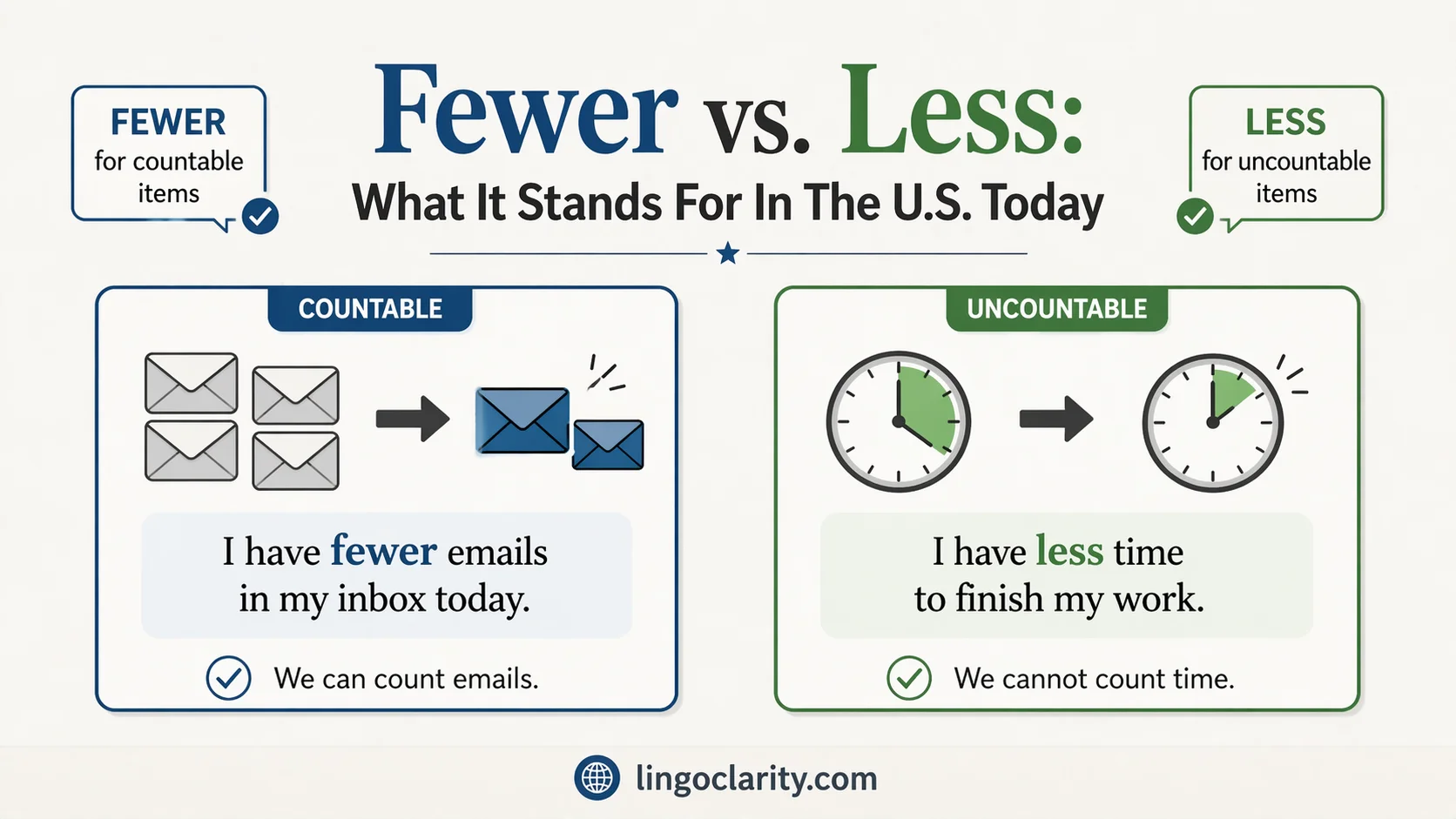
If you want the short answer on fewer vs. less, here it is: use fewer for things you can count and less for things you treat as an amount. In most cases, that means fewer emails but less time, fewer mistakes but less stress. The reason fewer vs. less confuses so many writers is that standard American English also allows less in several common measurement-style expressions, including money, time, distance, and phrases like one less thing. Once you understand that distinction, fewer vs. less becomes much easier to get right in everyday writing.
Quick Answer
Use fewer with plural countable nouns, such as fewer books, fewer cars, and fewer errors. Use less with uncountable nouns, such as less water, less traffic, and less confusion. Also use less with many amount-style expressions, including less than 20 minutes, less than $50, and less than five miles.
Why Fewer Vs. Less Confuses So Many Writers
The core issue in fewer vs. less is not whether a noun simply looks plural. The real issue is how the noun works in the sentence.
Use fewer when you mean a smaller number of separate items. Those items can be counted one by one: files, people, chairs, comments, and mistakes.
Use less when you mean a smaller amount, mass, or degree. That is why we write less sugar, less noise, less equipment, and less patience. These nouns are treated as quantities rather than as individual units.
That basic rule solves most fewer vs. less questions. Still, English does not stop there. Standard usage also accepts less in some cases where the following noun may look countable, especially when the whole phrase acts like a single amount or measurement.
The Core Rule
Here is the safest rule for formal American English:
- Use fewer with plural count nouns.
- Use less with noncount nouns.
- Use less with many amount-style expressions.
Examples make the pattern clear:
- fewer meetings
- fewer people
- fewer errors
- less coffee
- less traffic
- less information
- less than 30 minutes
- less than $100
- less than four miles
If you can count the noun as separate items, fewer is usually right. If the noun works as a mass, amount, or measurement, less is usually right.
When To Use Fewer
Use fewer with ordinary plural nouns you can count directly.
Correct examples include:
- fewer emails
- fewer students
- fewer cookies
- fewer problems
- fewer appointments
Each noun refers to separate items. You can count one email, two emails, three emails, and so on. Because the noun is plural and countable, fewer is the preferred choice.
This part of fewer vs. less is the least controversial. In careful edited writing, phrases such as less books, less people, and less mistakes are still treated as incorrect or at least clearly nonstandard.
Here are natural examples in US English:
We had fewer complaints after the update.
The new system caused fewer delays.
This year, the company made fewer hiring errors.
The revised layout needed fewer design changes.
When the noun is both plural and countable, fewer is almost always the safest choice.
When To Use Less
Use less with nouns treated as amounts, masses, or degrees.
Correct examples include:
- less time
- less money
- less stress
- less furniture
- less homework
- less traffic
In each case, the noun is not normally counted one by one in the sentence. Instead, it is understood as a quantity.
This point matters because writers sometimes overcorrect fewer vs. less and start using fewer everywhere. That creates awkward phrasing.
Write less advice, not fewer advice.
Write less equipment, not fewer equipment.
Write less confusion, not fewer confusion.
You can also use less with many abstract nouns:
- less pressure
- less resistance
- less excitement
- less uncertainty
These examples all reflect standard American usage.
How Framing Changes The Right Choice
One of the most useful things to understand about fewer vs. less is that the same idea can be framed in two different ways.
Compare these pairs:
- less coffee / fewer cups of coffee
- less traffic / fewer cars
- less luggage / fewer bags
- less furniture / fewer chairs
- less work / fewer tasks
Nothing changed in the real world. Only the wording changed. The first version treats the idea as a mass or amount. The second version counts units.
This is why fewer vs. less is not only a grammar issue. It is also a phrasing issue. Once you choose a countable noun, fewer usually follows. Once you choose a mass noun, less usually follows.
Important Exceptions In Fewer Vs. Less
The simple school rule is helpful, but it is not complete. Standard American English uses less in several important exceptions.
Less With Time, Money, Distance, And Weight
Use less when the phrase functions as a single amount of time, money, distance, or weight.
Examples:
- less than 10 minutes
- less than two hours
- less than $25
- less than six miles
- less than five pounds
Even though minutes, hours, miles, and pounds are plural, the full phrase is treated as one measurement. That is why less sounds natural here.
Less After One
Standard usage prefers less with singular count nouns after one.
Examples:
- one less problem
- one less reason
- one less task
- one less thing to fix
This point surprises people because the noun is countable. Still, the standard idiom is one less, not one fewer, in most everyday and edited American English.
Fixed Phrases Such As “Or Less”
Some phrases are so common and established that less remains standard even where a strict classroom rule might suggest otherwise.
Examples:
- 250 words or less
- 10 items or less
- or less
- no less than
In formal edited prose, many editors still prefer 10 items or fewer because items is a plural count noun. Even so, 10 items or less is a familiar public phrase, not a shocking usage error.
Common Mistakes In Fewer Vs. Less
The most common mistake is using less with a regular plural count noun.
Wrong: less emails
Right: fewer emails
Wrong: less people
Right: fewer people
Wrong: less chairs
Right: fewer chairs
A second mistake is overcorrecting and forcing fewer into amount-style expressions.
Awkward: fewer than 30 minutes
Better: less than 30 minutes
Awkward: fewer than $40
Better: less than $40
Awkward: one fewer thing to worry about
Better: one less thing to worry about
Another problem appears when writers ignore framing. Compare these examples:
Correct: less gasoline
Correct: fewer gallons of gasoline
Correct: less paperwork
Correct: fewer forms
Both choices can work when the sentence frames the noun differently.
A Simple Test You Can Use
When fewer vs. less feels unclear, ask two quick questions.
First, can I count the noun as separate items?
If yes, use fewer.
Second, am I talking about one amount, one mass, or one measurement?
If yes, use less.
Try the test with these examples:
- emails → separate items → fewer emails
- sugar → amount → less sugar
- hours in a duration phrase → one measurement → less than three hours
- chairs → separate items → fewer chairs
- work → amount → less work
That quick check solves most usage problems immediately.
Real-World Examples
Here are natural examples that show how fewer vs. less works in current US English:
We made fewer errors after the software update.
There were fewer cars on the road this morning.
She drinks less coffee than she used to.
The project took less time than expected.
This option costs less money and requires fewer steps.
The team had fewer meetings but less confusion.
He finished with one less task on his list.
Please keep your reply to 200 words or less.
The new design created fewer distractions for readers.
We covered the topic in less than an hour.
These examples show the real pattern clearly: fewer for countable items, less for amounts and measurement-style expressions.
Formal Writing Vs. Everyday Usage
In speech, many people use less where formal writing would prefer fewer. You will hear phrases such as less people or less cars in casual conversation. That does not make them the best choice for polished American English.
If you are writing for a website, publication, business, classroom, or professional audience, play it safe:
- Use fewer with ordinary plural count nouns.
- Use less with noncount nouns.
- Keep less for amount-style expressions such as time, money, distance, weight, and one less.
That approach makes your writing sound natural without sounding rigid or schoolmarmish.
Fewer Vs. Less In American English Today
Modern American English is a little more flexible than many school lessons suggest. That is why readers still see less than 50,000 people or 10 items or less in the wild. Yet the best publishing standard remains straightforward: choose fewer for countable plural nouns and reserve less for mass nouns, measurements, and established idiomatic exceptions.
For most writers, that is the sweet spot. It respects current usage, matches edited American English, and avoids both sloppy phrasing and unnecessary overcorrection.
FAQ
Is “10 items or less” wrong?
In careful edited writing, many editors prefer 10 items or fewer because items is a plural count noun. In public signs and everyday language, however, 10 items or less is extremely common. It is better described as common and less formal than as completely wrong.
Is “one less thing” correct?
Yes. One less thing is standard in American English. Even though thing is countable, the noun is singular, and standard usage strongly favors less after one.
Should I write “less than 5 percent” or “fewer than 5 percent”?
It depends on the sentence. If the percentage refers to an amount, less than 5 percent is often natural. If it refers clearly to countable items, fewer than 5 percent of voters may be a better fit. In many contexts, percentages behave like amount expressions.
Can I say “less people”?
Not in standard edited American English. For a countable plural noun like people, the preferred form is fewer people.
What Is The Safest Rule To Follow?
Use fewer with plural count nouns and less with noncount nouns and amount-style expressions. That rule will give you the safest result in most formal US writing.
Conclusion
The best practical rule for fewer vs. less is still the clearest one: use fewer for things you count and less for things you measure or treat as an amount. That means fewer books, fewer mistakes, and fewer emails, but less time, less money, and less stress. Just remember the standard exceptions that real American English uses every day, including less than 20 minutes, less than five miles, and one less thing
