
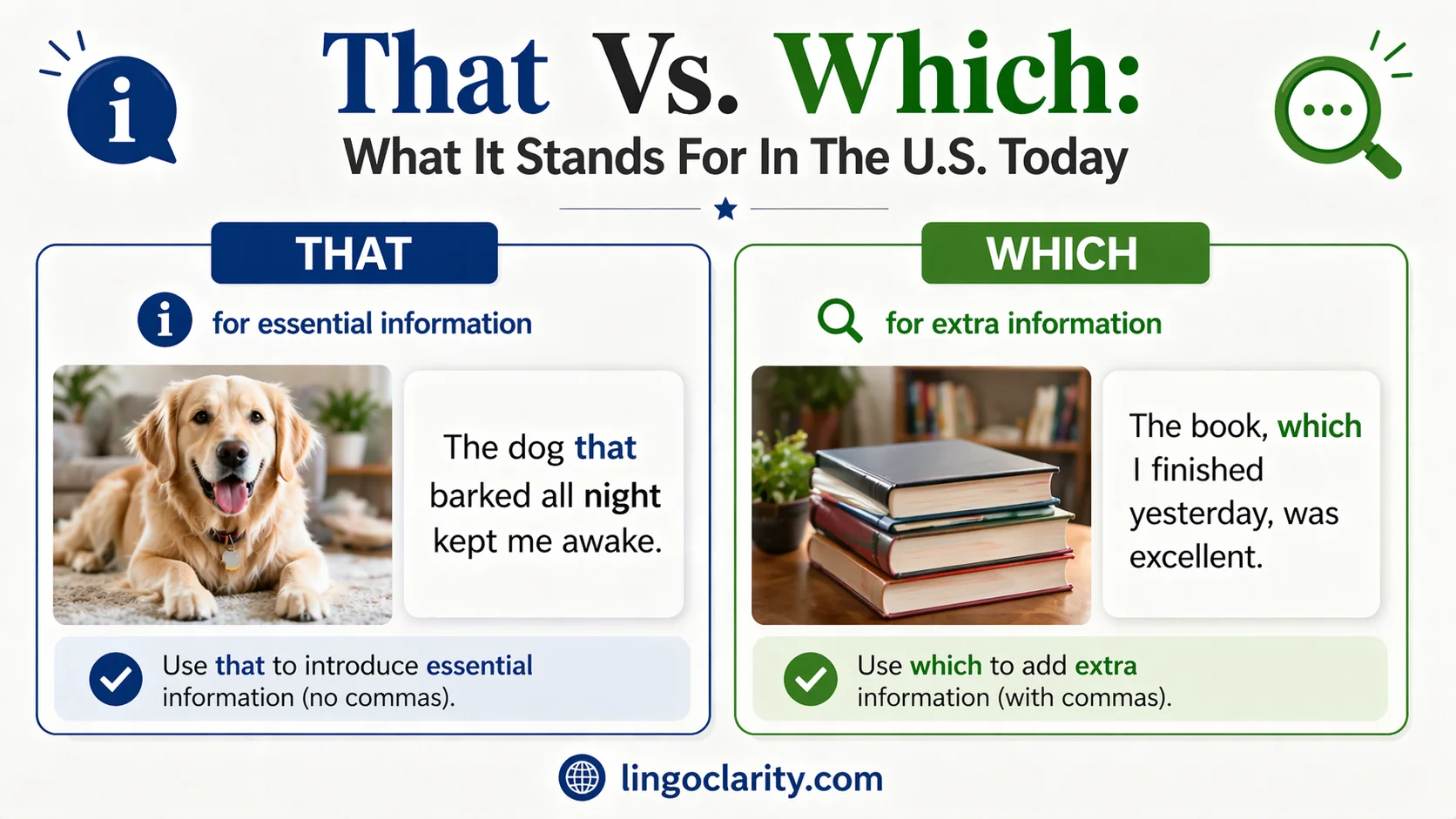
If you have ever wondered about that vs. which, the short answer is this: in standard US English, use that for information that is essential to the meaning of the sentence, and use which for information that is extra and set off by commas. The that vs. which distinction matters because it affects clarity, punctuation, emphasis, and sometimes the meaning of the sentence itself.
Quick Answer
In standard US edited English, use that for a restrictive clause and which for a nonrestrictive clause.
- That introduces information you need.
- Which introduces information you can remove without changing the core reference.
- Which usually follows a comma because nonrestrictive clauses are parenthetical.
Examples:
- The book that changed my mind is out of print.
- My copy of the book, which is full of notes, is on my desk.
In the first sentence, the clause tells you which book. In the second, the book is already identified, and the clause adds extra detail.
Why That Vs. Which Matters
The that vs. which rule is not just a style preference. It helps readers understand whether a clause identifies a specific person or thing or merely adds background information.
Compare these two sentences:
- The employees that work weekends get overtime.
- The employees, which work weekends, get overtime.
That second sentence sounds wrong in standard US English because the clause is essential. You mean a specific group of employees, so the clause should not be treated as extra information.
Now compare these:
- The car that is parked outside belongs to Maya.
- My car, which is parked outside, needs gas.
The first sentence identifies one car out of several. The second sentence identifies the car first and then adds an extra fact.
This is why that vs. which is really about meaning first and word choice second.
The Core Rule
The easiest way to understand that vs. which is to focus on clause type.
A restrictive clause limits the noun. It tells the reader exactly which person, place, or thing you mean. In standard US writing, restrictive clauses usually use that and do not take commas.
A nonrestrictive clause adds extra information about a noun that is already identified. In standard US writing, nonrestrictive clauses use which and are set off with commas.
Examples:
- The files that need review are in the shared folder.
- The shared folder, which was renamed last week, is easier to find now.
In the first sentence, only some files need review. In the second, the folder is already identified, and the clause only adds context.
How To Choose The Right Word
When deciding between that vs. which, ask one question:
Remove the clause and see what happens.
If the sentence no longer points to a specific person or thing, use that.
If the sentence still points to the same person or thing, use which with commas.
Examples:
- The jacket that was on sale sold out fast.
Remove the clause, and you no longer know which jacket. - My jacket, which was on sale, sold out fast.
Remove the clause, and you still know which jacket: my jacket.
That one test solves most that vs. which problems.
Use That For Essential Information
Use that when the clause is necessary to identify the noun.
Examples:
- The student that submitted the application early got a response first.
- The laptop that has the cracked screen is mine.
- The restaurant that serves breakfast all day is always busy.
- The version that includes the new feature is now live.
Each clause narrows the noun. Without it, the sentence becomes incomplete or ambiguous.
This is the safest choice in American edited writing, especially in professional, academic, legal, and business contexts.
Use Which For Extra Information
Use which when the clause adds information that is helpful but not necessary to identify the noun.
Examples:
- My laptop, which has a cracked screen, still works well.
- The annual report, which was published in January, includes revised figures.
- Our office, which is near the river, floods every spring.
- The update, which fixed two login bugs, rolled out overnight.
In each example, the noun is already clear before the which clause begins.
The commas matter. If you are using which in this structure, you are signaling that the clause is extra.
The Difference In Meaning
A big reason writers struggle with that vs. which is that the two forms can seem similar on the surface. But they do not always mean the same thing.
Compare:
- My brother who lives in Denver is visiting this week.
- My brother, who lives in Denver, is visiting this week.
The first sentence suggests I have more than one brother, and I mean the one in Denver. The second suggests I have one brother, and I am simply adding where he lives.
Now compare these:
- The proposals that mention staffing costs need revision.
- The proposals, which mention staffing costs, need revision.
The first sentence means only some proposals mention staffing costs. The second means all the proposals mention staffing costs, and that detail is secondary.
With that vs. which, commas can change the claim the sentence makes.
Why Commas Matter So Much
In this rule, commas are not decoration. They show whether the clause is essential or nonessential.
Look at these examples:
- The house that needs a new roof was built in 1920.
- The house, which needs a new roof, was built in 1920.
The first sentence identifies one house among multiple houses. The second sentence assumes the reader already knows which house is being discussed and adds a fact about it.
If you misuse the commas, you can accidentally change the meaning or make the sentence sound unnatural in US English.
That is why the that vs. which issue is really a punctuation issue as much as a word-choice issue.
Is Restrictive Which Always Wrong?
Not exactly.
In standard US edited English, that is usually preferred in restrictive clauses. That is the convention most American teachers, editors, and style guides recommend because it is clear and consistent.
However, you may still see restrictive which in published writing. It is not always treated as a serious grammatical error. In some contexts, it is simply less preferred for American formal prose.
For example:
- The policy which applies to interns starts Monday.
Many US editors would revise that sentence to:
- The policy that applies to interns starts Monday.
So the practical rule is simple: if you are writing for a US audience and want the safest, clearest choice, use that for restrictive clauses and save which for nonrestrictive ones.
American Vs. British Usage
The that vs. which rule is stricter in American usage than in British usage.
In US English, edited prose usually prefers:
- that for restrictive clauses
- which for nonrestrictive clauses
In British English, restrictive which is more common and more widely accepted.
That means a sentence like this may look normal in British writing:
- The team which won the contract will start in May.
In standard US edited prose, many editors would prefer:
- The team that won the contract will start in May.
If your audience is American, follow the US convention unless a publication or organization uses a different house style.
Use Who For People
Many people treat that vs. which as the only choice, but there is another important point: when the noun refers to a person, who is often the best option.
Examples:
- The teacher who explained the rule made it easy to understand.
- My neighbor, who works nights, sleeps during the day.
You may still hear or read that with people, especially in casual speech:
- The guy that called earlier left a message.
That wording is common in conversation, but who is usually better in formal writing.
So in practice, your choices often work like this:
- who for people
- that for essential clauses about things or groups
- which for extra clauses about things
Can You Leave Out That?
Sometimes you can omit that in a restrictive clause, especially when the sentence remains clear.
Examples:
- The movie that we watched last night was excellent.
- The movie we watched last night was excellent.
Both are natural.
More examples:
- The article that you sent me was helpful.
- The article you sent me was helpful.
Even so, keeping that can improve clarity, especially in longer or more complex sentences.
For example:
- The report that the committee approved after three weeks of debate will be published tomorrow.
In a sentence like that, keeping that helps the reader see the structure sooner.
So while omission is possible, it is not always the best editing choice.
Common Mistakes
Writers often make the same few errors with that vs. which.
Using That After A Comma
Incorrect:
- My car, that I bought last year, already needs repairs.
Correct:
- My car, which I bought last year, already needs repairs.
If the clause is parenthetical, which is the standard choice.
Using Which For Essential Information In Formal US Writing
Less natural in standard US prose:
- The software which supports offline access is more expensive.
Preferred:
- The software that supports offline access is more expensive.
Treating Commas As Optional
Incorrect punctuation often creates confusion:
- The employees, that were hired in June need training.
- The employees that were hired in June need training.
The second sentence is correct if the clause is essential. The first is not.
Forgetting That Meaning Comes First
Some writers choose based on sound alone. That leads to bad decisions. The real test is always whether the clause identifies the noun or merely comments on it.
Simple Editing Examples
Here are a few before-and-after fixes that show how to handle that vs. which in real writing.
Business Example
Before:
- The contract which includes the renewal clause needs legal review.
After:
- The contract that includes the renewal clause needs legal review.
Why: The clause identifies which contract.
Academic Example
Before:
- The experiment, that was repeated three times, produced similar results.
After:
- The experiment, which was repeated three times, produced similar results.
Why: The experiment is already identified.
Everyday Example
Before:
- The shoes which are by the door are mine.
After:
- The shoes that are by the door are mine.
Why: The clause tells us which shoes.
Published-Prose Example
Before:
- My apartment that overlooks the park gets great morning light.
After:
- My apartment, which overlooks the park, gets great morning light.
Why: The apartment is already identified by my apartment.
A Fast Test You Can Use Every Time
If you want a quick way to solve that vs. which without memorizing grammar terms, use this checklist:
- Remove the clause.
- Ask whether the sentence still points to the same specific person or thing.
- If it does, use which with commas.
- If it does not, use that.
- If the noun is a person, consider who first.
Examples:
- The document that needs approval is on your desk.
- The document, which needs approval, is on your desk.
The first sentence implies one document among several. The second sentence implies a specific document already known to the reader.
When Writers Overthink The Rule
A lot of grammar advice makes that vs. which sound more mysterious than it is.
The practical US rule is simple, and it works well in almost every formal context:
- Use that when the clause is essential.
- Use which when the clause is extra and takes commas.
The confusion usually comes from three places:
- People see restrictive which in real-world writing.
- They learn the rule without learning what “essential” means.
- They focus on the word instead of the meaning.
If you keep your attention on whether the clause identifies the noun, the answer is usually obvious.
FAQ
Is “which” ever correct in an essential clause?
Yes, you may see which in essential clauses, especially outside strict US editing contexts. But in standard US formal writing, that is usually the preferred choice.
Can “that” be used in a nonessential clause?
No. In standard edited English, nonessential clauses take which and commas, not that.
Do commas decide whether I should use “that” or “which”?
Not by themselves. Meaning comes first. But once you know the clause is nonessential, commas usually follow naturally, and which is the standard choice.
Should I use “that” or “who” for a person?
In most formal writing, use who for people. While that sometimes appears in speech and informal writing, who is usually the better choice.
Can I omit “that” in a restrictive clause?
Sometimes, yes. You can often leave out that when the sentence stays clear. But if the sentence becomes awkward or harder to follow, keep it.
Conclusion
The clearest answer to that vs. which in US English is this: use that for essential clauses and which for nonessential clauses with commas. That rule makes your writing cleaner, clearer, and easier to read.
More importantly, remember what the rule is really doing. You are not just choosing between two words. You are deciding whether the clause identifies the noun or simply adds extra information. Once you understand that, that vs. which stops feeling arbitrary and starts feeling logical.
