
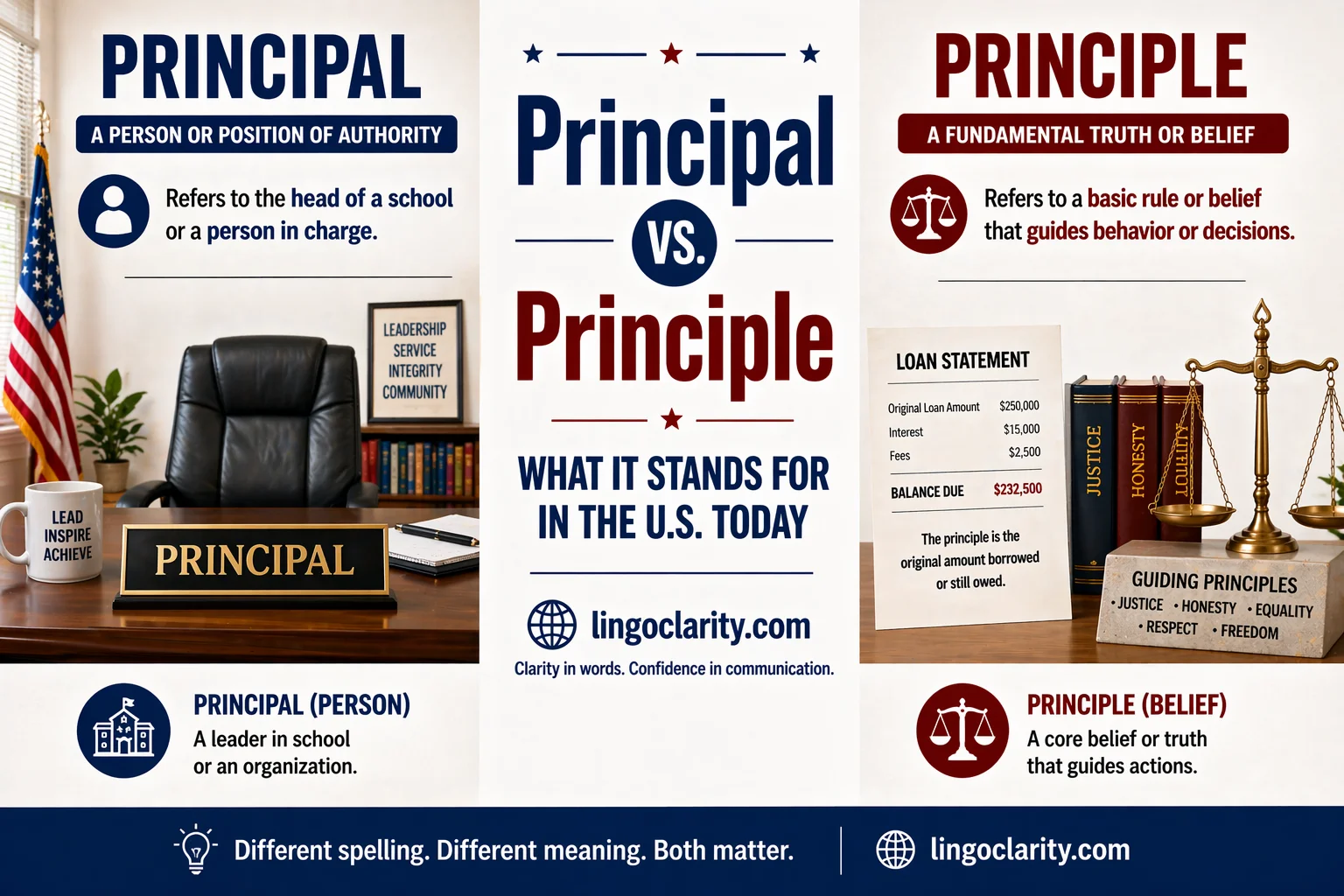
Use principal when you mean the person in charge, the main or most important thing, or the original amount of money in a loan or investment. Use principle when you mean a rule, value, standard, or basic truth. In standard US English, that is the difference that matters in almost every real-world sentence.
Principal Vs. Principle: The Core Difference
These two words sound the same, which is why they get mixed up so often. They are homophones, but they do not work the same way grammatically. Principal can be a noun or an adjective. Principle is a noun only. That part-of-speech difference is one of the fastest ways to tell them apart.
The meaning split is just as important. Principal is tied to ideas like authority, importance, and money. Principle is tied to beliefs, rules, standards, and fundamental truths. So if you mean main, chief, or primary, the word you want is usually principal. If you mean rule, belief, or basic idea, the right word is usually principle.
A fast test works well in editing:
- Replace the word with main or chief. If the sentence still works, use principal.
- Replace it with rule, belief, or standard. If that works, use principle.
What Does Principal Mean?
In modern US English, principal has several standard meanings. As a noun, it can refer to the head of a school, a person in a leading or controlling position, or the original sum of money in a loan or investment. In legal and business contexts, it can also refer to the main party with authority or primary responsibility. As an adjective, it means main, chief, primary, or most important.
That range is why the word causes confusion. Many people only remember the school meaning, but principal is also common in finance, law, business, and formal professional writing. A strong usage guide should cover all of those, not just the school example.
Principal As A Person In Charge
This is the meaning most Americans learn first: a school principal is the person who leads the school. That use is standard and familiar, which is why the classic mnemonic “the principal is your pal” has lasted so long.
Examples:
- The principal spoke to families before the school year began.
- Parents met with the principal after the board meeting.
- She became the principal after serving as assistant principal.
Principal As “Main” Or “Most Important”
This adjective use matters just as much as the school meaning. In formal writing, principal often means chief, main, or most important. That is why you see phrases like principal reason, principal concern, and principal objective.
Examples:
- Our principal objective is to reduce turnaround time.
- Safety is the principal concern in this facility.
- The principal cause of the delay was a software outage.
If you could swap in main without changing the meaning, principal is almost certainly correct.
Principal In Finance
In finance, principal means the original amount of money borrowed, lent, or invested, separate from interest. That is the sense used in phrases like principal amount, principal balance, and pay down the principal.
Examples:
- Most of her extra payment went toward the loan principal.
- The lender applied the payment to interest first and then to principal.
- He wants to preserve the principal and live off the returns.
This is one of the most common places writers make the wrong choice. In a money context, principle is not correct.
Principal In Law And Business
In legal and business usage, principal can also refer to the main party in a relationship, transaction, or action. A principal may authorize an agent to act on their behalf, or the term may identify a person with primary legal responsibility.
Most readers do not need the full legal doctrine. But this broader meaning matters because it shows that principal is not just a school word. It has real technical use beyond education and finance.
What Does Principle Mean?
Principle is always a noun. It refers to a rule, belief, moral value, standard of conduct, basic law, or fundamental truth. It can also refer to the underlying idea that explains how something works.
That makes principle common in ethics, science, philosophy, law, engineering, public policy, and everyday discussions of values. It is narrower grammatically than principal, but broader in the kinds of abstract ideas it can name.
Principle As A Rule Or Belief
This is the most common everyday meaning. A principle can be a moral commitment, a personal standard, or a code of conduct. Merriam-Webster and Cambridge both treat this as a core sense of the word.
Examples:
- Honesty is one of her core principles.
- They refused to change the policy on principle.
- He would not accept the offer because it violated his principles.
Principle As A Basic Truth Or Law
Principle can also name a foundational idea in science, engineering, economics, or reasoning. In this sense, it means a basic truth or operating law rather than a moral value.
Examples:
- The machine works on a simple mechanical principle.
- The course explains the basic principles of economics.
- One central principle of user experience is reducing friction.
Principal Vs. Principle In Common Contexts
The cleanest way to separate the two is by context. Reference guides agree on the major pattern: principal fits authority, importance, and finance; principle fits rules, values, and foundational truths.
| Context | Correct Word | Why |
|---|---|---|
| The head of a school | principal | It names a person in charge. |
| The main reason, concern, or goal | principal | It means chief or most important. |
| The amount borrowed or invested | principal | It names the base amount apart from interest. |
| A moral value or code | principle | It means a rule or belief. |
| A scientific or general truth | principle | It means a fundamental idea. |
| “In principle” | principle | This fixed phrase means in theory or in general. |
If you remember nothing else, remember this: principal is about importance, authority, or money; principle is about rules, beliefs, and foundational ideas.
How To Choose The Right Word In A Sentence
When you hesitate, do not guess from spelling alone. Test the job the word is doing.
Use Principal If The Sentence Is About One Of These Ideas
- a leader
- the main thing
- the most important reason
- the original sum of money
- a primary party with authority
Try swapping in main, chief, or primary.
Example:
- Our principal reason for moving was the commute.
- Our main reason for moving was the commute.
The sentence still works, so principal is the right choice.
Use Principle If The Sentence Is About One Of These Ideas
- a belief
- a standard
- a value
- a doctrine
- a law or truth
- a concept that explains how something works
Try swapping in rule, belief, or standard.
Example:
- She refused on principle.
- She refused on belief.
The sentence is less natural after the swap, but the meaning still points to a value or standard. That tells you principle is correct.
The Most Common Mistakes
Most errors fall into a few predictable patterns.
Mistake 1: Using Principle When You Mean “Main”
Wrong:
- Our principle goal is to improve retention.
Right:
- Our principal goal is to improve retention.
Why? Because the word is functioning as an adjective meaning main or most important.
Mistake 2: Using Principal For Ethics Or Values
Wrong:
- She acted on principal.
Right:
- She acted on principle.
Why? Because the sentence is about a value or moral standard, not authority, importance, or money.
Mistake 3: Writing “In Principal”
Wrong:
- We agreed in principal.
Right:
- We agreed in principle.
This is a fixed phrase. In principle means in theory, in general, or as a broad idea, even if the details are not settled yet. Scribbr states plainly that “in principal” is never correct in this sense.
Mistake 4: Misspelling Financial Terms
Wrong:
- The borrower paid down the loan principle.
Right:
- The borrower paid down the loan principal.
In finance, the original borrowed amount is always principal.
Common Phrases You Should Get Right
Certain phrases show up so often that they are worth memorizing as standard combinations. Usage guides and dictionary entries repeatedly confirm the importance of phrases like principal reason, principal amount, and in principle.
Phrases With Principal
- principal reason
- principal concern
- principal objective
- principal amount
- principal balance
- school principal
- principal investigator
- principal place of business
Phrases With Principle
- in principle
- on principle
- as a matter of principle
- guiding principle
- basic principle
- first principles
- moral principle
- scientific principle
Learning the phrases as chunks helps because it trains your eye to recognize the correct spelling in real writing.
Memory Tricks That Actually Help
Some memory tricks are cheesy. A few are useful.
The “Principal Is Your Pal” Trick
This classic mnemonic still works because it helps you remember the person meaning quickly:
- The school principal is your pal.
The Better Trick: Test The Meaning
The strongest method is still the substitution test:
- principal = main, chief, primary
- principle = rule, belief, standard, truth
That test is more reliable than a memory trick because it works in finance, school, legal, and abstract idea contexts.
Examples In Real Sentences
These examples show how the meaning changes by context.
Examples With Principal
- The principal spoke to families before the school year began.
- Cost was the principal reason the company changed vendors.
- She paid extra every month to reduce the mortgage principal.
- The principal actors were already on set when filming started.
- The company and its overseas principal signed the agreement yesterday.
Examples With Principle
- Transparency is a principle we take seriously.
- He resigned on principle rather than approve the deal.
- The design follows a simple engineering principle.
- Equal treatment under the law is a core democratic principle.
- In principle, the board supports the plan.
Why This Pair Causes So Much Confusion
The confusion is not random. First, the words are pronounced the same in standard US English. Second, they are spelled almost alike. Third, principal covers several different meanings, while principle stays in one part of speech but spans several abstract ideas. That combination makes them easy to mix up when you are writing quickly or editing by ear.
The problem gets worse because many people only know one meaning of principal. They remember the school principal but forget the adjective use and the finance meaning. That is exactly why a strong usage guide has to show the full range, not just the classroom example.
A Fast Self-Check Before You Publish
Before you hit publish, ask four questions:
- Is this word naming a person in charge?
Use principal. - Is it modifying a noun and meaning main or chief?
Use principal. - Is it talking about the original amount of money?
Use principal. - Is it naming a rule, belief, value, or basic truth?
Use principle.
That quick checklist will catch most mistakes in seconds.
FAQ
What is the difference between principal and principle?
Principal refers to a person in charge, something main or most important, or the original amount of money in a loan or investment. Principle refers to a rule, value, belief, or fundamental truth. If you mean main, choose principal. If you mean rule or belief, choose principle.
Is it principal reason or principle reason?
The correct phrase is principal reason because the word means main or most important in that sentence.
Is it school principal or school principle?
The correct term is school principal because it refers to the person who leads the school.
Is it loan principal or loan principle?
The correct term is loan principal because in finance principal means the original borrowed amount before interest.
Is “in principal” ever correct?
For the common phrase meaning in theory or as a general idea, the correct form is always in principle. In normal US English usage, in principal is treated as an error in this context.
Can principal be an adjective?
Yes. Principal can be an adjective meaning main, chief, or most important, as in principal objective or principal concern.
Can principle ever be an adjective?
Not in standard modern usage. Principle is a noun. The related adjective is principled.
The Bottom Line
Use principal for people in charge, main things, and money. Use principle for rules, beliefs, values, and basic truths. That is the distinction in plain English, and once you attach each word to its job in the sentence, the choice becomes much easier.
