
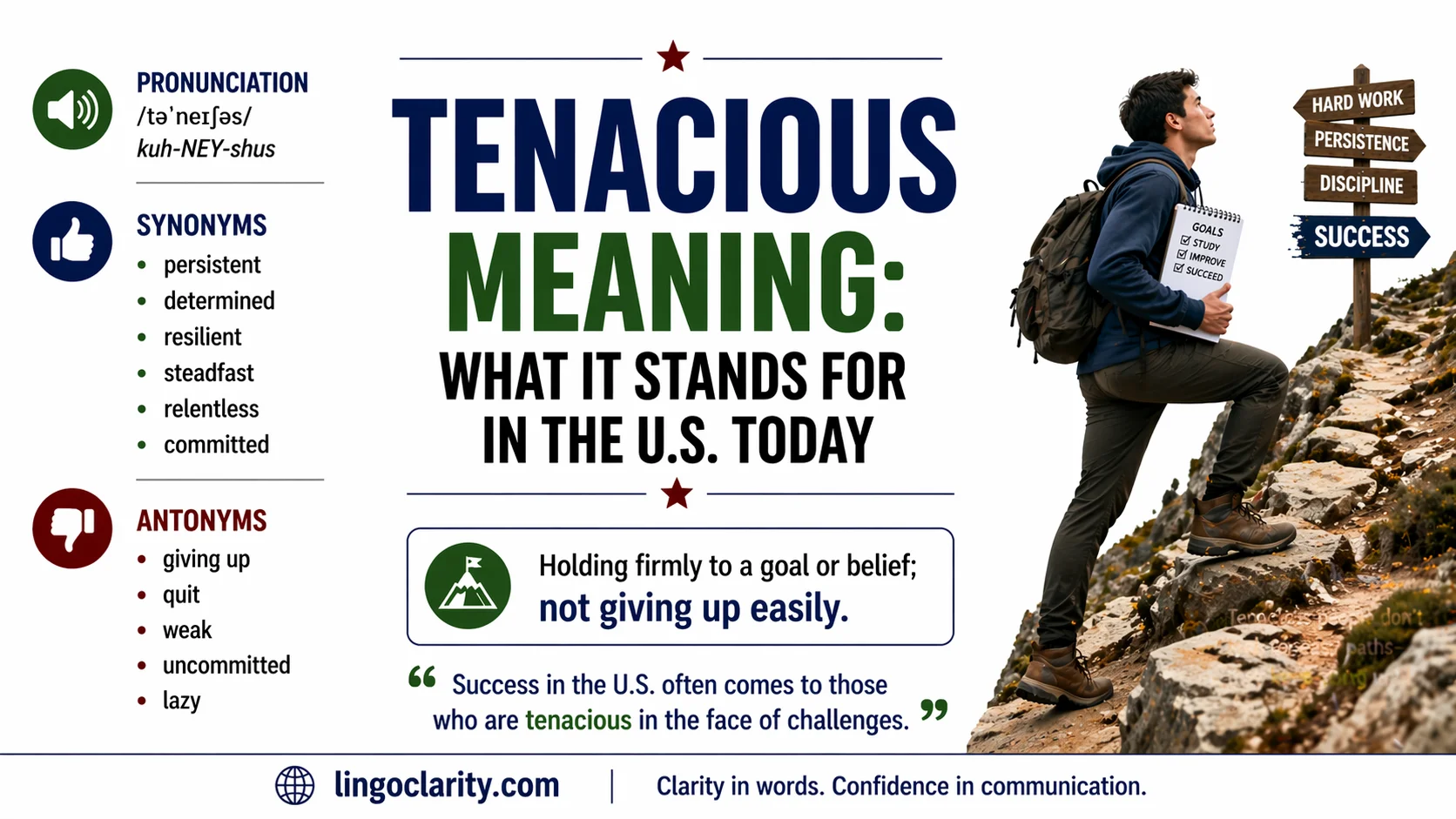
If you want the plain-English answer first, here it is: tenacious means not giving up easily or holding on firmly. In everyday American English, it usually describes a determined person, effort, or attitude. In other contexts, it can describe a strong grip, a lasting problem, or something that clings tightly.
That range matters. Many people know only the positive “persistent” meaning, but major dictionaries show that tenacious is broader than that. It can describe human determination, physical grip, staying power, retentive memory, and even sticky or cohesive material. Once you understand that core idea of “holding fast,” the word becomes much easier to use well.
Quick Answer
Tenacious is an adjective that usually means determined, persistent, and not likely to quit. It can also mean holding firmly, lasting stubbornly, or sticking tightly depending on the context. Standard US pronunciation is /təˈneɪʃəs/, often written in simple English as tuh-NAY-shus.
What Does Tenacious Mean?
At its center, tenacious carries the idea of holding on. That idea shows up in several common ways. The first is the one most people mean in everyday speech: a tenacious person keeps pushing through difficulty and does not give up easily. A tenacious lawyer, athlete, founder, student, or reporter keeps working when other people might stop.
The second common sense is physical. A tenacious grip, hold, root, or grasp clings tightly and is hard to pull away. Dictionaries also extend the word to things that last or keep their influence longer than expected, such as a tenacious myth, illness, superstition, or tradition.
Less common but still standard senses appear in major dictionaries too. Tenacious can describe something retentive, as in a tenacious memory, and something adhesive or cohesive, such as tenacious lint, mud, film, or material. Those uses are not the first ones most readers think of, but they are real parts of the word’s meaning.
How Americans Usually Use Tenacious
In modern US English, the most common use is positive and people-focused. Someone might call a candidate tenacious in a job interview, praise a team’s tenacious defense, or describe a journalist as tenacious for refusing to stop asking follow-up questions. In those settings, the word suggests grit, staying power, and serious effort under pressure.
You will also see it used for things that “won’t let go,” even when the subject is not a person. A rumor can be tenacious. So can a cough, a weed, a stain, a habit, or an old belief. That broader usage matters because it keeps you from reducing the word to “determined person” only.
The word is not slang. It is standard English, and it works in school, work, journalism, sports writing, and everyday conversation. Oxford marks it as formal, which is helpful to know: it is natural in ordinary speech, but it often sounds a little more polished than simpler choices like persistent or hardworking.
Pronunciation
The standard pronunciation in US English is /təˈneɪʃəs/. A simple pronunciation guide is tuh-NAY-shus. The stress falls on the middle syllable: tə-NAY-shəs.
If you are sounding it out, think of it in three beats: tuh + NAY + shus. The most important thing is the middle stress. That is what makes it sound natural in American English.
Part Of Speech And Word Forms
Tenacious is an adjective, so it describes a noun: a tenacious student, a tenacious effort, a tenacious grip, a tenacious myth. The normal comparative forms are more tenacious and most tenacious.
The related noun is tenacity, which means the quality of being tenacious. The related adverb is tenaciously. Those forms are worth learning because people often search the whole word family together.
When Tenacious Sounds Positive
Most of the time, tenacious sounds like praise. If someone says, “She is tenacious,” the usual meaning is that she stays focused, keeps trying, and does not fall apart when things get hard. That is why the word is common in hiring, leadership, sports, activism, and reporting.
In praise-heavy contexts, tenacious often suggests more than simple effort. It implies persistence with resistance in the way. A tenacious person is not just busy. They keep going when the situation is frustrating, competitive, or difficult. That extra pressure is part of the word’s force.
When Tenacious Can Sound Too Strong
The word is not always flattering. It can slide toward stubborn when a person refuses to let go of a weak idea, ignores good advice, or clings to a position after the facts change. Merriam-Webster explicitly notes that being called tenacious is mostly positive, but it can overlap with stubbornness.
That is why context matters. If the sentence highlights perseverance toward a worthwhile goal, tenacious usually sounds good. If it highlights refusal to listen, refusal to adapt, or blind insistence, the word can feel less complimentary.
Tenacious Vs. Stubborn
These two words overlap, but they are not the same. Tenacious usually emphasizes committed effort and resilience. Stubborn usually emphasizes resistance to change. A tenacious person keeps working. A stubborn person keeps resisting.
That difference becomes clearer in real situations. A student who keeps studying after failing twice is tenacious. A manager who ignores every useful suggestion is stubborn. A reporter who keeps digging for the truth is tenacious. A person who refuses to admit an obvious mistake is stubborn. The two words can touch, but they do not land the same way.
Common Ways To Use Tenacious
One of the easiest ways to sound natural is to pair tenacious with nouns it commonly modifies. Dictionaries and usage examples regularly connect it with words like grip, hold, defense, effort, negotiator, advocate, myth, illness, memory, tradition, material, and residue.
Here are some natural patterns:
- tenacious person
- tenacious effort
- tenacious defense
- tenacious grip
- tenacious hold on power
- tenacious myth or rumor
- tenacious illness or problem
- tenacious material or residue
Those pairings work because the “holding on” idea is still present in each one.
Examples Of Tenacious In Sentences
Here are examples built around the most useful senses of the word:
People and effort
- She stayed tenacious through three rounds of interviews and finally got the offer.
- The reporter was tenacious enough to keep asking questions after everyone else moved on.
- Their legal team took a tenacious approach and kept pressing for records.
Physical hold
- The toddler had a tenacious grip on his father’s hand.
- Ivy can form tenacious roots once it takes hold.
Things that last
- The rumor was surprisingly tenacious and kept resurfacing online.
- Inflation proved more tenacious than analysts expected.
Sticky or cohesive sense
- The tape left a tenacious residue on the glass.
- After the rain, the mud became thick and tenacious.
These examples show why tenacious is more versatile than many learners expect.
Synonyms And Antonyms
The best synonym depends on the sense you mean. For a person or effort, close options include persistent, determined, resolute, steadfast, dogged, and relentless. For the sticky or clinging sense, closer options include adhesive, sticky, glutinous, or clingy depending on context.
Common antonyms in the persistence sense include yielding, hesitant, irresolute, wavering, and faltering. For the adhesive sense, Merriam-Webster lists opposites such as nonadhesive and nonviscous.
A useful writing tip is not to treat all these words as perfect substitutes. Persistent is often more neutral than tenacious. Relentless feels stronger and can sound harsher. Stubborn is usually more critical. Steadfast often sounds calmer and more principled.
Common Mistakes
One common mistake is using tenacious for every kind of effort. The word works best when the idea of resistance, pressure, or firm hold is part of the situation. Saying “I’m tenacious about liking iced coffee” sounds unnatural because simple preference is not the point of the word. Better choices would be “I really like iced coffee” or “I’m loyal to iced coffee.”
Another mistake is assuming the word is always positive. It often is, but not always. In the wrong context, tenacious can sound like a polite way of saying someone is difficult, rigid, or overly attached to a bad idea.
A third mistake is ignoring the non-human senses. Standard dictionaries show that tenacious can describe a grip, memory, material, lint, myth, illness, or residue, not just a person.
Finally, do not confuse tenacious with tenacity. Tenacious is the adjective. Tenacity is the noun. So you would say, “She is tenacious,” but “She showed great tenacity.”
Origin Of Tenacious
The word comes from Latin tenax, meaning “holding fast,” from tenere, “to hold.” That origin is useful because it still explains the word perfectly today. A tenacious person holds fast to a goal. A tenacious grip holds fast to an object. A tenacious myth holds fast in public belief.
Merriam-Webster notes that tenacious has been in English since the early 1600s. That history is interesting, but the bigger takeaway is practical: if you remember the image of “holding fast,” you will usually understand the word correctly in context.
How To Choose Tenacious Instead Of A Simpler Word
Use tenacious when you want more force than hardworking or persistent. It is a strong word. It suggests sustained pressure, resistance, or grip. If a person merely works a lot, hardworking may be better. If someone keeps going through real obstacles, tenacious is often the sharper choice.
That is also why the word works well in profiles, interviews, recommendations, sports coverage, and commentary. It is efficient. In one word, it conveys determination plus difficulty plus refusal to let go.
FAQ
What does tenacious mean?
It usually means not giving up easily or holding on firmly. Depending on the context, it can describe a determined person, a strong grip, a lasting problem, a retentive memory, or something sticky or cohesive.
Is tenacious a compliment?
Usually, yes. In most everyday contexts, calling someone tenacious is praise for persistence, resilience, and serious effort. It can turn less positive only when the behavior starts sounding too rigid or too close to stubborn.
Does tenacious mean stubborn?
Not exactly. The words overlap, but tenacious usually focuses on perseverance toward a goal, while stubborn usually focuses on refusing to change or listen.
How do you pronounce tenacious?
In standard US English, it is pronounced /təˈneɪʃəs/, or tuh-NAY-shus in a simple guide.
Can tenacious describe a person?
Yes. That is one of its most common uses. It can describe a person, effort, defense, grip, illness, myth, memory, or material depending on context.
What is another word for tenacious?
Good alternatives include persistent, determined, resolute, steadfast, and dogged for the people sense, and adhesive or sticky for the clinging sense. The best choice depends on which meaning you need.
What is the opposite of tenacious?
In the persistence sense, common opposites include yielding, hesitant, irresolute, wavering, and faltering. In the adhesive sense, dictionaries also give opposites such as nonadhesive and nonviscous.
Is tenacious formal or informal?
It is a standard English word that works across everyday speech and formal writing. It often sounds slightly more formal or polished than simpler words like persistent.
Bottom Line
Tenacious means holding on firmly or refusing to give up. Most often, it describes determined people and efforts, but it can also describe grips, myths, illnesses, memories, and sticky or cohesive things. Learn the core image of “holding fast,” and the word becomes much easier to understand, pronounce, and use naturally.
