
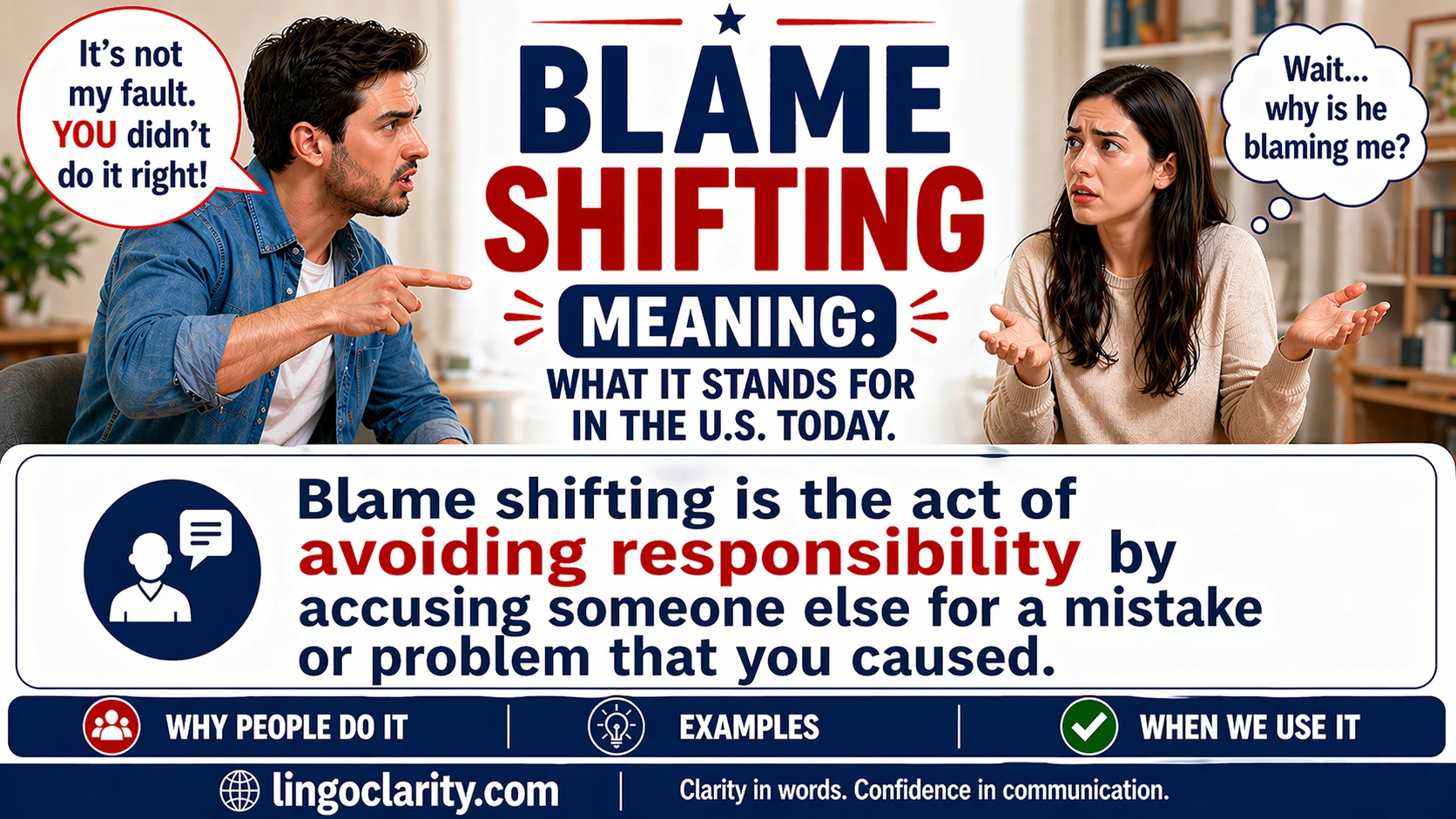
Blame shifting means trying to put responsibility for your own mistake, harmful behavior, or failure onto someone else. In plain English, it is what happens when a person avoids accountability and makes another person seem like the real cause of the problem. Dictionary-style references describe shifting blame or responsibility as unfairly making someone else responsible, and mental-health sources describe it as a common tactic in conflict and manipulative dynamics.
You will see this phrase in relationship advice, workplace discussions, family conflict, and everyday conversation. It is not slang. It is standard English, and it is commonly used both as a language phrase and as a label for a recognizable behavior pattern.
What Blame Shifting Means
The core idea is simple: someone does something wrong, something goes badly, or someone gets confronted, and instead of owning their part, they redirect the fault.
That redirection can sound obvious, as in, “This is your fault.” More often, it sounds softer and more strategic: “I only reacted that way because of you,” or “If you had handled this better, none of this would have happened.” The wording changes, but the purpose stays the same: move the blame away from the person responsible.
A plain-English definition would be this: blame shifting is the act of moving responsibility from the person who should carry it to someone else who should not. In ordinary usage, that is why the phrase almost always has a negative tone. It suggests unfairness, defensiveness, or manipulation.
How The Phrase Works In Everyday English
In usage terms, blame shifting is usually a noun phrase. It names the behavior.
Examples:
- Blame shifting ruins productive conversations.
- The meeting turned into blame shifting.
- Her apology sounded more like blame shifting than accountability.
The action form is shift blame or shift the blame. That is the verb phrase.
Examples:
- He tried to shift blame onto his assistant.
- She kept shifting the blame to everyone around her.
- The company shifted blame onto outside vendors.
The adjective form is usually hyphenated before another noun: blame-shifting behavior, blame-shifting tactics, blame-shifting language. Learner and dictionary-style references also support the common phrase pattern shift the blame/responsibility onto somebody, and usage examples show responsibility being placed “on” or “onto” someone.
If you want the pronunciation, it is straightforward: blame shifting sounds like BLAYM SHIF-ting.
Why People Use The Term
People do not usually use this phrase for ordinary blame alone. They use it when the blame feels unfairly relocated.
That distinction matters. Saying “I think you made a mistake here” is not automatically blame shifting. Saying “My mistake is really your fault” is much closer. The term is specifically useful when responsibility is being pushed away from the person who should be dealing with it.
That is why the phrase shows up in emotionally charged situations. When people feel shame, fear consequences, want to protect their self-image, or want to stay in control, they may try to shift blame rather than admit fault. Several therapy and relationship-focused sources describe blame shifting as a way to avoid uncomfortable emotions and accountability.
Where You Commonly See Blame Shifting
The phrase appears most often in relationship content, but it is not limited to dating or marriage.
You may see it in:
- family arguments
- workplace conflict
- team projects
- school settings
- bullying or harassment discussions
- public commentary about responsibility and accountability
That range matters because people often assume the term belongs only to abuse discourse. It does not. It can describe anything from a tense office exchange to a deeply manipulative personal pattern. The seriousness depends on the context, the frequency, and the power dynamic.
What Blame Shifting Sounds Like
Here are some natural examples:
At work:
A report is late, and instead of saying, “I misjudged the timeline,” someone says, “This happened because your notes were confusing.”
In a relationship:
A partner says something cruel, then follows it with, “I only said that because you pushed me.”
In a family argument:
A parent forgets an appointment and says, “You should have reminded me.”
In a group project:
A student does not finish their part and says, “The whole thing failed because no one supported me.”
Common blame-shifting lines include:
- “You made me do it.”
- “If you hadn’t done that, this wouldn’t have happened.”
- “You’re the real problem.”
- “I only reacted because of you.”
- “Why are you attacking me?”
- “You’re too sensitive.”
One sentence alone does not always prove a pattern. But repeated use of lines like these is exactly what many relationship and abuse-focused sources teach readers to watch for.
Why People Blame Shift
Blame shifting is usually driven by one or more of the following:
- fear of being criticized
- shame about being wrong
- defensiveness
- a need to protect status or self-image
- habit learned in family or group dynamics
- a desire to maintain control in the conversation
That does not excuse the behavior. It only explains why it happens. Good articles on this topic do not stop at “people do this to be manipulative.” Sometimes that is true. Sometimes the behavior is more impulsive, immature, or defensive. But in repeated patterns, especially where there is a power imbalance, the effect can still be manipulative and harmful.
Blame Shifting Vs. Gaslighting
Blame shifting and gaslighting overlap, but they are not the same thing.
Blame shifting is about relocating responsibility.
Gaslighting is about making someone doubt their memory, perception, or sense of reality.
If someone says, “This is your fault,” that is blame shifting.
If someone says, “That never happened. You’re imagining things,” that is gaslighting.
Some situations contain both. A person may first deny what happened, then insist you are confused, and then make you responsible for the problem. That is why several mental-health sources explain that gaslighting can include blame shifting, and that blame shifting can sit beside other tactics rather than standing alone.
A useful shortcut is this: blame shifting changes who is at fault; gaslighting changes what you think is real.
Blame Shifting Vs. Deflection, Projection, Scapegoating, And DARVO
These terms are related, but each one points to something slightly different.
Deflection is the broadest. It means redirecting attention away from the issue. A person can deflect by joking, changing the subject, or attacking a side issue. Blame shifting is one specific type of deflection.
Projection happens when a person attributes their own motives, feelings, or traits to someone else. In some abusive or highly defensive dynamics, projection and blame shifting appear together. A person who is angry may accuse you of being the angry one, then blame the conflict on your “attitude.”
Scapegoating means making one person carry the blame for a wider problem. It overlaps with blame shifting, but it is often broader and more social. A team, family, or organization can scapegoat someone.
DARVO stands for deny, attack, reverse victim and offender. It is a more specific pattern in which a wrongdoer denies what happened, attacks the person confronting them, and then flips the situation so they look like the victim. DARVO includes blame shifting, but it goes further.
Is Blame Shifting Always Abuse?
No. Not every defensive excuse or unfair argument deserves the label.
A person can shift blame in an everyday disagreement without it being part of a larger abusive pattern. At the same time, repeated blame shifting in a relationship, especially when paired with control, intimidation, denial, or reality distortion, can absolutely be part of emotional abuse. Abuse-focused sources describe blame shifting as a manipulation tactic that can create confusion, guilt, self-blame, and pressure to “fix” what the other person did.
The key questions are:
- Is it occasional or constant?
- Is the person ever accountable?
- Do you leave conversations feeling confused, guilty, or responsible for things that are not yours?
- Is there a power imbalance that makes it hard to push back?
Those questions help you use the term carefully rather than throwing it at every disagreement.
How To Use Blame Shifting In A Sentence
Use blame shifting when you want to name the behavior.
Examples:
- Blame shifting makes honest conflict resolution almost impossible.
- Her apology was full of blame shifting.
- The manager called out the blame shifting in the room.
Use shift blame when you want to describe the action.
Examples:
- He tried to shift blame onto the intern.
- They kept shifting the blame to each other.
- She shifted responsibility onto her coworker instead of admitting the error.
If you are writing for a broad audience, choose natural, plain patterns. Shift blame onto is especially common and easy to understand.
When Not To Use The Term
Do not use blame shifting for every disagreement, every explanation, or every case of shared responsibility.
This is not blame shifting:
- “I missed the deadline, and I should have started earlier.”
- “I was wrong, but the process was also unclear.”
- “We both handled that badly.”
This is closer to blame shifting:
- “I missed the deadline because everyone else failed me.”
- “I only yelled because you forced me to.”
- “The problem is not what I did. The problem is your reaction.”
The difference is not whether another factor existed. The difference is whether someone is using that factor to dodge their own part.
How To Respond To Blame Shifting
First, stay with the original issue. A blame shifter wants the focus to move. Do not chase every accusation.
Second, use simple factual language. Try: “We can talk about that next, but right now we are talking about what happened here.”
Third, name the pattern if needed. “You are shifting the blame instead of addressing your part.”
Fourth, set a boundary. “I’m willing to discuss this when we can talk about responsibilities fairly.”
Fifth, document the pattern if it happens repeatedly at work or in a difficult relationship. Several practical guides recommend keeping notes for your own clarity and seeking outside support when the behavior is persistent or damaging.
If the pattern is intense, chronic, or tied to emotional abuse, support from a therapist, advocate, HR, or a trusted third party may be more useful than trying to “win” the argument.
Related Terms, Synonyms, And Alternatives
There is no perfect one-word synonym for blame shifting, but several near matches are useful.
Close alternatives:
- shifting responsibility
- deflecting blame
- passing the buck
- finger-pointing
- scapegoating
Each one has a slightly different tone. Passing the buck is informal. Finger-pointing is broader. Scapegoating is harsher and usually wider in scope. Shifting responsibility is close and neutral.
Good opposites include:
- taking responsibility
- accountability
- accepting fault
- owning your mistake
Those phrases often make better antonyms than trying to force a single opposite word.
FAQ
Is blame shifting the same as gaslighting?
No. Blame shifting moves fault. Gaslighting makes someone doubt memory, perception, or reality. The two can overlap, but they are not interchangeable.
Is blame shifting emotional abuse?
Sometimes. On its own, it can describe ordinary but unfair defensiveness. When it becomes repeated, manipulative, and tied to control or intimidation, it can be part of emotional abuse.
What does blame shifting sound like?
It often sounds like “You made me do it,” “This is your fault,” or “If you had handled this better, none of this would have happened.” The wording varies, but the pattern is the same: the speaker dodges responsibility and puts it on someone else.
Can blame shifting happen at work?
Yes. It shows up in missed deadlines, bad handoffs, performance conversations, and group projects. Workplace versions are often less dramatic than relationship examples, but they still involve unfairly relocating responsibility.
What is the difference between blame shifting and projection?
Blame shifting moves responsibility. Projection puts a person’s own feelings, motives, or flaws onto someone else. They often appear together, but they are not identical.
How do you use shift blame in a sentence?
A natural example is: “He tried to shift blame onto his coworker after the project failed.” Another is: “The company shifted responsibility onto suppliers instead of owning the mistake.”
Final Takeaway
Blame shifting means unfairly moving responsibility from the person who should own it to someone else. That is the basic meaning, the everyday usage, and the reason the phrase matters.
Used carefully, it is a precise and useful term. It helps you name a pattern that can show up in casual conflict, toxic arguments, workplace tension, and serious emotional abuse. The key is to use it when responsibility is being redirected unfairly, not simply whenever two people disagree.
