
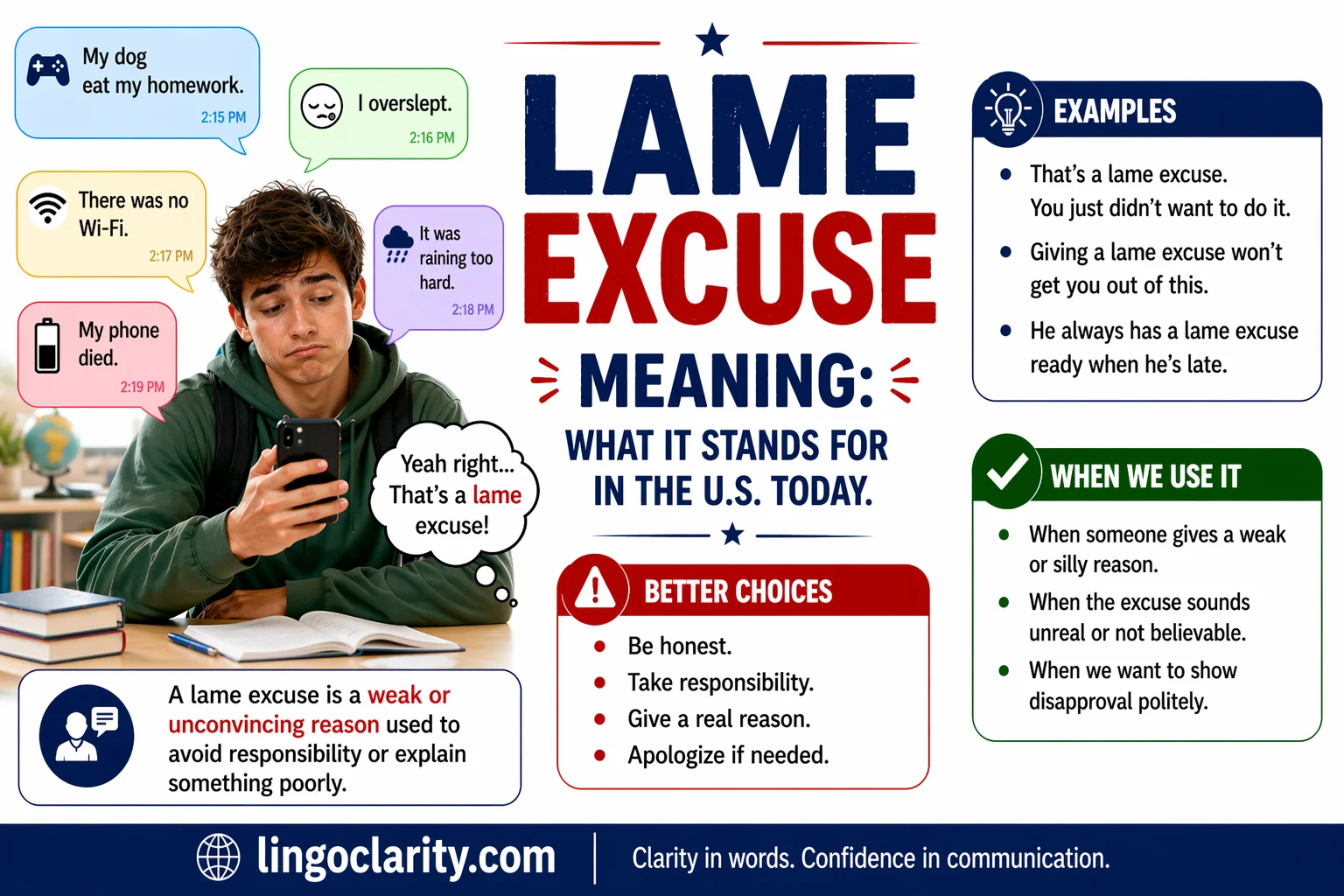
If someone calls a reason a lame excuse, they mean it sounds weak, unconvincing, or not good enough. In plain American English, the phrase usually suggests that the listener does not believe the explanation or thinks it is a poor attempt to avoid responsibility. Major dictionaries define lame in this sense as weak, unsatisfactory, poor, or hard to believe.
You will hear this phrase in casual conversation, texts, social media comments, and everyday spoken English. It is common enough to be easily understood, but it is not neutral. It carries judgment, and depending on the setting, it can sound dismissive, sarcastic, or rude.
Quick Answer
A lame excuse is a weak or unconvincing reason. People use the phrase when an explanation sounds flimsy, lazy, unbelievable, or simply not strong enough for the situation. It is usually informal and often critical.
What “Lame Excuse” Means
At its core, lame excuse means a poor explanation that fails to persuade the listener. The excuse may be false, partly true, exaggerated, or technically real but still too weak to justify what happened. That is why the phrase often carries more than one idea at once: disbelief, annoyance, and sometimes mild mockery.
For example, if someone misses a meeting and says, “I forgot what day it was,” another person might call that a lame excuse because it sounds careless and inadequate. The phrase does not always mean the speaker is accusing the person of lying. Sometimes it only means the reason feels too weak for the situation.
Is “Lame Excuse” Rude, Informal, Or Slang?
Lame excuse is best treated as informal everyday English, not formal writing. Dictionaries and learner references present it as a standard meaning of lame in phrases like lame excuse or lame explanation, while also showing that lame has a separate informal sense meaning boring, uncool, or unimpressive. In other words, the phrase is informal, but it is not just random internet slang.
That said, it often sounds blunt. Saying “That’s a lame excuse” to a friend may sound casual and sharp. Saying it to a coworker, manager, client, teacher, or someone you do not know well can sound disrespectful. A softer wording is usually better in professional or sensitive situations.
Why Some People Avoid The Word “Lame”
This is the nuance many short dictionary pages do not explain fully enough: some people avoid lame because of its disability-related history. Merriam-Webster notes that the older neutral medical use for people is now usually offensive and that disparaging uses such as “a lame excuse” are sometimes also considered offensive. Inclusive-language guidance from GOV.UK advises avoiding phrases that connect impairments with negative qualities, and workplace-inclusive language guidance also flags casual uses of lame for that reason.
That does not mean every English speaker will react negatively to the phrase. Many people still use it casually. But if you want to sound more professional, inclusive, or careful, it is smart to choose alternatives such as weak excuse, poor explanation, unconvincing reason, or thin justification.
Pronunciation And Grammar
Lame excuse is a noun phrase:
- lame = adjective
- excuse = noun
Simple pronunciation:
- lame = LAYM
- excuse (noun) = ik-SKYOOS
- excuse (verb) = ik-SKYOOZ
That last point matters. In lame excuse, excuse is a noun, so the final sound is -s, not -z. Merriam-Webster marks the verb as ik-ˈskyüz and the noun as ik-ˈskyüs, which matches the contrast many learners struggle with.
Natural sentence patterns include:
- That’s a lame excuse.
- He gave a lame excuse for being late.
- She came up with a lame excuse.
- That sounds like a lame excuse.
- I know that was a lame excuse.
How Americans Actually Use “Lame Excuse”
In American English, people most often use lame excuse when they think a reason does not “hold up.” The phrase often appears right after someone hears an explanation and rejects it.
Examples:
- “You skipped the meeting because your battery was low? That’s a lame excuse.”
- “He gave some lame excuse about traffic, but he left the house late.”
- “I know, I know. That was a lame excuse. Here’s the real reason.”
Notice the difference between saying it to someone and saying it about yourself. Calling your own reason a lame excuse usually sounds self-aware or apologetic. Using the phrase against another person, however, comes across as more judgmental.
When The Phrase Fits
Use lame excuse when all three of these are true:
- The reason sounds weak or unconvincing.
- The setting is informal enough for blunt language.
- You are comfortable sounding critical.
It works best in casual speech, texts, or dialogue-heavy writing. It also shows up naturally in commentary, humor, and mild arguments.
Examples:
- Friends: “He canceled again with another lame excuse.”
- School: “The teacher did not accept that lame excuse for missing class.”
- Online comments: “People in the replies called it a lame excuse.”
- Self-correction: “Sorry, that was a lame excuse. I should have just told the truth.”
When Not To Use It
Avoid lame excuse in formal, professional, or emotionally sensitive situations. Even when you think the explanation is weak, the phrase can make you sound dismissive rather than thoughtful.
Less suitable:
- “Your explanation is a lame excuse for missing the deadline.”
Better:
- “Your explanation is not convincing.”
- “That reason does not seem sufficient.”
- “I don’t think that explanation fully addresses the issue.”
Also be careful when the person may have a real problem you do not fully understand, such as a medical issue, family emergency, disability-related barrier, or serious personal situation. In those cases, the phrase can sound unfair or insensitive.
Better Alternatives To “Lame Excuse”
If you want the meaning without the bluntness, here are better options by tone:
Casual Alternatives
- weak excuse
- poor excuse
- flimsy excuse
- bad excuse
Neutral Alternatives
- weak explanation
- unconvincing reason
- thin justification
- insufficient explanation
Professional Alternatives
- the explanation is not persuasive
- the reason does not seem adequate
- the justification is weak
- that does not appear to be a sufficient reason
More Inclusive Alternatives
- unconvincing excuse
- poor explanation
- weak rationale
- implausible reason
Collins and related dictionary tools also show nearby collocations such as feeble excuse, flimsy excuse, reasonable excuse, and valid excuse, which is useful if you want to sound more precise.
“Lame Excuse” Vs. “Valid Excuse”
The opposite idea is not a single perfect word, but the closest choices are valid excuse, reasonable excuse, legitimate reason, and plausible explanation. Collins’ collocation listings for excuse include valid, reasonable, and legitimate-style alternatives, which reflect how English speakers judge whether a reason is acceptable or not.
The key difference is judgment:
- A lame excuse = the speaker rejects the reason.
- A valid excuse = the speaker accepts the reason.
- A plausible explanation = the reason sounds believable, even if not fully proven.
Examples In Real-Life Contexts
Here are more natural examples in American-style English:
School
- “Saying your Wi-Fi was slow is a lame excuse for not uploading the homework all day.”
- “He used a lame excuse when the professor asked why he missed the quiz.”
Work
- “Blaming the printer was a lame excuse because the report was submitted online.”
- “Her boss clearly thought that was a lame excuse for showing up late again.”
Friends And Plans
- “He said he was too tired to text back for three days. That sounded like a lame excuse.”
- “Canceling ten minutes before dinner with that reason felt like a lame excuse.”
Texting And Social Media
- “People in the comments said the apology sounded like a lame excuse.”
- “Don’t send me some lame excuse. Just be honest.”
Self-Use
- “I’m sorry. That was a lame excuse, and I should have told you the truth.”
- “Honestly, I gave a lame excuse because I felt embarrassed.”
These examples show the phrase’s emotional range. It can sound annoyed, sarcastic, disappointed, or self-aware.
Common Mistakes Learners Make
One common mistake is using lame excuse for every excuse. Not every excuse is weak. Some are fair, believable, and completely valid.
Another mistake is using it in formal writing. Even when grammatically correct, it often sounds too casual or too judgmental for a work email, report, or academic paper.
A third mistake is confusing lame excuse with the separate slang-ish use of lame meaning boring or uncool. In this phrase, the core meaning is closer to weak, poor, or hard to believe, not simply “not cool.” Oxford, Cambridge, and WordReference all support that distinction.
A fourth mistake is mispronouncing excuse. Remember that in lame excuse, it is the noun pronunciation: ik-SKYOOS.
FAQ
What does “lame excuse” mean?
It means a weak, poor, or unconvincing reason. If someone says an excuse is lame, they think it does not sound believable or strong enough.
Is “lame excuse” rude?
It can be. The phrase is openly critical, so it often sounds blunt. In casual conversation, that may be fine. In professional or sensitive situations, it can sound disrespectful.
Is “lame excuse” slang?
Not exactly. It is a standard, widely understood phrase in English, and dictionaries define it directly or through the adjective lame in this sense. But it is still informal in tone.
Does “lame excuse” mean the person is lying?
Not always. It usually means the reason sounds weak or unconvincing. Sometimes that implies dishonesty, but sometimes it only means the explanation feels inadequate. That distinction matters.
Why do some people dislike the word “lame”?
Some people see it as insensitive because of its disability-related history. Major usage guidance now notes that disparaging uses of lame can be considered offensive, and inclusive-language guides recommend avoiding language that links impairments with negative qualities.
What can I say instead of “lame excuse”?
Good alternatives include weak excuse, poor explanation, unconvincing reason, thin justification, and insufficient explanation. In professional settings, these usually sound better.
Can I use “lame excuse” at work?
You can, but it is risky. In many workplaces it will sound too sharp, informal, or insensitive. Safer choices include unconvincing explanation, weak justification, or insufficient reason.
How do you pronounce “excuse” in “lame excuse”?
Because excuse is a noun here, it is pronounced ik-SKYOOS. The verb form, as in “Please excuse me,” ends with a z sound: ik-SKYOOZ.
Final Take
Lame excuse means a weak or unconvincing reason, and Americans use it when they think an explanation does not hold up. It is common and easy to understand, but it is also informal, judgmental, and sometimes considered insensitive because of the word lame. For casual speech, it may work. For professional, respectful, or inclusive communication, a better choice is usually weak explanation, poor excuse, or unconvincing reason.
