
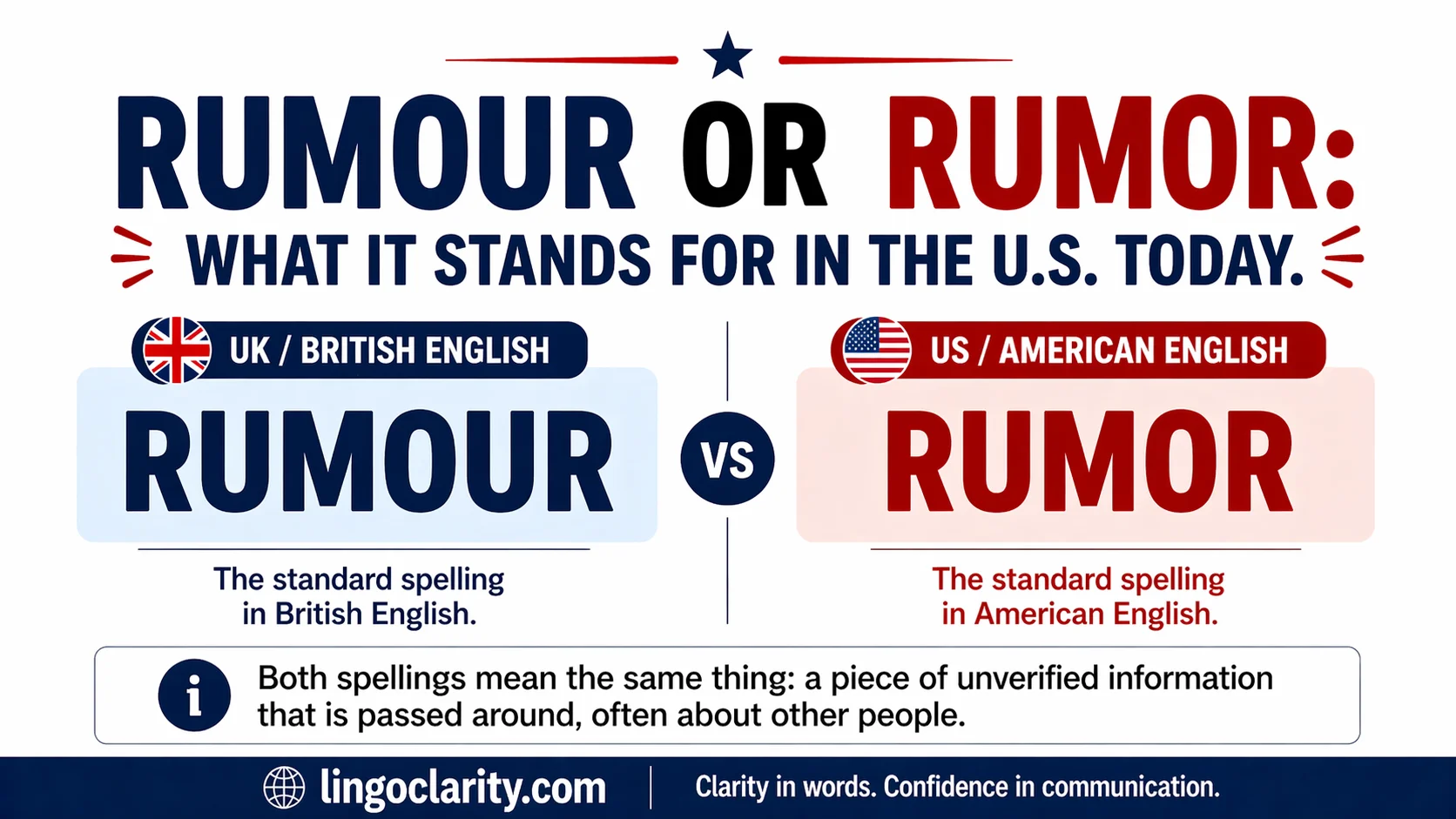
If you are writing for an American audience, use rumor. In US English, rumor is the standard spelling, while rumour is the standard British spelling. Major dictionary references align on that point, with Merriam-Webster treating rumour as chiefly British and Cambridge marking rumor as US and rumour as UK.
Quick Answer
Use rumor in American English.
Use rumour in British English.
They mean the same thing, and they are pronounced the same way. The difference is regional spelling, not meaning. Collins, Cambridge, and Merriam-Webster all support that distinction.
That means:
- A US newspaper should write rumor
- A UK publication should write rumour
- An international brand should pick one house style and stay consistent
For most American writers, the practical rule is simple: if your readers are in the US, rumor is the right choice.
What’s The Difference Between Rumour And Rumor?
There is no meaning difference between rumour and rumor.
Both words refer to unverified information, hearsay, or a story circulating without solid confirmation. Merriam-Webster defines rumor as talk or a report spread without known authority for its truth, while Cambridge gives the same basic sense and labels rumor as the US form and rumour as the UK form.
So this is not a case like two similar-looking words with different meanings. It is one word with two accepted spellings.
That distinction matters because many people assume one form must be “wrong” everywhere. It is not. The real issue is whether the spelling matches the variety of English you are using.
Which Spelling Should You Use In US English?
Use rumor in:
- American journalism
- US business writing
- US school and university writing
- American marketing copy
- US websites, blogs, and ecommerce content
- Most American legal, corporate, and internal communication
If you use rumour in US copy, most readers will still understand it. But it can look out of place, imported, or unedited for an American audience.
That is why editors usually care about this even though the meaning is obvious. Correct regional spelling helps writing feel polished, native, and consistent.
Examples in standard US English:
- There is a rumor that the company is changing its return policy.
- The rumor spread quickly across campus.
- She denied the rumor in a public statement.
- The story was based on rumor rather than confirmed reporting.
In all four examples, rumor looks natural to US readers. Rumour would still be understandable, but it would look British.
When Is Rumour Correct?
Rumour is correct when you are writing in British English or for readers who expect British spelling.
That usually includes:
- UK publications
- British school or university work
- Brands that follow British English house style
- Some international organizations that prefer British spelling
- Content aimed at UK, Irish, Australian, or New Zealand audiences
Cambridge and Collins both explicitly pair rumour with UK usage and rumor with US usage.
Examples in British-style writing:
- There is a rumour that the minister may resign.
- The paper dismissed the rumour as unconfirmed.
- A rumour began circulating after the interview.
If you are writing for the UK, rumour is the form that looks natural and correct on the page.
Why The Confusion Happens
The confusion is common because the words sound the same and differ by just one letter.
It also fits a broader spelling pattern across American and British English. American English often uses -or where British English uses -our, as in color/colour and favor/favour. The rumor/rumour split follows that same regional pattern, and usage references note that the pattern extends to related forms as well.
People get tripped up when they:
- read news from multiple countries
- work on international teams
- switch between US and UK clients
- copy language from sources that use a different spelling system
- rely on browser spellcheck set to the wrong English variant
That is why the question keeps coming up. The issue is not meaning. It is alignment.
Why Rumour Looks Wrong In US Copy
In American writing, rumour can create a subtle credibility problem.
Not because it is a fake word. It is not. But because US readers expect rumor, especially in edited writing. When they see rumour, they may assume one of three things:
- the content was copied from a British source
- the writer mixed English variants carelessly
- the piece was not fully edited for a US audience
None of those reactions help the writing.
This matters most in professional settings. A single British spelling in an otherwise American article may not derail the message, but repeated mismatches can make the copy feel less polished.
How Editors, Brands, And Businesses Should Handle It
The smartest rule is not “pick the prettier spelling.” It is “match the audience and stay consistent.”
If your organization publishes primarily for Americans, set rumor as the house style. Use it everywhere that spelling appears, including:
- headlines
- body copy
- social posts
- email campaigns
- product pages
- ad copy
- related forms such as rumored and rumor mill
If you publish separate US and UK versions of your content, localize the spelling by market. That means the US page should use rumor, while the UK page can use rumour.
If you serve a mixed global audience and do not localize by region, choose one standard and apply it consistently. In that case, the right answer depends on your brand style guide rather than the dictionary alone.
Related Word Forms To Keep Consistent
This is where many articles stop too early.
Once you choose rumor or rumour, you should usually carry that choice through related forms. Usage references note the same regional pattern with the -ed form, and Cambridge separately lists rumored as the US form and rumoured as the UK form.
For US English, prefer:
- rumor
- rumored
- rumor mill
For UK English, prefer:
- rumour
- rumoured
- rumour mill
Cambridge and Merriam-Webster also recognize rumor mill as the US form, while Collins pairs it with rumour mill in British usage.
That consistency matters more than many writers realize. A page that uses rumor in one paragraph and rumoured in the next looks patched together.
Examples In Real-World US Writing
Here is how the American form works in common contexts.
Journalism
A rumor about the merger began circulating before the official announcement.
Business Writing
The company addressed the rumor in a statement to investors.
Academic Writing
The claim remained a rumor until primary evidence emerged.
Marketing And Brand Communication
We do not comment on rumor or speculation.
Everyday Conversation
I heard a rumor that the restaurant is moving downtown.
These examples all sound normal in American English because rumor is the expected form.
Now compare the British versions:
- A rumour about the merger began circulating.
- The company addressed the rumour in a statement.
- The claim remained a rumour until evidence emerged.
Those are not wrong in a general English sense. They are simply British in appearance.
Common Mistakes To Avoid
One common mistake is assuming rumour looks smarter or more formal.
It does not in US English. It looks British.
Another mistake is mixing the two forms in one piece:
The rumor spread quickly, and the rumour grew online.
That is the kind of inconsistency editors flag immediately.
A third mistake is thinking the words carry different meanings. They do not. The distinction is regional spelling, not definition. Major dictionary sources agree on that.
A fourth mistake is forgetting the related forms. If you write rumor in US English, you should usually also write rumored and rumor mill.
What Major References Show
If you want the clean authority answer, the reference works are unusually aligned here.
Merriam-Webster treats rumour as chiefly British spelling of rumor. Cambridge marks rumor as US and rumour as UK. Collins presents the same word in American and British forms, with regional labeling that matches standard usage.
That consensus is useful because it removes any real ambiguity. This is not an unsettled language question. For US English, the standard editorial answer is rumor.
A Simple Rule For Mixed Audiences
If you write for both American and British readers, use this rule:
- choose the spelling that matches the edition you are publishing
- if there is only one edition, follow your house style
- once you choose, keep the entire article in the same spelling system
This is especially important for:
- international newsrooms
- SaaS companies with regional landing pages
- global ecommerce brands
- agencies writing for multiple clients
- academic or nonprofit organizations with international readership
Consistency often matters more than the theoretical acceptability of both forms.
FAQ
Is rumour wrong in American English?
Not technically. American readers will understand it. But it is not the standard US spelling, so it can look off-style in American writing. For polished US copy, use rumor.
Is rumor wrong in British English?
It is usually understood, but it is not the expected British form. In UK English, rumour is the natural standard choice.
Do rumor and rumour mean the same thing?
Yes. They refer to unverified information or hearsay. The difference is spelling preference by region, not meaning.
Which spelling should I use for a US website?
Use rumor. That is the safest, most natural spelling for American readers and American editorial style.
What about rumored and rumoured?
Follow the same regional pattern. In US English, use rumored. In UK English, use rumoured.
What should international brands do if they serve both markets?
Either localize by region or choose a house style and apply it consistently. The bigger problem is not choosing one “wrong” variant once; it is mixing variants carelessly across the same page.
Bottom Line
If you are writing in US English, the right spelling is rumor.
If you are writing in British English, the right spelling is rumour.
That is the full answer, and it is the one supported by the major dictionaries. For American readers, rumor is the spelling that looks standard, edited, and natural. Use it in your headlines, copy, emails, essays, and web content, and keep the same pattern in related forms like rumored and rumor mill.
