
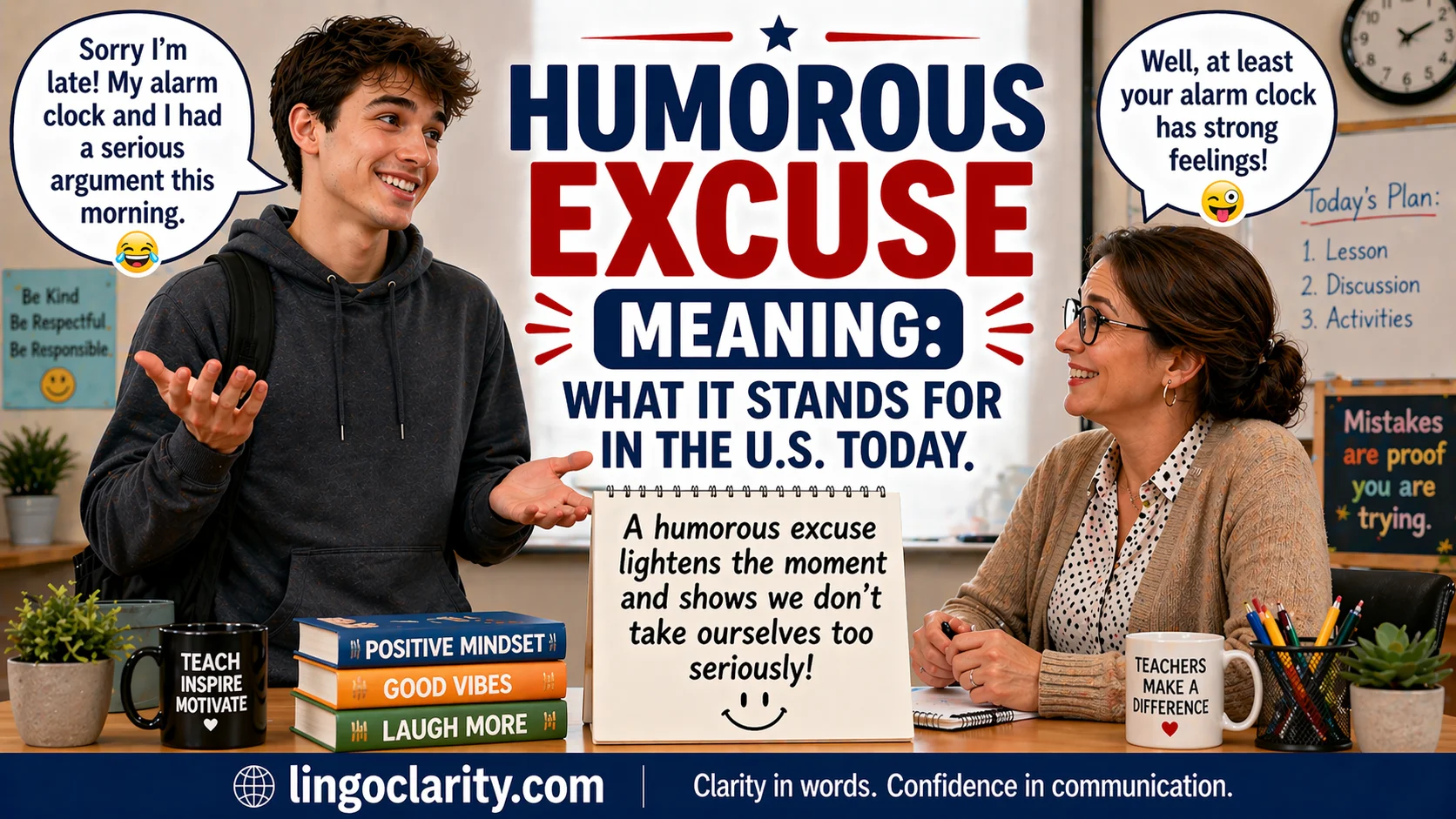
A humorous excuse means a funny or playful reason someone gives to explain a mistake, delay, absence, or small problem. In plain English, it is an excuse that sounds amusing instead of fully serious. The phrase is built from two ordinary English words: humorous, which means funny or making you laugh, and excuse, which as a noun means a reason you give to explain something wrong or avoid blame.
That means humorous excuse is usually not a special idiom. Instead, it is a normal descriptive phrase. In other words, the phrase tells you what kind of excuse it is: one with a light, funny, or playful tone. A student saying, “Sorry I’m late. My alarm clock filed for retirement,” is giving a humorous excuse. The point is not strict accuracy. Rather, the point is to soften the moment with humor.
What “Humorous Excuse” Means
At its simplest, a humorous excuse is an excuse told in a funny way. It may be clever, exaggerated, lightly silly, or obviously playful. Sometimes it is partly true. At other times, it is clearly invented for effect. Either way, the excuse is presented so the listener hears the humor first.
For example:
- “My homework was delayed by a very aggressive nap.”
- “I missed the bus because the bus and I were on different emotional schedules.”
- “Sorry I’m late. My shoes were not committed to the plan.”
Each sentence gives a reason. However, each one also sounds playful, which is what makes it a humorous excuse instead of a plain explanation.
Is “Humorous Excuse” An Idiom?
No. Humorous excuse is usually not an idiom. A phrase is a group of words that does not contain a full subject-verb structure, while an idiom has a meaning that cannot be understood literally from the words alone. Since humorous excuse means exactly what its parts suggest, it is better understood as a regular phrase, not a figurative idiom.
That matters because learners do not need to memorize it like a fixed expression such as spill the beans or hit the books. Instead, they can understand it naturally:
- humorous = funny
- excuse = a reason or explanation
So, when the two words appear together, the meaning stays direct.
Part Of Speech And Pronunciation
In the phrase humorous excuse, humorous is an adjective and excuse is a noun. Cambridge defines the noun excuse as “a reason that you give to explain why you did something wrong,” which fits this phrase exactly. Collins also labels this meaning as a countable noun.
Here is a simple American English pronunciation guide:
- humorous — hyoo-MOR-uhs
- excuse (noun) — ik-SKYOOS
Together, it sounds like:
- hyoo-MOR-uhs ik-SKYOOS
There is one especially useful learner detail here. The word excuse changes pronunciation when it is a verb. As a noun, it is pronounced /ɪkˈskjuːs/. As a verb, it is pronounced differently, with a final z sound. Collins explicitly marks this noun-versus-verb difference, which makes it worth learning early.
Compare these examples:
- Noun: “That was a weak excuse.”
- Verb: “Please excuse the delay.”
Why Tone Matters
The phrase is really about tone. A person can give a serious excuse, a weak excuse, a false excuse, or a humorous excuse. The facts may matter, but the tone shapes how the excuse feels.
A humorous excuse usually sounds:
- light
- playful
- mildly silly
- friendly
- not fully serious
That is why context matters so much. The same words can sound funny in one setting and careless in another.
Humorous Vs. Playful, Sarcastic, And Facetious
This is one of the most important distinctions for students and English learners.
Humorous Vs. Playful
Cambridge defines playful as funny and not serious. So, a playful excuse is close in meaning to a humorous excuse. In fact, the two often overlap. A playful excuse simply stresses a softer, friendlier mood.
Example:
- “I’m late because my backpack was refusing to cooperate.”
That sounds playful more than dramatic.
Humorous Vs. Sarcastic
Cambridge defines sarcastic as saying the opposite of what you mean in order to hurt someone’s feelings or humorously criticize something. Because of that, a sarcastic excuse can sound sharp or rude, even if it is technically funny.
Example:
- “Sure, I forgot the assignment because I obviously have no responsibilities.”
That sounds more sarcastic than light.
Humorous Vs. Facetious
Merriam-Webster defines facetious as joking or sarcastic in a way that others may regard as silly, annoying, or inappropriate. Collins also notes that humorous suggests a genuine sense of fun, while facetious suggests trying to sound witty without being taken seriously.
So, if someone makes a joke in the wrong moment, a humorous excuse can quickly sound facetious instead.
How To Use “Humorous Excuse” Naturally
Most of the time, people use this phrase to describe an excuse after hearing it. In other cases, they use it to label the tone before giving an example.
Common patterns include:
- give a humorous excuse
- offer a humorous excuse
- use a humorous excuse
- come up with a humorous excuse
- sound like a humorous excuse
Examples:
- “He gave a humorous excuse for being late.”
- “She used a humorous excuse to avoid embarrassment.”
- “That sounded like a humorous excuse, not the full story.”
- “The student came up with a humorous excuse about the printer.”
- “Her humorous excuse made the class laugh.”
These patterns sound more natural than forcing the phrase into unusual sentence shapes.
When To Use It
A humorous excuse works best in small, low-stakes situations where the audience is likely to understand the joke.
Good situations include:
- friendly classroom moments
- casual conversations
- light group chats
- storytelling
- social captions
- harmless lateness
- minor mistakes
For example, if a student says, “I’m sorry I forgot my notebook. My desk ate it,” the teacher may recognize that the excuse is humorous even if it is not serious.
ESL teaching resources often frame excuses in everyday social situations like invitations, requests, accusations, and being late. That supports the idea that learners benefit from phrase-based, context-based practice here, not just dictionary meaning.
When Not To Use It
However, a humorous excuse is not the right choice in serious or sensitive moments.
Avoid it in situations such as:
- job interviews
- formal emails
- major work deadlines
- legal issues
- medical issues
- disciplinary meetings
- conversations with upset people
For example, if you miss an important interview, a humorous excuse may sound irresponsible. In that case, a direct explanation is better. Likewise, if someone is already annoyed or hurt, humor may make the situation worse instead of better.
Examples For Students And English Learners
Here are clearer examples by context.
School Examples
- “The student gave a humorous excuse and said the dog submitted the homework late.”
- “Her humorous excuse about the printer almost made the teacher laugh.”
- “That was a humorous excuse, but you still need to finish the assignment.”
Work Examples
- “He offered a humorous excuse for arriving late to the meeting.”
- “Her humorous excuse made the team smile, although she still had to fix the error.”
- “The manager heard the humorous excuse and then asked for the real update.”
Texting Examples
- “Sorry I didn’t reply. My phone and I were taking a break.”
- “That text sounds like a humorous excuse, not an actual answer.”
- “I sent a humorous excuse so the chat would stay light.”
Storytelling And Social Media Examples
- “The character is known for giving a humorous excuse every time he fails.”
- “Her caption turned a small mistake into a humorous excuse.”
- “He posted a humorous excuse for ordering dessert again.”
These examples show an important point: the phrase usually describes the style of the excuse, not just the excuse itself.
Common Confusions
Learners often mix up excuse, reason, explanation, and joke. They are related, but they are not identical.
A joke exists mainly to amuse.
An explanation mainly tries to clarify what happened.
An excuse usually explains something while also trying to reduce blame, soften judgment, or avoid criticism. Cambridge and Collins both support this broader meaning of excuse as a reason given to explain behavior or avoid doing something.
So, a humorous excuse is not just any joke. It still functions as a kind of reason, even if the reason is playful.
Better Alternatives Depending On The Situation
Sometimes humorous excuse is the best phrase. At other times, another expression fits better.
Use funny excuse when you want simple everyday English.
Use playful excuse when you want a softer, friendlier tone.
Use silly excuse when the excuse sounds childish or obviously ridiculous.
Use facetious excuse when the humor feels ill-timed or annoying.
Use serious explanation or valid reason when the situation is formal or important.
Examples:
- “He gave a funny excuse for being late.”
- “She made a playful excuse and smiled.”
- “That was a silly excuse.”
- “His facetious excuse annoyed the teacher.”
- “I need a serious explanation, not a joke.”
Simple Guidance For Students And English Learners
If you want one easy rule, use this:
A humorous excuse is fine for small problems, but not for serious ones.
That rule helps you avoid the biggest mistake. Even a clever excuse can fail if the moment calls for honesty and seriousness.
Also, remember these learner tips:
- The phrase is usually informal.
- It is more common in speech than in formal writing.
- It often appears in stories, jokes, captions, and conversation.
- The noun excuse is pronounced differently from the verb excuse.
- A humorous excuse can be true, partly true, or invented for fun.
FAQ
What does humorous excuse mean?
It means a funny or playful excuse. More exactly, it is a reason or explanation given in a light, amusing way. The word humorous means funny, and the noun excuse means a reason given to explain wrong behavior, delay, or absence.
Is humorous excuse an idiom?
No. It is usually a regular phrase, not an idiom. The meaning comes directly from the two words, so it does not need idiomatic interpretation.
Can a humorous excuse still be true?
Yes. A humorous excuse can describe a real event in a funny way. For example, someone may truly be late but phrase the reason playfully to reduce tension.
Is humorous excuse positive or negative?
It can be either. In a relaxed setting, it may sound witty or charming. In a serious setting, however, it may sound evasive, immature, or badly timed.
What is the difference between a humorous excuse and a sarcastic excuse?
A humorous excuse usually tries to sound light and amusing. By contrast, a sarcastic excuse may carry criticism, irritation, or mockery. Cambridge’s definition of sarcastic shows why sarcasm often feels harsher.
Where do people use humorous excuses most?
You most often hear them in casual speech, stories, classrooms, group chats, jokes, captions, and social media. ESL teaching materials also place excuse-making in everyday conversational situations rather than formal writing.
What part of speech is excuse in this phrase?
In humorous excuse, excuse is a noun. It names the reason or explanation. Cambridge and Collins both present that noun meaning clearly.
Final Takeaway
A humorous excuse means a funny or playful excuse. It is not a special idiom. Instead, it is a normal English phrase used to describe an excuse with a light, joking tone.
So, if you hear someone say, “Sorry I’m late. My coffee had trust issues,” you are hearing a humorous excuse. The meaning is simple, but the tone is what matters most. Use it in casual, low-stakes moments, and avoid it when the situation calls for a serious explanation.
