
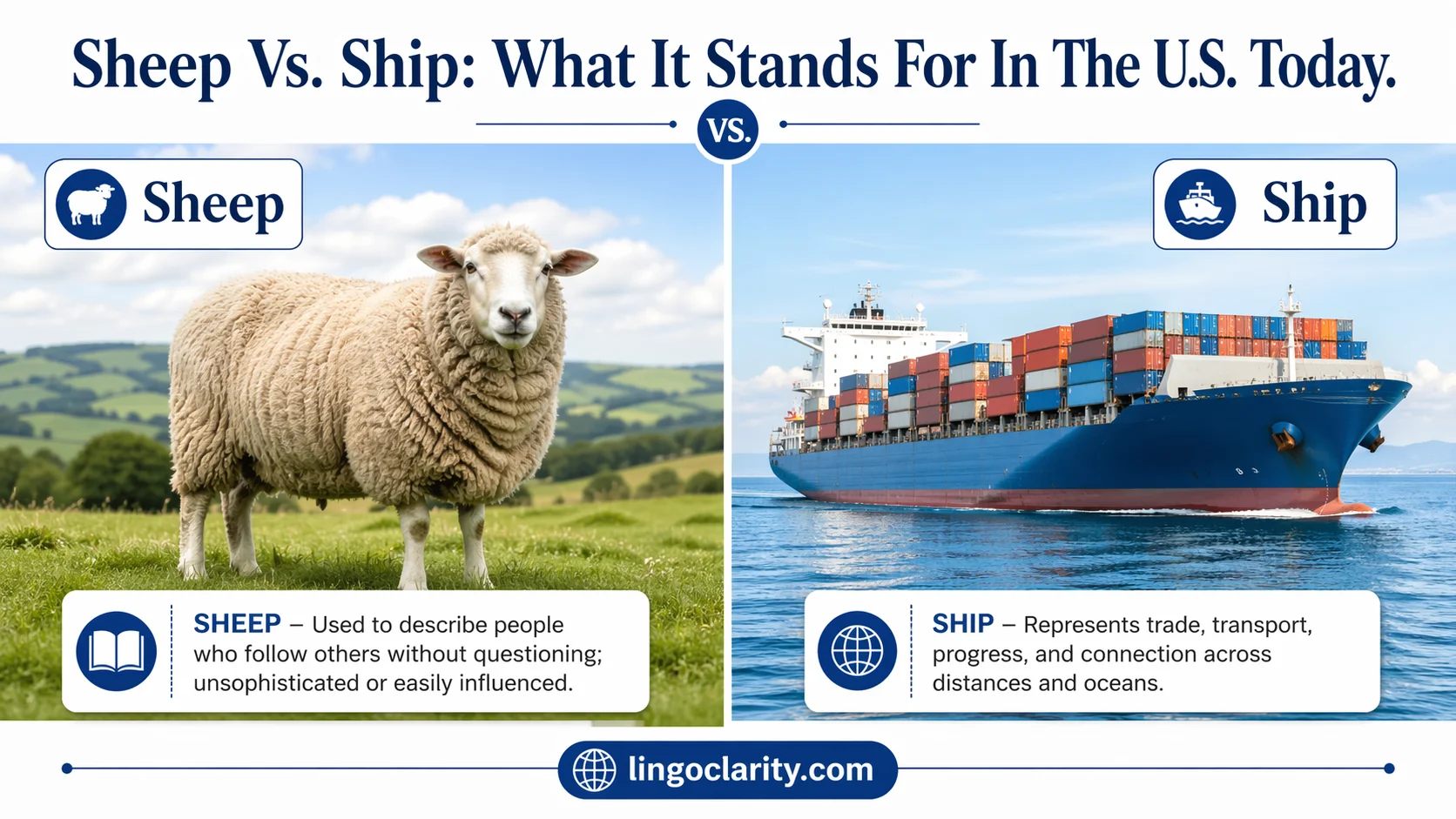
Quick answer: A sheep (/ʃiːp/) is a woolly farm animal. A ship (/ʃɪp/) is a large seagoing vessel, and as a verb it means to send something somewhere. The two words are not homophones. One sound separates them: the tense ee vowel in sheep versus the relaxed i vowel in ship.
What’s the difference between sheep and ship?
| Sheep | Ship | |
|---|---|---|
| Pronunciation (IPA) | /ʃiːp/ | /ʃɪp/ |
| Say it like | SHEEP, rhymes with keep | SHIP, rhymes with tip |
| Vowel | Tense /iː/ (the FLEECE vowel) | Relaxed /ɪ/ (the KIT vowel) |
| Part of speech | Noun | Noun and verb |
| Core meaning | A wool-bearing farm animal | A large vessel; to send goods |
| Plural | sheep (no -s) | ships |
| Everyday example | Three sheep got out of the pen. | Your order ships Monday. |
Those two entries differ by a single vowel, which is why sheep vs. ship trips up so many careful speakers. In writing, the spelling settles it instantly. In speech, your tongue has to do the work.
What does “sheep” mean?
Sheep (/ʃiːp/) is a noun for a domesticated ruminant raised for wool, meat, and milk. A female is a ewe, a male is a ram, and a young one is a lamb. Merriam-Webster records the same core sense you’d expect [link to Merriam-Webster entry for sheep].
The word has a zero plural: one sheep, twelve sheep, a whole hillside of sheep. English keeps a handful of these — deer, fish, moose — and sheeps isn’t one of the options.
Sheep also works figuratively for someone who follows the crowd without questioning it. That sense shows up in black sheep (the odd one out in a family), wolf in sheep’s clothing, and the blend sheeple, which Merriam-Webster added to its dictionary in 2017. Be careful with the figurative use. Calling a person a sheep is an insult, and sheeple carries a sneer that’s hard to walk back.
The adjective sheepish is gentler. It means embarrassed or bashful, as in a sheepish apology after you’ve forgotten someone’s name.
What does “ship” mean?
Ship (/ʃɪp/) is a noun for a large vessel built for deep water. The rough working distinction sailors use: a ship can carry a boat, but a boat can’t carry a ship.
As a verb, ship is the sense most Americans use daily. It means to send or transport goods, and it shows up in every order confirmation you’ve ever received. Shipping, shipment, and shipped all come from it.
There’s also an informal fandom sense. To ship two characters or people is to want them together romantically. It’s widely traced to online fan communities of the 1990s, where relationshipper was clipped down to shipper and then to ship. That usage is casual and internet-native. It belongs in a group chat, not a cover letter.
Fixed phrases carry their own weight: run a tight ship (manage something strictly), ship out (leave), and when my ship comes in (when my luck turns).
Where do sheep and ship come from?
Both words are old, and both are native English rather than borrowed.
- Sheep descends from Old English scēap, a West Germanic word with cousins in Dutch (schaap) and German (Schaf).
- Ship descends from Old English scip, from a Proto-Germanic root that also gave German Schiff and Dutch schip.
The shared sh- isn’t a coincidence of modern spelling. In Old English, the letter pair sc was regularly pronounced as the sound we now write sh, so these two words have sounded similar for well over a thousand years. Their vowels were what kept them apart then, and their vowels are what keep them apart now.
How do you pronounce sheep vs. ship?
Most guides tell you that sheep is long and ship is short. That advice is incomplete, and it fails on exactly this pair.
Length isn’t the real rule
English shortens a vowel before a voiceless consonant such as /p/, /t/, or /k/ — phoneticians call it pre-fortis clipping. Say she’d and then sheep, and you’ll hear the vowel in sheep get clipped. So the ee in sheep is already short, and stretching it out just makes you sound like you’re calling the animal from a distance.
What your mouth actually does
The difference is tension and tongue position, not duration.
- /iː/ in sheep: tongue high and pushed forward, lips spread as if you’re starting a small smile, mouth muscles tense. It’s the vowel in see, keep, and machine.
- /ɪ/ in ship: jaw drops a fraction, tongue relaxes down and slightly back, lips neutral. It’s the vowel in sit, big, and rhythm.
Phonologists group these as the FLEECE and KIT vowels, a labeling system from John Wells that dictionaries still use to describe accents [link to Cambridge Dictionary pronunciation entry].
A ten-second self-test
Say she. Hold it. Now, without moving your lips, let your jaw and tongue go slack, then close with a p. That slack version is ship. Snap the tension back and close with a p again, and you’ve got sheep. Do that five times in a row and the contrast starts to feel physical rather than theoretical.
Sheep vs. ship in real sentences
- Text message: “can you check if the sheep got into the back field again”
- Business email: “Your replacement unit will ship Thursday and should arrive by the weekend.”
- Spoken dialogue: “How many sheep are still out there?” — “Forty-one, unless one wandered off.”
- News writing: A container ship lost power roughly two miles outside the harbor.
- Casual online: “I ship them so hard, they’re perfect together.”
- Idiom in speech: She runs a tight ship, so nobody clocks in late twice.
Notice that context does most of the disambiguating for listeners. Nobody hears “your order sheeps Thursday” and gets confused, because sheep has no verb form. The pairs that genuinely cause trouble are the ones where both words fit the slot, like sleep and slip.
Common mistakes with sheep and ship
| The mistake | Why it happens | The fix |
|---|---|---|
| Writing sheeps | Applying the regular -s plural rule | Sheep is both singular and plural; only ships takes -s |
| Stretching the vowel to say sheep | The “long vs. short” rule taught in most classes | Tense your tongue and lips instead of holding the sound |
| Typing ship for sheep | Spellcheck can’t catch it; both are real words | Reread nouns near farm, wool, or flock |
| Assuming i always sounds like /ɪ/ | Spelling and sound don’t match reliably | Machine, police, and ski all use /iː/ |
| Using fandom ship in formal writing | The slang sense feels mainstream online | Keep it to informal contexts; write pair or root for elsewhere |
| Calling someone a sheep casually | The figurative sense sounds mild in print | It reads as contempt; sheeple is worse |
One more worth naming: some learners overcorrect after being drilled on this pair and start pronouncing every /ɪ/ as /iː/, so this turns into these and fit turns into feet. Practice both directions, not just the one you get wrong.
Related words and lookalike pairs
Words in the same family
- Sheepish — embarrassed, not sheep-like in the insulting sense. The tone is self-conscious, almost apologetic.
- Sheeple — a derogatory blend of sheep and people, aimed at those seen as uncritical. Loaded and best avoided in neutral writing.
- Shipment — the goods being sent, not the act of sending. Shipping is the act or the cost.
- Vessel — a formal cover term for ships and boats alike; useful in maritime or legal writing where ship would be imprecise.
Other pairs built on the same vowel contrast
If sheep vs. ship gives you trouble, these will too. Linguists call them minimal pairs — two words separated by one sound.
- cheap / chip
- sleep / slip
- feel / fill
- seat / sit
- beat / bit
- leave / live
- heat / hit
- peach / pitch
Each pair drills the same tense-versus-relaxed contrast, and unlike sheep and ship, several of them can appear in identical sentence slots. That’s where a mispronunciation actually costs you clarity.
Frequently asked questions
Are sheep and ship homophones?
No. Homophones sound identical, like there and their. Sheep and ship are a minimal pair: they differ by exactly one sound, the vowel, which makes them close but distinct.
Is the plural of sheep “sheeps”?
No. Sheep is both singular and plural, so you say one sheep and twenty sheep. Ship follows the normal rule and becomes ships.
Why do sheep and ship sound the same to me?
Many languages have only one high front vowel, so both English vowels map onto the same sound in your ear. Training the contrast in listening usually comes before producing it accurately.
What does it mean when someone says they “ship” two people?
It means they want those two to be a romantic couple. The slang comes from fan communities that shortened relationshipper to shipper, and it stays informal.
How can I remember which word is which?
Sheep has a double e, and so do sleep and keep, which all use the tense vowel. Ship has a single i, like sit and tip, which use the relaxed one.
Final Thoughts
Say the pair out loud once more, and pay attention to your jaw rather than the clock. Tension and tongue height carry the meaning here; length never really did. If you want a genuine workout, run through the minimal pairs above with a voice recorder and play them back — your ear catches what your mouth misses.
