
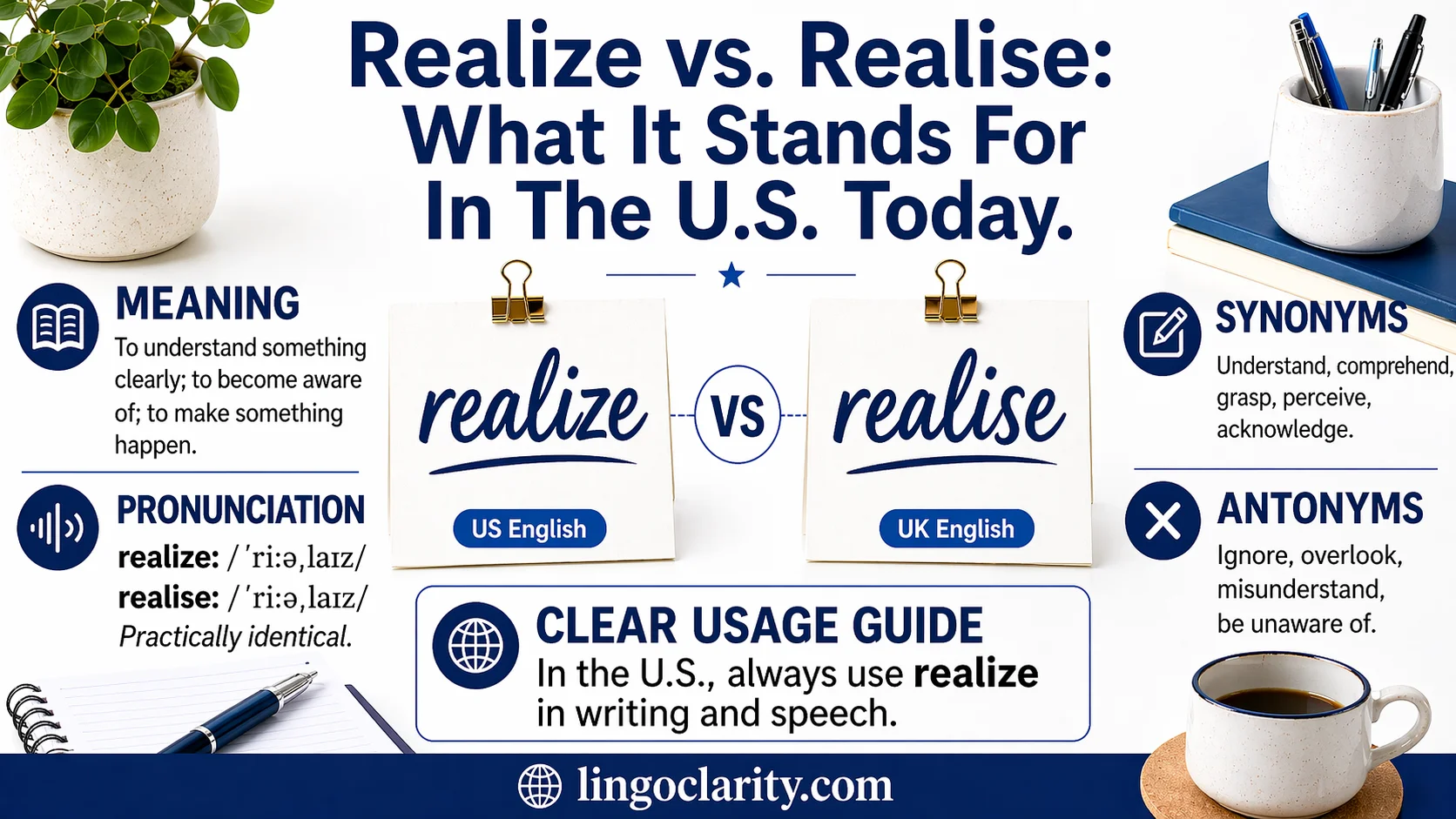
For US English, realize is the correct spelling. Write “I didn’t realize the deadline changed,” not “I didn’t realise the deadline changed,” when your audience is American.
Realise is a variant spelling used mainly in British-style English. The spelling changes by region and style, not by meaning. Merriam-Webster describes “realize” and “realise” as alternate spellings of the same word, with “realize” far more common in the US and Canada and “realise” dominant in the UK, Australia, and New Zealand.
That means the best choice depends on your audience:
| Writing Context | Use |
|---|---|
| American English | realize |
| US business writing | realize |
| US resumes and cover letters | realize |
| US school or college writing | realize |
| British-style everyday writing | realise |
| Oxford-style British writing | realize |
| Direct quotation | Keep the original spelling |
| Global document with no style guide | Pick one spelling and stay consistent |
Quick Answer
Use realize in American English.
Use realise when writing in a British-style context that prefers “-ise” spellings.
Both spellings mean the same thing: to become aware of something, understand something, make something real, achieve a goal, or, in financial writing, convert something into money. Merriam-Webster includes meanings such as “bring into concrete existence,” “convert into actual money,” and become aware; Cambridge also lists meanings related to understanding, achieving something, and selling or realizing assets.
Correct US examples:
I didn’t realize the meeting had moved to 3 p.m.
She worked for years to realize her dream of opening a bakery.
The company expects to realize savings from the new software rollout.
In US writing, realise will usually look like a British spelling or an error, even though readers will understand it.
Realize And Realise Mean The Same Thing
“Realize” and “realise” are two spellings of the same verb, not two different words.
Both are pronounced the same way in normal speech and follow the same grammar rules. You can use either spelling in the same kinds of sentence structures, as long as the spelling matches the English variety or style guide you are following.
The main meanings are:
| Meaning | US Example |
|---|---|
| To understand | I didn’t realize you were waiting outside. |
| To become aware | She realized the report was missing a key figure. |
| To achieve | He finally realized his goal of finishing the marathon. |
| To make real | The design team realized the concept in a working prototype. |
| To convert into money | The estate had to realize several assets to pay the debt. |
The British-style versions have the same meaning:
I didn’t realise you were waiting outside.
She realised the report was missing a key figure.
He finally realised his goal of finishing the marathon.
The spelling changes; the meaning does not.
Why The Spelling Difference Exists
The confusion exists because English spelling developed through different regional and editorial traditions. The “-ize” ending is not just an American invention. Merriam-Webster notes that early English examples used “realize,” and Grammarist explains that “realize” is older than “realise” and predates the United States and Canada by nearly two centuries.
Over time, American English standardized around realize, while much everyday British-style writing came to prefer realise. That is why American readers expect “realize,” while British readers often expect “realise.”
The extra wrinkle is Oxford spelling. Oxford-style British spelling uses “z” in many “-ize” words, including “realize,” while retaining other British spellings. LanguageTool describes Oxford spelling as the spelling style used by Oxford University Press and explains that it uses “z” in “-ize” suffixes, such as “organize” instead of “organise.”
So the clean rule is:
Use realize for US English.
Use realise for British-style English unless your style guide uses Oxford spelling.
US English: Always Choose Realize
In American English, realize is the expected form. Scribbr states that in US English, “realize” with a “z” is the correct spelling, and Merriam-Webster says US and Canadian writing overwhelmingly uses “realize.”
Use realize in:
work emails
client proposals
school papers
college essays
newsletters
blog posts
resumes
cover letters
legal or business correspondence
US-facing product copy
American academic writing
Examples:
I realize this deadline is tight, but the update is important.
The client did not realize the contract had already been revised.
We expect to realize a return on the investment within two years.
Maya realized she had attached the wrong file.
If you are writing for an American employer, teacher, editor, or customer, “realise” is not the best choice.
British English: Realise Is Common, But Realize Also Appears
In British English, realise is common and widely accepted. That is the spelling many UK readers expect in everyday writing.
Examples:
I didn’t realise the office was closed today.
They hope to realise the benefits of the new policy soon.
She realised the mistake after checking the invoice.
But British English is not completely one-sided. “Realize” also appears in some British contexts, especially in Oxford-style spelling. Grammarly notes that Oxford University Press prefers the “-ize” ending for words that derive from the Greek “-izo” suffix, and LanguageTool gives “realize” as an Oxford spelling example compared with British “realise.”
For UK-style writing, follow the document’s existing pattern. If the text uses “organise,” “recognise,” and “realise,” keep “realise.” If it uses “organize,” “recognize,” and “realize,” keep “realize.”
Best Choice By Context
The spelling choice becomes easier when you think about audience and consistency.
| Situation | Best Choice | Reason |
|---|---|---|
| Email to a US coworker | realize | Matches American business spelling |
| Resume for a US company | realize | Looks natural to American recruiters |
| US college essay | realize | Fits American academic expectations |
| Article for US readers | realize | Best search-intent match for US English |
| Article for UK readers | realise | Common British-style spelling |
| Oxford-style journal | realize | Oxford spelling often uses “-ize” |
| International company guide | Follow house style | Consistency matters more than preference |
| Direct quote from a UK source | Keep “realise” | Quoted text should preserve original spelling |
| Direct quote from a US source | Keep “realize” | Quoted text should preserve original spelling |
A good editor does not switch spellings randomly. Choose the spelling that fits the audience, then apply the same pattern to related words.
Realized, Realised, Realizing, Realising, Realization, And Realisation
The spelling difference extends to related forms.
| US English | British-Style English |
|---|---|
| realize | realise |
| realized | realised |
| realizing | realising |
| realization | realisation |
Grammarist specifically notes that the distinction extends to derivatives such as realized/realised, realizing/realising, and realization/realisation.
US examples:
I realized the answer during the meeting.
She is realizing how much work the project requires.
The realization came too late.
British-style examples:
I realised the answer during the meeting.
She is realising how much work the project requires.
The realisation came too late.
Do not write a US article with mixed forms such as “realize,” “realised,” and “realisation.” That looks inconsistent. In US English, use “realize,” “realized,” “realizing,” and “realization.”
Common Mistakes To Avoid
The most common mistake is mixing both spellings in one document:
Incorrect for US style: I didn’t realize the issue at first, but I later realised the cause.
Correct for US style: I didn’t realize the issue at first, but I later realized the cause.
Another mistake is assuming “realise” has a different meaning. It does not. The difference is spelling, not definition. Wordvice and 7ESL both explain that the two spellings carry the same meaning and differ mainly by regional usage or orthography.
A third mistake is changing spelling inside direct quotations. If a British source wrote “realised,” keep it that way inside the quote unless your publication’s style guide specifically tells you to normalize spelling. Outside the quote, return to your chosen house style.
A fourth mistake is using “realise” in a US resume or cover letter. American recruiters may not mark it as unintelligible, but it can look inconsistent with American English. Use “realize” for US job materials.
Realize In Business And Finance Writing
In everyday writing, “realize” often means “understand”:
I realize the schedule is difficult.
But in business, finance, and legal contexts, it can also mean to achieve a result or convert something into money. Cambridge lists a finance meaning involving something being sold for a particular amount of money and assets being sold to get money; Merriam-Webster also includes “convert into actual money.”
Examples:
The company expects to realize $2 million in annual savings.
The investor realized a gain after selling the shares.
The estate realized several assets to settle the debt.
The new process helped the team realize measurable efficiency gains.
In US business writing, use realize, realized, and realization.
Does Pronunciation Change?
No. In normal speech, “realize” and “realise” are pronounced the same way.
The difference is visible in writing, not useful in pronunciation. A reader may notice the spelling, but a listener will not hear a meaningful distinction.
That is why this pair causes confusion: both forms sound the same, both are real spellings, and both appear in edited English. The correct choice comes from audience and style, not sound.
How To Choose The Right Spelling Every Time
Use this simple editing rule:
For American readers, write realize.
British audiences usually expect realise when no style guide is specified, though Oxford-style British spelling uses realize.
A document with an existing house style should follow that style consistently. In direct quotations, keep the original spelling. For a global audience with no set style guide, choose one form and use it throughout. On a US-focused website, realize is usually the better default.
Examples In US English
I didn’t realize the file was missing.
Do you realize how much time this will save?
The team realized the old process was slowing them down.
She finally realized why the customer was upset.
We hope to realize the full value of the investment next year.
The founder realized a dream she had carried since college.
The company realized a profit after restructuring its operations.
I realize this is a small spelling difference, but consistency matters.
Examples In British-Style English
I didn’t realise the train left so early.
Do you realise how much work this will require?
The team realised the old process was slowing them down.
She finally realised why the customer was upset.
They hope to realise the full value of the investment next year.
The founder realised a dream she had carried since university.
The company realised a profit after restructuring its operations.
These examples are grammatically equivalent to the US versions. The spelling simply matches a different written standard.
Quick Editing Checklist
Before publishing, check these five points:
Does the article target US readers? Use realize.
Does the article target UK-style readers? Consider realise, unless the style guide says otherwise.
Are derivatives consistent? Use either “realized/realizing/realization” or “realised/realising/realisation.”
Are direct quotes preserved? Do not casually change spelling inside quotation marks.
Does the document mix US and UK spelling elsewhere? Fix related pairs such as organize/organise, recognize/recognise, color/colour, and center/centre according to the chosen style.
FAQ
Is realise wrong in American English?
For American English, realise is not the standard spelling. American readers expect realize, and US-focused writing should use “realize” unless you are quoting a source or following a special house style. Scribbr states that US English uses “realize” with a “z,” while Merriam-Webster describes “realize” as far more common in the US and Canada.
Is realize wrong in British English?
No. Realize can appear in British English, especially in Oxford-style spelling. However, realise is common in everyday British-style writing. Merriam-Webster notes that “realise” dominates in the UK, Australia, and New Zealand, though “realize” is sometimes used too.
Do realize and realise have different meanings?
No. They mean the same thing. Both can mean to understand, become aware, achieve something, make something real, or convert something into money in financial contexts.
Which spelling should I use on a US resume?
Use realize. A US resume should follow American spelling unless the employer has asked for another style. Write “realized cost savings,” “realized revenue growth,” or “helped realize project goals.”
Should I write realization or realisation?
Use realization in US English. Use realisation in British-style writing that prefers “-ise” spellings. If you are using Oxford spelling, “realization” is appropriate.
Can I use both spellings in one article?
Only when you are discussing the spellings themselves or quoting sources that use different forms. Otherwise, choose one spelling system and stay consistent. Grammarly also emphasizes consistency when choosing between “-ize” and “-ise” forms.
What is the easiest way to remember the difference?
For US English, remember the “z” in realize. For many British-style contexts, remember the “s” in realise. Then check your style guide, because Oxford-style British writing may still use “realize.”
Conclusion
For US English, realize is the correct spelling.
Realise is a British-style variant, not a different word. Both spellings have the same meaning and pronunciation, but they belong to different spelling conventions.
Use realize in American emails, articles, resumes, school papers, business documents, and web content. Use realise only when writing in a British-style context that prefers “-ise” spellings, or when preserving the spelling inside a direct quotation.
