
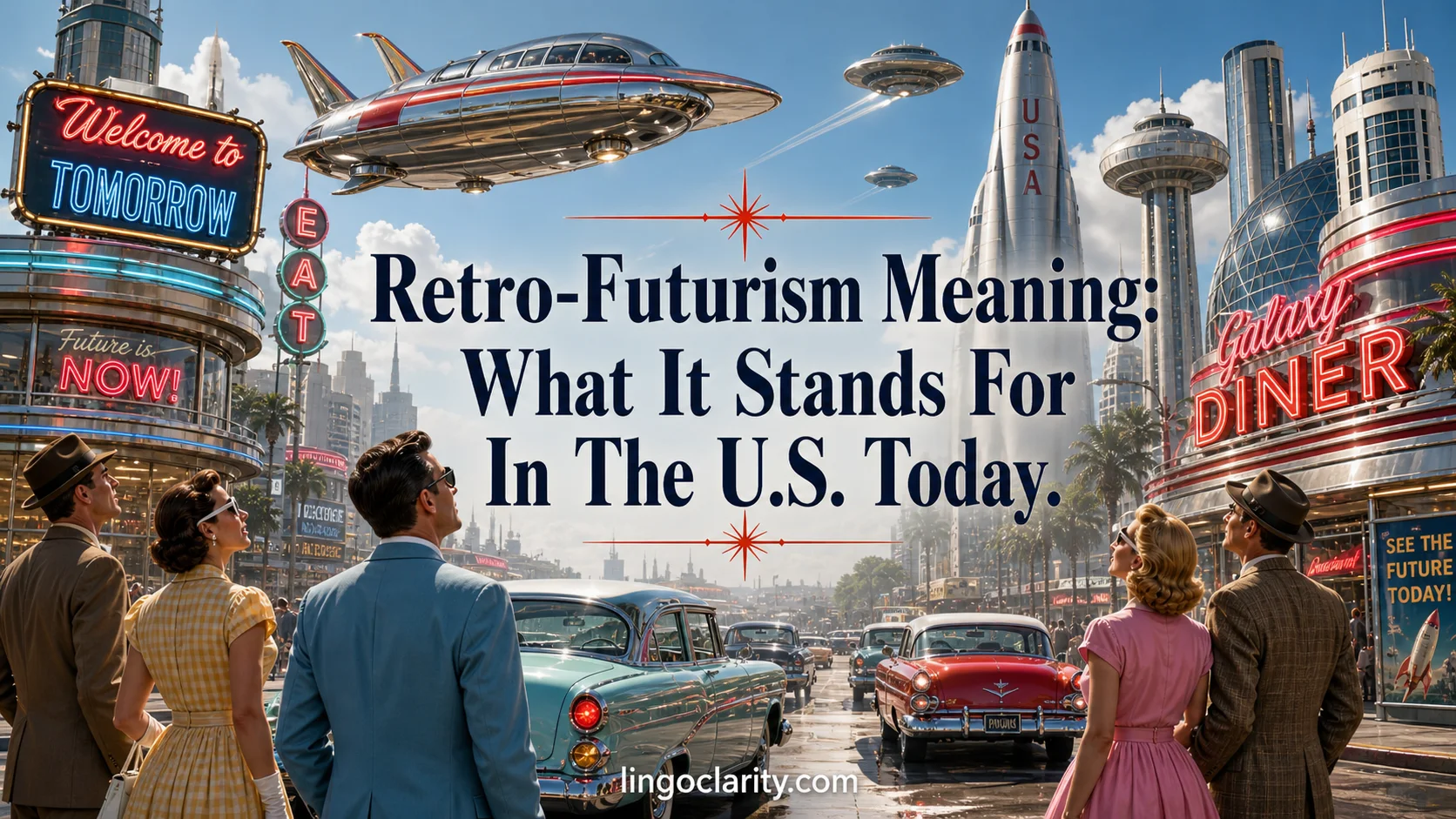
Retro-Futurism Meaning refers to the look of a future imagined by the past. You may notice retro-futurism in movies, posters, video games, fashion, architecture, or home design whenever something feels vintage and futuristic at the same time.
Think of 1950s-style flying cars, shiny space helmets, bubble-shaped buildings, chrome diners, robot helpers, round control panels, and cities filled with bold curves. These designs point toward the future, but they do it through the style, technology, and imagination of an earlier era.
That is why retro-futurism is more specific than simply “retro” or “futuristic.” It does not just look old, and it does not only look advanced. Instead, it shows how people in the past pictured tomorrow.
This guide explains the retro-futurism meaning in plain English, including its pronunciation, part of speech, examples, related terms, and common mistakes.
Quick Answer
Retro-futurism means a style, idea, or creative movement that shows the future as imagined in the past. It blends vintage design with futuristic themes, such as space travel, robots, flying cars, advanced machines, and imagined cities.
In simple words, retro-futurism means “yesterday’s idea of tomorrow.”
TL;DR
It often mixes nostalgia, imagination, optimism, and irony.
Retro-futurism means a past vision of the future.
It combines vintage style with futuristic ideas.
It is mainly used as a noun.
The adjective form is retro-futuristic.
It is not usually slang.
It appears in art, movies, games, fashion, interiors, and design.
What Retro-Futurism Means
Retro-futurism is a creative style that shows how people in earlier decades imagined the future would look. It often includes rockets, robots, flying cars, space colonies, moon bases, chrome surfaces, domed cities, bubble helmets, and machines with buttons, dials, and glowing panels.
However, retro-futurism is not only about objects. It also captures a feeling. Sometimes it feels hopeful, playful, and optimistic. Other times, it feels ironic or eerie because the promised future never arrived.
That tension is central to the meaning. Retro-futurism asks: What did the past think the future would become? Then it turns that imagined future into art, design, stories, or style.
Wikipedia describes retrofuturism as a creative-arts movement focused on depictions of the future produced in earlier eras, often blending retro styles with futuristic technology. It also notes that the style explores tension between past and future and between technology’s promise and its risks.
Quick Definition
Retro-futurism is a noun. It means a style or idea based on older visions of the future.
Simple definition: Retro-futurism is the future imagined through the style, technology, and culture of the past.
Short version: Retro-futurism is the “old future.”
Example: A 1960s-style moon kitchen with chrome cabinets, round windows, and a robot helper is retro-futuristic.
Pronunciation, Spelling, And Part Of Speech
Retro-futurism is pronounced:
reh-troh-FYOO-chur-iz-um
The main stress falls on FYOO.
Retro-futurism is usually a noun.
Examples:
- The movie uses retro-futurism in its sets.
- The poster’s retro-futurism makes space travel look cheerful and old-fashioned.
- The designer mixed retro-futurism with mid-century furniture.
The adjective is retro-futuristic.
Examples:
- a retro-futuristic car
- a retro-futuristic kitchen
- a retro-futuristic video game
- a retro-futuristic city skyline
Do not use retro-futurism as a verb. Instead of saying, “They retro-futurismed the room,” say, “They gave the room a retro-futuristic look.”
You may see three spellings: retrofuturism, retro-futurism, and retro futurism. All three appear in modern writing. However, for a polished article, choose one spelling and use it consistently.
How Retro-Futurism Works
Retro-futurism works by combining two time directions.
The first direction looks backward. It borrows from older styles, such as Art Deco, Streamline Moderne, mid-century modern, Space Age design, 1970s sci-fi, 1980s neon, or early computer graphics.
The second direction looks forward. It adds imagined technology, such as spaceships, robots, artificial intelligence, moon cities, aircars, holograms, ray guns, domed habitats, or advanced machines.
Together, these pieces create a future that feels outdated and futuristic at the same time.
For example, Fallout uses a retro-futuristic world shaped by mid-century American design, old advertising, diners, atomic-age optimism, and advanced technology. Similarly, The Jetsons imagines a future full of flying cars and robot helpers, but its design language still feels rooted in the early 1960s. StudioBinder lists Fallout, The Jetsons, and Metropolis as examples of retrofuturism.
The Two Main Types Of Retro-Futurism
Retro-futurism often appears in two overlapping forms.
The first is the future as seen from the past. This includes old illustrations, films, books, exhibitions, and advertisements that predicted future life. Think of early drawings of flying trains, space vacations, household robots, or cities under glass domes.
The second is the past as seen from the future. This happens when modern creators place advanced technology inside an older style. A new film might show artificial intelligence inside a 1970s office. A modern apartment might combine smart lighting with pod chairs, chrome lamps, and rounded Space Age furniture.
These two forms often overlap. A retro-futuristic game, for instance, might use 1950s design, imaginary atomic technology, and modern storytelling all at once.
Why Retro-Futurism Feels So Distinctive
Retro-futurism stands out because it is not a clean prediction of the future. Instead, it is a future filtered through memory, nostalgia, and historical imagination.
That is why the style can feel charming and strange at the same time. The machines may look advanced, but the buttons are oversized. The cars may fly, but their bodies look like tail-finned sedans. The city may be on the moon, but the furniture looks like it came from a 1960s showroom.
This contrast gives retro-futurism its emotional pull. It reminds us that every generation imagines the future through the tools, fears, hopes, and design habits it already knows.
Common Retro-Futurism Examples
Retro-futurism appears across many creative fields.
In movies and TV, it can show up as old-fashioned future cities, analog spaceships, chrome laboratories, or alternate timelines. Examples often associated with retro-futuristic style include Metropolis, Brazil, The Jetsons, Tomorrowland, The Incredibles, and Fallout. Wikipedia also notes examples such as Tomorrowland, For All Mankind, WandaVision, and the Time Variance Authority in the Marvel Cinematic Universe.
In games, retro-futurism often creates alternate worlds where technology advanced differently. A game may show nuclear-powered homes, robot servants, analog computers, or futuristic weapons with old industrial design.
In interior design, the style often includes pod chairs, Sputnik chandeliers, tulip tables, molded plastic, chrome, vinyl, velvet, bold color, rounded silhouettes, and clean walls. Reslisdence describes the interior style through rounded forms, low profiles, pod chairs, tulip bases, chrome, vinyl, and saturated colors.
In fashion, retro-futurism often includes metallic fabrics, geometric silhouettes, mod shapes, structured synthetics, and Space Age influence. The Vintage Fashion Guild connects the look to designers such as Courrèges, Rabanne, Pucci, and Cardin.
In graphic design, it may use neon grids, chrome text, pixel fonts, glowing effects, planets, stars, UFOs, circuit-board details, and analog interfaces. Eknoji Studio identifies chrome surfaces, neon landscapes, curved aerodynamic forms, analog interfaces, sci-fi objects, and retro-futuristic typography as key design traits.
How To Recognize Retro-Futurism
A design, scene, outfit, or object is probably retro-futuristic if it combines several of these features:
- A vintage style from the nineteenth or twentieth century
- Futuristic technology, machines, vehicles, or architecture
- Rockets, robots, flying cars, ray guns, domes, or space imagery
- Chrome, metallic surfaces, glossy plastics, or glass
- Rounded shapes, fins, curves, pods, bubbles, or geometric forms
- Analog controls, knobs, dials, switches, and tube-like screens
- A mood of optimism, irony, nostalgia, or “the future that never happened”
The simplest test is this: Does it show a future imagined through an older design style? If yes, retro-futurism is likely the right word.
Retro-Futurism Vs. Retro, Futuristic, And Science Fiction
| Term | Meaning | Example | Why It Is Different |
|---|---|---|---|
| Retro | Inspired by the past | A 1970s lamp | It looks old, but it does not necessarily imagine the future. |
| Futuristic | Suggesting the future | A sleek modern electric car | It looks advanced, but it may not use vintage style. |
| Science Fiction | Fiction about imagined science or technology | A novel about space travel | It may or may not have a retro visual style. |
| Futurism | A future-focused idea or art movement | Early twentieth-century machine-age art | It looks forward rather than looking back at older futures. |
| Retro-Futurism | A past vision of the future | A 1950s-style moon city | It blends vintage style with future-focused imagination. |
Merriam-Webster defines retro as relating to or reviving styles of the past, while futurism can refer to an art movement begun in Italy around 1909 or a point of view that finds meaning in the future. Retro-futurism combines those directions, but it has its own cultural meaning.
Related Styles And Subgenres
Retro-futurism is a broad umbrella. Several related styles sit under it or overlap with it.
Steampunk imagines advanced technology through Victorian-era design, steam power, gears, brass, goggles, airships, and mechanical invention.
Atompunk is usually tied to the Atomic Age, the Space Race, nuclear technology, Cold War anxiety, mid-century optimism, diners, domes, and bright Space Age forms.
Dieselpunk draws from the 1920s through the 1950s, often using Art Deco, diesel-era machines, wartime technology, pulp adventure, aircraft, and industrial design.
Raygun Gothic is a bright, space-age retro-futuristic style connected to Googie, Streamline Moderne, Art Deco, pulp sci-fi, ray guns, bubble helmets, and dramatic rockets. Wikipedia describes Raygun Gothic as a visual and architectural style that uses Googie, Streamline Moderne, and Art Deco in retrofuturistic science-fiction settings.
Cyberpunk usually looks less nostalgic and more dystopian. It focuses on advanced digital technology, hacking, corporate power, urban decay, and social breakdown.
These labels can overlap. However, retro-futurism is the broader concept: it describes any creative work that blends older visions with future-focused ideas.
How To Use Retro-Futurism In A Sentence
Use retro-futurism when you mean the overall style, concept, or movement.
Examples:
- The film’s retro-futurism makes its space station feel both advanced and outdated.
- The artist uses retro-futurism to imagine a future that looks like a 1960s advertisement.
- The game’s retro-futurism mixes atomic-age optimism with post-apocalyptic fear.
- The hotel lobby combines retro-futurism with mid-century furniture and chrome lighting.
Use retro-futuristic before a noun.
Examples:
- The café has a retro-futuristic interior.
- She wore a retro-futuristic silver jacket.
- The poster shows a retro-futuristic city with flying cars and glass towers.
- The designer created a retro-futuristic logo with chrome lettering and neon grids.
Common Mistakes To Avoid
The biggest mistake is using retro-futurism for anything old. A rotary phone, vinyl record, antique desk, or 1970s dress may be retro, but it is not automatically retro-futuristic.
Another mistake is using the term for anything futuristic. A minimalist white spaceship may look futuristic, but it is not retro-futuristic unless it also draws from an older style.
Also, do not assume all science fiction is retro-futurism. A sci-fi story can be futuristic, dystopian, realistic, cyberpunk, hard science fiction, or space opera without being retro-futuristic.
Finally, avoid awkward grammar. Say a retro-futuristic room, not a retro-futurism room. Say a room with retro-futurism, not a room that retro-futurisms.
Everyday Examples
A chrome diner with rocket-shaped lights, curved booths, and a robot waiter is retro-futuristic.
A 1960s-style poster of a family vacationing on Mars is retro-futuristic.
A smart speaker redesigned to look like a 1950s radio could be retro-futuristic if it suggests both old design and future technology.
A plain antique chair is not retro-futuristic. It is simply old or vintage.
A modern glass skyscraper is not retro-futuristic unless it intentionally uses an older vision of the future, such as Art Deco space-age forms or mid-century sci-fi details.
FAQs
What does retro-futurism mean in simple words?
Retro-futurism means the future imagined by the past. It describes designs, stories, objects, or worlds that mix vintage style with futuristic ideas.
Is retro-futurism one word or hyphenated?
You may see retrofuturism, retro-futurism, and retro futurism. All are used. For professional writing, choose one form and stay consistent. This article uses retro-futurism.
What is an example of retro-futurism?
A 1950s-style flying car poster is a simple example. Other examples include chrome space diners, robot servants in mid-century homes, ray guns, bubble helmets, and games or films that imagine advanced technology through an older design style.
Is retro-futurism the same as steampunk?
No. Steampunk is a related style, but it usually uses Victorian design, steam power, gears, brass, and industrial machinery. Retro-futurism is broader and can include steampunk, atompunk, dieselpunk, Space Age design, and other old visions of the future.
What is the difference between futurism and retro-futurism?
Futurism looks forward. Retro-futurism looks at how the past imagined the future. In other words, futurism asks what comes next, while retro-futurism asks what earlier generations thought would come next.
Is retro-futurism still popular?
Yes. It remains visible in games, streaming shows, fashion, graphic design, interiors, branding, and AI-era visual culture. In 2026 design coverage, retro-futuristic visuals are often linked to nostalgia, color, warmth, and a desire to make technology feel more human.
What makes something retro-futuristic?
Something is retro-futuristic when it combines an older visual style with imagined or advanced technology. The key is the mix. It must look backward and forward at the same time.
Final Takeaway
Retro-futurism is the art and style of the “old future.” It shows how people once imagined tomorrow through the design language of their own time. Use the term when something blends vintage style with futuristic ideas, such as a 1960s moon base, a chrome robot diner, a Space Age dress, or a game world full of analog machines and impossible technology.
