
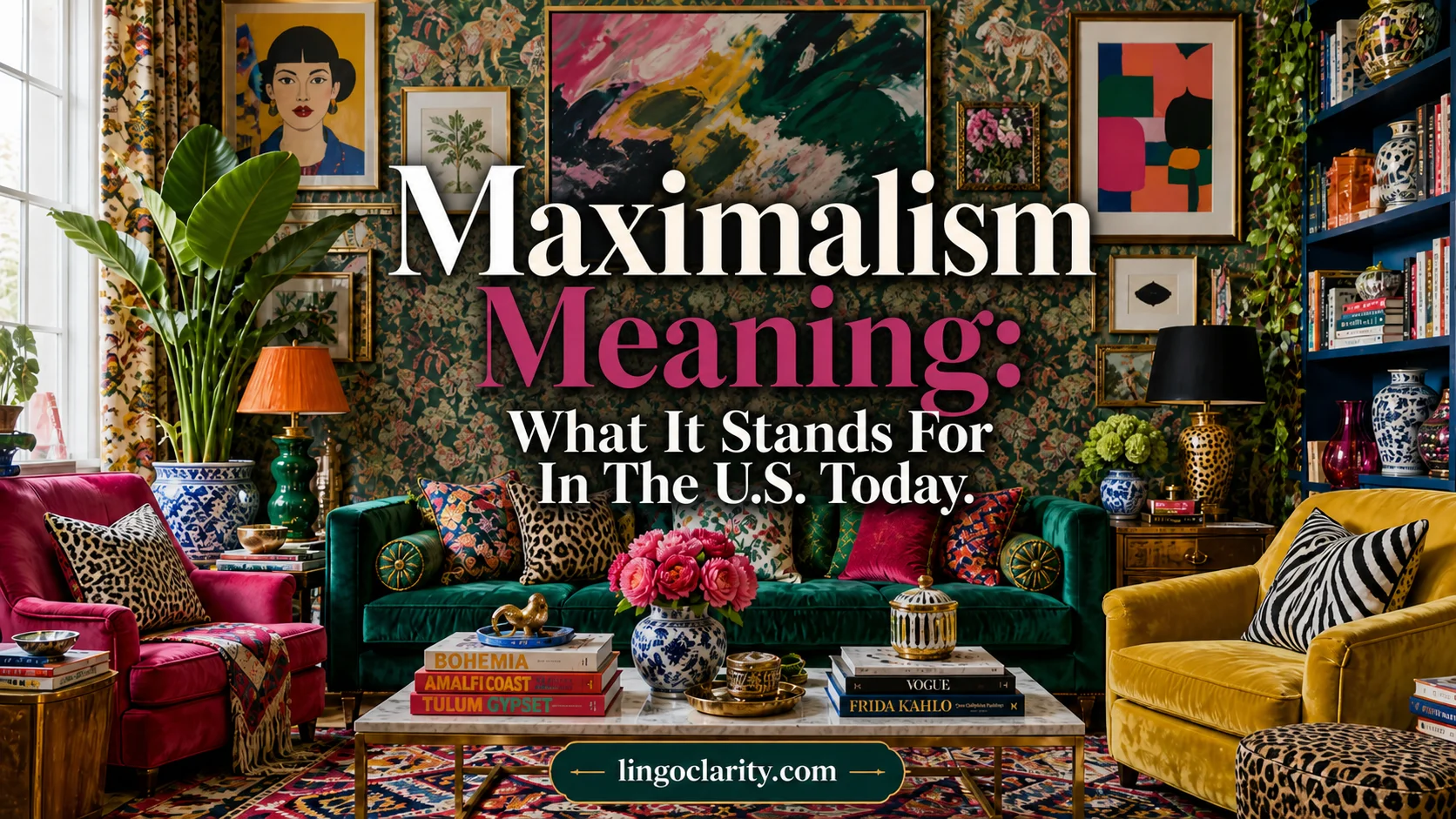
Maximalism means a style, idea, or creative approach that embraces abundance, bold expression, and layered detail. In simple terms, maximalism is the “more is more” approach. However, strong maximalism is not random excess. Instead, it uses color, pattern, texture, objects, language, sound, or ideas with intention.
You may see maximalism in interior design, fashion, art, writing, music, branding, and culture. For example, a maximalist room might include patterned wallpaper, colorful art, books, velvet furniture, plants, and collected objects. Similarly, a maximalist outfit might mix prints, jewelry, bright color, and dramatic shape. In each case, the point is not simply to add more. Rather, maximalism adds more meaning, personality, energy, or emotion.
Quick Answer
Maximalism is the intentional use of abundance, richness, and strong expression. Therefore, it often describes styles that feel full, decorative, layered, colorful, complex, or dramatic.
Maximalism is usually treated as the opposite of minimalism. While minimalism removes extra detail, maximalism builds impact through more detail. Still, both approaches can be thoughtful, polished, and useful when they serve the right purpose.
Maximalism In One Sentence
Maximalism is a “more is more” style that uses abundance on purpose to create richness, personality, and visual or creative impact.
Pronunciation And Part Of Speech
Maximalism is a noun. It is pronounced MAK-sih-muh-liz-um.
The related word maximalist can be a noun or an adjective. For example, you can say, “She is a maximalist,” or “She likes maximalist decor.” Additionally, the word can describe a person, a room, an outfit, a design, a novel, a song, or even a political position.
Do not use maximalism as a verb. For instance, “She maximalismed her bedroom” sounds unnatural. Instead, say, “She decorated her bedroom in a maximalist style.”
What Maximalism Means In Plain English
Maximalism means fullness with a point of view. It favors richness instead of restraint, expression instead of understatement, and layered detail instead of bare simplicity.
In everyday use, maximalism often describes something that looks or feels bold. However, the best examples do not feel careless. A maximalist space, outfit, or artwork usually has some kind of structure beneath the abundance.
For example, a living room with floral wallpaper, striped pillows, a patterned rug, framed paintings, brass lamps, and bright ceramics can be maximalist. However, if the colors repeat and the objects feel meaningful, the room can still look intentional. By contrast, a room filled with random piles, tangled cords, old mail, and unused objects is better described as cluttered.
Maximalism Vs. Minimalism
Minimalism and maximalism are often opposites. However, they are not enemies. Each style answers a different need.
| Style | Main Idea | Common Features | Best For |
|---|---|---|---|
| Maximalism | More Is More | Bold Color, Pattern, Texture, Collections, Ornament, Contrast | Personality, Warmth, Drama, Creative Expression |
| Minimalism | Less Is More | Open Space, Clean Lines, Fewer Objects, Simple Palettes, Restraint | Calm, Clarity, Focus, Ease |
Minimalism asks, “What can we remove?” By comparison, maximalism asks, “What can we add with meaning?”
A minimalist room might use one neutral sofa, one large artwork, and a few simple objects. Meanwhile, a maximalist room might use patterned walls, a gallery wall, layered rugs, colorful furniture, and shelves of books. Nevertheless, both rooms can look refined when the choices feel deliberate.
Maximalism In Interior Design
In interior design, maximalism means a bold, layered, personal space. It often uses color, pattern, artwork, books, collections, plants, vintage pieces, statement lighting, and unusual combinations.
For example, a maximalist living room might have emerald walls, a floral sofa, leopard-print pillows, a red lacquer table, stacked books, and a wall of framed art. However, the room still needs visual logic. Otherwise, the design can slide from expressive into chaotic.
Good maximalist interiors often use repetition to create order. For instance, a designer might repeat one color through the rug, artwork, pillows, and lampshades. Additionally, they might vary pattern scale, pairing a large floral print with a smaller stripe or geometric pattern. As a result, the room feels energetic without feeling completely uncontrolled.
Maximalist design can also include quiet areas. In fact, a plain wall, simple floor, or solid-color sofa can make the bolder details stand out. Therefore, maximalism is not about filling every inch. It is about creating a rich effect without losing the room’s function or mood.
Maximalism In Fashion
In fashion, maximalism means dressing with boldness and expression. It may include bright colors, mixed prints, oversized jewelry, dramatic silhouettes, layered pieces, textured fabrics, or unexpected accessories.
For instance, a maximalist outfit might pair a floral dress with a striped coat, red boots, gold earrings, and a printed handbag. Similarly, a person might wear one vivid color from head to toe and add sculptural jewelry or a dramatic jacket. Although the look may include many elements, it can still feel polished when the colors, shapes, or mood connect.
Maximalist fashion is not the same as wearing everything at once. Instead, it is about making strong choices and letting those choices express personality. Therefore, a maximalist outfit can be playful, elegant, theatrical, romantic, or rebellious, depending on the person wearing it.
Maximalism In Art And Design
In art and design, maximalism often describes work that feels dense, decorative, complex, energetic, or visually intense. It may use saturated color, heavy ornament, mixed media, repeated symbols, crowded compositions, or elaborate surfaces.
For example, a maximalist poster might use oversized typography, collage, bright color, decorative borders, and layered images. However, the design still needs hierarchy. If viewers cannot tell what to read first, the work may become confusing rather than powerful.
In visual art, maximalism can create a sense of abundance, movement, memory, fantasy, or excess. Moreover, it can challenge the idea that good taste must always be quiet, plain, or restrained. Still, maximalist art works best when its complexity supports a clear mood or idea.
Maximalism In Writing And Literature
In writing, maximalism means a rich, expansive, highly detailed style. A maximalist novel may include many characters, long scenes, multiple storylines, historical references, digressions, and layered themes.
For example, a minimalist sentence might say, “The city was loud.” By contrast, a maximalist sentence might describe subway brakes, kitchen fans, bar music, sirens, traffic, open windows, and strangers talking over one another. The second sentence gives the reader more texture.
However, more detail does not automatically make writing better. Additional description should deepen the scene, sharpen the voice, or expand the meaning. Otherwise, the writing may feel bloated instead of maximalist.
Maximalism In Music
In music, maximalism can describe a dense, layered, high-impact sound. A maximalist track may include stacked vocals, big drums, strings, synthesizers, samples, percussion, sudden shifts, or dramatic production.
For instance, a spare acoustic song may feel minimalist because it uses only a voice and guitar. Meanwhile, a song with layered harmonies, orchestral backing, heavy percussion, and electronic effects may feel maximalist. Still, the layers should create emotion, scale, or excitement. Otherwise, the arrangement can feel crowded.
The Political Meaning Of Maximalist
Although maximalism is common in design and culture writing, maximalist also has a political meaning. In politics, a maximalist position seeks the fullest possible demand and leaves little room for compromise.
For example, a group might take a maximalist stance if it rejects partial concessions and insists on the complete version of its goals. Therefore, this meaning is different from maximalist decor or fashion. In political writing, maximalist usually means uncompromising, not colorful or decorative.
How To Use Maximalism Correctly
Use maximalism when you mean intentional abundance. It works best when the subject has a clear style, mood, structure, or point of view.
Strong examples:
- Her apartment shows maximalism through patterned walls, bright art, layered rugs, and collected objects.
- The designer used maximalism without making the room feel cluttered.
- His novel leans toward maximalism because it has a huge cast, long scenes, and many overlapping themes.
- The album’s maximalism comes from its layered vocals and dramatic production.
- The dress is maximalist, but it still looks elegant.
Avoid using the word when you only mean mess. For example, “His desk is maximalism” sounds wrong. Instead, say, “His desk is cluttered.” Likewise, avoid using maximalism when the context needs plain function, such as medical forms, legal notices, warning labels, or road signs.
When Maximalism Works Best
Maximalism works best when the goal is personality, memory, warmth, drama, identity, or emotional impact. Therefore, it often fits homes, restaurants, fashion, art, music, editorial design, event styling, and expressive branding.
It can make a space feel lived-in and personal. It can also make an outfit feel confident and creative. In addition, it can help a brand feel energetic, distinctive, or memorable.
However, maximalism does not work everywhere. If a message must be understood instantly, simplicity is usually better. For instance, an emergency exit sign should not use layered decoration, ornate lettering, and competing colors. In that case, minimal design serves the user better.
Maximalism Is Not The Same As Clutter
The most important distinction is simple: clutter is accidental, while maximalism is intentional.
Clutter gets in the way. It makes a desk harder to use, a room harder to move through, or a message harder to understand. Maximalism, by contrast, should add mood, meaning, beauty, humor, energy, or personality.
For example, a shelf full of unpaid bills, loose cables, and random packaging is cluttered. However, a shelf arranged with books, ceramics, framed photos, candles, and travel objects can be maximalist. The difference is arrangement, purpose, and care.
Signs Of Good Maximalism
Good maximalism usually has order beneath the abundance. Although it may look full at first glance, it often uses pattern, repetition, scale, or color to hold everything together.
Look for these signs:
- repeated colors or materials
- a clear focal point
- varied pattern sizes
- meaningful objects
- contrast between busy and quiet areas
- functional space for daily use
- confident texture mixing
- a mood that feels consistent
Above all, good maximalism feels expressive rather than careless.
Related Words, Synonyms, And Antonyms
Maximalism has several related words, although none is a perfect synonym.
Abundance means a large amount of something. Extravagance suggests rich or showy excess. Opulence suggests luxury and fullness. Ornamentation means added decoration. Eclecticism means mixing styles or influences. Layering means building depth through multiple elements.
The main antonym is minimalism. Other near-opposites include simplicity, restraint, plainness, spareness, and understatement.
Common Mistakes To Avoid
Do not use maximalism as a polite word for mess. Instead, use clutter, disorder, or overcrowding when the problem is lack of control.
Do not assume maximalism must be expensive. In fact, maximalist style can include thrifted art, family photos, books, handmade objects, inherited furniture, and affordable textiles.
Do not assume maximalism means there are no rules. On the contrary, strong maximalism often depends on repetition, editing, proportion, and balance.
Finally, do not confuse maximalist with maximum. Maximum means the greatest amount possible. Maximalist means related to maximalism or to a full, uncompromising position.
FAQs About Maximalism
What does maximalism mean?
Maximalism means an intentional style or approach based on abundance, boldness, and rich detail. In simple words, it means “more is more,” but the “more” should still feel chosen.
Is maximalism the opposite of minimalism?
Yes, maximalism is usually the opposite of minimalism. However, both styles can be thoughtful. Minimalism removes extra elements, while maximalism adds layers and expression.
Is maximalism just clutter?
No, maximalism is not just clutter. Clutter is usually random or unmanaged. By contrast, maximalism uses abundance with purpose.
What is a maximalist person?
A maximalist person usually likes bold, expressive, abundant choices. For example, they may enjoy colorful rooms, layered outfits, dramatic art, or detailed writing. In politics, however, a maximalist person may be someone who refuses compromise.
What is an example of maximalism?
A room with patterned wallpaper, a colorful sofa, layered rugs, a gallery wall, books, plants, and meaningful objects can be an example of maximalism. Similarly, a bold outfit with mixed prints and statement accessories can be maximalist.
Can maximalism be elegant?
Yes, maximalism can be elegant. However, it needs balance, repetition, and editing. Otherwise, it may become overwhelming.
Is maximalism only about interior design?
No, maximalism is not limited to interior design. It can describe fashion, art, writing, music, branding, culture, and political positions.
Is maximalism expensive?
No, maximalism does not have to be expensive. In fact, personal collections, secondhand finds, books, prints, fabric, paint, and family objects can create a rich maximalist effect.
How do you pronounce maximalism?
Maximalism is pronounced MAK-sih-muh-liz-um. The stress comes near the beginning of the word.
Introduction
Maximalism means bold abundance with intention. It celebrates richness, detail, pattern, color, personality, and creative fullness. However, it should not be confused with clutter, waste, or random excess.
At its best, maximalism feels expressive and deliberate. Therefore, the strongest examples do not merely contain more things. They use more detail to create meaning, beauty, energy, and identity.
