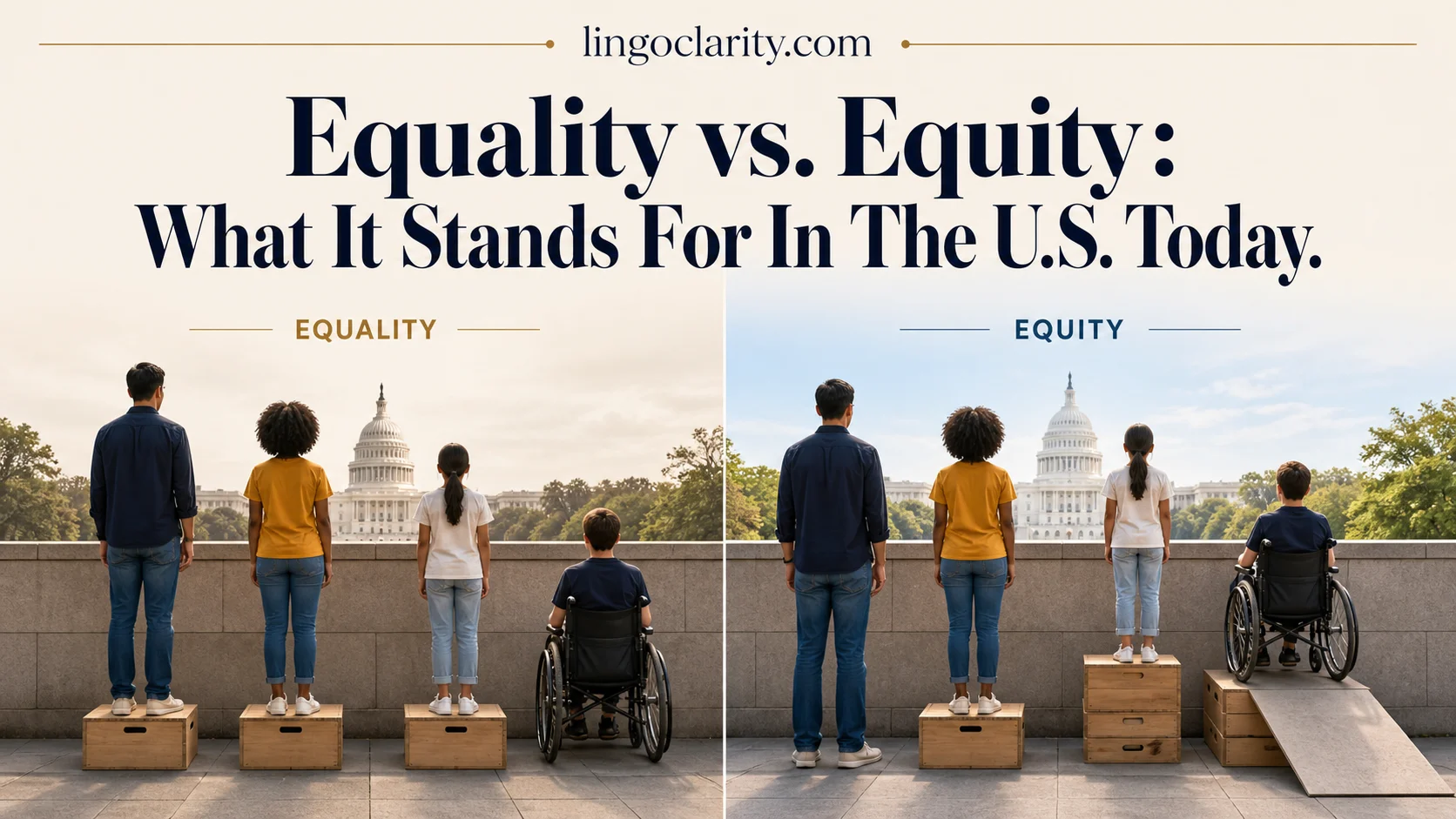
Equality vs equity is a common word-choice question because both words relate to fairness, but they do not mean the same thing. Use equality when you mean equal rights, equal status, equal access, equal opportunity, or the same treatment under the same rules.
Use equity when you mean fairness or justice, especially when different people may need different support to have a fair chance.
The simplest shortcut is this: equality asks whether people are being treated the same; equity asks whether people are being treated fairly for the situation. That distinction matches common usage guidance: equality centers on the same rights and opportunities, while equity centers on fairness or justice in treatment.
Both words can be positive. However, they are not interchangeable. Choosing the wrong one can change your meaning.
Quick Answer
Equality means the state of being equal. It often refers to equal rights, equal standing, equal access, equal opportunity, or identical treatment.
Equity means fairness or justice in treatment. It often refers to support, resources, or decisions that account for different needs, barriers, or starting points.
For example, a school shows equality when every student may use the library. The school shows equity when it adds audiobooks, ramps, translation support, or tutoring so students with different needs can actually benefit from that access.
Equality Vs Equity At A Glance
| Point Of Difference | Equality | Equity |
|---|---|---|
| Core Meaning | Equal status, rights, access, or treatment | Fairness or justice based on context |
| Main Question | Is everyone treated the same? | Is everyone getting a fair chance? |
| Common Contexts | Laws, civil rights, access, opportunity, rules | Education, health care, pay, policy, workplace support |
| Best For | Same rules or equal standing | Different needs or barriers |
| Risk If Misused | May ignore unequal starting points | May sound like finance or law without context |
What Equality Means
Equality means being equal in status, rights, access, treatment, or opportunity. It is the better word when sameness or equal standing is the point.
Use equality in sentences like these:
- “The law protects equality before the courts.”
- “The organization supports gender equality.”
- “The policy is meant to provide equality of access.”
- “The company says all applicants deserve equality of opportunity.”
Equality is especially natural in civil rights, legal rights, public access, voting, education access, and anti-discrimination contexts. Britannica describes equal opportunity as the idea that people should be able to compete on equal terms or on a level playing field, which is one common equality-related idea.
What Equity Means
Equity means fairness or justice in the way people are treated. It is the better word when fairness requires attention to need, barriers, circumstances, or unequal starting points.
Use equity in sentences like these:
- “The school invested in equity by providing extra reading support where students needed it most.”
- “The company reviewed pay equity across similar roles.”
- “The clinic expanded health equity programs in underserved communities.”
- “The city used equity data to decide where to add wheelchair-accessible transit stops.”
Equity does not always mean giving everyone the same thing. In education, for example, UNESCO describes the distinction as providing all students the same resources for equality, while allocating resources based on individual needs supports equity and fair outcomes.
The Main Difference Between Equality And Equity
The difference is not “fair vs unfair.” Both words can describe fairness. The difference is how fairness is understood.
Equality focuses on equal treatment, equal access, or equal standing.
Equity focuses on fair treatment that accounts for real conditions.
Imagine three workers are allowed to apply for the same promotion. That is equality of opportunity. Now imagine one worker needs screen-reader-compatible training materials, another needs a flexible training time because of caregiving responsibilities, and another needs no adjustment. Providing those supports is equity.
The goal may be the same: fair opportunity. The method is different.
Can Equality And Equity Work Together?
Yes. Equality and equity often work together.
A school may want equality of opportunity for all students. To reach that goal, it may use equity-based support, such as tutoring, assistive technology, meal programs, translation services, or transportation help.
A health system may want everyone to have an equal chance to live a healthy life. To move toward that goal, it may focus on health equity by addressing barriers such as cost, transportation, language access, or neighborhood conditions. The CDC defines health equity as a fair and just opportunity for everyone to attain their highest level of health.
So, equality can be the goal, while equity can be one way to reach it.
When To Use Equality
Use equality when your sentence is about equal standing, equal rights, or the same rules.
Use equality for legal rights.
Correct: “The constitution promises equality before the law.”
Less natural: “The constitution promises equity before the law.”
Use equality for equal access.
Correct: “The city improved equality of access to public buildings.”
Also possible: “The city improved accessibility and equity in public buildings.”
The first sentence stresses equal access. The second suggests the city considered different barriers people face.
Use equality for civil rights and social rights.
Correct: “The movement fought for racial equality.”
A court decision may also advance “marriage equality.”
In workplace writing, you could say, “The policy supports equality in hiring.”
When To Use Equity
Use equity when your sentence is about fairness that depends on need, context, or barriers.
Use equity for support based on need.
Correct: “The district used equity funding to help schools with the greatest needs.”
Use equity for health care access and outcomes.
Correct: “The program was designed to improve health equity in rural areas.”
Health equity is a common public-health phrase because people may face different barriers to care, such as cost, transportation, language, disability, or local provider shortages.
Use equity for pay fairness.
Correct: “The company conducted a pay equity review.”
Pay equity and equal pay are related, but they are not always identical phrases. The U.S. Department of Labor explains that the Equal Pay Act protects against wage discrimination based on sex and covers compensation such as salary, overtime, bonuses, benefits, and other forms of pay.
Use equity for finance or ownership.
Correct: “The homeowner built equity as the property value increased.”
Correct: “The founders gave investors an equity stake.”
In these sentences, equity does not mean social fairness. It means ownership value or ownership interest.
Everyday Examples Of Equality And Equity
Education
Equality: “Every student receives the same textbook.”
Equity: “Students who need extra reading support receive tutoring, audiobooks, or accessible materials.”
Workplace
Equality: “Every employee can apply for the leadership program.”
Equity: “The company offers mentorship, accessible training, and flexible scheduling so employees with different barriers can participate.”
Health Care
Equality: “Every patient can book an appointment online.”
Equity: “The clinic also offers phone scheduling, interpreters, transportation help, and sliding-scale fees for patients who need them.”
Public Services
Equality: “Every resident may use the public library.”
Equity: “The library provides ramps, large-print books, screen-reader access, multilingual materials, and home delivery for residents who cannot visit.”
Finance
Equality: “The partners have equal voting rights.”
Equity: “Each founder owns equity in the company.”
Common Phrases With Equality
Use equality in these common phrases:
- Equality before the law
- Equality of opportunity
- Gender equality
- Racial equality
- Marriage equality
- Social equality
- Political equality
- Equality of access
- Equality in education
- Equality in hiring
These phrases usually point to equal rights, equal status, equal access, or equal opportunity.
Common Phrases With Equity
Use equity in these common phrases:
- Health equity
- Pay equity
- Racial equity
- Educational equity
- Workplace equity
- Home equity
- Equity stake
- Equity financing
- Equity ownership
- Equity in a company
These phrases split into two major meanings. In social, workplace, education, and health contexts, equity usually means fairness that accounts for need or barriers. In finance and business ownership, equity usually means ownership value or shares.
Common Mistakes To Avoid
Mistake: Using Equity As A Fancy Word For Equality
Weak: “The law guarantees equity before the law.”
Better: “The law guarantees equality before the law.”
Use equality when you mean equal legal standing.
Mistake: Using Equality When You Mean Need-Based Support
Weak: “The program promotes equality by giving extra resources to the students who need them most.”
Better: “The program promotes equity by giving extra resources to the students who need them most.”
Use equity when support varies by need.
Mistake: Forgetting The Finance Meaning Of Equity
Wrong: “The homeowner built equality in the house.”
Correct: “The homeowner built equity in the house.”
In housing and investing, equity usually refers to ownership value.
Mistake: Treating Equality And Equity As Enemies
Weak: “The policy must choose equality or equity.”
Better: “The policy aims for equality of opportunity by using equity-based support.”
In many real situations, the two ideas are connected.
Equality Vs Equity In A Sentence
Use equality when the sentence would still make sense with “equal rights,” “equal access,” or “same treatment.”
Example: “The rule protects equality of access for all applicants.”
Use equity when the sentence would still make sense with “fair support,” “fairness,” or “justice based on need.”
Example: “The grant supports equity by directing resources to communities facing the greatest barriers.”
Simple Memory Trick
Ask yourself one question:
Do I mean the same, or do I mean fair for the situation?
If you mean the same rights, same access, same rules, or same treatment, choose equality.
If you mean fair treatment that accounts for need, barriers, or context, choose equity.
FAQ
Is equity the same as equality?
No. Equity and equality are related, but they are not the same. Equality focuses on equal rights, access, status, or treatment. Equity focuses on fairness or justice, especially when people need different support to have a fair chance.
Is equity better than equality?
Not always. The better word depends on the context. Equality is better when you mean equal rights or equal treatment. Equity is better when fairness requires support based on need, barriers, or circumstances.
Can you have equality without equity?
You can have formal equality without equity. For example, a school may allow every student to use the same online portal, but students without reliable internet may still be left out. Equity addresses those practical barriers.
What is an example of equality?
An example of equality is giving every qualified voter the same right to vote. Another example is allowing every applicant to apply under the same published requirements.
What is an example of equity?
An example of equity is giving students different types of support based on need, such as tutoring, translation, assistive technology, or transportation help, so they have a fair chance to succeed.
What does equity mean in finance?
In finance, equity usually means ownership value. Home equity is the value of a home after subtracting what is owed on it. Business equity can mean ownership shares or an ownership stake.
Which word should I use in everyday writing?
Use equality for equal rights, equal status, equal access, or the same treatment. Use equity for fairness based on need, barriers, or circumstances. In casual writing, use fairness if your audience may not understand the policy meaning of equity.
Conclusion
Equality and equity both relate to fairness, but they do different jobs.
Use equality when you mean equal rights, equal status, equal access, equal opportunity, or identical treatment.
Use equity when you mean fair treatment that considers need, barriers, context, or unequal starting points.
For the clearest choice, ask: same treatment or fair support? If your meaning is “the same,” choose equality. If your meaning is “fair for the situation,” choose equity.
