
Eon meaning is simple in everyday English: an eon is a very long period of time. You may see the word in science class, books, movies, articles, or casual conversation. For example, someone might say, “I haven’t seen you in eons,” while a science textbook might mention the Phanerozoic Eon.
In both cases, eon points to a very long time. However, the exact meaning depends on context. In everyday English, it usually means “a very long time” in a casual or exaggerated way. In geology, however, it means one of the largest divisions of Earth’s history.
Therefore, understanding the word helps you avoid confusing casual speech with scientific language. This guide explains the meaning of eon in plain English, how to pronounce it, how to use it in sentences, how it differs from era and epoch, and when a simpler phrase like a long time may work better.
Quick Answer
Eon means a very long period of time. In everyday English, people often use it to exaggerate how long something feels. In geology, however, an eon is a major division of Earth’s history and is larger than an era.
For example, “I haven’t seen you in eons” means “I haven’t seen you in a very long time.” Meanwhile, “the Phanerozoic Eon” refers to a formal unit of geologic time.
Eon Meaning In Plain English
An eon is an extremely long stretch of time. It may describe real long-term change, such as mountains forming over millions of years. However, it can also describe something that only feels long, such as waiting for a slow download.
For example, if someone says, “This line is taking eons,” they are exaggerating. They do not mean the line has lasted for millions or billions of years. Instead, they mean the wait feels painfully long.
In simple terms, eon means a very long time. In addition, eons can mean many very long periods or, more casually, “a very long time.” Therefore, the word can sound casual, dramatic, poetic, or technical depending on where it appears.
How To Pronounce Eon
Eon is most often pronounced EE-on. However, some speakers pronounce it closer to EE-ahn.
Simple pronunciation guide:
| Word | Pronunciation |
|---|---|
| eon | EE-on or EE-ahn |
| eons | EE-ons |
| aeon | Usually the same as eon |
The spelling can confuse English learners because eo does not sound like “ee-own.” Instead, keep the word short and smooth: EE-on.
Examples:
- “That happened an EE-on ago.”
- “I haven’t seen them in EE-ons.”
- “The rocks changed over EE-ons.”
Is Eon A Noun?
Yes. Eon is a noun. A noun names a person, place, thing, or idea. In this case, eon names an idea connected to time.
Examples:
- “An eon passed.”
- “Many eons passed.”
- “The eon ended long ago.”
- “The Phanerozoic Eon continues today.”
The plural form is eons. In addition, rare related words include eonic and eonian. However, most readers and writers only need eon and eons.
Everyday Meaning Of Eon
In everyday English, eon usually means “a very long time.” Often, people use it for humor, exaggeration, or emphasis.
Examples:
- “I haven’t watched that show in eons.”
- “This appointment is taking eons.”
- “We haven’t gone on a road trip in eons.”
- “That trend feels like it happened eons ago.”
These sentences do not describe exact time. Instead, they show feeling. The speaker wants to stress that something seems old, slow, distant, or long overdue.
Because of that, eon works well in casual speech when you want a playful or slightly dramatic tone. However, in formal writing, a long time may sound clearer unless the large scale matters.
Scientific Meaning Of Eon
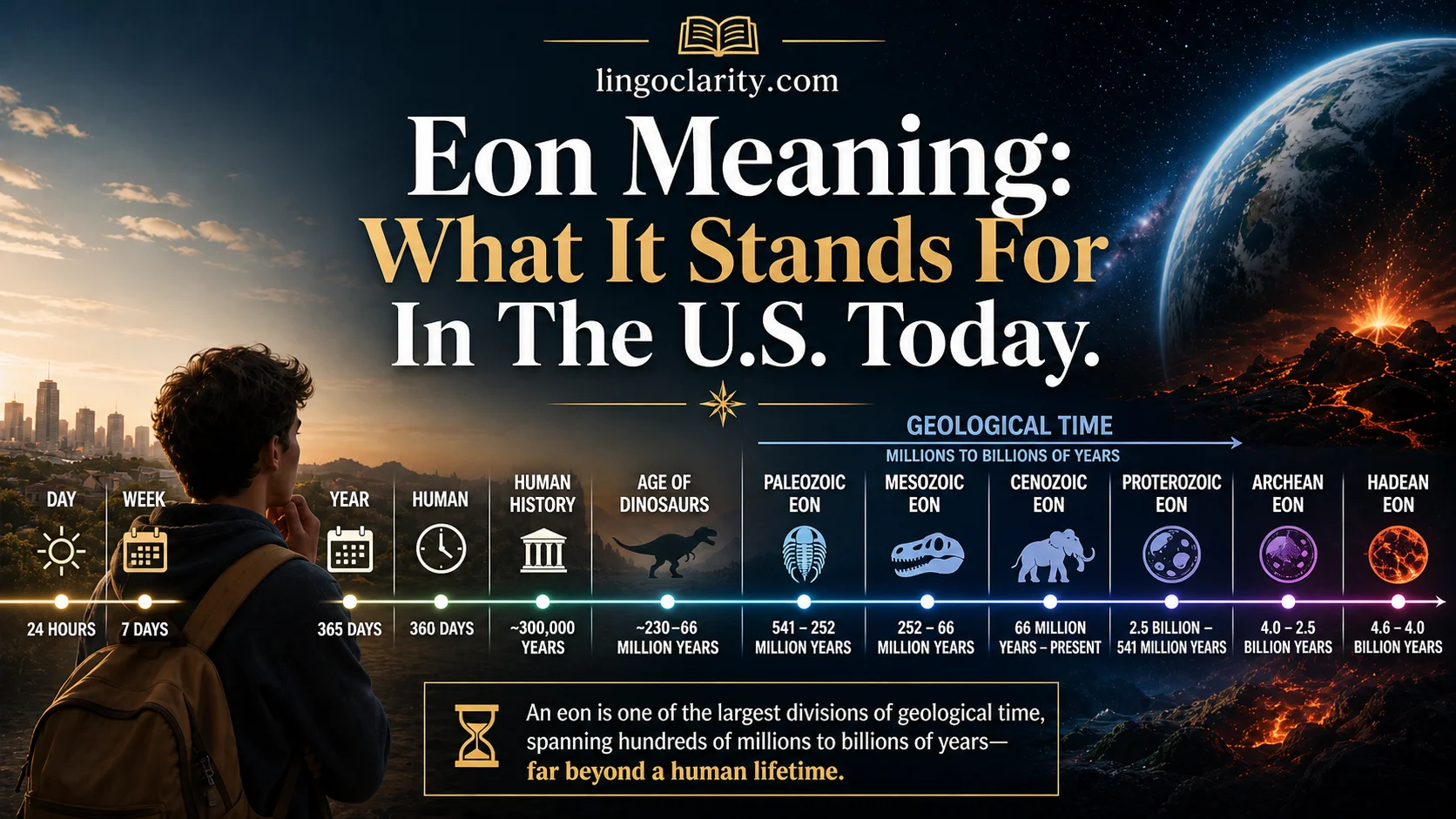
In geology, an eon is one of the largest units of geologic time. Scientists use eons to divide Earth’s long history into major sections.
The order from largest to smaller units is:
| Geologic Time Unit | Size |
|---|---|
| Eon | Largest |
| Era | Smaller than an eon |
| Period | Smaller than an era |
| Epoch | Smaller than a period |
| Age | Smaller than an epoch |
A simple way to understand it is to imagine folders. An eon is the biggest folder. Inside it are eras. Then, inside eras are periods. After that, inside periods are epochs, and inside epochs are ages.
For example, the Phanerozoic Eon includes the Paleozoic, Mesozoic, and Cenozoic eras. The Jurassic Period, however, is not an eon. It is a period inside the Mesozoic Era.
As a result, accuracy matters in science writing. You should not use eon, era, period, and epoch as if they mean the same thing.
How Long Is An Eon?
In everyday English, an eon does not have an exact length. It simply means a very long time.
In scientific use, however, the answer depends on context. Some dictionaries describe an eon as a billion years, especially in broad scientific or astronomical use. In formal geology, though, eons are not all exactly the same length. Instead, they are large divisions of Earth history, and their lengths vary.
For practical writing, remember this:
- In casual speech, eon means “a very long time.”
- In geology, eon means a huge division of Earth’s history.
- In some scientific contexts, eon may refer to about one billion years.
- In formal geologic time, eons are not always exactly one billion years long.
Therefore, the safest definition is this: an eon is a very long time, or, in geology, a major division of Earth’s history.
Eon Vs. Era
Eon and era both refer to time. However, they are not equal.
An eon is larger than an era in geology. An era is a smaller division inside an eon.
Examples:
- Correct: “The Phanerozoic is an eon.”
- Correct: “The Mesozoic is an era.”
- Incorrect: “The Jurassic was an eon.”
- Correct: “The Jurassic was a period.”
In everyday language, era often means a notable period in history or culture. For example, you might say “the digital era,” “the Victorian era,” or “the streaming era.”
However, eon usually suggests a much longer span.
Compare:
- “That singer defined an era.”
- “Those rocks formed over eons.”
The first sentence refers to a recognizable historical period. Meanwhile, the second sentence suggests deep time.
Eon Vs. Epoch
An epoch is smaller than an eon in geology. It is a more specific unit of geologic time.
For example, the Holocene Epoch is part of the Quaternary Period, which is part of the Cenozoic Era, which is part of the Phanerozoic Eon.
That may sound technical at first. However, the basic idea is simple: eon is much larger, while epoch is much smaller.
In everyday English, epoch can also mean an important period in history, especially one marked by major change. Still, it sounds more formal than era and much less common than age or period.
Eon Vs. Aeon
Eon and aeon usually mean the same thing. The difference is spelling.
- Eon is the common spelling in American English.
- Aeon appears more often in British English, older writing, philosophy, religion, and some literary contexts.
Examples:
- American English: “The mountains changed over eons.”
- British English: “The mountains changed over aeons.”
For most US readers, use eon. However, if you are writing for a British audience or quoting older material, aeon may also be acceptable.
Is Eon Slang?
Eon is not true slang. It does not have a hidden texting meaning or special social media definition.
However, it can sound informal when people use it casually.
Examples:
- “Haven’t been here in eons.”
- “This game is taking eons to load.”
- “We need to catch up. It’s been eons.”
In these examples, eons simply means “a very long time.” The tone is casual and exaggerated.
Therefore, you can use eon with friends, in captions, or in relaxed writing. In formal writing, though, use it carefully. If you only mean “a long time,” that simpler phrase may be better.
How To Use Eon In A Sentence
Use eon when you want to show that something lasted, changed, existed, or felt long for an impressive amount of time.
Common sentence patterns include:
| Pattern | Example |
|---|---|
| in eons | “I haven’t seen her in eons.” |
| for eons | “Those cliffs stood for eons.” |
| over eons | “The canyon formed over eons.” |
| an eon ago | “That feels like an eon ago.” |
| eons of | “The fossils reveal eons of change.” |
More examples:
- “The meeting felt like it lasted an eon.”
- “Over eons, wind and water shaped the valley.”
- “I haven’t heard that song in eons.”
- “The species changed slowly across eons.”
- “That phone model feels like it came out an eon ago.”
Notice how the tone changes. For instance, “The meeting lasted an eon” is playful exaggeration. By contrast, “The valley formed over eons” sounds more scientific and serious.
When To Use Eon
Use eon when the idea of a very long time matters. It works best when you want scale, drama, humor, or scientific accuracy.
Good uses:
- To describe deep time: “The rocks formed over eons.”
- To exaggerate a wait: “The train took eons to arrive.”
- To show nostalgia: “I haven’t been there in eons.”
- To write poetically: “The stars burned across eons.”
- To discuss geology: “The Phanerozoic Eon includes several eras.”
However, avoid eon when it makes the sentence sound too dramatic or unclear.
Weak: “The coffee took an eon to brew.”
Better: “The coffee took forever to brew.”
Weak: “Submit the form after an eon.”
Better: “Submit the form after a long delay.”
In simple instructions, therefore, a long time, a while, or many years may be clearer.
Synonyms Of Eon
Several words can replace eon, but they do not always mean the same thing. Therefore, choose the synonym that fits your tone and context.
| Word | Best Use |
|---|---|
| ages | Casual speech |
| forever | Informal exaggeration |
| era | A marked historical period |
| age | A long period or stage |
| eternity | Endless or seemingly endless time |
| deep time | Scientific discussion of Earth history |
| long time | Simple, clear writing |
Examples:
- “I haven’t seen you in ages.”
- “The wait felt like forever.”
- “The internet changed the modern era.”
- “Geologists study deep time.”
- “The ruins stood for a long time.”
Overall, eon is stronger than a long time and more scientific than forever.
Antonyms Of Eon
Since eon means a very long time, its opposites refer to short amounts of time.
Common antonyms include:
- moment
- instant
- second
- minute
- brief time
- short while
Examples:
- “The decision took only a moment.”
- “The flash lasted an instant.”
- “The delay was brief.”
These words create the opposite feeling of eon because they suggest speed, shortness, or immediacy.
Common Mistakes With Eon
Using Eon For Every Small Delay
You can use eon as a joke. However, too much exaggeration can sound unnatural.
Too dramatic: “The elevator took an eon.”
Better: “The elevator took forever.”
Confusing Eon With Era
In geology, an eon is larger than an era. Therefore, the two words should not be used interchangeably in science writing.
Incorrect: “The Mesozoic Eon included dinosaurs.”
Correct: “The Mesozoic Era included dinosaurs.”
Calling The Jurassic An Eon
The Jurassic was not an eon. Instead, it was a period.
Incorrect: “Dinosaurs lived in the Jurassic Eon.”
Correct: “Dinosaurs lived during the Jurassic Period.”
Assuming Eon Always Means Exactly One Billion Years
In some contexts, eon can mean a billion years. However, in formal geology, eons vary in length. Therefore, it is safer to define an eon as a very large division of geologic time.
Using Eon When Simpler Wording Is Better
If your reader needs quick clarity, choose a simpler phrase.
Instead of: “The process may take eons.”
Use: “The process may take a very long time.”
Mini Quiz
Choose the best answer.
What does eon usually mean?
A. A short moment
B. A very long time
C. A loud sound
What part of speech is eon?
A. Verb
B. Adjective
C. Noun
Which sentence uses eon naturally?
A. “I ate an eon.”
B. “The rocks changed over eons.”
C. “She eoned the door.”
Which is larger in geology?
A. Eon
B. Era
C. Epoch
Is aeon a related spelling?
A. Yes
B. No
Answer key: B, C, B, A, A
FAQ
What does eon mean?
An eon means a very long period of time. In casual English, it often means “a long time.” In geology, however, it means a major division of Earth’s history.
What is eon in simple words?
In simple words, an eon is a huge amount of time. People also use it casually when something feels like it took a very long time.
How do you pronounce eon?
Pronounce eon as EE-on or EE-ahn. The plural eons sounds like EE-ons.
Is eon a noun?
Yes. Eon is a noun. The plural form is eons.
How long is an eon?
In everyday English, an eon is not exact. It simply means a very long time. In geology, however, it refers to a huge unit of geologic time, and formal geologic eons are not all the same length.
Is eon slang?
No, eon is not true slang. However, it can sound informal when people use it casually, as in “I haven’t seen you in eons.”
What is the difference between eon and era?
An eon is larger than an era in geology. An era is a smaller division inside an eon.
What is the difference between eon and aeon?
Eon and aeon usually mean the same thing. However, eon is the common American spelling, while aeon is more common in British English and older writing.
Can I say “in eons”?
Yes. “In eons” is a natural phrase in casual English. For example, “I haven’t seen that movie in eons” means “I haven’t seen that movie in a very long time.”
Is eon formal or informal?
It can be both. In geology, eon is formal and technical. In everyday speech, however, eons often sounds informal and exaggerated.
Conclusion
Eon means a very long period of time. In casual English, it often adds humor, drama, or exaggeration. In geology, however, it has a more precise meaning as one of the largest divisions of Earth’s history.
Use eon when you want to show great scale, deep time, or a long wait that feels endless. However, when clarity matters more than style, a simpler phrase like a long time may be the better choice.

1 thought on “Eon Meaning Explained: Definition, Science Uses, Examples”
Comments are closed.