
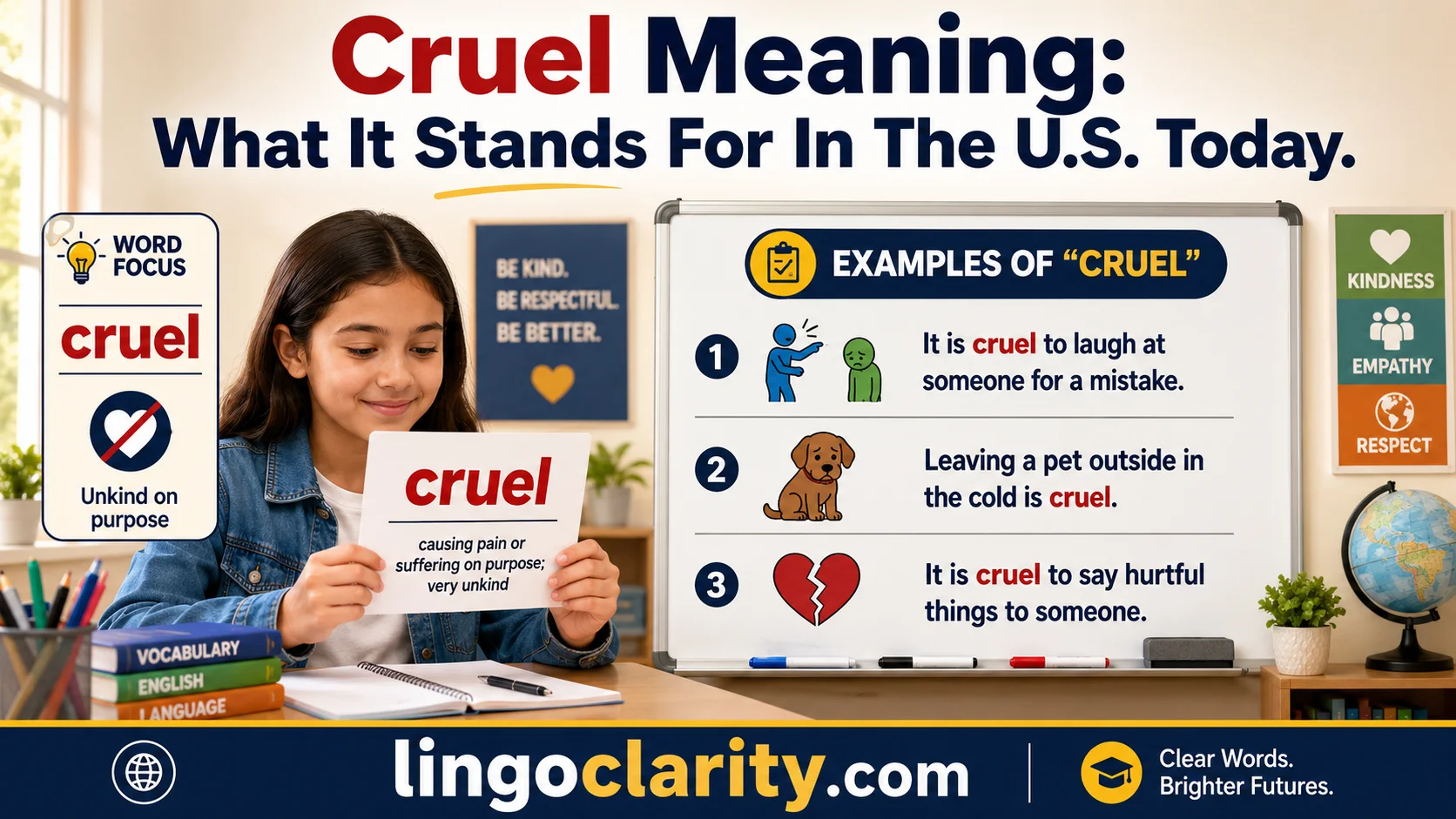
The cruel meaning is “very unkind and causing pain, suffering, or distress.” In other words, cruel describes a person, action, comment, rule, punishment, or situation that hurts someone physically or emotionally.
Although cruel can describe events or situations, it usually means more than simple bad luck. Instead, the word often points to harm, harshness, unfairness, or a lack of mercy. For example, laughing at someone who is already embarrassed can be cruel. Likewise, leaving an animal without food or water is also cruel.
Quick Answer
The cruel meaning is: deeply unkind, harsh, or harmful in a way that causes suffering.
- Part Of Speech: Adjective
- Pronunciation: KROO-uhl
- IPA: /ˈkruːəl/
- Common Forms: cruel, crueler, cruelest
- Noun Form: cruelty
- Adverb Form: cruelly
- Opposite: kind
For example, you can say, “That was a cruel thing to say.” Therefore, the word works best when someone’s words or actions cause real pain.
What Cruel Means In Plain English
In plain English, cruel means causing pain without enough kindness, care, or mercy. The pain may be physical, emotional, or mental.
For example, a cruel person may hurt others on purpose. However, a cruel action can also happen when someone ignores another person’s suffering. Meanwhile, a cruel situation may feel painfully unfair even when no person caused it directly.
Here are simple examples:
- “It was cruel to mock him after he made a mistake.”
- “The law was criticized as cruel and unfair.”
- “Leaving a pet outside in extreme heat is cruel.”
- “The final result felt like a cruel ending to the game.”
The cruel meaning is not just “bad” or “annoying.” Instead, it includes the idea of suffering.
Pronunciation, Spelling, And Word Forms
Cruel is pronounced KROO-uhl. The first part sounds like crew, and the word has two syllables.
In American English, the common comparison forms are crueler and cruelest. However, you may also see crueller and cruellest, especially in British-style writing.
Common word forms include:
- Cruel — adjective
- Cruelly — adverb
- Cruelty — noun
- Crueler — comparative adjective
- Cruelest — superlative adjective
For example, “He acted cruelly” uses the adverb form. In addition, “animal cruelty” uses the noun form.
Is Cruel An Adjective?
Yes, cruel is mainly an adjective. It describes a noun, such as a person, joke, comment, rule, punishment, or decision.
Examples:
- “a cruel person”
- “a cruel joke”
- “a cruel remark”
- “a cruel rule”
- “a cruel punishment”
- “a cruel decision”
Although some rare regional uses treat cruel differently, English learners should use it as an adjective in normal American English.
How To Use Cruel In A Sentence
You can place cruel before a noun.
Examples:
- “That was a cruel joke.”
- “The story is about a cruel king.”
- “She made a cruel comment during the argument.”
You can also use cruel after linking verbs such as be, seem, sound, feel, or look.
Examples:
- “His words were cruel.”
- “That rule seems cruel.”
- “The punishment sounded cruel.”
- “It felt cruel to leave without saying goodbye.”
In addition, use cruel to when naming the person or animal being harmed.
Examples:
- “He was cruel to his classmates.”
- “They were cruel to the stray cat.”
- “The manager was cruel to employees who made small mistakes.”
You can also use cruel of when judging someone’s behavior.
Examples:
- “It was cruel of them to laugh.”
- “It was cruel of her to share the private message.”
Because the cruel meaning is serious, use the word carefully when describing real people.
Examples Of Cruel In Sentences
These examples show how cruel works in natural English.
- “It was cruel to laugh when she cried.”
- “That comment was cruel, even if you meant it as a joke.”
- “The movie showed a cruel ruler who punished innocent people.”
- “Leaving a dog without water is cruel.”
- “The coach was cruel to the younger players.”
- “She apologized for her cruel words.”
- “The team lost in the final second, which felt cruel.”
- “The decision seemed cruel because it ignored the family’s situation.”
- “He had a cruel habit of embarrassing people in public.”
- “The winter was cruel to families without heat.”
As these examples show, cruel can describe people, words, actions, systems, events, and conditions. However, it usually carries emotional weight.
Cruel Vs Mean, Rude, Harsh, Brutal, And Sadistic
The cruel meaning is close to several other negative words, but each word has a different strength.
Mean means unkind or nasty. It is common in casual speech.
Example: “That was a mean thing to say.”
Rude means impolite or disrespectful. However, rude behavior does not always cause deep pain.
Example: “It was rude to interrupt her.”
Harsh means severe, hard, or unpleasant. Still, a harsh rule is not always cruel.
Example: “The teacher gave harsh feedback.”
Brutal means extremely harsh, violent, or forceful.
Example: “The attack was brutal.”
Sadistic means enjoying another person’s pain. Therefore, it is stronger and more specific than cruel.
Example: “The villain took sadistic pleasure in hurting others.”
In short, use cruel when the main idea is serious unkindness that causes suffering or shows no mercy.
When To Use Cruel
Use cruel when a person, action, rule, or situation causes real pain.
Good uses include:
- Someone mocks another person’s fear.
- A person harms an animal.
- A punishment is far too severe.
- A joke humiliates someone.
- A rule causes unnecessary suffering.
- A situation feels painfully unfair.
Examples:
- “It was cruel to tease her about something she could not control.”
- “The policy was called cruel because it hurt vulnerable families.”
- “His silence felt cruel after everything she had shared.”
Because the cruel meaning includes harm, the word fits best in serious emotional, moral, or physical contexts.
When Not To Use Cruel
Do not use cruel for every small problem. For example, if your coffee tastes bad, “cruel” is too strong. Instead, say the coffee is terrible, bitter, or disappointing.
Weak examples:
- “This coffee is cruel.”
- “My phone battery is cruel.”
- “The chair was cruel.”
- “My friend was cruel because he was five minutes late.”
Better examples:
- “This coffee is terrible.”
- “My phone battery is annoying.”
- “The chair is uncomfortable.”
- “My friend was inconsiderate.”
Also, do not confuse strict with cruel. A teacher, parent, coach, or boss can be strict without being cruel. However, if that person humiliates, harms, or shows no compassion, then cruel may be the right word.
Common Phrases With Cruel
Cruel Joke
A cruel joke is a joke that hurts someone instead of simply making people laugh.
Example: “Calling it a joke did not make it less cruel.”
Cruel Remark
A cruel remark is a hurtful comment.
Example: “She regretted the cruel remark immediately.”
Cruel Punishment
A cruel punishment is punishment that feels too harsh, painful, or inhumane.
Example: “Many people considered the punishment cruel.”
Cruel To Animals
This phrase describes behavior that harms animals or ignores their suffering.
Example: “Leaving pets without shelter in freezing weather is cruel to animals.”
Cruel Twist Of Fate
A cruel twist of fate is an unexpected event that feels painfully unfair.
Example: “After training for a year, the injury was a cruel twist of fate.”
Cruel Blow
A cruel blow is a painful setback or disappointment.
Example: “Losing the scholarship was a cruel blow to her plans.”
Cruel To Be Kind
Cruel to be kind means doing something that seems harsh now because it may help someone later.
Example: “Refusing to keep lending him money felt cruel, but it forced him to budget.”
However, this phrase should not be used to excuse abuse, humiliation, or unnecessary harm.
Cruel And Unusual Punishment
Cruel and unusual punishment is a legal phrase for punishment considered inhumane, excessive, or deeply unfair.
Example: “The case raised questions about cruel and unusual punishment.”
Synonyms Of Cruel
The best synonym depends on the sentence. Therefore, do not replace cruel with the same word every time.
Useful synonyms include:
- Unkind — softer and more general
- Mean — casual and common
- Harsh — severe or hard
- Heartless — lacking compassion
- Merciless — showing no mercy
- Ruthless — determined without pity
- Brutal — extremely harsh or violent
- Inhumane — lacking basic human compassion
- Sadistic — enjoying another person’s pain
Examples:
- “That was an unkind comment.”
- “The punishment was harsh.”
- “The attack was brutal.”
- “The decision seemed heartless.”
Although these words overlap, they are not identical. For example, unkind is milder than cruel, while sadistic is stronger.
Antonyms Of Cruel
The clearest opposite of cruel is kind. However, several other words can also work.
Useful antonyms include:
- kind
- gentle
- humane
- merciful
- compassionate
- caring
- sympathetic
- considerate
Examples:
- “A kind person helps others.”
- “The judge showed mercy.”
- “The shelter gave the animals humane treatment.”
- “Her response was compassionate, not cruel.”
As a result, the opposite you choose should match the sentence.
Word Family: Cruel, Cruelly, And Cruelty
The cruel meaning becomes easier to understand when you learn its word family.
Cruel is the adjective.
Example: “That was a cruel decision.”
Cruelly is the adverb.
Example: “He spoke cruelly to his sister.”
Cruelty is the noun.
Example: “Animal cruelty is a serious issue.”
Crueler compares two things.
Example: “Ignoring her apology was crueler than arguing with her.”
Cruelest describes the highest degree of cruelty.
Example: “The cruelest part was that he laughed afterward.”
Common Mistakes With Cruel
Using Cruel For Mild Annoyance
Incorrect: “The traffic was cruel.”
Better: “The traffic was awful.”
Using Cruel When You Mean Strict
Incorrect: “The teacher is cruel because she gives homework.”
Better: “The teacher is strict.”
However, if a teacher humiliates students or treats them without compassion, cruel may be accurate.
Using Cruel Without A Clear Reason
Weak: “The situation was cruel.”
Stronger: “The situation felt cruel because she lost her job one week before rent was due.”
Confusing Cruel And Crude
Cruel means causing pain or suffering.
Crude means rough, offensive, simple, or not refined.
Example: “That was a cruel joke.”
Example: “That was a crude joke.”
A joke can be crude without being cruel. Likewise, a joke can be cruel without being crude.
Mini Quiz
Choose the best answer.
What part of speech is “cruel” in “a cruel joke”?
Answer: Adjective.
Which word is softer: “cruel” or “unkind”?
Answer: Unkind.
Which sentence uses “cruel” correctly?
A. “The chair was cruel.”
B. “The cruel joke hurt his feelings.”
Answer: B.
What is one opposite of “cruel”?
Answer: Kind, humane, gentle, merciful, or compassionate.
Frequently Asked Questions About Cruel
What does cruel mean?
Cruel means very unkind and causing pain, suffering, or distress. It can describe a person, action, comment, rule, punishment, or situation.
What is the cruel meaning in simple words?
The cruel meaning in simple words is “very unkind and hurtful.” It often describes behavior that causes emotional or physical pain.
What does cruel mean in English?
In English, cruel means harsh, harmful, and lacking kindness or mercy. It is stronger than rude or mean.
What is a cruel person?
A cruel person hurts others or does not care about their suffering. The harm may come through words, actions, choices, or repeated behavior.
Is cruel an adjective?
Yes, cruel is mainly an adjective. It describes nouns such as “person,” “joke,” “rule,” “remark,” “king,” or “punishment.”
How do you pronounce cruel?
Pronounce cruel as KROO-uhl. The first part sounds like crew.
What is the opposite of cruel?
The clearest opposite of cruel is kind. Other opposites include gentle, humane, merciful, compassionate, and caring.
Is cruel stronger than rude?
Yes, cruel is stronger than rude. Rude means impolite, while cruel means hurtful in a deeper way.
Is it crueler or crueller?
In American English, crueler and cruelest are common. However, British-style writing may use crueller and cruellest.
Can a situation be cruel?
Yes, a situation can be called cruel when it feels painfully unfair or harsh. For example, “a cruel twist of fate” means an unexpected event that causes pain or disappointment.
What is the noun form of cruel?
The noun form is cruelty. For example, “The story shows the cruelty of the dictator.”
Final Meaning Of Cruel
The cruel meaning is very unkind, harsh, or harmful in a way that causes suffering. Therefore, use cruel for serious emotional or physical harm, not for mild inconvenience. A rude comment may annoy someone, but a cruel comment can wound someone. Similarly, a strict rule may be difficult, but a cruel rule causes needless pain.
