
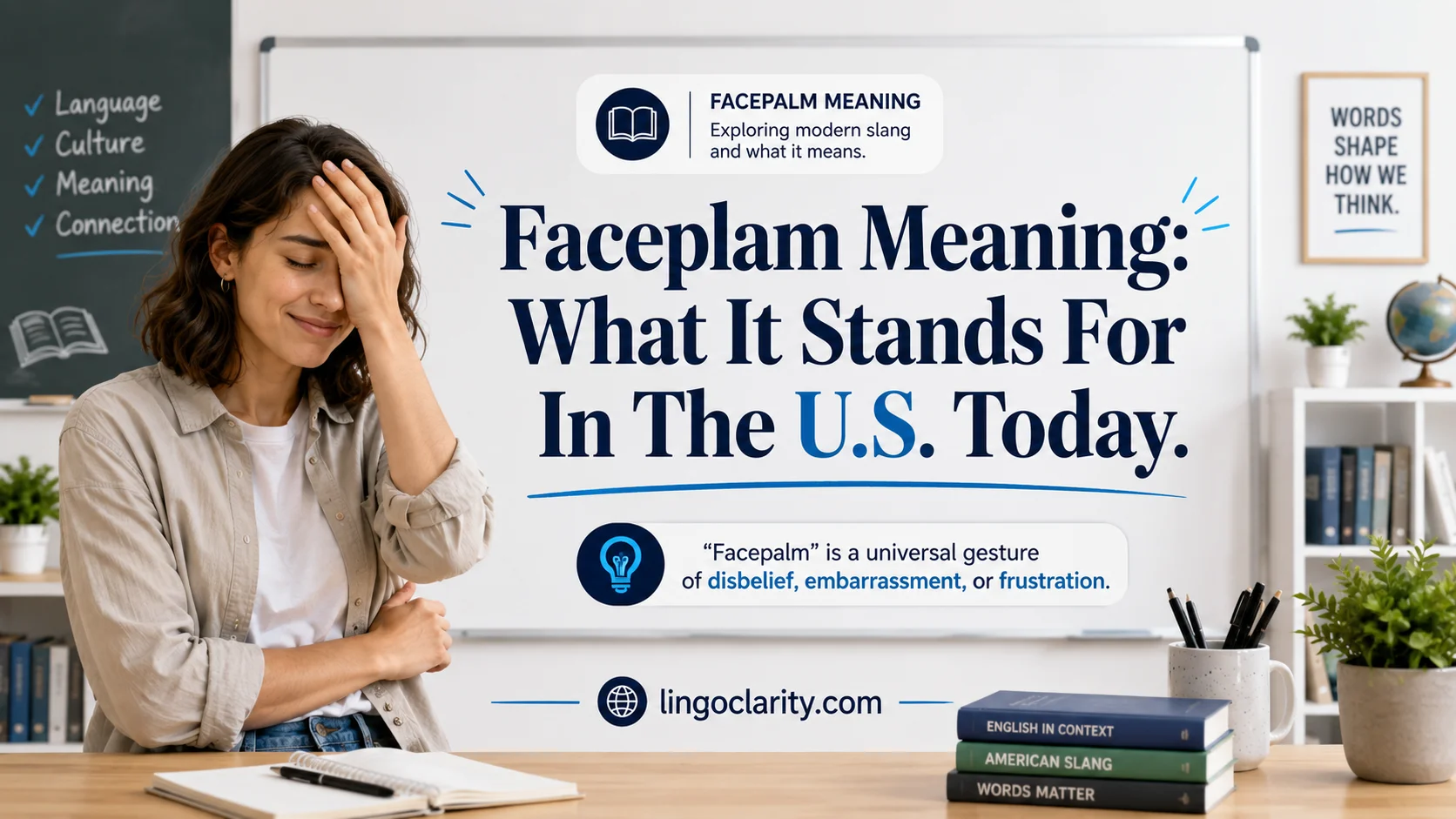
Faceplam meaning is usually searched by people who want to know what “faceplam” means in texts, comments, captions, or social media posts. In most cases, faceplam is simply a misspelling of facepalm, the correct word for a gesture or reaction that shows embarrassment, frustration, disbelief, disappointment, or mild annoyance.
You may see someone write facepalm after an obvious mistake, an awkward moment, or something silly. People also use it as a quick reaction online, similar to the emoji 🤦.
This guide explains the correct spelling, meaning, usage, examples, tone, emoji meaning, and common mistakes so you can use facepalm correctly in English.
Quick Answer
Faceplam is usually a misspelling of facepalm.
The correct word is facepalm. A facepalm is a gesture or reaction that shows embarrassment, frustration, disbelief, disappointment, or mild annoyance.
You can use facepalm when someone makes an obvious mistake, says something silly, or creates an awkward situation.
Correct: I forgot my own password again. Facepalm.
Incorrect: I forgot my own password again. Faceplam
TL;DR
- Faceplam is not the standard spelling.
- Facepalm is the correct word.
- It means covering your face with your hand because something feels embarrassing, frustrating, or unbelievable.
- It can work as a noun, verb, or reaction word.
- The emoji form is 🤦.
- Use it mostly in casual writing, texts, comments, captions, and social media.
- Avoid it in very formal writing.
What Does Facepalm Mean?
Facepalm means placing your hand on your face because you feel embarrassed, annoyed, disappointed, shocked, or frustrated.
The word can describe the real physical gesture. However, people also use it online to describe the feeling behind the gesture.
In simple words, facepalm means:
“I can’t believe that happened.”
Example:
I sent the email without the attachment. Facepalm.
This means the speaker feels embarrassed or annoyed by an obvious mistake.
Is Faceplam Correct?
No. Faceplam is not the standard spelling in normal English.
The correct spelling is facepalm.
| Spelling | Status | Use It? |
| facepalm | Correct | Yes |
| faceplam | Misspelling or joke spelling | No |
The mistake usually happens because the letters are typed in the wrong order. The correct word comes from:
face + palm = facepalm
A palm is the inside part of your hand. A facepalm is the action of putting your palm on your face.
Faceplam Vs Facepalm
The difference is simple: facepalm is correct, and faceplam is usually a typo.
Correct: That was such a facepalm moment.
Incorrect: That was such a faceplam moment.
Correct: She facepalmed after reading the message.
Incorrect: She faceplammed after reading the message.
You may see faceplam online in usernames, jokes, memes, or typo-filled comments. However, for clear writing, always use facepalm.
Facepalm Meaning In English
In English, facepalm describes a reaction to something that feels foolish, awkward, annoying, or hard to believe.
It is an informal word. That means it works well in everyday speech, messages, captions, and casual posts. It is not usually the best choice for academic essays, business reports, or professional emails.
Example:
The team printed the posters with the wrong date. It was a total facepalm.
Here, facepalm means the mistake was obvious and embarrassing.
Facepalm Meaning In Slang And Texting
In texting and social media, facepalm often works like a quick reaction.
People use it when they do not want to write a full sentence. It can show that something was silly, frustrating, awkward, or unbelievable.
Examples:
- I left my phone in the fridge. Facepalm.
- He replied-all to the whole office. 🤦
- She studied the wrong chapter. Total facepalm.
- I walked into the wrong class again. facepalm
In slang, the tone can be funny, sarcastic, self-critical, or annoyed. The exact meaning depends on the situation.
How To Pronounce Facepalm
Facepalm is pronounced like:
FAYS-pahm
It has two parts:
- Face sounds like fays
- Palm sounds like pahm
In American English, the l in palm is usually silent or very light. So, do not pronounce it strongly as pal-m.
Is Facepalm A Noun Or Verb?
Facepalm can be a noun, a verb, or a standalone reaction word.
| Use | Example | Meaning |
| Noun | That was a facepalm. | An embarrassing or frustrating moment |
| Verb | I facepalmed after reading it. | I reacted with a facepalm |
| Reaction Word | Facepalm. | I feel embarrassed, annoyed, or shocked |
As a verb, the common forms are:
- facepalm
- facepalms
- facepalmed
- facepalming
Examples:
She facepalmed when she saw the typo.
Everyone facepalmed after the wrong answer appeared on screen.
I was facepalming the whole time.
How To Use Facepalm In Sentences
Use facepalm when a mistake, comment, or situation feels embarrassing, awkward, frustrating, or unbelievable.
Everyday Examples
- I wore two different shoes to work. Facepalm.
- My glasses were on my head the whole time.
- He forgot the meeting while sitting in the meeting room.
- She facepalmed after sending the blank file.
- That answer made everyone facepalm.
Text Message Examples
- I just texted the wrong person 🤦
- I forgot my own address for a second. Facepalm.
- The homework was due yesterday. facepalm
Social Media Examples
- That awkward moment when your phone is in your hand and you’re looking for it. Facepalm.
- Me after realizing I was muted for the whole meeting: 🤦
- A true facepalm moment.
Facepalm Emoji Meaning
The facepalm emoji is 🤦.
It shows a person holding one hand to the face. People use it to show frustration, embarrassment, disbelief, or secondhand embarrassment.
Secondhand embarrassment means you feel awkward because of what someone else did.
Examples:
- I sent the message to the wrong group 🤦
- He forgot his own birthday dinner 🤦
- We drove to the wrong airport 🤦
You may also see gendered versions:
- 🤦 person facepalming
- 🤦♂️ man facepalming
- 🤦♀️ woman facepalming
These emojis are casual. They fit texts, chats, comments, and social media posts. Avoid them in formal emails unless the tone is very friendly.
Tone, Context, And Formality
Facepalm is casual and expressive. It is useful, but the tone can change quickly.
| Context | Good Choice? | Better Option |
| Texting a friend | Yes | facepalm / 🤦 |
| Funny social caption | Yes | facepalm moment |
| Casual blog post | Yes | facepalm |
| Work email | Usually no | embarrassing mistake |
| Academic writing | No | error, mistake, oversight |
| Professional report | No | issue, error, problem |
In friendly writing, facepalm can sound funny and relatable.
I forgot my coffee on top of the car. Facepalm.
However, when you use it about someone else, it can sound rude or mocking.
Harsh:
You forgot again? Facepalm.
Softer:
No worries, that was an easy mistake to make.
A good rule is simple: facepalm is safest when you use it about your own mistake.
Common Mistakes With Facepalm
The most common mistake is spelling the word as faceplam.
Correct: I had a facepalm moment.
Incorrect: I had a faceplam moment.
Another mistake is using facepalm for any sad emotion. The word is more specific than sadness. It usually involves embarrassment, frustration, disbelief, or annoyance.
Weak:
I missed my friend. Facepalm.
Better:
I forgot my friend’s birthday. Facepalm.
A third mistake is using facepalm in formal writing.
Too casual:
The report had a facepalm error.
More professional:
The report contained an obvious error.
Facepalm Vs SMH, Cringe, And Eye Roll
Facepalm, SMH, cringe, and eye roll are related, but they do not mean exactly the same thing.
| Term | Meaning | Tone |
| Facepalm | Embarrassment, frustration, disbelief | Casual, often funny |
| SMH | “Shaking my head”; disbelief or disapproval | Casual, sometimes judgmental |
| Cringe | Strong awkwardness or embarrassment | Casual, stronger |
| Eye roll | Annoyance or disbelief | More dismissive |
| Sigh | Tired frustration | Softer |
| Headdesk | Extreme frustration | Exaggerated internet slang |
Example:
I forgot my own name tag. Facepalm.
This sounds self-critical and funny.
He lied again. SMH.
This sounds more disapproving.
That speech was so awkward. Cringe.
This sounds stronger than facepalm.
Formal Alternatives To Facepalm
In professional or academic writing, avoid facepalm and use a clearer phrase.
| Casual | Formal Alternative |
| facepalm moment | embarrassing mistake |
| total facepalm | obvious error |
| I facepalmed | I was frustrated by the mistake |
| That made me facepalm | That was disappointing |
| facepalm-worthy | poorly handled / avoidable |
Examples:
Casual:
The missing attachment was a facepalm moment.
Formal:
The missing attachment was an avoidable mistake.
Casual:
Everyone facepalmed after the typo appeared.
Formal:
The typo caused embarrassment during the presentation.
Mini Quiz
Choose the best answer.
1. Which spelling is correct?
A. faceplam
B. facepalm
2. What does facepalm usually show?
A. Joy
B. Embarrassment or frustration
3. Which sentence uses facepalm correctly?
A. I won the prize, facepalm.
B. I forgot my own phone number, facepalm.
4. Is facepalm formal or informal?
A. Informal
B. Very formal
Answer Key:
- B
- B
- B
- A
FAQs
What does facepalm mean?
Facepalm means placing your hand on your face because you feel embarrassed, annoyed, disappointed, shocked, or frustrated. It can describe the real gesture or the feeling behind it.
Is faceplam a real word?
Faceplam is usually a misspelling of facepalm. Use facepalm in normal English writing.
Is facepalm slang?
Facepalm is informal. It is common in texting, comments, memes, captions, and casual speech. It is not the best choice for very formal writing.
Can facepalm be a verb?
Yes. You can say I facepalmed, she facepalms, or they were facepalming. It means someone reacted with embarrassment, frustration, or disbelief.
What does the facepalm emoji mean?
The emoji 🤦 means frustration, embarrassment, disbelief, or secondhand embarrassment. People use it when a mistake or situation feels awkward or unbelievable.
What is a facepalm moment?
A facepalm moment is an embarrassing, foolish, or frustrating moment.
Example:
Sending the email without the attachment was a facepalm moment.
Is facepalm rude?
It can be rude if you use it to mock someone. It sounds safer and kinder when you use it about your own mistake.
Gentle use:
I forgot my keys again. Facepalm.
What is the correct spelling: facepalm or face-plam?
The correct spelling is facepalm. The forms faceplam and face-plam are not standard.
Conclusion
Faceplam meaning usually refers to facepalm, the correct spelling.
A facepalm is a gesture or reaction that shows embarrassment, frustration, disbelief, disappointment, or mild annoyance. You can use it as a noun, verb, reaction word, or emoji-style response in casual English.
Use facepalm in texts, captions, comments, friendly blog posts, and everyday speech. For formal writing, choose clearer words such as mistake, error, oversight, or embarrassing moment.
The simple rule is:
Write facepalm, not faceplam.
