
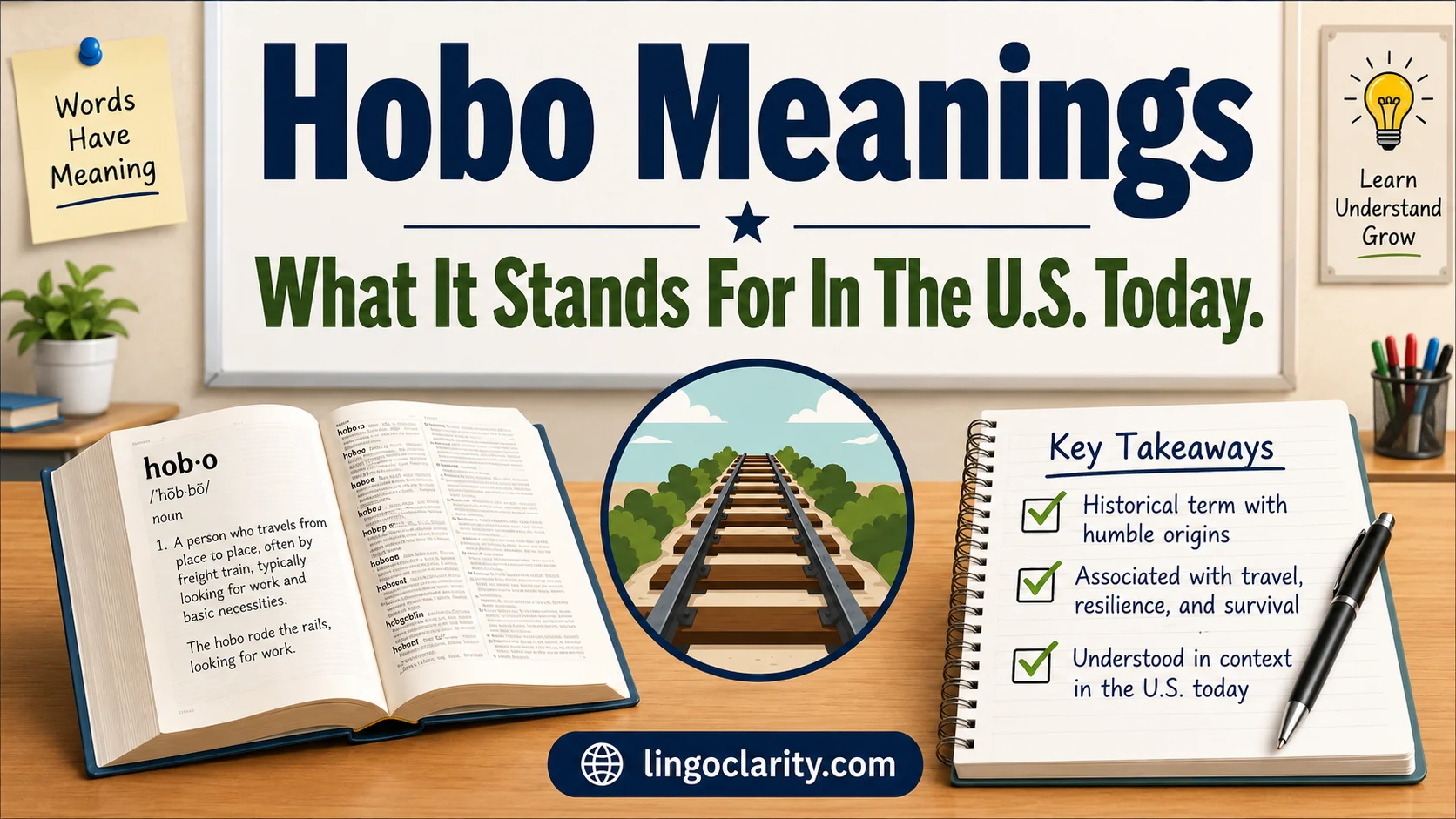
Hobo meanings can be confusing because the word has more than one use in English. In simple terms, hobo usually means a person with no permanent home who travels from place to place, often with little money. In older American English, it often described a traveling worker who moved around to find temporary jobs.
Today, the word has a sensitive tone. It can sound old-fashioned, rude, or dismissive when used for a real person. For respectful writing, phrases like person experiencing homelessness, person without housing, unhoused person, or traveling worker are usually better.
Still, hobo appears in old books, songs, railroad history, dictionaries, folk stories, and fixed phrases such as hobo bag, hobo camp, and hobo signs. Understanding it helps you read older English clearly and avoid careless use.
Quick Answer
Hobo is a noun. It usually means a poor person with no permanent home who travels from place to place. In older American use, it can also mean a traveling worker who moves around to find temporary work.
The word is not a good everyday label for a real person because it can sound harsh, dated, or disrespectful. Use it mainly when explaining vocabulary, discussing history, quoting older writing, or describing a fitting fictional character.
A plain modern replacement is often person experiencing homelessness or person without housing. However, those phrases are not exact matches for travel, railroad culture, or migrant work.
What Does Hobo Mean?
A hobo is a person who travels from place to place without a settled home. The word often suggests poverty, movement, instability, and life on the road.
In older US usage, hobo had a more specific meaning: a person who traveled to look for work. This is why the word is often connected with railroads, freight trains, farms, seasonal labor, and the Great Depression era.
However, hobo does not simply mean “traveler.” A tourist, commuter, backpacker, road-tripper, or digital nomad is not a hobo. They do not carry the same ideas of poverty, unstable housing, and social hardship.
It also does not simply mean “homeless person.” A person can experience homelessness without traveling from place to place. So hobo is narrower, older, and usually less respectful than modern housing-related language.
Hobo Definition In Plain English
Hobo means a person with no permanent home who travels from place to place, often with little money. In older American use, it can also mean a traveling worker who moves from one area to another to find temporary work.
A simple learner-friendly definition is:
Hobo = an old-fashioned word for a poor traveling person with no fixed home, sometimes linked with migrant work and railroad travel.
This definition is useful because it includes the three main ideas behind the word: travel, lack of a settled home, and economic hardship.
Is Hobo Offensive?
Hobo can be offensive when it is used as a casual label for a real person. It can make someone sound like a stereotype instead of a human being.
For example, “Some hobos were sleeping near the station” sounds harsh. A more respectful version is “Some people were sleeping near the station.” If housing status matters, you could write, “Some people experiencing homelessness were sleeping near the station.”
The word is less likely to sound offensive in a historical, literary, or educational context. For example, “The novel describes a hobo traveling by train during the Depression” uses hobo to match a time period and setting, not as a modern insult.
Hobo Vs Homeless Person
Hobo and homeless person are related, but they do not mean exactly the same thing.
A person experiencing homelessness may be living in a shelter, staying temporarily with others, sleeping in a car, living outside, or lacking stable housing. The phrase focuses on housing status.
A hobo, in the traditional sense, is someone who travels from place to place and may look for temporary work. The word focuses on movement, poverty, and an older image of life on the road.
So the difference is simple: hobo is old-fashioned and connected with travel, poverty, and sometimes temporary work. Person experiencing homelessness is modern, respectful wording for someone without stable housing.
Hobo Vs Tramp, Bum, Drifter, And Migrant Worker
These words overlap, but they do not have the same tone.
Hobo traditionally suggests a traveling person who may look for work. Tramp suggests a wandering person with no fixed home, but it is also dated and can sound insulting. Bum is usually more openly rude and can suggest laziness, worthlessness, or failure.
Drifter means someone who moves without a clear plan or settled life. Migrant worker means someone who moves to find work, often seasonal or temporary.
Use hobo for older vocabulary, history, or fiction; migrant worker for labor context; person experiencing homelessness for housing status; and traveler or wanderer for general movement.
Tone, Register, And Formality
Hobo is informal, old-fashioned, and sensitive. It is not a formal social-service term, and it is not the best word for news, policy, healthcare, housing, or community-support writing.
In historical writing, hobo can sound descriptive when it refers to a specific older social setting. Fiction may also use the word naturally when the story takes place in an earlier period. However, everyday speech is different because hobo can sound rude, careless, or mocking when used for a real person.
The phrase hobo bag is separate. In fashion, it simply means a soft, slouchy bag style.
Before using the word, ask: Am I explaining a historical or vocabulary term, or am I labeling a real person today? If you are labeling a real person today, choose a more respectful phrase.
Pronunciation, Part Of Speech, And Plural Form
Hobo is pronounced HOH-boh in standard US English. It has two syllables: ho as in hope and bo as in bonus.
Do not confuse hobo with hobby. Hobo has a long o sound. Hobby has a short o sound.
Hobo is usually a noun. Examples: “The museum had an exhibit about a hobo’s life on the road.” “The story includes two hobos near a train yard.”
The plural can be hobos or hoboes. Both forms are acceptable, but hobos is simpler and more common in modern everyday writing.
Common Hobo Meanings
The word hobo has a few related meanings.
A person with no fixed home who travels: This is the main meaning.
A traveling worker: In older American use, hobo can mean a worker who travels to find temporary jobs.
A fictional or historical character type: In books, songs, films, and cartoons, hobo often refers to a wandering character linked with train travel, hunger, freedom, hardship, or survival.
A hobo bag: A hobo bag is a soft, slouchy shoulder bag. This is a fashion term and does not mean a person.
Examples Of Hobo In Sentences
“The history book described how hobos traveled across the country looking for work.”
“The teacher explained that hobo is an old-fashioned word and should not be used carelessly.”
“The novel’s main character meets a hobo near a railroad camp.”
“Please do not call that man a hobo. We do not know his situation.”
“The article used hobo in a historical sense, not as a modern insult.”
“She bought a soft hobo bag with a long shoulder strap.”
Examples To Avoid
Avoid using hobo when a more respectful or accurate word is available.
Avoid: “There are hobos outside the store.”
Better: “There are people outside the store.”
Better if housing status matters: “There are people experiencing homelessness outside the store.”
Avoid: “He dresses like a hobo.”
Better: “His clothes look worn and mismatched.”
The better versions avoid turning people into insults.
Synonyms And Antonyms For Hobo
Synonyms for hobo are tricky because many similar words are also dated or disrespectful. Possible alternatives include drifter, wanderer, migrant worker, traveling worker, person with no permanent home, and person experiencing homelessness.
Be careful with words like tramp, bum, and vagrant. They may appear in dictionaries or thesauruses, but they can sound harsh, legalistic, old-fashioned, or judgmental.
There is no perfect everyday antonym for hobo. Possible contrasts include resident, settled person, homeowner, permanent resident, and local.
Word History Of Hobo
Hobo became known in American English in the late 1800s. Its exact origin is uncertain.
Many origin stories exist. Some people have connected it to phrases like homeward bound, ho, boy, or hoe-boy, but these explanations are not proven. A careful writer should say origin uncertain or origin unknown, not present one story as fact.
The word is strongly connected with older American travel and labor history. It often brings to mind railroads, freight trains, seasonal jobs, and hard economic times.
Common Phrases With Hobo
A hobo camp means a place where hobos stay or gather, usually in an older historical or literary context. Hobo signs are symbols associated with hobo folklore and travel culture. In fashion, a hobo bag is a soft, slouchy shoulder bag. A hobo nickel is a carved or altered coin associated with folk art.
FAQs About Hobo Meanings
What does hobo mean in simple words?
Hobo means a person who travels from place to place without a permanent home, often with little money. In older American use, it can also mean a traveling worker who moves around to find temporary jobs.
Is hobo a rude word?
Hobo can be rude when used for a real person today. It sounds old-fashioned and can feel dismissive. It is safer in historical, literary, or vocabulary contexts.
Is hobo the same as homeless?
No. Hobo suggests travel and an older idea of life on the road. Person experiencing homelessness focuses on housing status and is usually more respectful for modern use.
What should I say instead of hobo?
Use person experiencing homelessness, person without housing, migrant worker, traveling worker, drifter, or traveler, depending on what you actually mean.
Final Thought
Hobo meanings center on one main idea: a person with no permanent home who travels from place to place. In older American English, the word often connects to traveling workers, railroads, temporary jobs, and life on the road.
However, hobo is not a neutral modern label for a real person. It can sound dated, careless, or insulting. Use it mainly for history, literature, vocabulary study, fixed phrases, or fictional settings.
For current real-life situations, choose wording that respects the person first. In most cases, person experiencing homelessness, person without housing, migrant worker, or traveling worker will be clearer, kinder, and more accurate.
