
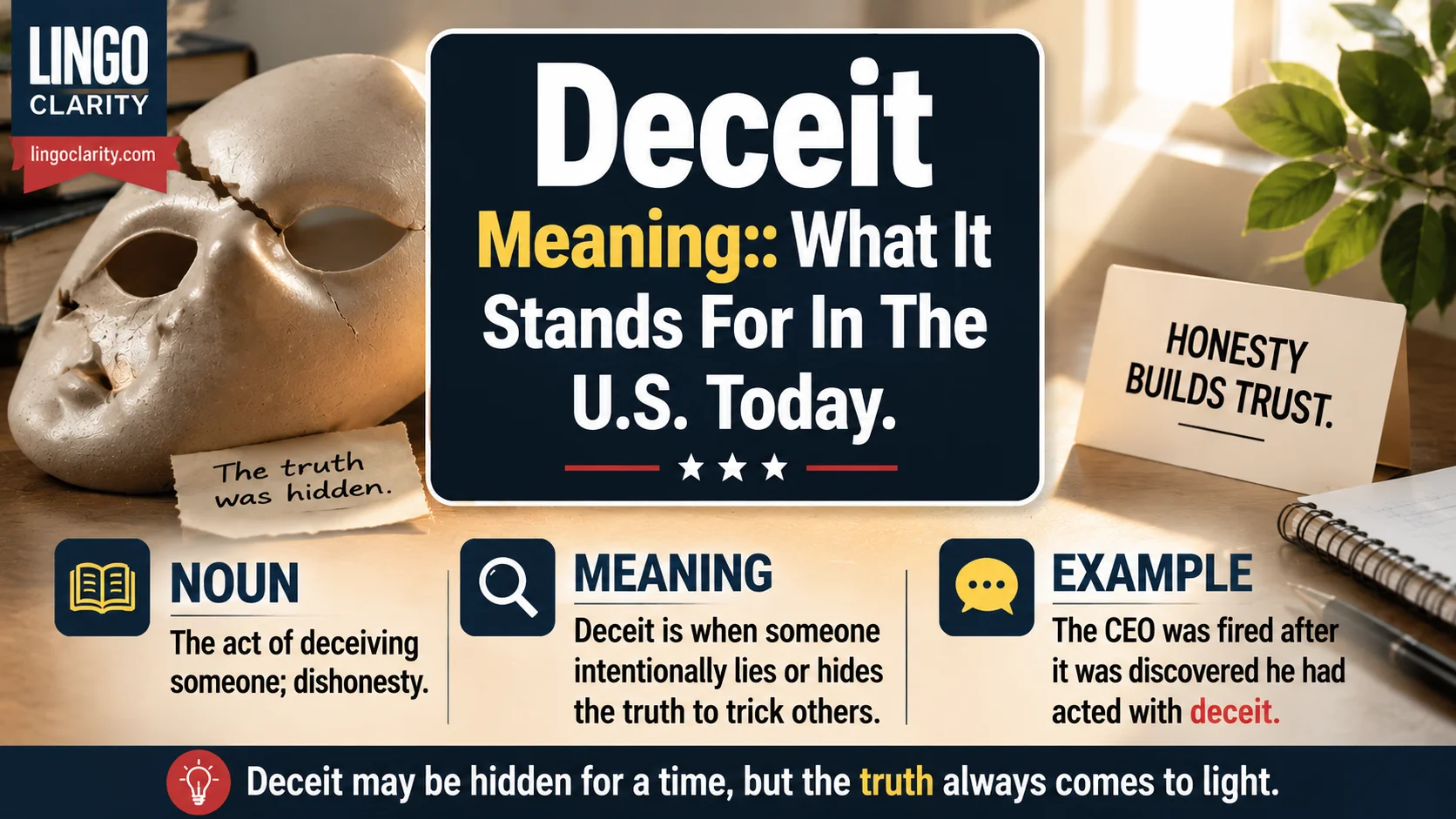
Deceit means intentional dishonesty that makes someone believe something false. You may see this word in books, news reports, school assignments, legal writing, movies, and serious conversations about trust.
The word is stronger than a simple mistake. If someone gives the wrong answer by accident, that is usually an error. However, if someone hides the truth, twists facts, or creates a false impression on purpose, this noun is the right choice.
This guide explains the term in plain English. You will learn its definition, pronunciation, grammar role, common sentence patterns, related words, synonyms, antonyms, and mistakes to avoid.
Quick Answer
Deceit is the act or practice of misleading someone on purpose. It can involve lying, hiding important facts, twisting the truth, or creating a false impression. The word is mainly a noun, and it has a serious, negative tone because it suggests dishonest intent and broken trust.
TL;DR
This word means intentional dishonesty.
It is mainly a noun.
Pronounce it di-SEET.
The sound rhymes with seat, meet, and complete.
A close synonym is deception.
A clear opposite is honesty.
Do not use it as a verb. Use deceive instead.
What Deceit Means In Plain English
Deceit means making someone believe something false on purpose. It can happen through direct lies, hidden facts, false promises, or carefully shaped information that gives the wrong impression.
The key idea is intent. A person must be trying to mislead someone. If someone says something wrong because they are confused, that is usually not dishonest behavior. However, if they know the truth and hide it, the word may fit.
The Main Idea
At its core, the term describes dishonest behavior that creates a false belief. It does not simply mean “being incorrect.” Instead, it points to a choice to mislead.
Examples:
The scam depended on deceit.
She felt hurt by his dishonesty.
The report exposed years of hidden wrongdoing.
Their plan was built on lies and secrecy.
Why Intent Matters
Intent separates this idea from a normal mistake. A mistake can happen without bad motives. Misleading behavior involves a choice to hide, twist, or cover up the truth.
For example, if a person gives you the wrong time because they forgot, that is a mistake. If someone gives you the wrong time so you miss an important meeting, that is intentional dishonesty.
Is Deceit A Noun Or A Verb?
Deceit is a noun. It names dishonest behavior, a dishonest act, or a trick meant to mislead someone.
Correct:
His deceit hurt the whole team.
The company was accused of dishonest conduct.
The story reveals a web of lies.
Incorrect:
He deceit his friend.
They tried to deceit the customer.
Use deceive when you need a verb.
Correct:
He deceived his friend.
They tried to deceive the customer.
This grammar point is important because many learners confuse the noun with the verb. One names the dishonest thing. The other shows the action.
How To Pronounce Deceit
Deceit is pronounced di-SEET.
The stress is on the second syllable: di-SEET.
It rhymes with:
seat
meet
feet
complete
Do not pronounce it like “dee-sight.” The final sound is seet, not sight.
Example:
His lies were finally exposed.
How To Use Deceit In Sentences
Use deceit when you want to name dishonest behavior that misleads someone. It often appears in serious contexts involving trust, truth, secrets, betrayal, scams, and hidden motives.
Common Sentence Patterns
Common phrases include:
an act of dishonesty
a web of deceit
lies and dishonesty
full of falsehood
use deception
expose dishonesty
discover the truth
suspect hidden motives
Clear Examples
The manager used deception to hide the losses.
The family discovered the truth years later.
His apology did not erase the damage.
The movie follows a web of deceit.
She wanted honesty, not secrecy.
The investigation revealed dishonest conduct in the company’s records.
A simple rule helps here: use the noun for the dishonest behavior and deceive for the action.
Correct:
The fake email tried to deceive customers.
The fake email was part of a larger dishonest plan.
Countable And Uncountable Use
This noun can be uncountable when it describes dishonest behavior in general.
Examples:
The deal was full of deceit.
She was tired of lies and dishonesty.
The story explores jealousy, power, and betrayal.
It can also be countable when it means one dishonest act, trick, or false appearance.
Examples:
That promise was a cruel trick.
The offer turned out to be false.
Their friendship was damaged by several lies.
In everyday writing, the uncountable use is more common. You will often see phrases like lies and dishonesty or a web of deceit.
Deceit Vs Deception
Deceit and deception are very close in meaning. Both can describe the act of misleading someone.
However, the first word often sounds more personal, moral, or emotionally harsh. It points strongly to broken trust. Deception can sound broader and sometimes more neutral, depending on the context.
Examples:
Her deceit destroyed their trust.
During the trick, the magician used deception.
The first sentence sounds personal and negative. In contrast, the second sentence sounds more neutral because magic tricks are expected to mislead the audience in a harmless way.
Choose deceit when the action feels dishonest, harmful, or morally wrong. Choose deception when you need a broader word for misleading, tricking, or creating a false impression.
Deceit, Deceive, Deceitful, And Deceptive
These words belong to the same word family, but they do not work the same way.
Deceit
Deceit is a noun. It means dishonest behavior or a dishonest act.
Example:
His deceit damaged the relationship.
Deceive
Deceive is a verb. It means to make someone believe something false.
Example:
The fake website tried to deceive shoppers.
Deceitful
Deceitful is an adjective. It describes a dishonest person, answer, action, or behavior.
Example:
That was a deceitful excuse.
Deceptive
Deceptive is also an adjective. It describes something that gives a false impression.
Example:
The chart was visually deceptive.
Easy Memory Tip
Deceit names the dishonest thing.
Deceive shows the action.
Deceitful describes dishonest behavior or character.
Deceptive describes something that gives a false or misleading impression.
Common Contexts For This Word
This word is not usually light or playful. It fits serious situations where honesty matters.
Relationships
In relationships, dishonest behavior may involve secret messages, hidden actions, false promises, or pretending something is true when it is not.
Example:
Their relationship ended because of repeated lying.
Business
In business, the word may describe misleading customers, hiding costs, changing facts, or making false claims.
Example:
The lawsuit accused the company of deceit.
Crime And Scams
In scams, it often describes a dishonest plan used to gain money, access, or trust.
Example:
The scammer used deception to collect private information.
Stories And Movies
In stories, hidden dishonesty creates suspense and conflict. A mystery, thriller, or drama may reveal layers of secrets over time.
Example:
The novel begins with a secret and ends by exposing a web of deceit.
Synonyms For This Word
Common synonyms include deception, dishonesty, lying, fraud, trickery, duplicity, cheating, double-dealing, and misrepresentation.
These words are related, but they are not always interchangeable.
Deception is the closest general synonym.
Dishonesty is broader and can describe many kinds of untruthful behavior.
Lying means saying something false.
Fraud often suggests illegal or financial cheating.
Trickery suggests sneaky methods.
Duplicity suggests two-faced behavior or hidden double intentions.
Misrepresentation means presenting something in a false or misleading way.
Example:
The advertisement was not just unclear; it was a form of misrepresentation.
Choose the synonym that fits the exact situation. In a friendship, dishonesty may sound natural. In a legal or business context, fraud or misrepresentation may fit better.
Antonyms For This Word
Clear antonyms include honesty, truthfulness, sincerity, openness, good faith, candor, and integrity.
Examples:
She valued honesty over comfort.
The agreement was made in good faith.
His apology sounded sincere.
The opposite you choose depends on the sentence. Honesty is the simplest and most common opposite. Good faith works well in formal, business, or legal contexts. Sincerity works well when feelings and intentions matter.
Common Mistakes With This Word
The most common mistake is using this noun as a verb.
Incorrect:
He deceit his friend.
Correct:
He deceived his friend.
Correct:
His deceit hurt his friend.
Another mistake is using the word for any wrong statement. A wrong statement is not always intentional. The person must be trying to mislead someone.
Incorrect:
I gave the wrong date by deceit.
Better:
I gave the wrong date by mistake.
Also avoid using it for harmless surprises.
Too strong:
The birthday party involved deceit.
Better:
The birthday party was a surprise.
Save the word for situations involving real dishonesty, hidden truth, or broken trust.
Mini Quiz
Choose the best answer.
- Is this word a noun or a verb?
- Which sentence is correct?
A. He tried to deceit them.
B. He tried to deceive them.
- What is a close synonym?
- What is a clear opposite?
- Does the word usually suggest intent?
Answer Key
- Noun.
- B.
- Deception.
- Honesty.
- Yes.
FAQs About This Word
What does it mean in simple words?
It means lying, hiding the truth, or misleading someone on purpose. The word describes dishonest behavior that makes another person believe something false.
Is this word a noun?
Yes. Deceit is a noun. It names dishonest behavior, a dishonest act, or a trick meant to mislead someone.
What is a clear example?
One example is hiding important facts to make someone sign a bad deal. Another example is pretending to be someone else to gain trust.
Is it the same as deception?
They are very close. Deceit often sounds more personal or morally negative, while deception can be broader and sometimes more neutral.
Is it the same as lying?
Lying is one form of it. However, the word can also include hiding facts, twisting details, leaving out important information, or creating a false impression.
What is the opposite?
The clearest opposite is honesty. Other opposites include truthfulness, sincerity, openness, good faith, candor, and integrity.
What does “web of deceit” mean?
A web of deceit means many connected lies, secrets, or dishonest actions. It suggests that one dishonest act leads to another.
Can deceit be accidental?
Usually, no. The word normally suggests intent. If someone gives false information by accident, mistake is usually a better word.
Conclusion
Deceit means intentional dishonesty that misleads someone. It is a serious word because it points to hidden truth, false impressions, and damaged trust.
For clear writing, remember the grammar difference: deceit is the noun, and deceive is the verb. Say his deceit hurt them or he deceived them, but do not say he deceit them. Use the term when the situation involves real dishonesty, not a simple error or harmless surprise.
