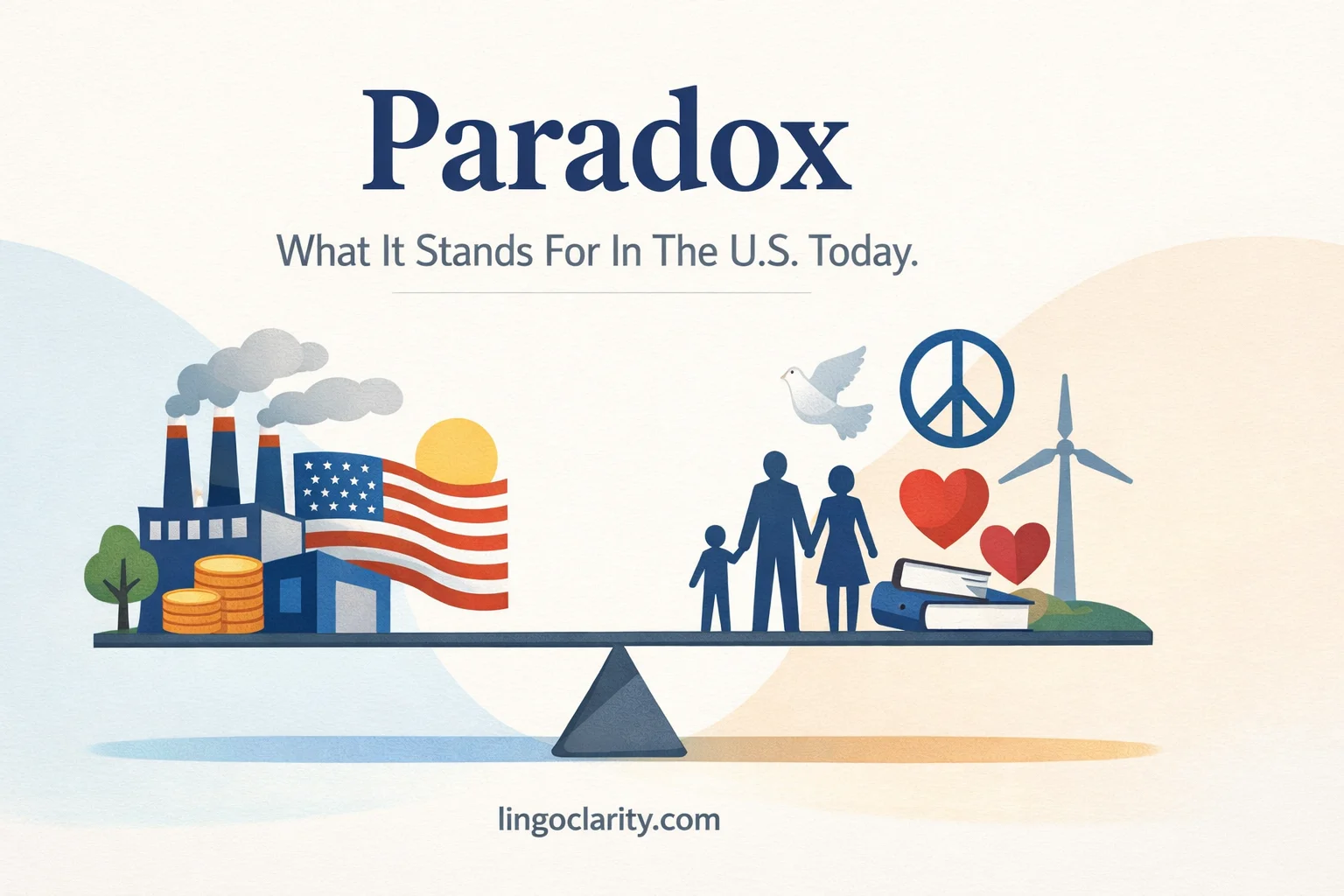
A paradox is a statement, situation, or person that seems to contradict itself but may still be true, meaningful, or revealing. In plain English, it is something that looks wrong on the surface but makes more sense when you think about it more carefully.
A classic example is “less is more.” It sounds backward at first, but it expresses a real idea: sometimes simplicity is stronger than excess.
What Paradox Means
At its core, paradox means an apparent contradiction. The contradiction is only apparent because the deeper meaning still holds up.
That is what makes paradox different from plain nonsense. A paradox creates tension between two ideas that seem to clash, yet together they reveal something true, surprising, or worth thinking about.
People use the word in several ways. A paradox can be:
- a statement that sounds self-contradictory
- a real-life situation with conflicting truths
- a person who seems to combine opposite qualities
Definition In Plain English
In plain English, a paradox is:
something that seems impossible or self-contradictory, but may still be true or meaningful
A quick way to remember it:
- A contradiction simply clashes.
- A paradox clashes and still makes a point.
For example, “The more you learn, the less you realize you know” is a paradox. It sounds contradictory, but it reflects a real experience: gaining knowledge often makes people more aware of how much they still do not know.
How Paradox Is Used
Paradox is a standard English noun. It works in everyday speech, journalism, education, literature, and analytical writing.
Common patterns include:
- the paradox of choice
- it is a paradox that…
- a paradoxical result
- she is a paradox
Examples:
- It is a paradox that devices built to save time can make people feel busier.
- The company faces a growth paradox: revenue is rising, but margins are shrinking.
- He is a paradox—quiet in groups but fearless when it matters.
The adjective form is paradoxical. The plural is paradoxes.
Pronunciation And Part Of Speech
In American English, paradox is commonly pronounced:
PAIR-uh-docks
It is mainly used as a noun.
Examples:
- a paradox
- the paradox of success
- modern life is full of paradoxes
The adjective form is paradoxical, as in:
- a paradoxical outcome
- a paradoxical situation
Paradox Vs. Contradiction
A contradiction and a paradox are not the same thing.
A contradiction is usually just a conflict between two ideas that cannot both be true in the same way.
A paradox looks contradictory at first, but it may still contain a truth.
For example:
- Contradiction: “I never eat sugar” and “I eat dessert every night”
- Paradox: “The only constant is change”
The first example is just inconsistent. The second sounds impossible at first, but it expresses a real truth about life.
Paradox Vs. Oxymoron
This is one of the most common points of confusion.
An oxymoron is usually a short phrase made of opposite words, such as:
- deafening silence
- living death
- bittersweet
A paradox is usually a fuller statement, idea, or situation, such as:
- less is more
- the more choices people have, the harder choosing becomes
A simple rule helps:
- If opposite words are placed side by side, it is usually an oxymoron.
- If the whole idea seems self-contradictory but reveals a truth, it is usually a paradox.
Types Of Paradox
Paradoxes do not all work the same way. The word is used in a few common senses.
Logical Paradox
A logical paradox creates a problem in reasoning.
Example:
“This statement is false.”
If the statement is true, then it must be false. If it is false, then it must be true. That loop is what makes it a paradox.
Literary Paradox
A literary paradox is used in writing to create depth, emphasis, or insight.
Example:
“I must be cruel only to be kind.”
This kind of paradox helps writers show that two opposite ideas can both be true in a deeper sense.
Situational Paradox
A situational paradox happens in real life when outcomes cut against common expectations.
Example:
The more connected people are online, the lonelier many of them feel.
That tension is not just wordplay. It reflects a real social pattern.
Real-Life Examples Of Paradox
Paradox shows up in everyday conversation more often than many people realize.
Here are clear examples:
- The more options shoppers have, the harder it becomes to make a decision.
- Phones help people stay connected, yet they can also make face-to-face connection weaker.
- A leader can be both confident and humble.
- People work hard to create freedom, then use that freedom to fill life with more obligations.
- Someone can be deeply private and still be very powerful in public.
These examples work because each one holds together two ideas that seem to pull in opposite directions.
Famous Examples Of Paradox
Some paradoxes are so well known that people use them without thinking about the label.
- Less is more.
- The only constant is change.
- I can resist everything except temptation.
- The beginning of the end.
- The more we know, the more we realize how little we know.
These lines are memorable because they create tension and insight at the same time.
Synonyms And Near Synonyms
There is no single perfect synonym for paradox in every context.
Depending on the sentence, close alternatives may include:
- contradiction
- incongruity
- anomaly
- puzzle
- enigma
- riddle
Still, these words are not exact matches.
For example:
- contradiction sounds flatter and more literal
- puzzle is broader and simpler
- enigma leans more toward mystery than conflict
That is why paradox remains the best word when a contradiction also carries meaning.
How To Use Paradox In A Sentence
Here are natural sentence examples:
- It is a paradox that the tools designed to save time can make life feel more rushed.
- The city faces a housing paradox: jobs are increasing, but affordable homes are disappearing.
- She is a paradox—reserved in private, yet magnetic onstage.
- The essay uses paradox to show that freedom and responsibility often grow together.
- “Less is more” is one of the most widely quoted paradoxes in English.
Common Mistakes To Avoid
One common mistake is using paradox for any contradiction at all. Not every contradiction deserves the word. Use paradox when the contradiction reveals something real or meaningful.
Another mistake is confusing paradox with oxymoron. Remember that an oxymoron usually works at the phrase level, while a paradox usually works at the level of the full idea.
A third mistake is assuming a paradox must be false. In many cases, the point of a paradox is that it seems false at first but turns out to express a truth.
Word Origin
The word paradox comes from Greek roots linked to something that goes against opinion or expectation. That older meaning still fits modern English well. A paradox challenges what people assume should make sense.
Why The Word Matters
Paradox is a useful word because life is full of situations that do not fit simple either-or thinking.
People often use it when they want to describe:
- mixed truths
- complex human behavior
- surprising outcomes
- ideas that sound wrong but reveal something right
That is why the word appears in literature, philosophy, journalism, business writing, and everyday conversation.
FAQ
What is a paradox in simple words?
A paradox is something that seems to contradict itself but may still be true or meaningful.
Can a paradox be true?
Yes. Many paradoxes sound false at first, but they express a real truth once you look more closely.
What is the difference between a paradox and an oxymoron?
An oxymoron is a short phrase with opposite words, such as “deafening silence.” A paradox is a larger statement or idea that seems contradictory but still makes sense.
Is “less is more” a paradox?
Yes. It sounds self-contradictory, but it expresses a real idea: simplicity can sometimes produce a stronger result than excess.
Can a person be called a paradox?
Yes. A person can be called a paradox when they seem to combine opposite traits, such as being shy in private but bold in public.
Conclusion
A paradox is a statement, situation, or person that appears contradictory but may still reveal a truth. Once you understand that core idea, the word becomes easy to recognize and use.
It is not just about conflict. It is about meaning inside conflict. That is what makes paradox such a useful and powerful word in English.
