
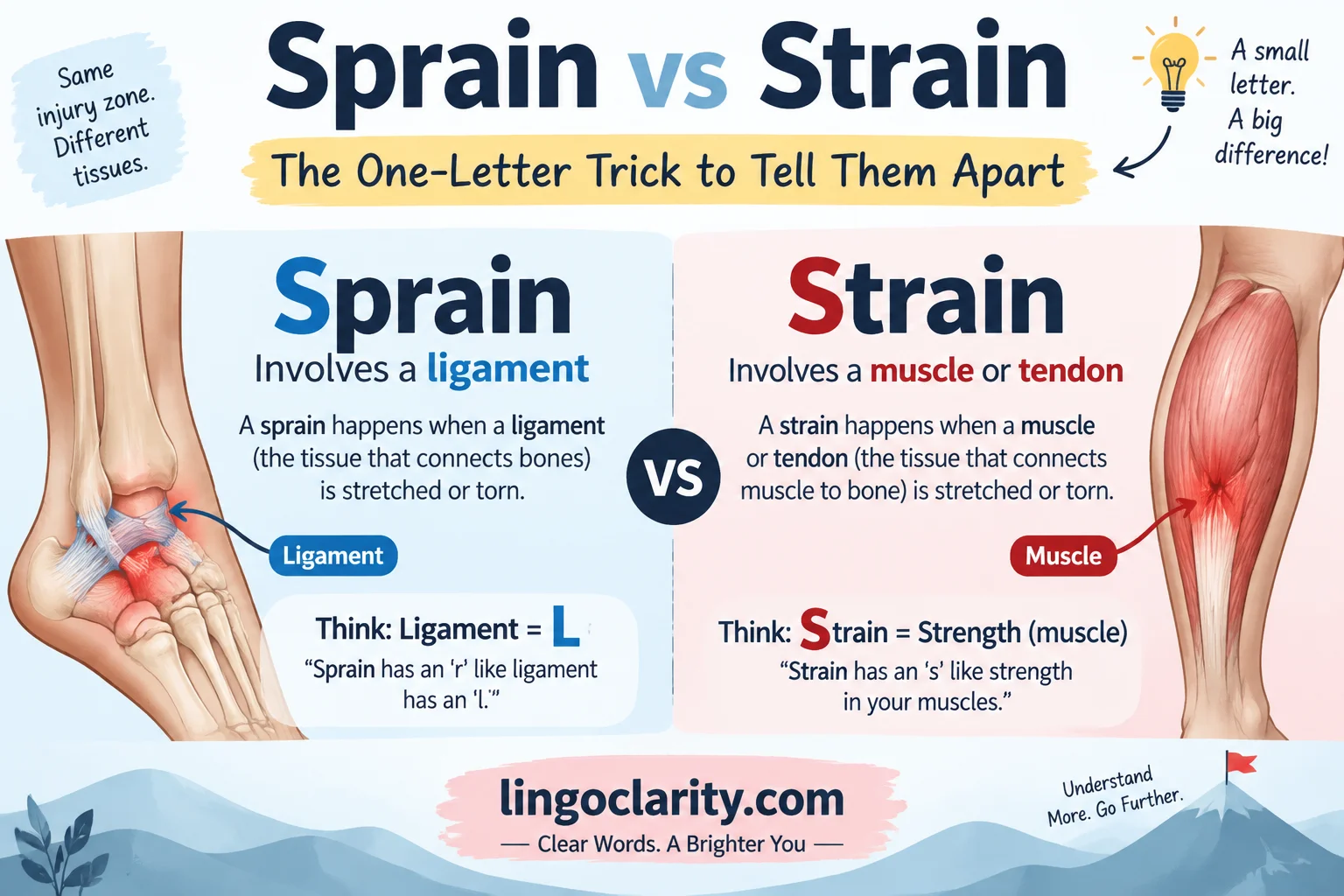
Quick answer: The sprain vs strain difference comes down to the tissue that got hurt. A sprain is a stretched or torn ligament, the band that joins bone to bone at a joint. A strain is a stretched or torn muscle or tendon, the cord that joins muscle to bone. You sprain an ankle, knee, or wrist. You strain a hamstring or your lower back.
The sprain vs strain mix-up happens because the words sound alike and describe the same moment: a bad step, a sharp pain, some swelling. Each still points to a different body part. Below you’ll find what each word means, where both came from, how to use them, and the extra meanings only strain has. We also checked Merriam-Webster, Dictionary.com, and the National Library of Medicine, and they don’t fully agree.
This is a language guide, not medical advice. If you’re hurt, a doctor or physical therapist can tell you which injury you have.
What Is the Difference Between a Sprain and a Strain?
A sprain injures a ligament, and a strain injures a muscle or tendon. The National Institute of Arthritis and Musculoskeletal and Skin Diseases (NIAMS) states the rule exactly this way [link to NIAMS “Sprains and Strains” page].
- Ligaments connect bone to bone and keep a joint steady. That’s why sprains happen at joints, most often the ankle, knee, and wrist.
- Tendons connect muscle to bone. Strains happen in a muscle or where it attaches, most often the lower back and hamstring.
The National Library of Medicine’s MeSH thesaurus files both under “Sprains and Strains,” a group term for muscle and ligament injuries without a fracture or dislocation [link to NLM MeSH “Sprains and Strains” descriptor]. They’re related terms, not synonyms.
Why Do Dictionaries and Doctors Define Sprain Differently?
Merriam-Webster matches medical use: a sprain is a sudden twist of a joint that stretches or tears ligaments [link to Merriam-Webster entry for “sprain”]. Dictionary.com’s synonym note under strain uses older wording, describing a sprain as damage to the tendons and muscles around a joint [link to Dictionary.com entry for “strain”].
That looser sense lingers in casual talk, where any bad wrench of a joint gets called a sprain. For a health article, injury report, or insurance claim, follow the medical definition.
Where Do the Words Sprain and Strain Come From?
Strain is about three centuries older. It entered English around 1300 as the Middle English verb streinen, from Old French estreindre, “to bind tightly,” and Latin stringere, “to draw tight” [link to Online Etymology Dictionary entry for “strain”]. The injury sense appears by the late 1300s. The same Latin root gave us stringent.
Sprain is harder to trace. Merriam-Webster dates the noun to 1601, the verb to 1622, and lists the origin as unknown. A link to Old French espreindre, “to press out,” has been suggested, but it remains a theory.
How Do You Use Sprain and Strain in a Sentence?
Both words work as nouns and as regular verbs: sprain, sprained, spraining; strain, strained, straining.
- Verb: “I sprained my ankle.” / “She strained her calf.”
- Noun: “It’s a bad sprain.” / “The scan showed a mild strain.”
- Adjective: “a sprained wrist,” “a strained hamstring”
Everyday Phrases That Mean a Sprain or a Strain
Most people describe what happened before they name the injury. The phrase usually tells you which word fits.
| Everyday phrase | Usually means | Why |
|---|---|---|
| “I rolled my ankle.” | Sprain | Ankle ligaments stretch when the foot turns under |
| “I twisted my knee.” | Sprain | Twisting loads the knee’s ligaments |
| “I pulled a muscle.” | Strain | The casual name for a muscle strain |
| “I threw out my back.” | Usually a strain | Often a back muscle strain, though other problems feel similar |
Meanings of Strain That Have Nothing to Do With Injuries
Sprain only means an injury. Strain has several other jobs:
- Pressure: “Medical bills put a strain on their savings.”
- To filter: “Strain the pasta before you add the sauce.”
- To tire through overuse: “Reading in dim light strains your eyes.”
- A variety: “a new strain of flu” (traced to a separate Old English word tied to lineage)
- Physics: how much an object changes shape under force, as in “stress and strain”
Sprain and Strain in Real Sentences
- Sports report: “Jaylen Brooks sprained his left ankle in the fourth quarter and is listed as day-to-day.”
- Workplace injury form: “Employee reported a right shoulder strain after lifting a 50-pound box.”
- Doctor’s visit summary: “X-rays negative. Diagnosis: grade 1 sprain, right wrist.”
- Casual speech: “I strained my lower back hauling my mom’s couch up three flights of stairs.”
- Text message: “cant make pickleball tonight, sprained my thumb on the ice”
- Office email: “Two open positions are putting a real strain on the night shift.”
Formal writing names the body part and often the grade. Texts and speech lean on phrases like “pulled something.”
Sprain vs Strain Side by Side
| Feature | Sprain | Strain |
|---|---|---|
| Tissue injured | Ligament (bone to bone) | Muscle or tendon (muscle to bone) |
| Common spots | Ankle, knee, wrist, thumb | Lower back, hamstring, calf, neck |
| Typical cause | Twist, fall, awkward landing | Overstretching, heavy lifting, overuse |
| Common sign (not a diagnosis) | Bruising at the joint | Muscle spasms and cramping |
| Casual phrase | “rolled my ankle” | “pulled a muscle” |
| Non-injury meanings | None | Pressure, filter, variety, physics |
| First known use | 1601 | About 1300 |
What Mistakes Do People Make With Sprain and Strain?
- “I sprained a muscle.” Muscles strain. Write “I strained a muscle” or “I pulled a muscle.”
- “Sprain the broth” or “sprained relations.” Only strain means to filter or to put under pressure.
- Treating symptoms as the answer. Pain and swelling show up with both, and one fall can cause both. Confirming the tissue usually takes an exam.
- Mixing up ligament and tendon. This causes most sprain vs strain errors. Ligament: bone to bone. Tendon: muscle to bone.
Is There an Easy Way to Remember Sprain vs Strain?
Look for the letter T. Strain has a T, and so does tendon. Sprain has no T, so it’s the ligament word.
A second trick: strain and stretch both start with “str,” and a strain is a muscle stretched too far. Etymologists even link strain to the same ancient root as the Old English word for stretch.
Frequently Asked Questions
Is a sprain worse than a strain?
Neither word tells you how serious an injury is. Doctors grade both, usually from grade 1, a mild stretch, to grade 3, a complete tear. A grade 3 strain can be worse than a grade 1 sprain, and the reverse is also true. Only an exam can set the grade.
Can you sprain a muscle?
Not in precise usage. Muscles and tendons strain, while ligaments sprain. People say “I sprained my shoulder muscle” casually, but a medical note would call that a strain. If you mean the ligaments inside the shoulder joint, sprain is correct.
Is a pulled muscle a sprain or a strain?
A pulled muscle is a strain. “Pulled muscle” is the everyday name for a muscle strain, most often heard with hamstrings, calves, groin muscles, and the lower back. Sprain doesn’t fit, because no ligament is involved in that injury.
Is a rolled ankle a sprain or a strain?
A rolled ankle is usually a sprain. When the foot turns under, ligaments on the outside of the ankle stretch or tear. The ankle is the most common place for a sprain. A rolled ankle can also hide a broken bone, so severe pain calls for a medical check.
Do British and American English use sprain and strain the same way?
Yes. Both words are spelled and used the same way in US and UK English, with no variant spellings. The ligament versus muscle-or-tendon distinction is standard in medical writing in both countries, so the sprain vs strain rule works wherever you are.
Can you have a sprain and a strain at the same time?
Yes. A single fall or awkward twist can stretch a ligament at a joint and overstretch a nearby muscle in the same moment. In writing, name each injury separately, as in “a sprained ankle and a strained calf,” so the reader knows exactly what’s hurt.
The Letter T Settles Sprain vs Strain
Here’s the detail most comparison pages miss: strain has worked many jobs in English since around 1300, while sprain has done only one since 1601. So try a quick swap test. If the sentence still makes sense with “pressure” or “filter” in place of the word, you need strain, because sprain never passes.
