
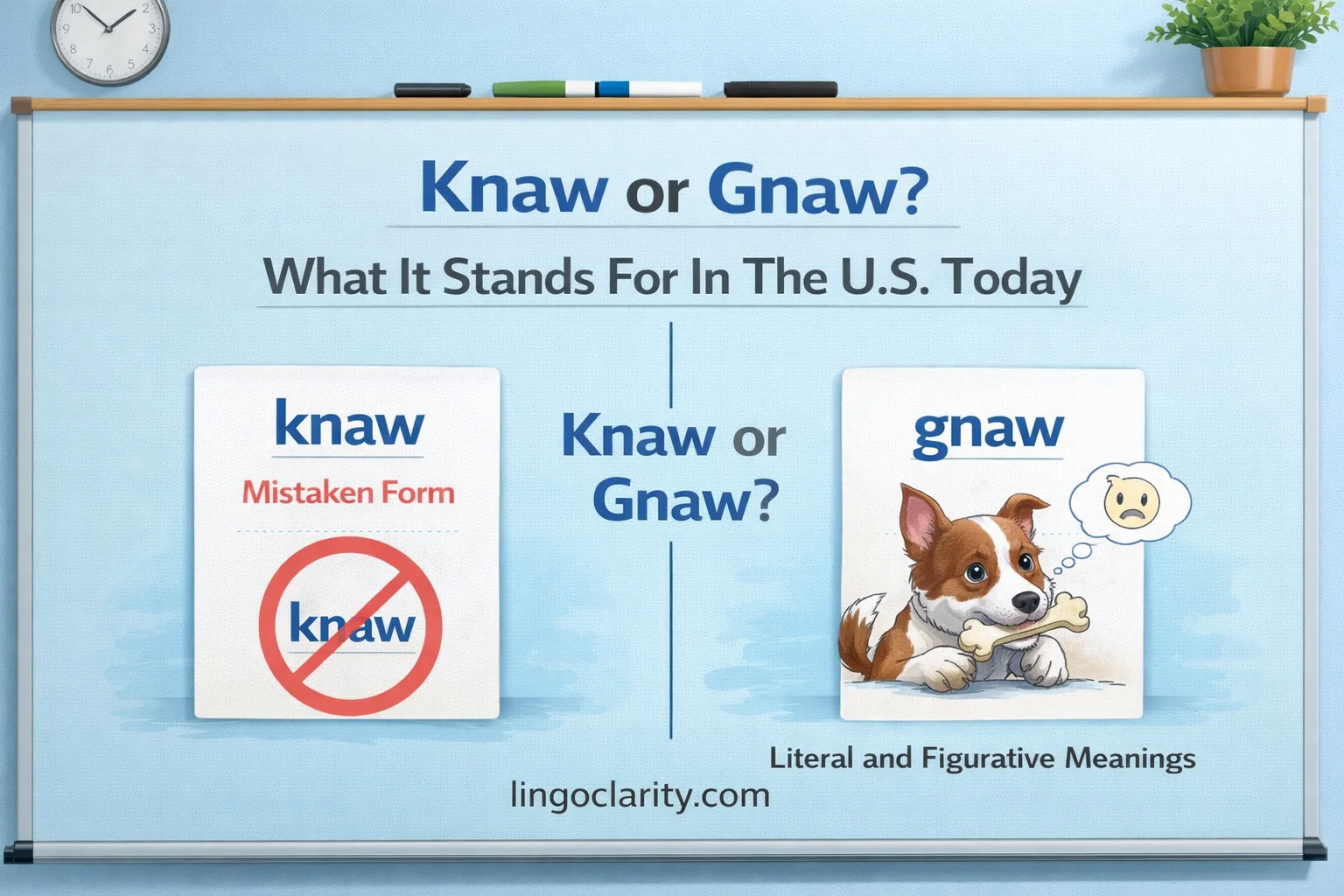
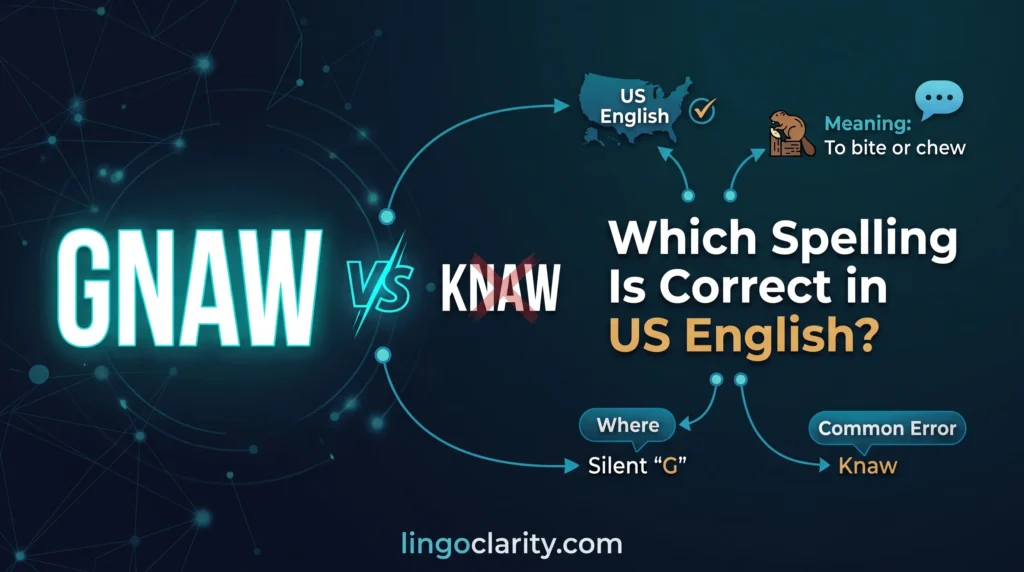
English keeps letters it stopped pronouncing centuries ago, and gnaw is one of the clearest examples. Many writers hesitate between gnaw and knaw because both spellings look possible once you hear the word out loud. Since the g is silent, gnaw sounds exactly like “naw,” and that missing sound is where the doubt starts.
There is another reason the wrong spelling feels right. English is full of words that open with a silent k — knee, knife, knot, know — so the brain reaches for kn- automatically. The trouble is that knaw has never been the standard modern spelling of this word.
The correct choice is simple: use gnaw when you mean to bite, chew, wear something away, or describe a feeling that slowly troubles someone. The word works in literal sentences, such as a dog gnawing a bone, and in figurative ones, such as guilt gnawing at someone’s mind.
I have edited this word out of client drafts more times than almost any other silent-letter mistake, and the fix always sticks once writers see the gn- family behind it. This guide explains the difference between gnaw and knaw, why writers confuse them, how to pronounce gnaw, which word forms you need, and how to use it correctly in everyday and professional writing.
Quick Answer
Gnaw is the correct spelling in modern English. It means to bite or chew something repeatedly, to slowly wear something away, or to describe a worry, fear, or doubt that keeps bothering someone over time. It comes from the Old English verb gnagan, and the g has been silent for centuries.
Knaw is not the standard modern spelling of gnaw. Although rare historical or dialect uses of knaw may appear in some older sources, modern dictionaries — including Merriam-Webster, Cambridge, and Oxford — list only gnaw. When you mean chewing, gradual damage, or persistent worry, gnaw is the spelling to use in every context: school, work, and published writing.
Memory trick: gnaw belongs to the gn- family — gnat, gnome, gnash, gnarled. If the word is about teeth or biting, the silent letter is g, not k.
TL;DR
- ✅ Gnaw is the correct and standard spelling.
- ❌ Knaw is not the normal spelling for biting, chewing, or worrying.
- 🦷 Gnaw has three main meanings: chewing, wearing away, and causing emotional worry.
- 🔤 Common forms: gnaw, gnaws, gnawed, gnawing — all keep the silent g.
- 🔊 The g is silent — gnaw sounds like “naw” (/nɔː/ in US English).
- 🧠 Memory hook: gnaw sits with gnat, gnome, gnash — never with knee or knife.
- 📚 Origin: Old English gnagan, meaning to bite or chew away.
What “Gnaw” Actually Means
Gnaw is a verb with three connected meanings, all related to repeated action or gradual effect.
- Literal chewing — to bite or nibble something again and again, usually with the teeth.
The beaver gnawed through the branch in minutes. - Gradual wearing-away — to damage or erode something little by little.
Rust had gnawed away at the old railing until it crumbled. - Figurative pressure — to trouble, worry, or bother someone emotionally.
A quiet doubt gnawed at her throughout the interview.
Why Writers Confuse Gnaw and Knaw
The confusion comes from pronunciation, not meaning. Gnaw begins with a silent g, so it sounds exactly like “naw.” When writers hear a word that does not match its spelling, they often try to spell it phonetically. That makes knaw look like a reasonable guess, especially because English already has silent kn- words such as know, knee, and knife.
The problem is that knaw is not the word most writers want. When the meaning involves biting, chewing, erosion, or worry, the correct spelling is always gnaw.
Is “Knaw” Ever Correct?
Knaw has very limited use and does not work as the standard spelling of gnaw. Modern writers should not use it for meanings such as “bite,” “chew,” “wear away,” or “worry.”
If you mean:
- a dog chewing a bone → gnaw
- rats damaging wood → gnaw
- doubt bothering someone → gnaw
Use gnaw, not knaw.
Gnaw vs. Knaw at a Glance
| Context | Correct Spelling | Why |
|---|---|---|
| A dog chewing a bone | Gnaw | Standard verb for repeated biting or chewing |
| Rats damaging wood or wire | Gnaw | Describes gradual damage caused by biting |
| Fear or doubt bothering someone | Gnaw | Common figurative use |
| School, work, or formal writing | Gnaw | The spelling readers expect |
| Trying to spell the sound you hear | Gnaw, not knaw | The silent g remains in writing |
How To Pronounce Gnaw
🔊 Gnaw (naw)
Gnaw is pronounced like “naw.” The g is completely silent, so the word sounds similar to law, paw, and saw in many American accents. The spelling keeps the old g, even though modern speakers do not pronounce it.
Word Forms of Gnaw
Gnaw is primarily used as a verb in modern English. Its common forms are:
| Form | Example |
|---|---|
| gnaw (base) | Puppies gnaw on things when they are teething. |
| gnaws (present) | The dog gnaws its bone every evening. |
| gnawed (past) | Rats had gnawed a hole in the box. |
| gnawing (present participle) | She had a gnawing feeling that something was wrong. |
The word also appears in common patterns such as:
- gnaw on something → bite or chew something repeatedly
- gnaw at something → slowly bother or worry someone
- gnaw through something → damage something by biting repeatedly
How To Use Gnaw in a Sentence
Literal Use (Biting or Chewing)
- The puppy gnawed the corner of the couch cushion while no one was watching.
- Squirrels can gnaw through plastic bird feeders with surprising speed.
- He gnawed on the cap of his pen during the meeting.
Gradual Damage Use (Wearing Something Away)
- Years of coastal wind had gnawed away at the wooden sign until the letters became difficult to read.
- Unchecked expenses can gnaw away at a company’s profits.
- Salt spray slowly gnaws at the metal railings along the boardwalk.
Figurative Use (Worry, Guilt, or Doubt)
- A small regret gnawed at him for weeks after the argument.
- The unanswered question kept gnawing at the team all weekend.
- Homesickness gnawed at her during her first few nights in a new city.
Words Often Confused With Gnaw
The silent g pattern causes confusion with several other words:
| Word | Meaning | Example |
|---|---|---|
| gnaw | To bite, chew, wear away, or worry | The mouse gnawed a hole in the wall. |
| gnash | To grind teeth, usually from anger or pain | He gnashed his teeth in frustration. |
| gnat | A tiny flying insect | A gnat kept circling the porch light. |
| knaw | Rare historical/dialect form, not standard for gnaw | Not used for chewing or worrying. |
| naw / nah | Informal spellings of “no” | “Naw, I’m good.” |
Synonyms and Antonyms for Gnaw
The best synonym depends on the meaning:
| Sense | Synonyms | Opposites |
|---|---|---|
| Literal chewing | chew, nibble, bite, chomp | — |
| Gradual damage | erode, corrode, wear away | repair, restore |
| Figurative worry | bother, trouble, trouble, prey on | soothe, relieve |
For example, rust gnaws away at metal, while guilt gnaws at someone’s mind.
Common Mistakes To Avoid
- Spelling it by sound: Because gnaw sounds like “naw,” some writers remove the silent g or replace it with knaw.
- Assuming knaw is another spelling of gnaw: It is not the standard modern spelling for biting, chewing, or worrying.
- Using gnaw only for animals: Gnaw also describes emotions, problems, and gradual damage.
- Writing incorrect forms: Avoid spellings like knawed or knawing. The correct forms are gnawed and gnawing.
A Simple Memory Trick
Remember:
You hear “naw,” but you write gnaw.
The silent g stays in every form:
- gnaw
- gnaws
- gnawed
- gnawing
Quick Self-Check Quiz
Fill in the blanks:
- The dog has been ______ on that bone for an hour.
- A nagging worry kept ______ at her all afternoon.
- Rats had ______ through the box in the garage.
- The correct past-tense form of gnaw is ______.
Answers:
- gnawing
- gnawing
- gnawed
- gnawed
The Bottom Line
Gnaw is the correct word for chewing, gradual damage, and persistent worry. It works in both everyday and formal writing.
Knaw does not serve as the standard spelling for the meanings most writers want. When you mean bite, wear away, or bother someone over time, choose gnaw.
Remember: the sound is “naw,” but the spelling is gnaw.
Frequently Asked Questions
Is knaw ever correct in English?
In rare historical or dialect contexts, you may find knaw, but modern writers should use gnaw when they mean “bite,” “chew,” “wear away,” or “cause worry.”
Is gnaw only used to describe animals?
No. Gnaw can describe physical chewing, gradual damage, and emotional pressure. For example, a beaver gnaws a branch, while guilt gnaws at someone’s mind.
Why is the g silent in gnaw?
The spelling comes from the word’s history. English kept the older g spelling even after speakers stopped pronouncing that sound.
What are the correct forms of gnaw?
The standard forms are:
- gnaw
- gnaws
- gnawed
- gnawing
Is knaw the British spelling of gnaw?
No. Gnaw is the standard spelling in both American and British English. Knaw is not a regional spelling of gnaw.
What is an easy way to remember gnaw?
Remember this sentence:
“You hear naw, but you write gnaw.”
What is the difference between gnaw and gnash?
Gnaw means to bite, chew, wear away, or worry. Gnash means to grind the teeth, usually because of anger, frustration, or pain.
