
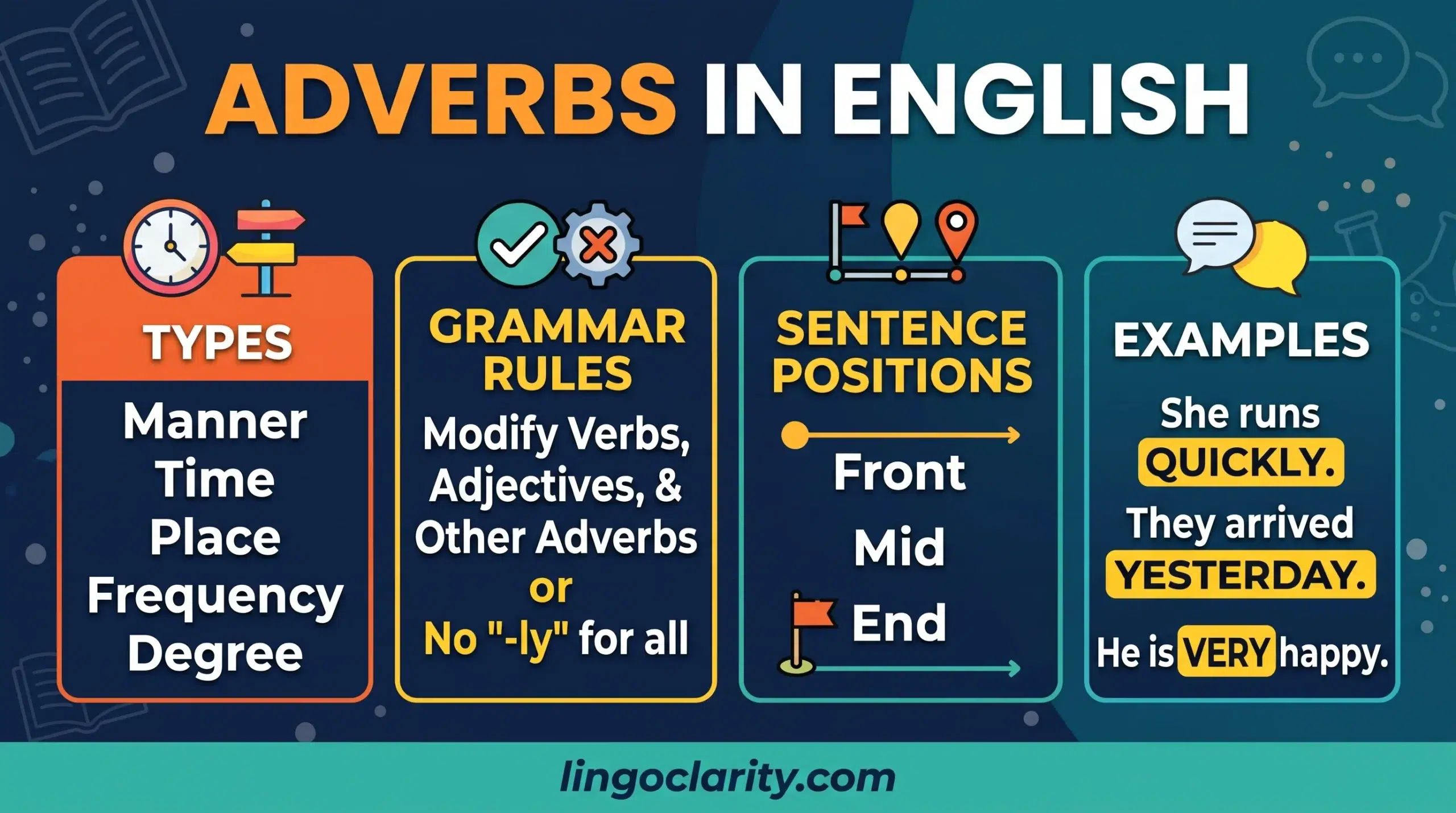
Adverbs are an important part of English grammar because they explain how, when, where, and how often something happens. However, many learners struggle to identify adverbs, distinguish them from adjectives, and place them correctly in sentences. Words such as hard and hardly, or late and lately, can also create confusion because their meanings are different.
An adverb modifies a verb, an adjective, another adverb, or sometimes an entire sentence. Understanding its types, formation, position, and usage can help you write clearer sentences and communicate more accurately.
This guide explains the main types of adverbs, their grammatical rules, adverb phrases and clauses, common mistakes, and practical examples.
What Is an Adverb?
An adverb is a word that modifies a verb, an adjective, another adverb, or sometimes an entire sentence. It provides additional information about an action, quality, or statement.
Consider these examples:
- The students worked carefully.
- The examination was extremely difficult.
- She speaks quite fluently.
- Fortunately, nobody was injured.
Here, carefully modifies the verb worked, while extremely describes the adjective difficult. Similarly, quite modifies the adverb fluently. Finally, fortunately expresses the speaker’s attitude toward the entire statement.
Adverbs make communication more specific by adding useful details to sentences.
Types of Adverbs
Adverbs are classified according to the information they provide. The following are common types used in everyday conversations and formal writing.
Adverbs of Manner
Adverbs of manner explain how an action is performed. They answer the question How?
Examples:
- The teacher explained the lesson clearly.
- She answered the question confidently.
- The driver stopped suddenly.
Adverbs of Time
Adverbs of time indicate when an action happens. They answer When?
Examples:
- We will submit the report tomorrow.
- She arrived early.
- I met him yesterday.
Other examples include today, soon, already, and later.
Adverbs of Place
Adverbs of place indicate where an action happens or the direction of movement. They answer Where?
Examples:
- Please sit here.
- The children are playing outside.
- She looked everywhere for her keys.
Adverbs of Frequency
Adverbs of frequency explain how often an action occurs. They answer How often?
Examples:
- He always arrives on time.
- She usually studies in the evening.
- They sometimes work in groups.
- He never misses a class.
Other examples include often, rarely, frequently, and occasionally.
Adverbs of Degree
Adverbs of degree indicate the intensity or extent of an action, quality, or condition.
Examples:
- The examination was very difficult.
- She is extremely intelligent.
- I almost missed the bus.
- The room is too small.
Common examples include very, quite, rather, almost, nearly, and enough.
Adverbs of Affirmation and Negation
Adverbs of affirmation express certainty or confirmation, while adverbs of negation communicate a negative meaning.
Affirmation:
- She will certainly attend the meeting.
- He has definitely completed the task.
Negation:
- She will not attend the meeting.
- He has never visited London.
- I hardly know him.
Interrogative Adverbs
Interrogative adverbs introduce questions about time, place, manner, or reason.
Examples:
- When will the lecture begin?
- Where do you live?
- Why did she leave early?
- How did you solve the problem?
Relative Adverbs
Relative adverbs introduce clauses that provide additional information about time, place, or reason. The most common are when, where, and why.
Examples:
- I remember the day when we first met.
- This is the university where my brother studied.
- That is the reason why she resigned.
Sentence Adverbs
Sentence adverbs express the speaker’s opinion, attitude, or reaction to an entire statement.
Examples:
- Fortunately, nobody was injured.
- Honestly, I did not expect this result.
- Unfortunately, the event was canceled.
Focusing Adverbs
Focusing adverbs draw attention to a particular word or part of a sentence.
Examples:
- Only Sarah completed the assignment.
- Even the teacher found the question difficult.
- I especially enjoyed the final chapter.
The position of a focusing adverb can change the meaning of a sentence.
Conjunctive Adverbs
Conjunctive adverbs connect ideas between independent clauses and show relationships such as contrast, result, or addition.
Examples:
- The weather was terrible; however, we continued our journey.
- She studied regularly; therefore, she passed the examination.
- The course is affordable; moreover, it offers practical training.
How Are Adverbs Formed?
Many adverbs are formed from adjectives, but their spelling can change depending on the ending.
Adding -ly
The most common method is to add -ly to an adjective.
| Adjective | Adverb |
|---|---|
| Careful | Carefully |
| Quick | Quickly |
| Slow | Slowly |
| Beautiful | Beautifully |
| Confident | Confidently |
Example: She writes carefully.
Changing -y to -ily
When an adjective ends in a consonant followed by -y, the y usually changes to i before adding -ly.
| Adjective | Adverb |
|---|---|
| Happy | Happily |
| Easy | Easily |
| Angry | Angrily |
| Heavy | Heavily |
Changing -le to -ly
When an adjective ends in -le, the final e is usually replaced by y.
| Adjective | Adverb |
|---|---|
| Gentle | Gently |
| Simple | Simply |
| Possible | Possibly |
| Comfortable | Comfortably |
Adverbs with the Same Form as Adjectives
Some words have identical adjective and adverb forms.
- He is a fast runner. (Adjective)
- He runs fast. (Adverb)
- She attended the early session. (Adjective)
- She arrived early. (Adverb)
Other examples include hard, late, and straight.
Irregular Forms
Some adverbs have forms that must be learned separately.
| Adjective | Adverb |
|---|---|
| Good | Well |
| Fast | Fast |
| Hard | Hard |
| Early | Early |
| Late | Late |
Example:
- She is a good speaker.
- She speaks well.
Position of Adverbs in Sentences
The position of an adverb depends on its type, meaning, and grammatical function. Adverbs commonly appear in three main positions.
Front Position
An adverb appears at the beginning of a sentence, often to provide emphasis or introduce a comment.
Examples:
- Yesterday, we visited the museum.
- Fortunately, everyone arrived safely.
- Usually, she studies in the morning.
Mid Position
Adverbs appear in the middle of a sentence, usually around the main verb or auxiliary verb.
Examples:
- She always arrives early.
- They have never visited London.
- He is usually busy.
Frequency adverbs generally appear before the main verb but after the verb be. When auxiliary verbs are present, they usually follow the first auxiliary.
End Position
Many adverbs appear at the end of a sentence, especially adverbs of manner, place, and time.
Examples:
- She speaks politely.
- The children are playing outside.
- We will meet tomorrow.
Position of Adverbs of Degree
Adverbs of degree usually appear before the adjective or adverb they modify.
Examples:
- The lecture was extremely useful.
- She speaks very clearly.
However, enough usually comes after an adjective or adverb.
- The explanation was clear enough.
- He did not speak loudly enough.
Order of Adverbs in a Sentence
When a sentence contains multiple adverbial expressions, their order can affect its natural flow.
A common order is:
Manner + Place + Time
Example:
She worked carefully in the office yesterday.
- Carefully = Manner
- In the office = Place
- Yesterday = Time
Another example:
The students studied quietly in the library last night.
However, this order is a general guideline rather than an unbreakable rule. Writers can change the arrangement for emphasis or clarity.
Adverb Phrases
An adverb phrase is a group of words that performs the function of an adverb. It modifies a verb, adjective, or another adverb by providing information about manner, time, place, or degree.
Examples:
- She completed the assignment with great care.
- We will leave in a few minutes.
- He spoke in a very polite manner.
- The children played near the river.
In the first example, with great care explains how she completed the assignment. In the second, in a few minutes indicates when the action will happen.
Unlike a single adverb, an adverb phrase contains multiple words working together.
Adverb Clauses
An adverb clause is a dependent clause that modifies a verb, adjective, or entire independent clause. It usually begins with a subordinating conjunction such as because, although, when, while, if, or since.
Common types include:
| Type | Example |
|---|---|
| Time | Call me when you arrive. |
| Place | Sit wherever you feel comfortable. |
| Reason | She stayed home because she was sick. |
| Condition | You will succeed if you work hard. |
| Contrast | Although it was raining, we continued walking. |
| Purpose | He spoke slowly so that everyone could understand. |
An adverb clause contains a subject and a verb but cannot usually stand alone as a complete sentence.
Adverbs and Adjectives: Understanding the Difference
One common grammar problem is confusing adjectives with adverbs. An adjective describes a noun or pronoun, whereas an adverb modifies a verb, adjective, another adverb, or sometimes an entire sentence.
Compare:
- She is a careful student.
- She works carefully.
In the first sentence, careful describes the noun student. In the second, carefully explains how she works.
| Adjective | Adverb |
|---|---|
| Beautiful | Beautifully |
| Careful | Carefully |
| Fluent | Fluently |
| Quiet | Quietly |
| Successful | Successfully |
Some words can function as both adjectives and adverbs without changing their spelling.
- He is a fast runner. (Adjective)
- He runs fast. (Adverb)
Always identify a word by its function in the sentence rather than its spelling alone.
Commonly Confused Adverbs
Some English words look similar but have different meanings.
Hard and Hardly
Hard means making a serious effort, while hardly means almost not.
- He works hard to support his family.
- He hardly works these days.
Late and Lately
Late means after the expected time, while lately means recently.
- She arrived late for the meeting.
- I have been busy lately.
Near and Nearly
Near indicates closeness, while nearly means almost.
- The university is near my house.
- We have nearly completed the project.
Good and Well
Good is generally an adjective, while well commonly functions as an adverb.
- She is a good teacher.
- She teaches well.
Well can also describe someone’s health: I am feeling well today.
Slow and Slowly
Slow is generally an adjective, whereas slowly is the standard adverb form.
- It was a slow journey.
- The car moved slowly.
However, slow is also used informally as an adverb in expressions such as “Drive slow.”
Comparison of Adverbs
Some adverbs have positive, comparative, and superlative forms. These forms help compare how actions are performed.
| Positive | Comparative | Superlative |
|---|---|---|
| Fast | Faster | Fastest |
| Hard | Harder | Hardest |
| Early | Earlier | Earliest |
| Carefully | More carefully | Most carefully |
| Efficiently | More efficiently | Most efficiently |
Examples:
- She works faster than her colleague.
- He completed the task more carefully than before.
- Ali performed most confidently.
Some adverbs have irregular comparison forms.
| Positive | Comparative | Superlative |
|---|---|---|
| Well | Better | Best |
| Badly | Worse | Worst |
| Little | Less | Least |
| Far | Farther/Further | Farthest/Furthest |
Common Mistakes in Using Adverbs
Recognising common errors can improve sentence construction and make communication more effective.
| No. | Common Mistake | Incorrect Sentence | Correct Sentence | Explanation |
|---|---|---|---|---|
| 1 | Using an adjective instead of an adverb | She speaks English fluent. | She speaks English fluently. | Fluently describes how she speaks. |
| 2 | Using an adverb instead of an adjective | He is a carefully driver. | He is a careful driver. | Careful describes the noun driver. |
| 3 | Confusing hard and hardly | She studies hardly for her examinations. | She studies hard for her examinations. | Hard means making a serious effort, while hardly means almost not. |
| 4 | Incorrect placement of frequency adverbs | She goes always to the library. | She always goes to the library. | Adverbs of frequency usually come before the main verb. |
| 5 | Using double comparison | He works more faster than his colleague. | He works faster than his colleague. | Do not use more with the comparative form faster. |
| 6 | Confusing good and well | She performed good in the examination. | She performed well in the examination. | Well describes how she performed. |
Using Adverbs Effectively in Academic and Professional Writing
Adverbs can make academic and professional communication more informative by explaining how actions are performed and how strongly statements are expressed.
Compare:
- General: The researcher examined the results.
- More informative: The researcher carefully examined the results.
Another example:
- General: The company responded to the complaint.
- More informative: The company responded promptly to the complaint.
However, excessive adverb use can make writing wordy or less precise.
Wordy: The researcher very carefully and extremely thoroughly examined the results.
Clearer: The researcher thoroughly examined the results.
Choose adverbs that add meaningful information instead of using several unnecessary modifiers. Precise verbs and carefully selected adverbs generally produce clearer writing.
Practice Exercises with Answers
Test your understanding of adverbs. Select the correct answer for each question and submit your answers to see your score.
Your Quiz Results
Conclusion
Adverbs play an important role in English grammar because they provide additional information about actions, qualities, and statements. They describe manner, time, place, frequency, and degree. They can also introduce questions, connect clauses, and express certainty or negation.
To use adverbs correctly, learners should understand their types, formation, position, and comparison. They should also distinguish adverbs from adjectives and learn the differences between commonly confused words such as hard and hardly, late and lately, and good and well.
Effective communication does not require using as many adverbs as possible. It requires choosing the right words and placing them correctly so that every sentence remains clear, accurate, and meaningful.
