
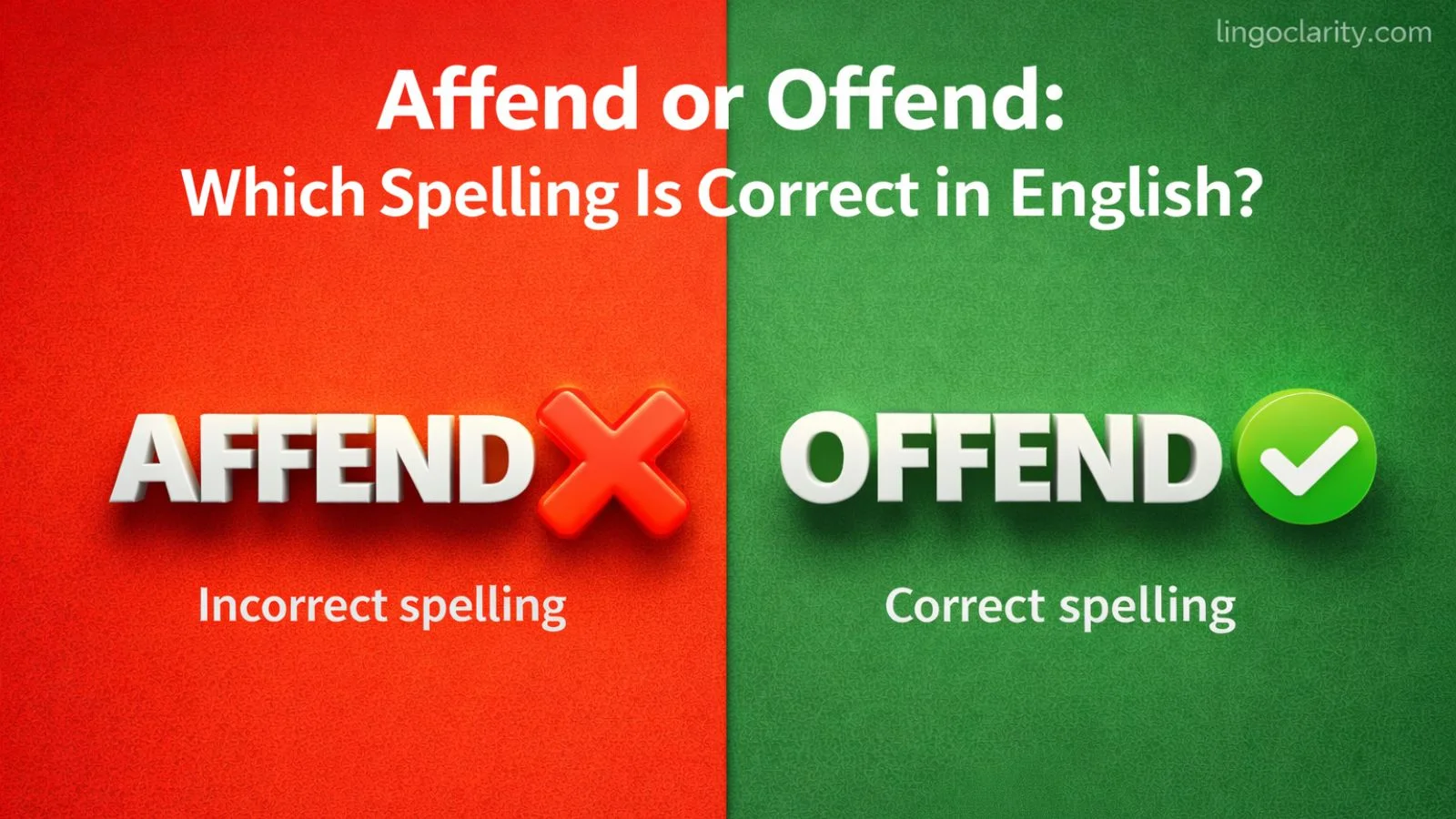
People often confuse affend and offend because the two words look and sound similar. This mistake can appear in text messages, social media comments, school assignments, emails, and other everyday writing.
The confusion usually happens because English pronunciation does not always make spelling obvious. Some people write words based on how they hear them, while others type quickly and miss the correct letters.
Choosing the right spelling helps your writing look clear and professional. A single incorrect letter can distract readers and make a message harder to understand.
This guide explains the difference between affend and offend, including the correct spelling, meaning, pronunciation, examples, common mistakes, word forms, and usage in American English.
Quick Answer
Offend is the correct English spelling. Affend is not a standard English word and is usually a spelling mistake. Use offend when you mean to hurt someone’s feelings, insult someone, or break a rule or law. In American English, offend is the only accepted spelling for normal writing.
Key Differences Between Affend and Offend
Although affend and offend look similar, only one is correct in standard English.
| Word | Correct or Incorrect | Meaning | Usage |
|---|---|---|---|
| Offend | Correct | To upset someone, insult someone, or break a rule | Used in everyday, academic, professional, and formal writing |
| Affend | Incorrect | Not a recognized English word | Usually a spelling mistake or typo |
Main Difference
The main difference is simple:
Offend = correct English word
Affend = incorrect spelling
The word offend is used by native speakers, dictionaries, schools, businesses, and professional writers. The spelling affend is not accepted in standard English.
If you write “affend” in an essay, article, email, or workplace message, most readers will assume you made a spelling error.
What Does “Offend” Mean?
The verb offend has different meanings depending on the context.
Offend Meaning: Hurt Someone’s Feelings
The most common meaning of offend is to make someone feel upset, insulted, or disrespected.
Examples:
- I did not mean to offend you with my comment.
- His joke accidentally offended some people.
- She apologized because she did not want to offend anyone.
Offend Meaning: Insult Someone
Sometimes offend means saying or doing something that feels disrespectful.
Examples:
- The remark was not meant to offend anyone.
- Some viewers felt the advertisement could offend certain groups.
Offend Meaning: Break a Rule or Law
In formal or legal contexts, offend can mean breaking a rule, law, or accepted standard.
Examples:
- The action may offend company policies.
- Repeat offenders can receive stronger penalties.
Why Does “Affend” Appear?
The spelling affend usually appears because of confusion, not because it has a separate meaning.
Common reasons include:
- Fast typing: People may accidentally type “a” instead of “o.”
- Sound confusion: The first sound in “offend” can be unclear.
- Similar spelling patterns: Words like attend, defend, and amend may influence incorrect spelling.
- Autocorrect problems: Some typing tools may not recognize every mistake.
Some people may use affend as a joke spelling online. However, in normal writing, it should be corrected to offend.
How to Pronounce Offend
The word offend is pronounced with stress on the second syllable:
uh-FEND
The first part sounds softer, while the second part receives more emphasis.
Offend Word Forms
Understanding related forms helps avoid mistakes:
| Form | Example |
| Offend | I did not want to offend her. |
| Offended | He felt offended by the comment. |
| Offending | The offending message was removed. |
| Offender | The offender broke the law. |
| Offense (US) | The comment caused offense. |
| Offence (UK) | The comment caused offence. |
British vs American English: Offense or Offence?
The verb spelling is the same in both English styles:
✅ offend
❌ affend
The difference appears in the noun form.
| English Style | Correct Noun |
| American English | offense |
| British English | offence |
Examples:
American English:
- That joke caused serious offense.
British English:
- That joke caused serious offence.
For a United States audience, offense is the preferred spelling.
Common Mistakes With Affend and Offend
Mistake 1:
❌ I didn’t mean to affend you.
✅ I didn’t mean to offend you.
Mistake 2:
❌ She was affended by his words.
✅ She was offended by his words.
Mistake 3:
❌ His comment may affend people.
✅ His comment may offend people.
Mistake 4:
❌ I got offend by the joke.
✅ I got offended by the joke.
The past tense requires -ed:
offend → offended
Everyday Examples of Offend
Casual Conversation
“I’m sorry. I didn’t mean to offend you.”
Social Media
“Everyone has different opinions, but my goal is not to offend anyone.”
Workplace Communication
“If my message came across as harsh, I apologize. That was not my intention.”
School Writing
“Writers should choose words carefully so they do not offend their audience.”
Offend vs Affend Comparison Table
| Context | Correct Choice | Reason |
| School essay | Offend | Standard spelling |
| Work email | Offend | Professional and recognized |
| Social media post | Offend | Clear for readers |
| Apology message | Offend | Common expression |
| Legal writing | Offend | Used for rule-breaking meanings |
| Online joke spelling | Affend (avoid) | Usually seen as an error |
Which One Should You Use?
Always use offend in:
- School assignments
- Professional emails
- Articles and blogs
- Business communication
- Social media posts
Avoid affend unless you are specifically showing an example of a spelling mistake.
FAQs
Is affend a real word?
No. Affend is not a standard English word. It is usually a misspelling of offend.
What does offend mean?
Offend means to upset, insult, or hurt someone’s feelings. It can also mean breaking a rule, law, or standard.
How do you pronounce offend?
Most Americans pronounce offend as “uh-FEND,” with stress on the second syllable.
What is the past tense of offend?
The past tense is offended.
Example:
- She was offended by the comment.
Is offense or offence correct?
Both are correct depending on English style.
- American English: offense
- British English: offence
Why do people write affend instead of offend?
People usually write affend because of fast typing, pronunciation confusion, or spelling mistakes.
Mini Quiz
- Which spelling is correct?
A) Affend
B) Offend
Answer: Offend
- Complete the sentence:
“I didn’t mean to ______ you.”
Answer: offend
- What is the past tense of offend?
Answer: offended
- Which spelling is preferred in American English?
A) Offence
B) Offense
Answer: Offense
- Is affend a standard English word?
Answer: No
Conclusion
Affend or offend has a clear answer: offend is the correct spelling. The word means to upset someone, insult someone, or break a rule depending on the context.
Although affend may appear in online typing mistakes or jokes, it is not accepted standard English. Use offend in school, work, professional writing, and everyday communication.
Choosing the correct spelling helps your writing stay clear, accurate, and trustworthy.

4 thoughts on “Affend or Offend: Correct Spelling, Meaning & Examples”
Comments are closed.