
Many English learners and even experienced writers stop when they reach afterward and afterwards. Both forms look correct. Both appear in real writing. Both mean the same basic thing. So it is easy to wonder whether one is more formal, more modern, or simply more correct.
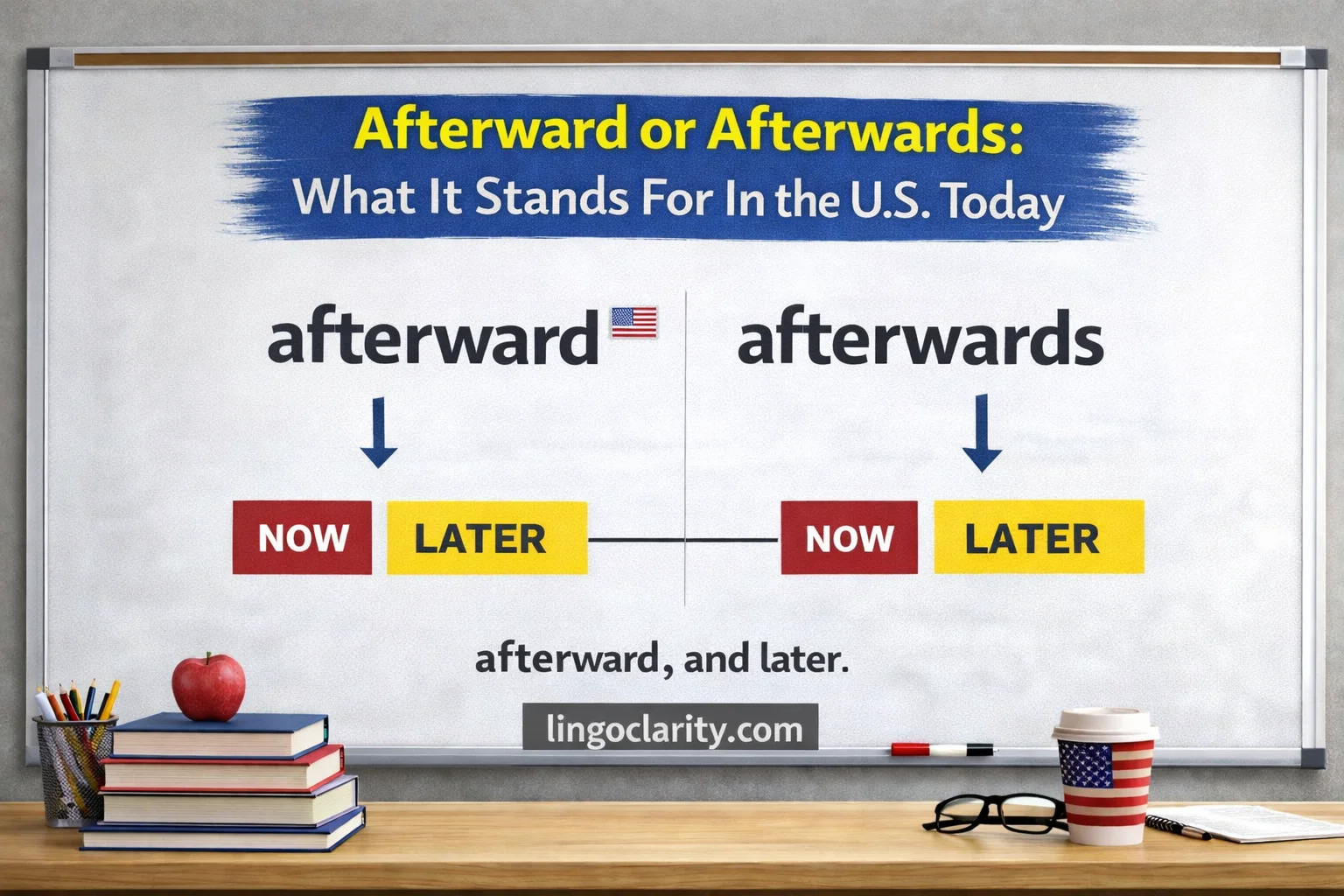
For a US audience, the answer is straightforward. Afterward is usually the better choice in American English. Afterwards is also correct, but it is more strongly associated with British English. Current dictionary guidance still reflects that pattern: major references treat both forms as standard adverbs meaning “later,” while marking afterward as the usual North American form and afterwards as especially British or mainly UK.
That means this is not a meaning problem. It is mostly a regional usage question. If you are writing for readers in the United States, choose afterward and stay consistent from start to finish.
Quick Answer
Both afterward and afterwards mean later or after that. In US English, afterward is the more natural and more typical choice. In British English, afterwards is more common. Both are standard, but afterward usually fits American writing better.
Here is the simple rule:
- Write afterward for a US audience.
- Write afterwards for a UK audience.
- For a global audience, either form can work, but pick one and use it consistently.
Simple Definition
Afterward means at a later time, later, or after that.
Afterwards means the same thing.
Both words function as adverbs, which means they describe when something happened. Dictionaries define them this way, and Merriam-Webster even lists afterwards as a variant of afterward.
Examples:
- We finished dinner and talked afterward.
- She felt nervous before the interview but relaxed afterwards.
The meaning stays the same in both examples.
Afterward Vs Afterwards: The Main Difference
The main difference is not meaning. The main difference is usage preference by region.
In American English, writers usually prefer afterward. In British English, writers more often choose afterwards. Oxford Learner’s Dictionaries states this directly by labeling afterwards as especially British and noting that North American English usually uses afterward. Cambridge also labels afterward as the US form while treating afterwards as mainly UK in that entry.
So when people ask, “Which is correct?” the best answer is this:
- Both are correct
- Afterward is usually better for US English
- Afterwards is more common in British English
That is why this pair confuses people. The words are so close in meaning that many learners expect a grammar difference, but the real issue is audience and style.
Why People Confuse These Words
People confuse afterward and afterwards because they can replace each other in most sentences without changing the meaning.
Look at these two examples:
- We went out for coffee, and afterward we walked home.
- We went out for coffee, and afterwards we walked home.
The message does not change. The sequence does not change. The tone barely changes. Only the regional feel changes.
That is why this pair is tricky. It feels like there should be a deeper rule, but there usually is not. In most cases, you are simply choosing the form that best matches your readers.
Which Form Sounds More Natural In US English
If your audience is American, afterward usually looks cleaner and more natural.
It appears more in US dictionaries and is the safer default for:
- blog posts
- school writing
- workplace emails
- business reports
- web copy
- educational content
- casual conversation in writing
That does not mean afterwards is wrong in the United States. It only means it is less typical. A US reader will still understand it. However, if your goal is natural American style, afterward is usually the stronger choice.
Is One More Formal Than The Other
Usually, no.
This pair is not mainly about formality. It is about regional preference. You can use afterward in formal writing, casual writing, academic writing, and business writing. The same is true for afterwards.
What changes is what sounds more local and more expected.
For example:
- In a US business memo, afterward will usually feel more natural.
- In a UK article or email, afterwards may feel more familiar.
So do not treat this as a formal-versus-informal choice. Treat it as an audience choice.
How To Use Afterward In A Sentence
Use afterward when you want to say that something happened later.
Common sentence patterns include:
- Afterward + comma + main clause
- Main clause + afterward
- Soon afterward
- Shortly afterward
- Not long afterward
Examples:
- Afterward, we reviewed the notes and made a plan.
- She called me afterward to explain what happened.
- The team met at noon. Soon afterward, they announced the decision.
- He apologized shortly afterward.
- Not long afterward, everyone understood the problem.
These patterns are natural, clear, and common in American writing.
How To Use Afterwards In A Sentence
Use afterwards in the same way if you are writing for a British audience or if you prefer that form for stylistic reasons.
Examples:
- Afterwards, they went out for lunch.
- She felt better afterwards.
- We spoke again shortly afterwards.
- The lights went out, and the alarm sounded soon afterwards.
Again, the meaning does not change. The difference is mainly the regional preference.
When You Need After Instead
This is where many writers make the real mistake.
Sometimes the problem is not afterward versus afterwards. Sometimes the real problem is that the sentence actually needs after.
Use after before a noun phrase:
- We left after lunch.
- She called after the meeting.
Use after before a clause:
- Call me after you get home.
- We went out after the rain stopped.
Cambridge’s grammar guidance makes this distinction clear: after works as a preposition and conjunction, while afterwards works as an adverb.
So these are wrong:
- We left afterward lunch.
- Call me afterwards you get home.
Those sound wrong because afterward and afterwards do not introduce a noun phrase or clause in the way after does.
Real-Life Example
Imagine this short workplace situation:
Maria finishes a presentation at 10:00 a.m. She answers questions, sends the updated file, and then writes a follow-up email.
A natural US version would be:
“Maria finished the presentation at 10:00. Afterward, she emailed the revised slides to the team.”
A British-leaning version could be:
“Maria finished the presentation at 10:00. Afterwards, she emailed the revised slides to the team.”
Both are correct. But if the article, email, or website is written for American readers, the first version is the smoother choice.
Synonyms
The closest synonyms for afterward and afterwards include:
- later
- after that
- subsequently
- then
- thereafter
These do not all sound identical in every sentence, but they often express a similar idea.
Examples:
- We went to lunch and later returned to the office.
- She explained the issue, and after that everyone understood.
- The company released a statement and subsequently changed its policy.
- He called me then, not before.
- They met once and thereafter worked together regularly.
Among these, later and after that are usually the plainest and most conversational. Subsequently and thereafter sound more formal.
Opposites
There is no single perfect opposite in every sentence, but the most useful opposites are:
- before
- earlier
- beforehand
- previously
Examples:
- We talked before, not afterward.
- She arrived earlier, not afterward.
- Please read the instructions beforehand.
- He had spoken to her previously.
Choose the opposite that best fits the sentence.
Sentence Usage Examples
Here are more natural examples using afterward in US English:
- I was upset during the meeting, but I felt calmer afterward.
- We watched the game and went out for burgers afterward.
- The teacher explained the rule, and afterward the exercise made sense.
- He was tired during the trip but laughed about it afterward.
- We signed the lease and celebrated afterward.
Now compare them with afterwards:
- I was upset during the meeting, but I felt calmer afterwards.
- We watched the game and went out for burgers afterwards.
- The teacher explained the rule, and afterwards the exercise made sense.
- He was tired during the trip but laughed about it afterwards.
- We signed the lease and celebrated afterwards.
Every sentence still works. In US writing, though, the afterward versions usually feel more natural.
Common Mistakes
Treating One Form As Always Wrong
A common mistake is thinking that one form is correct and the other is always wrong.
That is not true. Both forms are standard English. The better question is which one suits your audience.
Quick fix:
Use afterward for US English and afterwards for British English.
Mixing Both Forms In One Article
Writers sometimes use afterward in one paragraph and afterwards in the next without any reason.
This makes the writing feel inconsistent.
Quick fix:
Choose one version based on your audience and use it throughout the piece.
Using Afterward Or Afterwards Before A Noun
This is a grammar mistake.
Wrong:
- We met afterward lunch.
Right:
- We met after lunch.
Quick fix:
If a noun comes right after the word, you probably need after.
Using Afterward Or Afterwards Before A Clause
This is also a grammar mistake.
Wrong:
- Call me afterwards you arrive.
Right:
- Call me after you arrive.
Quick fix:
If a full clause follows, use after.
Confusing Afterward With Afterword
This mistake happens more often than people expect.
Afterward is an adverb meaning later.
Afterword is a noun meaning a concluding section at the end of a book. Merriam-Webster defines afterword as an epilogue or concluding section.
Examples:
- We talked afterward.
- I read the author’s afterword at the end of the book.
A Simple Memory Trick
Use this quick memory trick:
- Afterward = the usual US choice for “later”
- Afterwards = the same meaning, but more British in feel
- After = use it before a noun or clause
- Afterword = a section at the end of a book
If you remember only one thing, remember this:
For American readers, default to afterward.
Which One Should You Use In Different Situations
Here is the practical rule by context:
For US blogs, websites, lessons, and business writing:
Use afterward
For UK-focused writing:
Use afterwards
For international writing with no house style:
Either can work, but be consistent
For sentences like “after lunch” or “after we arrived”:
Use after
That simple approach will solve nearly every case.
Final Verdict
If you are writing for a US audience, afterward is usually the better choice.
It is the more typical American form, it sounds natural in modern US writing, and it keeps your style aligned with what American readers expect. Afterwards is not wrong. It is simply less common in US English and more at home in British English. Dictionaries and learner references continue to reflect that distinction today.
So the best rule is simple:
Choose afterward for American English.
Choose afterwards for British English.
Choose one form and stay consistent.
FAQs
Is afterwards wrong in American English?
No. Afterwards is not wrong in American English. American readers will understand it easily. It is just less typical than afterward in US usage.
Do afterward and afterwards mean the same thing?
Yes. In normal use, they both mean later or after that. The difference is mainly regional preference, not meaning.
Which form should I use in a US school essay?
Use afterward. It is the safer and more natural choice for American academic and general writing.
Can I use afterward before a noun?
No. Use after before a noun. Write after lunch, not afterward lunch. Cambridge’s grammar guidance distinguishes after from afterwards in exactly this way.
What is the difference between afterward and afterword?
Afterward means later.
Afterword is a noun that means a concluding section at the end of a book.
Is afterward more formal than afterwards?
Not usually. The choice is mainly about regional style, not formality. In most cases, audience matters more than tone level.
