
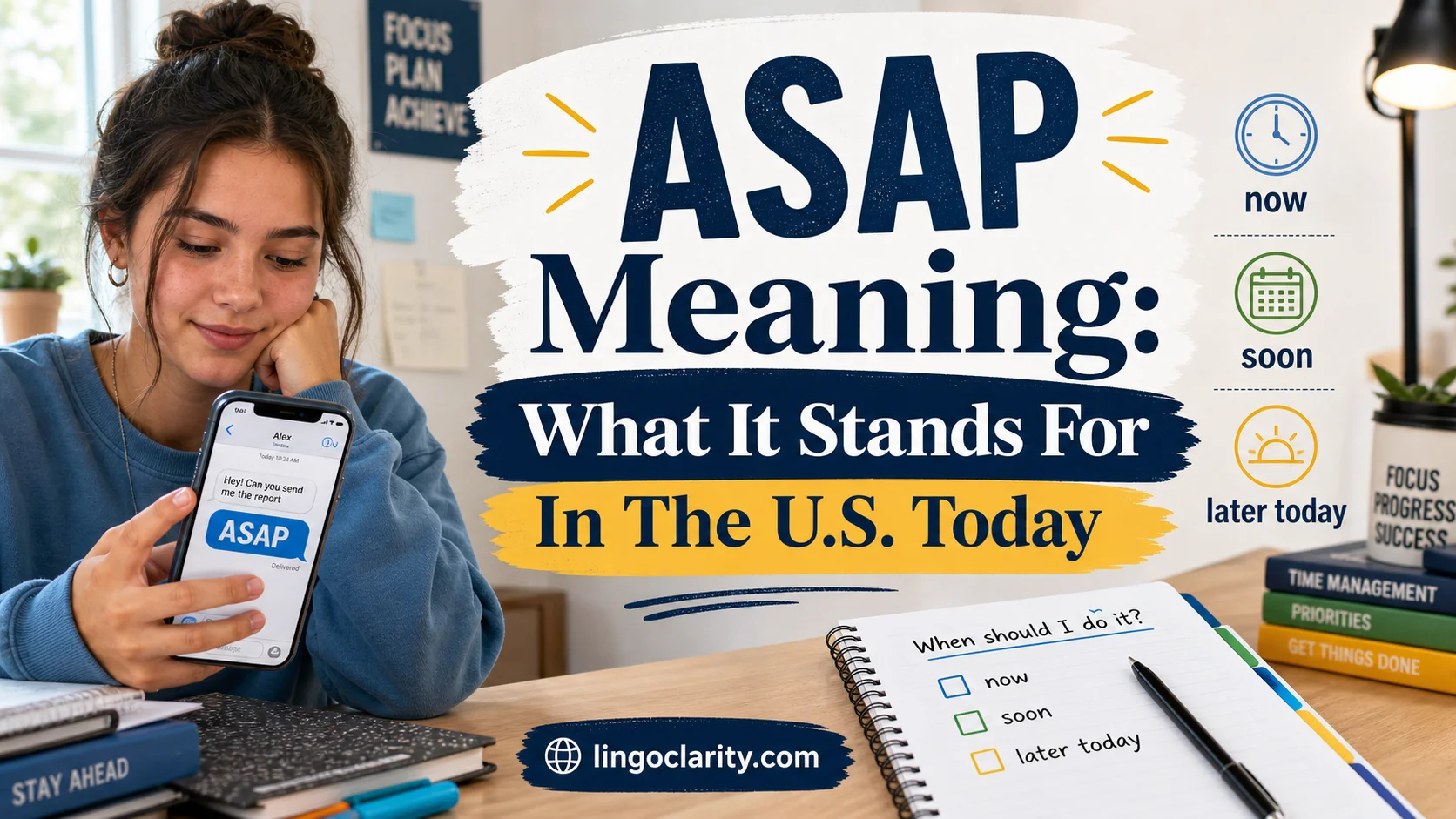
ASAP meaning in English is “as soon as possible.” People use ASAP when they want something done quickly, but the abbreviation does not give a clear deadline.
In real messages, ASAP usually means “please do this at the earliest practical time.” It may mean right now, later today, or simply sooner than usual, depending on the situation. That is why ASAP can be useful, but it can also be confusing.
The best rule is simple: use ASAP for urgency, but use an exact time when timing matters.
Quick Answer
ASAP stands for “as soon as possible.” It asks for quick action, a quick reply, or quick attention. Major dictionaries define it as “as soon as possible,” and some also define it as acting “without delay” or “promptly.”
Example:
“Please call me ASAP.”
Meaning:
“Please call me as soon as you can.”
Better when timing matters:
“Please call me by 4 p.m. today.”
Key Points About ASAP
ASAP means “as soon as possible.”
The abbreviation shows urgency.
However, it does not give an exact time.
Without context, the phrase can sound pushy.
You can use it in texts, chats, emails, school messages, and work messages.
For important requests, add a deadline.
For polite requests, add “please,” a reason, or a softer phrase.
What ASAP Means In Plain English
ASAP is an abbreviation for “as soon as possible.” It means someone wants something to happen quickly and without unnecessary delay.
In plain English, ASAP means:
“Do this soon.”
“Reply quickly.”
“Handle this as soon as you can.”
“Please do not delay.”
However, ASAP does not tell the reader exactly when the action should happen. A message like “Send this ASAP” may leave the other person wondering whether you mean in five minutes, before lunch, by the end of the day, or sometime this week.
That is the main weakness of ASAP: it sounds urgent, but it is not precise.
How To Pronounce ASAP
ASAP has two common pronunciations in American English.
You can say each letter:
“A-S-A-P”
You can also say it like one word:
“AY-sap”
Both pronunciations are accepted. Saying each letter sounds clearer and more careful. Saying “AY-sap” sounds faster and more casual. Merriam-Webster and Oxford both list the letter-by-letter pronunciation and the one-word pronunciation.
Is ASAP Slang?
ASAP is often used in texting and casual messages, so many people think of it as slang. However, it is not only slang.
You can see ASAP in:
Texts
Emails
School messages
Work chats
Customer service messages
Project updates
Medical or office instructions
Business communication
It is more accurate to call ASAP a common abbreviation. It can feel casual, but it also appears in professional communication. In very formal writing, though, the full phrase “as soon as possible” or a specific deadline usually sounds more polished.
How To Use ASAP Correctly
ASAP usually comes near the action you want done quickly. Most often, it appears at the end of a sentence.
Examples:
“Please send the file ASAP.”
“Call me ASAP.”
“We need your answer ASAP.”
“I’ll finish the form ASAP.”
“The office needs the signed document ASAP.”
You can also place it in the middle of a sentence:
“We need to leave ASAP to catch the train.”
“She asked me to reply ASAP.”
“The issue should be fixed ASAP.”
These examples are grammatically natural. However, they are not always clear. If the person needs an exact time, give one.
Less clear:
“Please send the file ASAP.”
Clearer:
“Please send the file by 3 p.m. today.”
Best for work:
“Please send the file by 3 p.m. today so I can include it in the final report.”
When To Use ASAP
Use ASAP when speed truly matters. It works best when a delay could create a problem.
Good reasons to use ASAP include:
A late form needs to be submitted.
A ride, call, or meeting depends on a quick reply.
A customer is waiting.
A team member is blocked.
A safety issue needs attention.
A deadline is close.
A mistake needs to be fixed before something goes live.
ASAP can also sound natural when you are talking about your own action.
Examples:
“I’ll send the receipt ASAP.”
“You’ll hear back from me ASAP.”
“The typo will be fixed ASAP.”
“I can check the order ASAP.”
These sentences usually sound less demanding because you are not pressuring someone else. You are promising to act quickly.
When To Avoid ASAP
Avoid ASAP when the task is not truly urgent. If everything is marked ASAP, the word loses meaning.
Also avoid ASAP when you actually mean “whenever you have time.” Those phrases do not mean the same thing.
Confusing:
“Reply ASAP when you have time.”
Better:
“Reply when you have time.”
Avoid ASAP in very formal letters, legal messages, sensitive customer communication, or high-stakes workplace requests where the exact timing matters. In those cases, a deadline is clearer and more respectful.
Weak:
“Please return the contract ASAP.”
Stronger:
“Please return the signed contract by Friday at 5 p.m. ET.”
Does ASAP Sound Rude?
ASAP is not automatically rude. Still, it can sound rude when it feels like a command.
The problem is usually not the abbreviation itself. The problem is vagueness. “ASAP” gives pressure without giving a clear deadline. That can make the reader feel rushed, blamed, or forced to drop other work.
Blunt:
“Send this ASAP.”
Better:
“Please send this by 2 p.m. today so I can prepare for the meeting.”
Blunt:
“Reply ASAP.”
Better:
“Could you reply by noon if possible? I need to confirm the schedule.”
Blunt:
“I need this ASAP.”
Better:
“This is time-sensitive. Please send it by end of day.”
A clear deadline and a short reason usually sound better than ASAP alone. Grammarly, HubSpot, and Inki all emphasize the same core point: specificity reduces confusion and makes urgent requests easier to prioritize.
ASAP In Texts, Emails, School, And Work
The tone of ASAP changes by setting, audience, and urgency. A short text to a friend may sound normal, while the same phrase in a work email can feel too blunt without a deadline or reason.
| Context | Natural Example | Better Choice When Timing Matters |
|---|---|---|
| Text To A Friend | “Call me ASAP.” | “Call me before 8 if you can.” |
| School Message | “Submit the form ASAP.” | “Submit the form by Friday.” |
| Work Chat | “Can you check this ASAP?” | “Can you check this before the 2 p.m. meeting?” |
| Email To A Client | “Please reply ASAP.” | “Please reply by Thursday at noon.” |
| Emergency | “Come ASAP.” | “Come now” or give exact instructions. |
ASAP works best when the urgency is already clear to both people. When the timing could be misunderstood, add a specific time or date.
ASAP Vs. Immediately, Soon, And A Deadline
ASAP is often confused with other timing words. These words are related, but they are not equal.
| Phrase | Meaning | Urgency Level | Clarity |
|---|---|---|---|
| Soon | In a short time | Low To Medium | Low |
| As Soon As You Can | When you are able | Medium | Medium |
| ASAP | As soon as possible | Medium To High | Medium |
| Right Away | Very soon, often now | High | Medium |
| Immediately | Now, without delay | Very High | High |
| By 3 P.M. Today | Exact deadline | Depends On Time | Very High |
Choose “immediately” when you mean now.
“Soon” works better when there is no serious urgency.
A deadline is the clearest choice when the other person needs to plan.
ASAP fits when urgency matters, but the exact time is flexible.
Polite Alternatives To ASAP
ASAP is direct, but it is not always the best choice. These alternatives help you match the tone to the situation.
| Alternative | Best For | Tone |
|---|---|---|
| As Soon As You Can | Friendly requests | Polite And Natural |
| When You Have A Chance | Low-pressure requests | Soft |
| By Friday, Please | Clear deadlines | Respectful And Specific |
| By 3 P.M. Today | Time-sensitive work | Clear And Professional |
| At Your Earliest Convenience | Formal but not highly urgent requests | Polite And Flexible |
| Promptly | Business or service messages | Professional |
| Without Delay | Serious or official situations | Firm |
| Right Away | Urgent everyday speech | Direct |
| Immediately | Emergencies or critical tasks | Strong |
| As A Priority | Workplace task management | Firm But Professional |
Be careful with “at your earliest convenience.” It sounds polite, but it usually gives the other person flexibility. Do not use it when you need something by a firm deadline.
Better Email Examples With ASAP
Weak:
“Please send the report ASAP.”
Better:
“Please send the report by 4 p.m. today so I can include it in tomorrow’s meeting notes.”
Weak:
“Can you review this ASAP?”
Better:
“Can you review this by noon tomorrow? I need your feedback before I send the final version.”
Weak:
“Need your answer ASAP.”
Better:
“Could you let me know by the end of the day? I need to confirm the booking.”
Weak:
“Fix this ASAP.”
Better:
“This error is affecting the checkout page. Please prioritize it and update me by 1 p.m.”
These versions work better because they explain the timing, the reason, and the expected action.
Common Mistakes With ASAP
One common mistake is using ASAP when no urgency exists.
Weak:
“Read this article ASAP.”
Better:
“Read this article when you have time.”
Another mistake is using ASAP instead of a deadline.
Weak:
“Send the assignment ASAP.”
Better:
“Send the assignment by Monday morning.”
A third mistake is using ASAP in a sentence that gives mixed signals.
Weak:
“Reply ASAP whenever you can.”
Better:
“Reply whenever you can.”
Better with urgency:
“Please reply by 5 p.m. today.”
Another mistake is using too many urgent words at once.
Weak:
“Please respond ASAP immediately right now.”
Better:
“Please respond immediately.”
Capitalization And Punctuation
ASAP is usually written in all capital letters.
Most common:
“ASAP”
Less common but still seen:
“A.S.A.P.”
“a.s.a.p.”
For modern texts and emails, use “ASAP.” It is clean, familiar, and easy to read.
Examples:
“Please call me ASAP.”
“I’ll send it ASAP.”
“Can you check this ASAP?”
Related Abbreviations
ASAP often appears near other time-based abbreviations.
FYI means “for your information.”
ETA means “estimated time of arrival.”
EOD means “end of day.”
TBD means “to be determined.”
COB means “close of business.”
These abbreviations are useful, but they can confuse readers who do not know them. When clarity matters, write the full phrase or add the exact time.
FAQs About ASAP
What does ASAP stand for?
ASAP stands for “as soon as possible.” It means someone wants quick action, a quick reply, or quick attention.
What does ASAP mean in texting?
In texting, ASAP means “do this soon” or “reply quickly.” It often adds urgency to a short message.
Example:
“Call me ASAP.”
Meaning:
“Call me as soon as you can.”
Does ASAP mean immediately?
Not always. ASAP means quickly, but it does not always mean this second. Use “immediately,” “right now,” or an exact time if you need stronger urgency.
Is ASAP rude in an email?
ASAP can sound rude if it appears without context, a reason, or a deadline. “Please reply by 3 p.m. today” usually sounds clearer and more respectful than “Reply ASAP.”
Is ASAP formal or informal?
ASAP is common in casual and workplace messages. In very formal writing, use “as soon as possible” or give a specific deadline.
How do you say ASAP politely?
You can say “as soon as you can,” “when you have a chance,” or “by Friday, please.” For professional messages, the clearest option is often a deadline plus a reason.
Example:
“Could you send the file by 2 p.m. today so I can finish the report?”
What is a better word than ASAP?
The best replacement depends on the situation. Use “immediately” for very urgent action, “promptly” for professional communication, “as soon as you can” for a polite request, and an exact deadline when timing matters.
Can I use ASAP in school messages?
Yes, but it is better to use a deadline when possible.
Less clear:
“Submit your homework ASAP.”
Clearer:
“Submit your homework by Friday at 9 a.m.”
Mini Quiz
Choose the best answer.
What does ASAP mean?
A. After school and practice
B. As soon as possible
C. Always send a photo
Answer: B. As soon as possible.
Does ASAP always give a clear deadline?
A. Yes
B. No
Answer: B. No.
Which sentence is clearer?
A. “Send it ASAP.”
B. “Send it by 3 p.m. today.”
Answer: B. “Send it by 3 p.m. today.”
Which phrase is more polite for a flexible request?
A. “Do this ASAP.”
B. “When you have a chance, could you look at this?”
Answer: B. “When you have a chance, could you look at this?”
Final Takeaway
ASAP means “as soon as possible.” It is short, common, and useful when something needs quick attention.
However, ASAP is not a real deadline. It can also sound demanding if you use it without context. For clearer communication, add a specific time, a short reason, or a more polite alternative.
Use ASAP when speed matters. Use a deadline when clarity matters more.
