
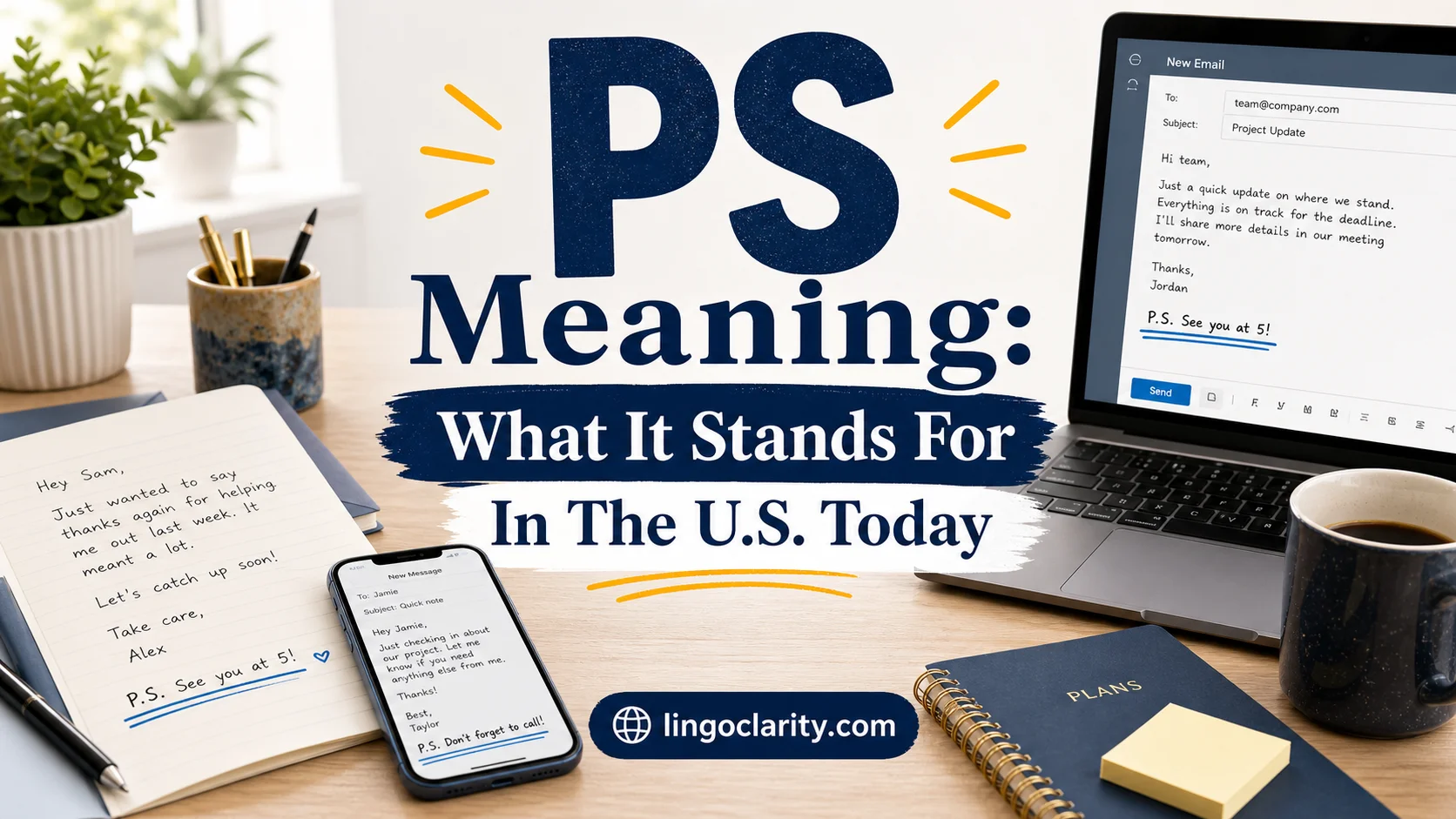
PS Meaning is simple: PS means postscript, an extra note added after the main message is finished. In everyday writing, it usually works like saying “one more thing” at the end of a text, email, letter, card, or social media post.
However, PS is not just a random ending. Instead, it signals that the writer wants to add a final thought, reminder, correction, or personal detail after the main message already feels complete.
For example:
Thanks again for helping me move today.
PS: I left your jacket by the front door.
In this message, the main point is complete. Therefore, the PS works as a short extra note rather than a new paragraph.
Quick Answer
PS stands for postscript. It means an added note placed after the main message.
In everyday writing:
- PS means postscript.
- It usually appears at the end of a message.
- It adds one short extra thought.
- It is pronounced “pee-ess.”
- PS and P.S. are both common.
- However, important information should go in the main message, not in a PS.
What Does PS Mean?
PS is short for postscript, which means something written after the main text. The word comes from the Latin phrase post scriptum, meaning “written after.”
Because of that origin, PS has a clear purpose. It lets you add information after a message already feels complete.
For example:
I’ll send the final file this afternoon.
PS: I also added the notes from yesterday’s call.
Here, the PS adds a useful detail. However, it does not change the main message.
PS can also make writing feel more personal. For instance, in a birthday card, a PS may add warmth:
Happy birthday! I hope your day is full of good food and zero responsibilities.
PS: Save me a slice of cake.
In this case, the PS feels friendly and natural.
How To Pronounce PS
PS is pronounced as two letters: pee-ess.
Do not pronounce it as one word. Also, you do not need to say “postscript” unless you are explaining what the abbreviation means.
Correct:
I added a pee-ess at the end of the email.
Incorrect:
I added a “pss” at the end.
Because PS is an abbreviation, it works best when read letter by letter.
Is PS A Word, An Abbreviation, Or An Acronym?
PS is an abbreviation for postscript. It can also act like a noun when you are talking about the extra note itself.
For example:
She added a PS to her letter.
In that sentence, PS means the added note.
However, PS is not usually used as a verb. Therefore, avoid awkward wording like this:
I PSed you yesterday.
Instead, write:
I added a PS to my message yesterday.
That version sounds cleaner and more natural.
PS Vs P.S.: Which One Is Correct?
Both PS and P.S. are widely understood. However, the best choice depends on your style guide, audience, and tone.
In modern digital writing, PS often looks clean and simple. Meanwhile, P.S. feels more traditional, especially in personal letters and cards.
| Context | Better Choice | Why |
|---|---|---|
| Text Message | PS | Fast, casual, and clear |
| Personal Letter | P.S. or PS | Both feel familiar |
| Work Email | PS or P.S. | Either works if consistent |
| Newsletter | PS | Clean and easy to scan |
| Formal Report | Avoid PS | Add the detail to the main text |
The main rule is consistency. Therefore, do not write PS in one place and P.S. in another unless a style guide tells you to.
How To Write PS Correctly
The cleanest format is:
PS: Your note goes here.
For example:
PS: I attached the updated invoice.
A colon after PS is helpful because it separates the label from the note. Also, it makes the sentence easier to scan.
Better:
PS: Don’t forget your umbrella.
Less polished:
PS don’t forget your umbrella.
Incorrect:
PS. Don’t forget your umbrella.
In casual texting, people often skip punctuation. However, in emails, articles, newsletters, and professional messages, the colon looks clearer.
Where Does PS Go?
Traditionally, PS goes after the sign-off and signature in a letter or email.
For example:
Best,
Maya
PS: I included the receipt as an attachment.
In a text message, however, there is usually no signature. Therefore, PS simply goes at the end of the message.
Example:
I’m leaving now.
PS: I picked up coffee for you.
In social media captions, PS also appears at the end. For example:
New recipe is live today.
PS: The sauce also works well on roasted vegetables.
Because PS acts like an afterthought, it should not appear at the beginning of a message.
When To Use PS
Use PS when your main message is complete, but you want to add one short extra thought.
PS works well for:
- A quick reminder
- A friendly afterthought
- A small correction
- A personal note
- A final detail
- A light call to action
- A warm closing line
For example:
Thanks for joining the call today.
PS: I added the meeting notes to the shared folder.
This PS works because it is short and useful. Also, it does not carry the most important information in the message.
Another example:
Hope you can come Saturday.
PS: Bring a jacket because we’ll be outside.
Here, the PS adds a practical reminder. As a result, the message feels helpful without becoming crowded.
When Not To Use PS
Do not use PS for information the reader must not miss. Important details belong in the main message.
Weak:
I can attend the meeting.
PS: We need to change the date, time, location, and agenda.
Better:
I can attend the meeting, but we need to update the date, time, location, and agenda.
The second version is stronger because the important information is not hidden at the end.
Avoid PS in:
- Legal notices
- Academic papers
- Formal reports
- Serious complaints
- Policy documents
- Sensitive workplace messages
- Messages with major deadlines or changes
Also, avoid using PS too often. Because it stands out, it loses impact when every message includes one.
PS In Text Messages
In texts, PS usually feels casual, friendly, or playful. It helps you add one more thought without rewriting the whole message.
Examples:
I’m almost there.
PS: I grabbed your charger.
Dinner was great tonight.
PS: Your playlist was perfect.
Happy birthday!
PS: Your gift should arrive tomorrow.
In texting, PS can feel light and natural. However, it should still be clear. Therefore, avoid using it for anything confusing or urgent.
Weak:
PS: Big problem.
Better:
PS: I need to reschedule because my flight was delayed.
The better version gives the reader enough information.
PS In Emails
In emails, PS can be useful when the extra note is short, relevant, and easy to understand.
Example:
Hi Jordan,
Thanks for reviewing the proposal. I made the edits we discussed and updated the timeline.
Best,
Avery
PS: I also added the pricing sheet to the folder.
This PS works because it adds a helpful detail. In addition, the message would still make sense without it.
However, PS should not replace a clear email structure. If the note is important, place it in the body of the email.
Weak:
Best,
Avery
PS: The deadline has moved to tomorrow at noon, and the client needs a signed version today.
Better:
The deadline has moved to tomorrow at noon. Also, the client needs a signed version today.
That version is clearer because the key information appears in the main email.
Is PS Professional In A Work Email?
Yes, PS can be professional in a work email. However, it must fit the tone and purpose of the message.
Use PS professionally for:
- A short reminder
- A link
- A note about an attachment
- A polite follow-up
- A friendly personal touch
Example:
Best,
Natalie
PS: The revised deck is attached as a PDF for easier sharing.
That sounds professional because the PS is brief and useful.
However, avoid PS for:
- New deadlines
- Contract terms
- Bad news
- Salary details
- HR concerns
- Legal language
- Major project changes
In those cases, put the information in the email body. Otherwise, the reader may overlook it.
PS In Letters And Cards
In personal letters and cards, PS often adds warmth. Because it appears after the main message, it can feel intimate, funny, or sincere.
Birthday card:
Hope your day is full of good food, loud laughter, and no responsibilities.
Love,
Aunt Claire
PS: Save me a slice of cake.
Thank-you note:
Thank you for the beautiful cookbook. I already marked three recipes to try this weekend.
Love,
Emma
PS: The lemon tart is first on my list.
In these examples, the PS adds personality. Also, it makes the message feel less stiff.
PS In Marketing And Newsletters
In marketing emails and newsletters, PS often highlights a final reminder or call to action. Because many readers skim, the PS can draw attention to one useful point.
Examples:
Early registration closes tonight at midnight, so the PS works as a final deadline reminder.
You can also use it to point readers to a bonus resource, such as:
PS: The free checklist is included at the bottom of this email.
For time-sensitive content, it can highlight access limits:
PS: You can still watch the replay until Friday.
However, this tactic should be used carefully. If every email uses PS to create urgency, readers may start ignoring it. Therefore, save PS for notes that genuinely help the reader.
Good PS Vs Bad PS Examples
| Weak PS | Why It Fails | Better Version |
|---|---|---|
| PS: Everything changed. | Too vague | PS: The meeting is now Friday at 2 p.m. |
| PS: Important update!!! | Too dramatic | PS: The deadline moved to Thursday. |
| PS: I forgot a lot of details. | Too broad | Add the details to the main message. |
| PS: Reply now. | Too pushy | PS: Please reply by Friday if you can attend. |
| PS: Attachment. | Too unclear | PS: I attached the signed form. |
A strong PS is specific. Also, it should be short enough to read at a glance.
Examples Of PS In Real Messages
Friendly Text
I had fun tonight.
PS: Your restaurant pick was perfect.
Work Email
Thanks for sending the draft.
PS: I left one comment on page three.
School Message
I finished the worksheet.
PS: I had a question about number six.
Invitation
Hope you can come Saturday.
PS: Bring a sweater because we’ll be outside.
Thank-You Note
Thank you for the gift card.
PS: I used it to buy the mystery novel we talked about.
Apology Message
I’m sorry I missed your call earlier. I’ll call you back after dinner.
PS: I did get your voicemail.
Newsletter
The full guide is now live on the blog.
PS: There’s a printable checklist at the end.
Romantic Note
I loved seeing you today.
PS: I’m still smiling.
Each example works because the PS adds one clear idea. In addition, none of the examples hides the main message at the end.
PS Vs PPS
PS is the first extra note. PPS means a second postscript after the first one.
Correct:
PS: Bring snacks.
PPS: Bring a folding chair too.
Incorrect:
PS: Bring snacks.
PSS: Bring a folding chair too.
Use PPS only when you truly need another short note. However, if you need several extra notes, the message probably needs editing.
Better:
Please bring snacks and a folding chair.
That version is simpler because it puts both details in one clear sentence.
Other Meanings Of PS
PS usually means postscript in writing. However, the letters can mean other things in specific contexts.
| Context | Possible Meaning |
|---|---|
| Writing | Postscript |
| Gaming | PlayStation |
| Design | Photoshop |
| Schools | Public School |
| Printing Or Software | PostScript |
| Messaging | Postscript, most of the time |
Context tells you the meaning.
Example:
I bought a new PS controller.
Here, PS probably means PlayStation.
Example:
PS: Call me when you get home.
Here, PS means postscript.
Therefore, always read the surrounding words before deciding what PS means.
PS Vs Note, FYI, And Addendum
PS is not the only way to add extra information. Sometimes, another term sounds clearer or more professional.
| Term | Best Use |
|---|---|
| PS | A short afterthought at the end |
| Note | A neutral extra detail |
| FYI | A quick informational aside |
| Reminder | A practical follow-up |
| Addendum | A formal added section |
| N.B. | A formal “note well” |
Use PS when the tone is conversational. However, use “note” or “reminder” when you want a more direct professional tone.
Casual:
PS: The bakery is closed on Mondays.
Professional:
Note: The bakery is closed on Mondays.
Formal:
Addendum: The bakery will remain closed on Mondays during the renovation.
Common Mistakes With PS
Using PS For Essential Information
If the reader must know it, put it in the main message.
Weak:
PS: The deadline is today.
Better:
The deadline is today at 5 p.m.
Writing A Long PS
A PS should usually be one sentence. However, two short sentences can work if the note stays clear.
Weak:
PS: I also wanted to explain the whole situation, give you the new timeline, mention the budget change, and ask for your opinion.
Better:
PS: I added the updated timeline to the shared folder.
Using PS Too Often
PS stands out because it is occasional. Therefore, do not use it in every message.
Mixing PS And P.S.
Choose one style and stay consistent. Otherwise, your writing may look careless.
Writing PSS Instead Of PPS
Use PPS for a second postscript. PSS is a common mistake.
Making The Tone Too Casual
PS can sound friendly. However, it may feel too casual in legal, academic, or sensitive professional writing.
Quick Style Guide
| Question | Best Answer |
|---|---|
| What does PS mean? | Postscript |
| Where does PS go? | At the end of a message |
| How do you pronounce PS? | Pee-ess |
| Should PS have periods? | PS and P.S. are both common |
| Should PS have a colon? | A colon is usually clearest |
| Can PS be used in work emails? | Yes, if brief and appropriate |
| Is PS slang? | No, but it can feel casual |
| What is a second PS called? | PPS |
| Is PSS correct? | No |
FAQs
What does PS mean?
PS means postscript. It is an extra note added after the main message is finished.
What does PS mean in text?
In text, PS still means postscript. It adds one last thought, reminder, or afterthought at the end of a message.
What does P.S. stand for?
P.S. stands for postscript. The term comes from the Latin phrase post scriptum, meaning “written after.”
Is PS slang?
PS is not slang. However, it often feels casual in texts, social posts, and personal notes.
Should I write PS or P.S.?
Both PS and P.S. are common. PS looks clean and modern, while P.S. feels more traditional.
Do you put a colon after PS?
A colon is usually the clearest choice. For example: PS: I attached the file.
Can I use PS in a professional email?
Yes, you can use PS in a professional email. However, keep it short, relevant, and appropriate for the tone.
Where does PS go in an email?
Traditionally, PS goes after the sign-off and signature. However, in short casual emails, it may simply appear at the end.
What is the difference between PS and PPS?
PS is the first extra note. PPS is a second extra note after the PS.
Is PSS correct?
No. Use PPS for a second postscript.
Can PS mean PlayStation?
Yes, PS can mean PlayStation in gaming contexts. However, in letters, texts, and emails, it usually means postscript.
Can PS be more than one sentence?
Yes, but it should stay brief. If the PS becomes longer than one or two short sentences, move the information into the main message.
Conclusion
PS means postscript, or an extra note added after the main message. It is useful when you want to add one short reminder, warm detail, correction, or final thought.
For clear writing, use this format:
PS: Your note goes here.
However, do not use PS for essential information. Instead, put major details in the main message so the reader cannot miss them.
