
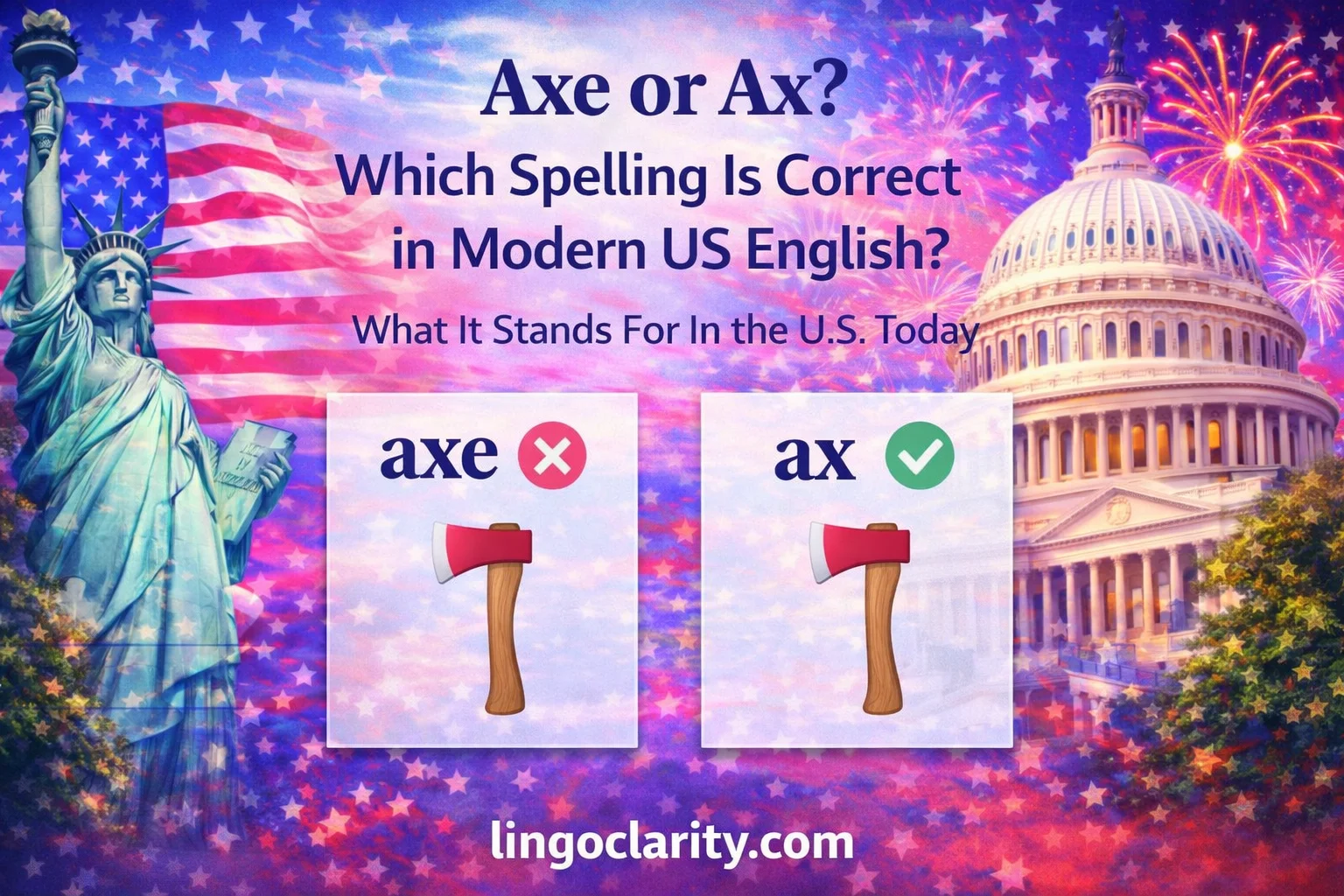
Many writers hesitate when choosing between axe and ax because both spellings look correct. You may see ax in American writing, while dictionaries, books, and British publications often use axe. This can make the choice confusing, especially when you want your writing to look accurate and professional.
The simple answer is that axe and ax are both correct spellings of the same word. They have the same meaning, the same pronunciation, and can both refer to the cutting tool used for chopping wood. In American English, both forms are accepted, although axe is more common overall. In British English, axe is the standard spelling.
For most general writing, axe is the safest choice because it is widely recognized across different English-speaking regions. However, ax is not a mistake, and it can be used confidently when following an American style preference.
This guide explains the difference between axe vs ax, when to use each spelling, common mistakes, examples, and how to choose the right form for your writing.
Quick Answer
Axe and ax are two correct spellings of the same word. Both mean a tool with a sharp blade used for cutting wood, and both have the same pronunciation. In British English, axe is the standard form, while American English accepts both axe and ax. If you want the most widely recognized spelling, choose axe.
What Does Axe or Ax Mean?
An axe or ax is a tool with a heavy metal blade attached to a handle. People traditionally use it for cutting, chopping, and splitting wood.
The word can also be used as a verb. As a verb, axe or ax can mean:
- To cut something with an axe
- To remove something
- To cancel or eliminate something suddenly
Examples:
- Literal meaning: He used an axe to chop firewood.
- Figurative meaning: The company axed several projects to reduce costs.
The spelling changes only the appearance of the word. The meaning remains the same.
Axe vs Ax: What Is the Difference?
| Feature | Axe | Ax |
|---|---|---|
| Meaning | A cutting tool used for wood | Same meaning |
| Pronunciation | Same | Same |
| Correct spelling | Yes | Yes |
| British English | Standard spelling | Less common |
| American English | Common | Accepted variant |
| Global recognition | More widely recognized | More associated with US usage |
The main difference between axe and ax is not meaning. It is mainly about regional preference and writing style.
Are Axe and Ax the Same Word?
Yes. Axe and ax are the same word. They have identical meanings and functions.
Both spellings can be used as a noun:
- She carried an axe into the forest.
- The old ax was hanging in the garage.
Both can also be used as verbs:
- The company decided to axe the unnecessary program.
- The manager had to ax several expenses.
The pronunciation does not change:
Axe = Ax = /æks/
The only difference is spelling preference.
Is Ax a Correct Spelling?
Yes, ax is a correct English spelling. It is not a shortened version, typo, or incorrect form.
Many writers assume that axe is the only proper spelling, but dictionaries recognize both versions. In American English, ax is a valid alternative spelling, although axe remains more common overall.
The shorter spelling is sometimes preferred in American publications because English often develops shorter spelling forms in US usage.
For example:
- Axe: The firefighter grabbed an axe.
- Ax: The firefighter grabbed an ax.
Both sentences are correct.
Why Does Axe Have an Extra E?
The extra e in axe does not create a different pronunciation or meaning. It is simply a spelling variation that developed over time.
English contains many words with different regional spellings. Some forms become more common in certain countries, while others continue to exist alongside them.
In this case:
- Axe became the more common international spelling.
- Ax remained accepted, especially in American English.
The extra e does not make one version better or more correct.
Axe vs Ax in American and British English
The biggest difference appears when comparing English varieties.
American English
In the United States, both spellings are accepted.
Examples:
- He chopped the tree with an axe.
- He chopped the tree with an ax.
However, many American dictionaries still list axe as the more common spelling.
British English
In British English, axe is the expected spelling.
Examples:
- He bought a new axe for camping.
- The company decided to axe the television program.
Using ax in British writing may look unusual to many readers.
Which Spelling Should You Use in Modern Writing?
For most websites, blogs, school assignments, and general content, axe is usually the best choice.
Why?
- It is accepted in both American and British English.
- It is more common worldwide.
- Most readers recognize it immediately.
- It avoids confusion for international audiences.
However, ax is perfectly acceptable if:
- Your publication follows that style.
- Your editor prefers American shortened forms.
- You are writing for a specific audience that commonly uses it.
The most important rule is consistency.
Do not write:
The company used an axe to cut costs and later decided to ax the project.
While both forms are correct, mixing them in one article can make your writing appear inconsistent.
Choose one spelling and use it throughout your content.
Real-Life Examples of Axe and Ax
As a Noun
- The woodsman carried an axe into the forest.
- He kept an ax in his tool shed.
- A camping axe can be useful during outdoor trips.
- The old ax was passed down through generations.
As a Verb
- The company decided to axe several jobs.
- The manager had to ax unnecessary expenses.
- The network may axe the show after poor ratings.
- The organization decided to ax the outdated policy.
Common Expressions
Both spellings appear in familiar expressions.
Get the axe
Meaning: To be removed or fired.
Example:
Several employees got the axe after the company restructure.
Have an ax to grind
Meaning: To have a personal complaint or hidden reason for an opinion.
Example:
He has an ax to grind against the new policy.
Common Mistakes To Avoid
Mistake 1: Thinking Ax Is Wrong
This is incorrect.
Ax is a recognized spelling in English, especially in American usage. It is not a spelling mistake.
Mistake 2: Believing Axe Is Only British
This is also incorrect.
Although axe is the standard British spelling, it is also widely used and accepted in American English.
Mistake 3: Mixing Both Spellings
Using both forms randomly in the same article can make your writing look unpolished.
Choose:
- axe throughout the article, or
- ax throughout the article
Consistency matters more than the choice itself.
Mistake 4: Assuming Shorter Means More American
Some writers think that ax must always be the American choice because it is shorter.
That is not true.
American English accepts both forms, and axe is still very common in US writing.
Synonyms and Related Words
The best synonym depends on the meaning.
For the Cutting Tool:
- Hatchet
- Chopper
- Cutting tool
Note: A hatchet is usually smaller than an axe, so the words are not always exact replacements.
For the Verb Meaning “Remove”:
- Cut
- Cancel
- Eliminate
- Drop
- Remove
- Scrap
Example:
The company axed the project.
Similar:
The company canceled the project.
History of Axe and Ax Spellings
Both axe and ax come from the same historical English word. Over time, different regions developed different spelling preferences.
The shorter spelling ax became associated more strongly with American English, while axe remained the dominant spelling in British and international English.
English kept both forms instead of replacing one completely, which is why modern dictionaries recognize both spellings today.
You do not need to memorize the history to use the word correctly. The practical rule is simple: choose the spelling that fits your audience and stay consistent.
Final Verdict: Axe or Ax?
The answer is simple:
Axe and ax are both correct spellings.
They:
- Have the same meaning
- Have the same pronunciation
- Can both be nouns and verbs
- Are accepted in modern English
For general writing, axe is usually the safest option because it is widely recognized around the world. However, ax is completely acceptable in American English when used consistently.
The best rule to remember:
Use axe for the broadest audience, use ax when your preferred style calls for it, and never mix both randomly.
FAQs
No. Ax is a correct spelling in American English. It is recognized as a variant spelling of axe and is not considered an error.
No. Although axe is the standard spelling in British English, it is also correct and commonly used in American English.
No. They have the same meaning. Both refer to the cutting tool and can also be used as verbs meaning to remove or cancel something.
Axe is more common overall. It is widely used internationally and is the standard spelling in British English.
Yes. Both forms can work as verbs in American English.
Examples:
The company axed the project.
The company axed the project.
The meaning is the same.
The plural form is axes.
Examples:
Two axes were stored in the shed.
The workers carried several axes
You can, but it is better not to. Even though both spellings are correct, switching between them can make your writing appear inconsistent. Choose one form and use it throughout your article.
