
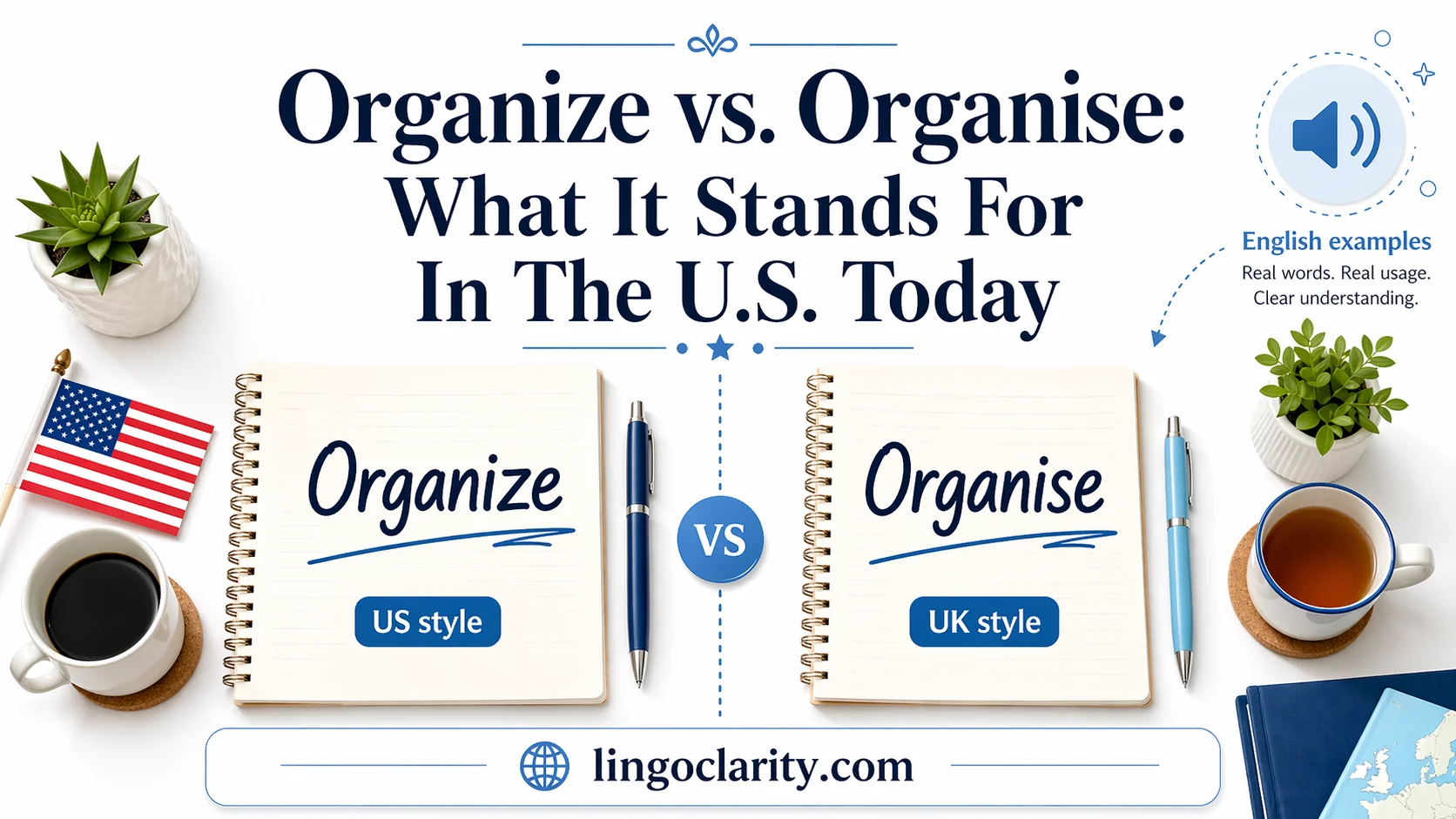
For US writers, organize is the correct spelling in almost every situation. Organise is not a separate word, and it does not have a different meaning. Instead, it is a spelling variant used mainly in British English and in some other English varieties that follow British spelling conventions.
The difference is simple: American English uses organize, while many British-style publications use organise. However, there is one important exception. Some British and international publishers follow Oxford-style spelling, which also uses organize with a “z.”
So, if you are writing for a US audience, use organize. Also use the related US forms: organized, organizing, organization, and organizer.
In other words, the choice is not about grammar or meaning. It is about audience, spelling style, and consistency. Once you choose a spelling system, you should use it throughout the entire document.
Quick Answer
Use organize in American English.
Use organise only when you are writing in a British style that prefers “-ise” spellings or when you are preserving the original spelling in a quote, title, or official name.
Both words mean the same thing: to arrange, plan, put in order, coordinate, or form people into a group.
For example:
- US English: We need to organize the files before the meeting.
- British-style English: We need to organise the files before the meeting.
Although both spellings are understandable, organize is the standard choice for US writing. Therefore, it is the best option for American resumes, emails, reports, school assignments, blog posts, website copy, and business documents.
Organize vs. Organise At A Glance
| Context | Best Choice | Example |
|---|---|---|
| US English | Organize | Please organize the notes by topic. |
| US resume or cover letter | Organize | I helped organize weekly team reports. |
| US business writing | Organize | The manager will organize the launch schedule. |
| British “-ise” style | Organise | The committee will organise the local event. |
| Oxford-style British English | Organize | The department will organize the conference. |
| Direct quote from a British source | Keep the original | “We plan to organise volunteers by region.” |
| One document or website | Stay consistent | Do not mix organize and organise. |
What Organize Means
Organize is a verb that means to arrange something in a clear order, create a system, make plans, coordinate people, or bring parts together into a useful structure.
For instance, you can organize a closet, a meeting, a report, a schedule, a team, a campaign, or your thoughts. In a workplace context, you might organize files, organize a presentation, or organize a product launch. In a labor context, workers may organize to form or join a union.
Here are common US examples:
- I need to organize my inbox before Monday.
- She helped organize the annual fundraiser.
- The app lets users organize photos into albums.
- We should organize our ideas before writing the proposal.
- Employees voted to organize after months of discussion.
- Please organize the client folders by account name.
As these examples show, organize is the natural spelling for American readers.
What Organise Means
Organise means the same thing as organize. The only difference is spelling.
It appears mainly in British-style English, especially in publications, schools, and documents that prefer “-ise” endings. Therefore, a British-style sentence may look like this:
- The school will organise a charity event.
- Local volunteers helped organise the cleanup.
- The team is organising a public workshop.
However, if those same sentences were written for a US audience, they would normally use organize, organized, and organizing instead.
So, organise is not wrong everywhere. Nevertheless, it is not the standard spelling for American English.
Are Organize And Organise The Same Word?
Yes. Organize and organise are spelling variants of the same word.
They have the same meaning, the same pronunciation, and the same grammar function. Both are verbs. Both can describe arranging, planning, structuring, coordinating, or forming a group.
The pronunciation does not change either. Both spellings are pronounced like OR-guh-nyze.
As a result, the choice between them depends on style rather than meaning. If you are writing for US readers, choose organize. If you are writing for a British-style publication that uses “-ise” spellings, choose organise.
Why People Confuse Organize And Organise
People confuse organize and organise because both spellings are real. In addition, the difference is only one letter: z in American spelling and s in many British-style spellings.
However, that small spelling difference matters in polished writing. Readers notice whether a document follows a consistent spelling style. For example, a US reader expects organize, organized, and organizing. Meanwhile, a British reader may expect organise, organised, and organising, depending on the publication’s house style.
The biggest mistake is mixing both forms in the same document.
Incorrect mixed style:
- The team will organize the files after the manager has organised the schedule.
Correct US style:
- The team will organize the files after the manager has organized the schedule.
Correct British “-ise” style:
- The team will organise the files after the manager has organised the schedule.
Because consistency affects credibility, choose one spelling family and use it throughout your writing.
US English: Use Organize
In American English, organize is the standard spelling. Therefore, US writers should use it in professional, academic, and everyday writing.
Use organize in:
- Emails
- Resumes
- Cover letters
- Reports
- School assignments
- College papers
- Blog posts
- Website copy
- Product descriptions
- Business documents
- Marketing content
- Internal company documents
For example:
- I helped organize the onboarding process.
- We need to organize the quarterly sales data.
- She will organize the training materials.
- The nonprofit plans to organize a food drive.
- Can you organize the files before the audit?
Since these examples are written for US readers, organize is the correct and natural choice.
British English: Organise Is Common
In British English, organise is common, especially in writing that follows “-ise” spelling preferences. Therefore, British-style documents may use organise, organised, and organising.
For example:
- The council will organise a public meeting.
- She organised the archive by year.
- We are organising a charity auction.
- The committee helped organise the event.
Even so, not all British writing uses organise. Some British institutions, academic publishers, and international organizations use Oxford-style spelling, which prefers organize with a “z.”
Because of this, the best rule for British writing is to follow the required house style. If no style guide is provided, choose one spelling system and stay consistent.
Oxford Spelling: The Important Exception
Many people assume organize is only American, but that is not completely accurate. Oxford-style spelling also uses organize, organized, and organizing.
Oxford spelling is a British spelling system that keeps many British forms, such as “colour” and “centre,” while using “-ize” endings for words like organize, realize, and recognize.
Therefore, a document can be British in style and still use organize.
For example:
- Oxford-style British English: The university will organize the research seminar.
- British “-ise” style: The university will organise the research seminar.
- American English: The university will organize the research seminar.
This is why it is more accurate to say: organize is standard in US English and also accepted in Oxford-style British English; organise is mainly British-style spelling.
Organized vs. Organised
The spelling difference continues in the past tense.
Use organized in US English.
Use organised in British-style writing that prefers “-ise” spellings.
Examples for US English:
- She organized the files by date.
- The report was organized into five sections.
- We organized a training session for new employees.
Examples for British-style English:
- She organised the files by date.
- The report was organised into five sections.
- We organised a training session for new employees.
If you are writing for a US audience, organized is the correct choice.
Organizing vs. Organising
The same rule applies to the “-ing” form.
Use organizing in US English.
Use organising in British-style writing that prefers “-ise” spellings.
Examples for US English:
- We are organizing the event this week.
- He is organizing his research notes.
- The team is organizing a customer webinar.
Examples for British-style English:
- We are organising the event this week.
- He is organising his research notes.
- The team is organising a customer webinar.
Again, the meaning does not change. Only the spelling style changes.
Organization vs. Organisation
The noun form also changes by region.
Use organization in US English.
Use organisation in British-style writing.
Examples for US English:
- She works for a nonprofit organization.
- The company needs a better organization system.
- Strong organization makes the report easier to read.
Examples for British-style English:
- She works for a nonprofit organisation.
- The company needs a better organisation system.
- Strong organisation makes the report easier to read.
This spelling pair is especially important because many writers accidentally mix forms. For example, they may write organize but later use organisation. In US writing, that combination looks inconsistent.
For US English, use this spelling family:
- organize
- organized
- organizing
- organization
- organizational
- organizer
Organizer vs. Organiser
Use organizer in US English.
Use organiser in British-style English.
Examples for US English:
- She is the event organizer.
- I bought a desk organizer.
- The conference organizer sent the agenda.
Examples for British-style English:
- She is the event organiser.
- I bought a desk organiser.
- The conference organiser sent the agenda.
As with the other forms, the meaning is the same. However, the spelling should match the rest of your document.
Spelling Family Comparison
| US English | British “-Ise” Style |
|---|---|
| organize | organise |
| organized | organised |
| organizing | organising |
| organization | organisation |
| organizational | organisational |
| organizer | organiser |
| disorganized | disorganised |
| reorganization | reorganisation |
This table gives you the simplest consistency check. If you choose US English, keep your spelling in the left column. If you choose British “-ise” style, keep your spelling in the right column.
Which Spelling Should You Use In Professional Writing?
For US professional writing, use organize.
This applies to resumes, cover letters, business emails, client proposals, reports, presentations, and website copy. In these contexts, spelling affects first impressions. Even though “organise” is a real word, it may look out of place to American readers.
For example, a US resume should say:
- Organized weekly reports for the sales team.
- Helped organize a company-wide training event.
- Created an organized filing system for client records.
It should not say:
- Organised weekly reports for the sales team.
- Helped organise a company-wide training event.
- Created an organised filing system for client records.
The British forms are understandable, but they are not the best fit for a US resume.
When To Keep Organise In US Writing
Although US writers should usually use organize, there are a few cases where you should keep organise.
First, keep the original spelling in direct quotes.
Example:
- The spokesperson said, “We plan to organise volunteers by region.”
Second, keep the spelling in official titles, names, or source material.
Example:
- The article “How to Organise Your Revision Notes” was published by a UK education site.
Third, use organise when your content is specifically written for a British-style publication that requires “-ise” spellings.
Otherwise, for US readers, organize is the better choice.
Common Mistakes To Avoid
Using Organise In A US Document
Weak:
- Please organise the project folders.
Better for US English:
- Please organize the project folders.
Mixing Organize And Organise
Weak:
- We need to organize the meeting and organise the notes afterward.
Better for US English:
- We need to organize the meeting and organize the notes afterward.
Mixing Organization And Organisation
Weak for US English:
- Our organisation will organize the fundraiser.
Better for US English:
- Our organization will organize the fundraiser.
Assuming Organise Is More Formal
“Organise” is not more formal than “organize.” It is simply a British-style spelling. For US readers, organize is formal, standard, and correct.
Changing Quotes Without A Reason
If a source uses “organise” inside a direct quote, keep it unless your editorial policy says otherwise. Changing quoted spelling without a reason can misrepresent the source.
Examples Of Organize In US English
Here are natural examples for American writing:
- Please organize the meeting notes before Friday.
- I need to organize my tax documents this weekend.
- The school will organize a food drive in May.
- Can you organize the files by project name?
- Workers voted to organize after months of discussion.
- She helped organize the team lunch.
- The app helps users organize photos into albums.
- We should organize our ideas before writing the proposal.
- The manager asked us to organize the client records.
- A clear outline can help you organize your thoughts.
Examples Of Organise In British-Style English
Here are examples using British “-ise” spelling:
- The committee will organise the local fundraiser.
- He helped organise the conference schedule.
- The group plans to organise volunteers by region.
- The museum will organise a weekend event for families.
- Local residents will organise the cleanup after the storm.
For a US article, report, or email, these sentences would normally use organize instead.
How To Choose The Right Spelling Every Time
The easiest way to choose the right spelling is to ask three questions.
First, who is the audience? If the audience is American, use organize.
Second, what style guide are you following? Check the style guide next. For US English, use organize. For British “-ise” spelling, use organise. Under Oxford spelling, use organize.
Third, are you quoting someone? If yes, keep the original spelling in the quote.
Once you answer those questions, the choice is usually clear.
FAQ
Is organise wrong in American English?
For standard American English, organise is not the preferred spelling. US writers should use organize. Although American readers will usually understand “organise,” it can look British or inconsistent in a US document.
Is organize used in British English?
Yes. Organize is used in Oxford-style British English. However, many British-style publications prefer organise. Therefore, British writers should follow the style guide required by their school, employer, publisher, or organization.
Do organize and organise mean the same thing?
Yes. Organize and organise mean the same thing. Both can mean to arrange, plan, structure, coordinate, or form a group. The difference is spelling style, not meaning.
Should I write organized or organised?
Use organized in US English. Use organised in British-style writing that prefers “-ise” spellings. Most importantly, keep the spelling consistent with the rest of your document.
Should I write organization or organisation?
Use organization in US English. Use organisation in British-style writing. For American readers, organization is the standard and safest choice.
Which spelling should I use in a resume?
Use organize in a US resume. For example, write “Organized weekly reports,” “Helped organize training sessions,” or “Created an organized filing system.”
Which spelling should I use on a US website?
Use organize on a US website. Also use organized, organizing, organization, and organizer. This keeps your spelling natural for American readers.
Can I use both spellings in one article?
Use both spellings only if you are comparing them or quoting sources that use different styles. Otherwise, choose one spelling system and use it consistently.
Does the pronunciation change?
No. Organize and organise are pronounced the same way. The spelling changes, but the sound stays the same.
What is the safest spelling for US writers?
The safest spelling for US writers is organize. It is standard in American English and appropriate for professional, academic, and everyday writing.
Conclusion
Use organize for US English.
Use organise only when writing in a British “-ise” style or when preserving the original spelling in a quote, title, or official name.
Both spellings are real, and both have the same meaning. However, for American readers, organize is the correct, natural, and professional choice.
