
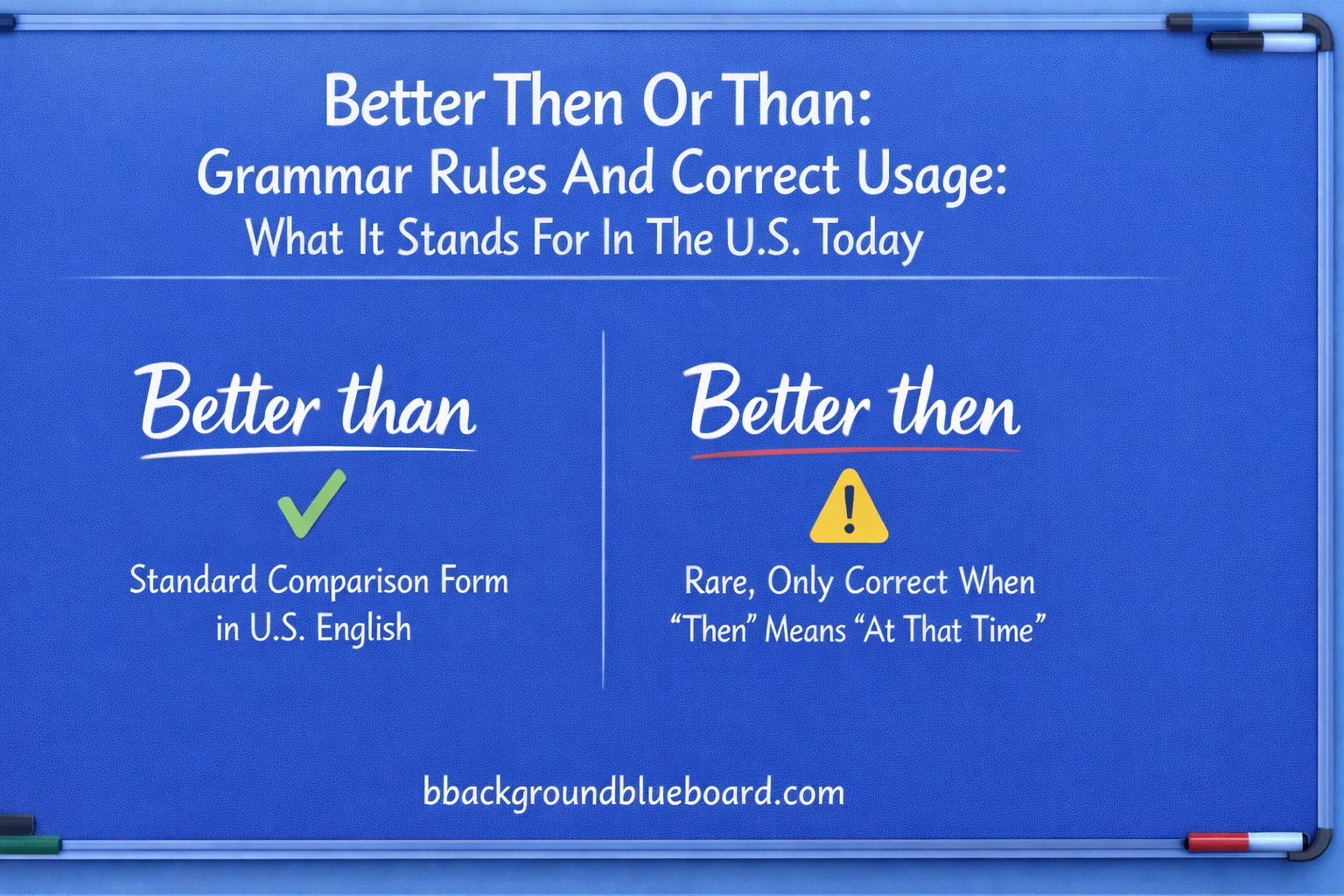
Many writers hesitate over better then and better than because the two words look similar and may sound close in casual speech. However, they do not mean the same thing, and they do not follow the same grammar rule.
In standard US English, better than is the correct form when you are making a comparison. Better then is usually wrong in that situation. Still, it can be correct in the much less common case where then keeps its time-related meaning, such as at that time or back then.
That difference matters because one small spelling change can alter the meaning of the whole sentence.
Quick Answer
Use better than when you are comparing one thing with another.
Use better then only when then refers to time.
Examples:
- This option is better than the last one.
- The weather was better then than it is now.
What Is Correct: Better Then Or Better Than?
For nearly all everyday writing, the correct phrase is better than.
That is because than is the standard word used to introduce comparisons in English. After a comparative word such as better, worse, faster, slower, more, or less, than is usually the correct choice.
So if your sentence compares two people, things, situations, or results, use better than.
Examples:
- This software is better than the old version.
- She performed better than expected.
- Our new system works better than the previous one.
By contrast, better then is not the standard comparison form. It is only correct when then means at that time.
The Core Grammar Rule
The rule is simple:
- Than is used for comparison.
- Then is used for time, sequence, or what happens next.
So when better compares one thing with another, than is the right word.
Quick Rule Table
| Form | Use | Meaning |
|---|---|---|
| better than | Comparison | One thing is superior to another |
| better then | Time meaning only | Something was better at that time |
A fast test helps:
Ask yourself, Am I comparing two things?
If the answer is yes, use than.
When Better Than Is Correct
Use better than when you compare quality, ability, value, results, preference, or condition.
Examples:
- This phone is better than my old one.
- He writes better than he did last year.
- The second draft sounds better than the first.
- Tea tastes better than coffee to me.
- She handled the interview better than I expected.
In each case, the sentence compares one thing with another. That makes than necessary.
When Better Then Can Be Correct
Use better then only when then means at that time rather than showing comparison.
Examples:
- The roads were better then than they are now.
- Her health was better then, before the long winter.
- Life seemed better then, at least from his point of view.
In these sentences, then points to a time in the past. It does not introduce the comparison. The comparison is still handled by the later than in sentences such as:
- The roads were better then than they are now.
That structure is grammatical, but it is much less common than the normal comparison phrase better than.
When Better Then Is Incorrect
Better then is incorrect when the writer is simply making a comparison.
Incorrect:
- This plan is better then the first one.
- He sings better then his brother.
- The new design looks better then the old one.
Correct:
- This plan is better than the first one.
- He sings better than his brother.
- The new design looks better than the old one.
If you can replace the phrase with superior to or more effective than, you need than, not then.
Meaning Difference Between Then And Than
The difference is not just spelling. It is also a difference in meaning.
- Than signals a comparison.
- Then signals time or sequence.
Compare these:
- Life feels better than before.
- Life felt better then, before everything changed.
The first sentence compares two states.
The second sentence points to a specific time in the past.
That is why mixing up then and than can confuse readers. The wrong choice changes the sentence structure and may change the meaning.
Real Examples In Modern US English
Here are realistic examples that show the difference clearly:
Examples With Better Than
- My new laptop runs better than the old one.
- She knows the process better than I do.
- This route is better than the highway during rush hour.
- The final version reads better than the draft.
Examples With Better Then
- The neighborhood was quieter and felt better then.
- Our internet service was better then than it is today.
- Things seemed better then, before prices went up.
These examples show why better than appears far more often. Most writers are making comparisons, not referring to a past time.
A Quick Memory Trick
A simple memory trick can help:
- Than goes with comparison
- Then goes with time
Another easy reminder is this:
If you are choosing between two things, use than.
If you are talking about that time or what happened next, use then.
Common Mistakes And Quick Fixes
Writers often use then after a comparative word because the words sound similar in speech. That leads to common mistakes such as:
Wrong:
- better then
- more then
- less then
- rather then
Right:
- better than
- more than
- less than
- rather than
This is one of the most common spelling errors in English because pronunciation does not always make the distinction obvious.
Another Common Point Of Confusion
Many writers also wonder about what comes after than:
- better than me
- better than I am
Both can be acceptable depending on context and level of formality.
- Better than me is natural in everyday speech and normal informal writing.
- Better than I am may sound more formal or more complete.
That is a separate grammar issue, but it often appears in sentences built around better than.
Grammar Rule Details
Rule
Use than after better when the sentence compares one thing to another. Use then only when you mean at that time, next, or afterward.
Correct Usage
These are correct:
- This restaurant is better than the one across the street.
- Her grades are better than they were last semester.
- The economy was better then than it is now.
- I liked the app better then, before the redesign.
Incorrect Or Less Natural Usage
These are incorrect:
- This restaurant is better then the one across the street.
- Her grades are better then they were last semester.
This can be correct, but only with a time meaning:
- Things were better then.
That sentence works because then means at that time.
Quick Test To Check Your Sentence
Use this fast two-step test:
Test 1: Can You Substitute “Compared With”?
If yes, use than.
- This version is better than the old one.
- This version is better compared with the old one.
Test 2: Can You Substitute “At That Time”?
If yes, use then.
- The roads were better then.
- The roads were better at that time.
This check solves most cases in seconds.
Usage Notes For Clear Writing
In modern US writing, readers expect better than almost every time they see better followed by another noun, pronoun, or clause.
Because better then looks like a typo in most contexts, use it only when the time meaning is obvious from the full sentence. Otherwise, readers may assume it is a mistake.
That matters especially in:
- school writing
- business writing
- website copy
- professional emails
- edited articles
In all of those contexts, better than is the safe and standard choice whenever you are comparing.
Frequently Asked Questions
Is “better than” always correct?
It is correct when you are making a comparison. That is the standard pattern in US English.
Can “better then” ever be correct?
Yes. It can be correct when then means at that time. For example: The economy was better then than it is now.
Why Do People Confuse “Then” And “Than”?
They are close in spelling, and many speakers pronounce them similarly in fast conversation. Because of that, writers often mix them up when typing.
Is “better than me” wrong?
No. It is common and natural in everyday English. In very formal writing, some people prefer better than I am or better than I do, depending on the sentence.
How Can I Remember The Difference Fast?
Use than for comparison and then for time. That one check will fix most mistakes.
Conclusion
If your sentence compares one thing with another, the correct form is better than.
Use better then only when then truly means at that time. That use is real, but it is uncommon. In most school, business, and online writing, better than is the form you want.
When in doubt, ask one question: Am I making a comparison?
If the answer is yes, choose than.
