
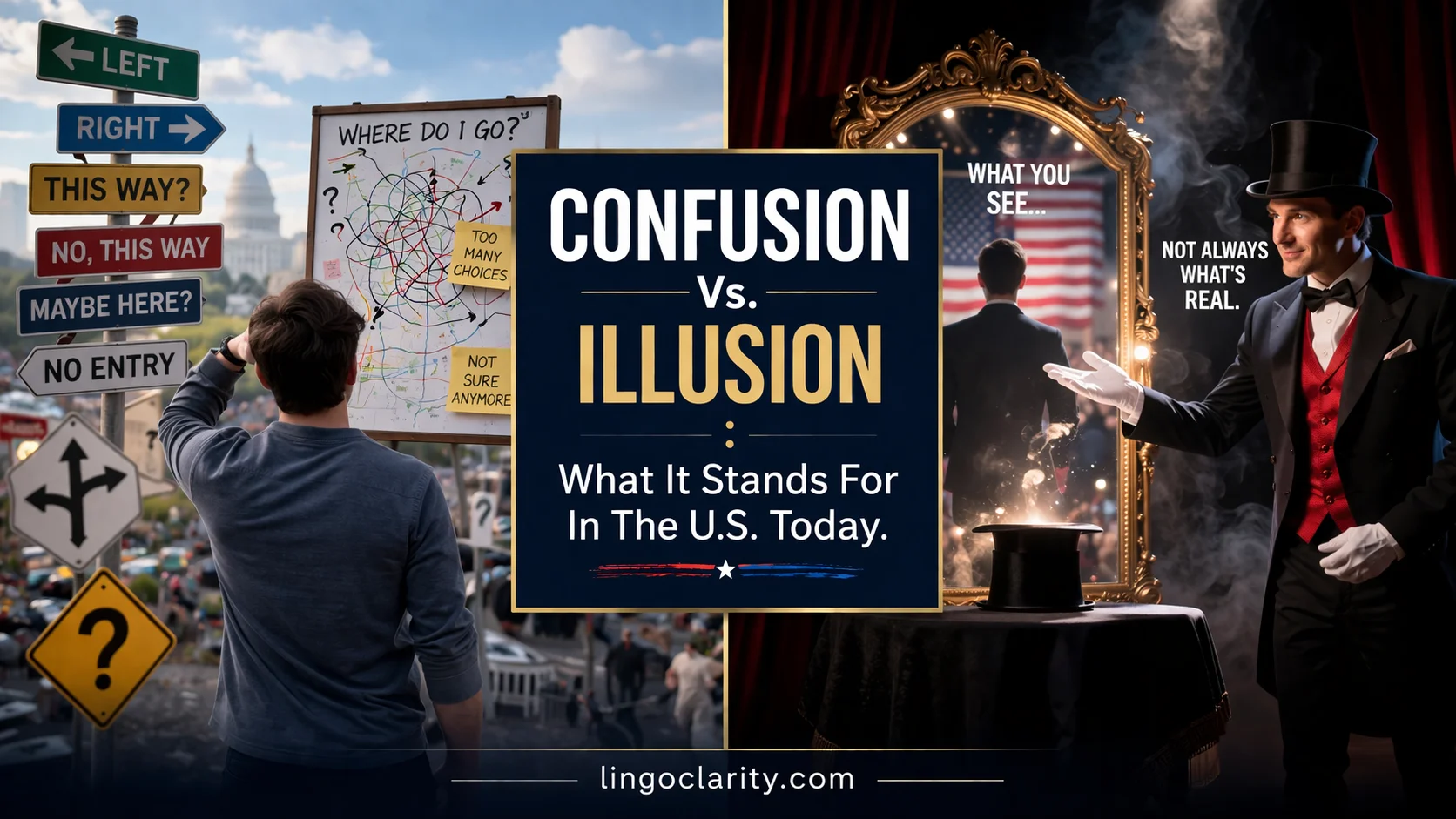
If you have ever hesitated between confusion and illusion, you are not alone. The two words look similar, sound somewhat related, and often appear in situations where something is not clear. But in standard US English, they do not mean the same thing.
The simplest distinction is this: confusion is a state of not understanding, while illusion is a false appearance or mistaken belief. Dictionaries consistently separate the two this way. Merriam-Webster defines confusion as an act or state of being confused, while Merriam-Webster, Cambridge, and Britannica define illusion as a misleading image, false appearance, or untrue belief.
That difference matters in everyday writing. A room change can cause confusion. A mirror can create an illusion of space. A vague policy creates confusion. A polished ad can create the illusion of quality. Once you see the pattern, the choice becomes much easier.
This guide explains the difference clearly, shows when each word fits, highlights the phrases native speakers actually use, and helps you avoid the kinds of swaps that make a sentence sound wrong.
Quick Answer
Use confusion when the problem is uncertainty, misunderstanding, disorder, or mixed-up information.
Use illusion when something seems real, true, or solid but is not.
Here is the difference in one line:
Confusion = “I do not understand what is happening.”
Illusion = “It seems true or real, but it is not.”
Compare these examples:
- The last-minute gate change caused confusion among passengers.
- The glass wall created the illusion of a larger office.
In the first sentence, people do not know what is going on. In the second, the office only appears bigger than it really is. That is the core distinction, and it holds across most real-world uses.
Key Differences At A Glance
| Feature | Confusion | Illusion |
|---|---|---|
| Core Meaning | Lack of understanding, uncertainty, disorder | False appearance, misleading effect, mistaken belief |
| What It Names | A feeling, state, or messy situation | A deceptive image, impression, or belief |
| Common Contexts | Instructions, schedules, policies, conversations, mistakes | Mirrors, design, stage magic, advertising, psychology |
| Helpful Test | “Do people not understand?” | “Does it only seem true or real?” |
| Natural Patterns | confusion about, confusion over, in confusion, cause confusion | illusion of, create the illusion of, under the illusion that |
This summary reflects standard dictionary usage in American English, including common patterns such as confusion about and under the illusion that.
What Confusion Means
Confusion is about a breakdown in clarity. It can describe what someone feels internally, or what a group experiences when information, actions, or conditions become hard to follow.
For example, a student may feel confusion after receiving two different due dates for the same assignment. A company may experience confusion after sending conflicting instructions to employees. In both cases, the issue is not deception or false appearance. The issue is that people do not understand what is happening.
That is why confusion works so naturally in sentences about misunderstandings, mixed messages, disorder, and uncertainty:
- confusion about the instructions
- confusion over the final schedule
- confusion between two similar terms
- in confusion, the crowd moved toward the wrong door
Merriam-Webster’s examples include phrases such as confusion as to and confusion about, which is exactly how the word behaves in normal usage.
A good practical rule is this: if the problem can be solved by clearer communication, better organization, or more accurate information, confusion is probably the right word.
What Illusion Means
Illusion is different. It does not mean uncertainty. It means a false impression, a deceptive appearance, or a belief that feels true but is not.
Sometimes the meaning is visual. A mirror can create the illusion of depth. Stage lighting can create the illusion of movement. A carefully edited photo can create the illusion that a product is larger, brighter, or more luxurious than it really is.
Sometimes the meaning is conceptual. A person may be under the illusion that a task is finished when it has only been postponed. A team may operate under the illusion that more choices always mean more freedom. In these cases, illusion refers to a mistaken belief, not to a moment of being confused. Merriam-Webster and Cambridge both recognize this broader meaning, not just the visual one.
This is why illusion often appears in writing about design, marketing, performance, psychology, architecture, and abstract analysis. It is the right word when something presents a false surface—whether that surface is literal or metaphorical.
Why People Mix Them Up
The mix-up happens for understandable reasons.
First, the words look alike. They share the same ending and have a similar rhythm. Second, both can appear in situations where reality is not being perceived clearly. Third, both words often show up in explanatory writing, which makes them feel like near-synonyms even when they are not.
But the overlap is only partial. Both words relate to a gap between reality and perception, yet they point to different parts of that gap:
- Confusion focuses on the person or situation that lacks clarity.
- Illusion focuses on the false image or false belief itself.
That distinction is especially useful in editing. If your sentence is about people being unsure, use confusion. If it is about something seeming true when it is not, use illusion.
Confusion Vs. Illusion In Everyday US English
In everyday American English, confusion is broader and more common. It works in schools, workplaces, news writing, customer service, healthcare communication, casual conversation, and formal prose. You can talk about confusion over a bill, confusion about parking rules, confusion during a fire drill, or confusion between two software versions.
Illusion is also standard, but it is more specific. It tends to appear when the writer wants to emphasize false appearance, deceptive presentation, or mistaken belief. You are more likely to see it in phrases such as the illusion of control, the illusion of choice, the illusion of safety, or the illusion of space. Cambridge gives examples such as a mirror creating the illusion of space and a person being under the illusion that something is true.
That difference in range explains why these sentences sound natural:
- There was confusion about which entrance guests should use.
- The wide-angle lens created the illusion of a larger room.
And it explains why these sound awkward:
- The event caused an illusion.
- The hallway mirror caused confusion in the design.
Those versions miss the target because the first sentence is about misunderstanding, while the second is about visual effect.
How To Choose The Right Word
When you are deciding between the two, ask one question:
Am I talking about uncertainty, or am I talking about false appearance?
If the answer is uncertainty, choose confusion.
If the answer is false appearance or mistaken belief, choose illusion.
Here is a fast decision test:
- People are unsure what the rules mean → confusion
- A product only looks premium because of lighting and styling → illusion
- Two file names are getting mixed up → confusion
- A showroom mirror makes a room seem larger → illusion
- Employees do not know which policy is current → confusion
- A graph gives the illusion of dramatic growth because the axis is cropped → illusion
This is also why replacing one word with the other usually weakens the sentence. They are not stylistic alternatives. They do different semantic jobs.
Common Patterns And Collocations
Confusion Usually Appears With These Patterns
In natural US English, confusion often appears with prepositions and phrases that point to uncertainty or disorder:
- confusion about
- confusion over
- confusion as to
- confusion between
- in confusion
- cause confusion
Examples:
- There was confusion about the deadline.
- The update created confusion over which version was final.
- Customers showed confusion as to where returns should be sent.
- The similar labels caused confusion between the two products.
These are standard, idiomatic patterns. Merriam-Webster explicitly shows examples such as confusion as to the time and confusion about how the system works.
Illusion Usually Appears With These Patterns
Illusion usually points to a misleading impression, so it often appears in structures like these:
- illusion of
- create the illusion of
- under the illusion that
- labor under the illusion that
- optical illusion
Examples:
- The design creates the illusion of more space.
- The ad created the illusion of exclusivity.
- She was under the illusion that the payment had already gone through.
- The museum display relies on an optical illusion.
Merriam-Webster defines under the illusion as having a mistaken belief, and Cambridge gives examples such as create the illusion of space and under the illusion that.
When One Choice Sounds Wrong
A strong editor’s test is to check what the sentence is really naming.
Take this sentence:
“The meeting caused an illusion.”
Most readers will pause, because meetings do not usually create deceptive visual effects or false beliefs by themselves. What meetings often create is confusion—especially if plans change, speakers contradict one another, or instructions remain vague.
Now take this one:
“The mirror added confusion to the room.”
That sounds off in most contexts because mirrors typically do not make a room mentally unclear. They make it seem larger, deeper, or brighter. In design writing, that is an illusion, not confusion.
Try these corrected versions:
- The meeting caused confusion about the revised process.
- The mirror created the illusion of extra depth.
Once you identify whether the sentence is about misunderstanding or misleading appearance, the right word usually becomes obvious.
Common Mistakes And Better Rewrites
Writers most often go wrong in four ways.
Mistake 1: Using illusion for ordinary misunderstanding
Wrong: The email update created an illusion among employees.
Better: The email update created confusion among employees.
Mistake 2: Using confusion for visual or staged deception
Wrong: The lighting caused confusion that the hallway was wider.
Better: The lighting created the illusion that the hallway was wider.
Mistake 3: Ignoring common word patterns
Wrong: illusion about the schedule
Better: confusion about the schedule
Wrong: confusion of extra space from the mirror
Better: the illusion of extra space from the mirror
Mistake 4: Treating the words as close synonyms
Wrong: The campaign gave buyers confusion that the service was premium.
Better: The campaign gave buyers the illusion that the service was premium.
The safest editing habit is simple: do not swap these words unless the sentence still keeps the same idea. In most cases, it will not.
Examples In Real Sentences
Here are clear, natural examples in everyday US English:
- The new parking signs caused a lot of confusion on Monday morning.
- There was still some confusion over which Zoom link was the live one.
- Her face showed real confusion when the instructions changed again.
- The agency’s ad created the illusion that the product was already sold out.
- A floor-to-ceiling mirror can create the illusion of a larger bedroom.
- He was under the illusion that the subscription had been canceled.
- The overlapping announcements created confusion between the two events.
- The stage set used light and shadow to produce an illusion of movement.
These examples work because each word matches the kind of problem being described.
Word Origin And Why It Still Fits The Modern Meaning
The history of each word also supports the modern distinction.
Confusion comes through French and Latin from a root connected to mixing or blending together. That history aligns neatly with the modern idea of disorder, mingling, and lack of clarity. Illusion comes through French and Latin from a root connected to mockery, deception, or deceptive appearance. That fits its modern sense of false image or mistaken belief.
You do not need etymology to use the words correctly, but it does help explain why the meanings feel so different once you separate them.
FAQs
Is confusion the same as illusion?
No. Confusion means uncertainty, misunderstanding, or disorder. Illusion means a false appearance or mistaken belief. They can appear in similar situations, but they do not name the same thing.
Can illusion mean a false belief and not just a visual trick?
Yes. In standard English, illusion can refer to both a misleading visual effect and an idea or belief that is not true. That is why phrases like under the illusion that are normal and widely understood.
Why does “under the illusion that” sound natural but “under the confusion that” does not?
Because illusion can name a mistaken belief, while confusion usually names a state of uncertainty. Native usage supports under the illusion that, but confusion normally appears in patterns such as confusion about, confusion over, or confusion as to.
Which word should I use in business writing?
Use confusion when the issue is poor communication, mixed instructions, process breakdown, or uncertainty. Use illusion when you are criticizing misleading presentation, false confidence, superficial polish, or the appearance of something that is not actually there. In workplace writing, confusion is usually the more common choice.
Can one situation involve both confusion and illusion?
Yes. An ad campaign can create the illusion that a product is premium, and that same campaign can cause confusion if the pricing, features, or availability are not explained clearly. In that case, the illusion is the false impression, and the confusion is the audience’s response.
What is the easiest way to remember the difference?
Remember this shortcut:
- Confusion = not understanding
- Illusion = false seeming
If the problem is “I do not get it,” choose confusion. If the problem is “it only seems true,” choose illusion.
Conclusion
The difference between confusion and illusion is clear once you focus on what each word actually names.
Choose confusion when the issue is uncertainty, misunderstanding, mixed information, or disorder.
Choose illusion when the issue is false appearance, deceptive effect, or mistaken belief.
That one rule will help you get the choice right in almost every sentence. If people are unsure, use confusion. If something only appears to be true or real, use illusion. And when you edit with that distinction in mind, your writing immediately becomes sharper, more natural, and more precise.
