
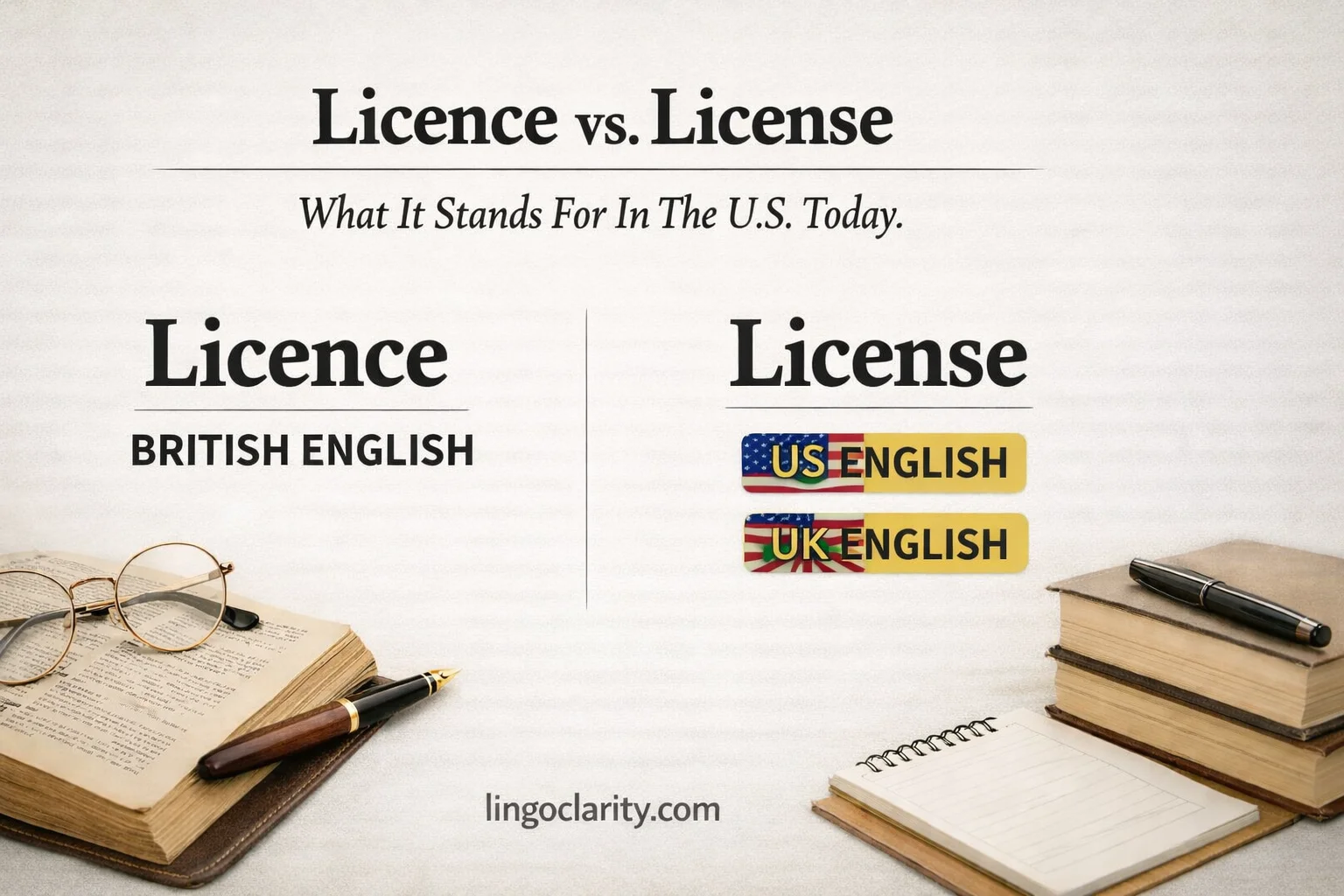
At first glance, licence and license look so similar that they seem interchangeable. After all, they sound the same, refer to the same general idea, and appear in many of the same contexts. However, for a US audience, the choice is much simpler than many writers expect.
In standard American English, license is the form you will almost always need. In other words, if you are writing for readers in the United States, license is normally the correct spelling whether you are using the word as a noun or as a verb.
By contrast, licence is mainly associated with British English. As a result, it usually looks out of place in American content unless you are quoting a British source, preserving an official non-US title, or discussing British usage directly.
That distinction matters more than it may seem. After all, spelling choices affect readability, credibility, and consistency. Even when readers understand what you mean, a nonstandard spelling can make a sentence feel copied, mismatched, or lightly edited. Therefore, if your audience is in the US, choosing the expected form helps your writing feel smoother and more professional.
This guide explains the difference clearly, shows when each spelling is appropriate, and gives real examples so you can choose the right form with confidence.
Quick Answer
For US English, license is the correct choice in almost every normal case.
Use license as a noun:
“She renewed her medical license.”
Use license as a verb:
“The state will license the new clinic next month.”
Use licence only when you are intentionally preserving British wording, quoting a source exactly, or referring to an official non-US title that uses that spelling.
So, for most American writing, the rule is straightforward: use license.
Why People Confuse Licence And License
The confusion happens for a simple reason. Both words sound exactly the same, and both point to the same central idea: official permission.
Because of that, many writers assume the difference must be minor or optional. However, the real difference is not about meaning. Instead, it is about regional spelling conventions.
In American English, license does both jobs. It works as the noun and the verb. In British English, however, the pattern is usually split: licence is commonly the noun, while license is commonly the verb.
Naturally, that creates uncertainty for US writers. Someone may see licence in a British article and wonder whether it is the more formal noun form. Likewise, another writer may assume license is only correct as a verb. In reality, neither assumption fits standard American usage.
So, this is not really a grammar problem in the usual sense. Rather, it is a usage problem shaped by region. Once you understand that, the choice becomes much easier.
Key Differences At A Glance
| Feature | Licence | License |
|---|---|---|
| Standard In US English | Rarely | Yes |
| Standard As A US Noun | No | Yes |
| Standard As A US Verb | No | Yes |
| Common British Noun Form | Yes | No |
| Common British Verb Form | No | Yes |
| Best Choice For US Readers | Only In Special Cases | Almost Always |
As the table shows, license is the standard American form across the board. Therefore, if your readers are in the United States, that is the spelling you should default to.
What License Means In American English
In American English, license can function as both a noun and a verb. That is the key point most US writers need to remember.
As a noun, license usually refers to an official permit, certification, or document that proves permission. For example, someone may hold a driver’s license, a medical license, or a business license.
As a verb, license means to grant permission, authorize, certify, or allow use under formal terms. For instance, a state may license a new facility, or a software company may license its product to customers.
Importantly, the meaning does not change because the spelling changes in American English. Instead, license simply handles both functions.
That is why these sentences all look correct to US readers:
- “Her teaching license expires in September.”
- “The agency will license three new operators this year.”
- “The product is sold under a commercial license.”
- “The university may license the technology to a startup.”
In each case, license fits naturally because that is the standard American form.
What Licence Means And Why It Looks British In US Writing
The word licence is a real word. However, in modern usage, it is mainly tied to British English, where it is commonly used as the noun form.
For example, a British source may refer to a driving licence, a TV licence, or a marriage licence. In that context, the spelling is normal and correct.
In US writing, though, licence usually does not read as a helpful alternative. Instead, it often signals one of three things: British spelling, inconsistent editing, or a simple misspelling.
As a result, American readers often pause when they see it. They may not be confused about the meaning, but the word can still interrupt the flow. Therefore, unless you have a specific reason to keep the British spelling, licence usually weakens American copy instead of improving it.
Why License Is Usually The Right Choice For US Readers
If your audience is in the United States, license is not just acceptable. More importantly, it is standard, expected, and professional.
American readers expect to see license in nearly every major context, including:
- legal writing
- business writing
- healthcare content
- educational materials
- government communication
- software documentation
- general web content
Because of that, using license helps your writing feel settled and trustworthy. By contrast, licence can make otherwise strong content feel imported or uneven.
This is especially important in high-trust subjects. For example, if you are writing about medical compliance, software agreements, or state regulations, readers expect familiar American forms. Therefore, even a small spelling inconsistency can make the copy feel less polished.
In short, license is the form that matches both American usage and American reader expectations.
How License Works As A Noun
As a noun, license usually refers to permission granted by an authority or the document that proves that permission.
For example, you might need a license to drive, operate a business, practice medicine, or use copyrighted software. In each case, the noun points either to the legal permission itself or to the official record of that permission.
Consider these examples:
- “She renewed her nursing license last month.”
- “You need a business license before opening the store.”
- “His driver’s license was still valid.”
- “The company signed a software license agreement.”
In addition, license can appear in broader figurative expressions. One common example is poetic license, which refers to the freedom to bend ordinary rules for artistic effect.
For instance:
- “The director took some poetic license with the historical timeline.”
So, although the word often appears in legal or administrative settings, it also shows up in everyday and creative language.
How License Works As A Verb
As a verb, license means to authorize, certify, or grant formal permission.
That use is especially common in regulatory, business, academic, and technical contexts. For example, a state may license professionals, a government agency may license facilities, and a university may license research to a private company.
Here are some clear US-style examples:
- “The state will license the new childcare center next month.”
- “The board can license providers after the final review.”
- “The company plans to license its software to hospitals.”
- “The university may license the patent to a commercial partner.”
Again, the important point is consistency. In American English, the verb is license, and the noun is also license. Therefore, US writers do not need to switch spellings based on grammatical role.
When You Should Still Use Licence
Even though license is the standard American choice, there are still a few cases where licence is correct to keep.
Most importantly, use licence when you are preserving original British wording. That may happen in a direct quotation, an official title, a cited document, or a discussion of British English itself.
For example:
- “The article quoted a UK page about a television licence.”
- “The form referred to a temporary export licence issued in Britain.”
- “In British English, licence is commonly the noun spelling.”
In each of those examples, the spelling is being preserved intentionally. In other words, it is not being chosen as the normal American form. That distinction is important.
So, while licence is not wrong in every situation, it is still the exception rather than the rule in US writing.
Common US Phrases That Use License
One of the easiest ways to remember the American standard is to think about familiar US phrases. In standard American English, these are the expected forms:
- driver’s license
- business license
- marriage license
- medical license
- software license
- professional license
- hunting license
- fishing license
- license agreement
- poetic license
These combinations look natural because they match the spellings Americans see every day.
Now compare them with British-style alternatives:
- driver’s licence
- software licence
- marriage licence
To a US reader, those versions usually feel off. Therefore, fixed phrases can be a useful reality check. If the phrase is one Americans regularly see, license is almost certainly the right spelling.
When One Choice Sounds Wrong
Sometimes the clearest test is simple readability. In American English, licence often looks wrong in sentences like these:
- “She forgot to renew her driver’s licence.”
- “The board will licence three new providers.”
- “Our software licence expires in June.”
- “He needs a state licence to perform that work.”
An American reader will usually expect:
- “She forgot to renew her driver’s license.”
- “The board will license three new providers.”
- “Our software license expires in June.”
- “He needs a state license to perform that work.”
Meanwhile, the reverse is also true in British contexts. A noun such as driving license may look Americanized to a UK reader. Therefore, the best spelling depends on audience, region, and editorial style.
Common Mistakes To Avoid
Writers often make the same few mistakes with this word pair. Fortunately, each one is easy to fix once you know what to watch for.
Assuming The British Rule Applies Everywhere
A common mistake is believing that licence must always be the noun and license must always be the verb. However, that pattern reflects British usage, not American usage.
In US English, license handles both roles. Therefore, an American article should not switch to licence just because the word is being used as a noun.
Mixing British And American Spellings
Another frequent mistake is mixing styles in the same piece. For example, a page may say driver’s license in one paragraph and software licence in another. Even if readers understand both, the inconsistency makes the article feel unpolished.
So, if your audience is American, keep the American spelling system throughout unless you are preserving a quotation or official title.
Using British Spelling In Fixed American Phrases
Some phrases are deeply established in American English. As a result, British-style spellings look especially unnatural inside them.
Use these standard US forms:
- driver’s license
- marriage license
- business license
- poetic license
Forgetting Related Forms
Also pay attention to related words. In standard US English, the normal forms are:
- licensed
- licensing
For example:
- “She is a licensed therapist.”
- “The agency oversees provider licensing.”
By contrast, licenced and licencing usually look British rather than American.
Practical Examples In Real US Writing
Now let’s look at how this works in real contexts.
Legal And Professional Contexts
In legal and professional writing, license is the expected US form.
Examples:
- “Her medical license is active in two states.”
- “The board may license additional providers after inspection.”
- “You cannot practice without a valid professional license.”
Business And Regulatory Contexts
Likewise, business and regulatory writing almost always uses license.
Examples:
- “The restaurant needs a city license before opening.”
- “The county will license the facility once it passes review.”
- “Their operating license was renewed this year.”
Technology And Software Contexts
In software and product writing, the same standard applies.
Examples:
- “The platform runs under an enterprise software license.”
- “The company may license the tool to hospitals and clinics.”
- “Please review the end-user license agreement.”
Everyday American Usage
Even in ordinary daily language, Americans use license.
Examples:
- “I need to renew my driver’s license next week.”
- “She bought a fishing license before the trip.”
- “The movie takes some poetic license, but it still works.”
As these examples show, license fits smoothly across formal, technical, and casual contexts.
How To Choose The Right Spelling Fast
When you are editing quickly, use this shortcut:
If the audience is American and you are not quoting British text, choose license.
That rule covers almost every normal US case. Therefore, it works well for:
- blog posts
- landing pages
- legal summaries
- compliance content
- healthcare pages
- product copy
- FAQs
- internal documentation
In other words, this is not a decision you need to overcomplicate. For American English, the standard answer is usually obvious once you focus on the audience.
FAQs
Is licence ever correct in American English?
Yes, but only in limited situations. For example, you may keep licence when quoting British text, preserving an official non-US title, or explaining British usage. Otherwise, for normal US writing, license is the standard choice.
Is license a noun or a verb in US English?
It is both. In American English, license works as a noun and as a verb. Therefore, you do not need separate spellings for the two roles.
Why do people confuse licence and license?
They are confusing because they sound the same and share the same core meaning. However, the spelling changes across regional varieties of English. That is why US and UK usage do not always match.
Which spelling should I use for American readers?
Use license. In US English, it is the standard spelling for the noun, the verb, and most related phrases.
What about licensed and licensing?
For American English, the standard related forms are licensed and licensing. By contrast, licenced and licencing are associated with British usage.
Is driver’s licence wrong in the US?
Yes, for an American audience, it usually looks wrong. In US English, the expected form is driver’s license.
Conclusion
For US readers, the answer is clear: use license.
Use license as the noun. Use license as the verb. Use licensed and licensing for related forms. Keep licence only when you are intentionally preserving British wording in a quote, title, or non-US reference.
Ultimately, this is less about two competing words and more about matching your audience. If your readers are in the United States, license is the spelling that looks natural, correct, and professional.
So, when in doubt, keep it simple: choose license
