
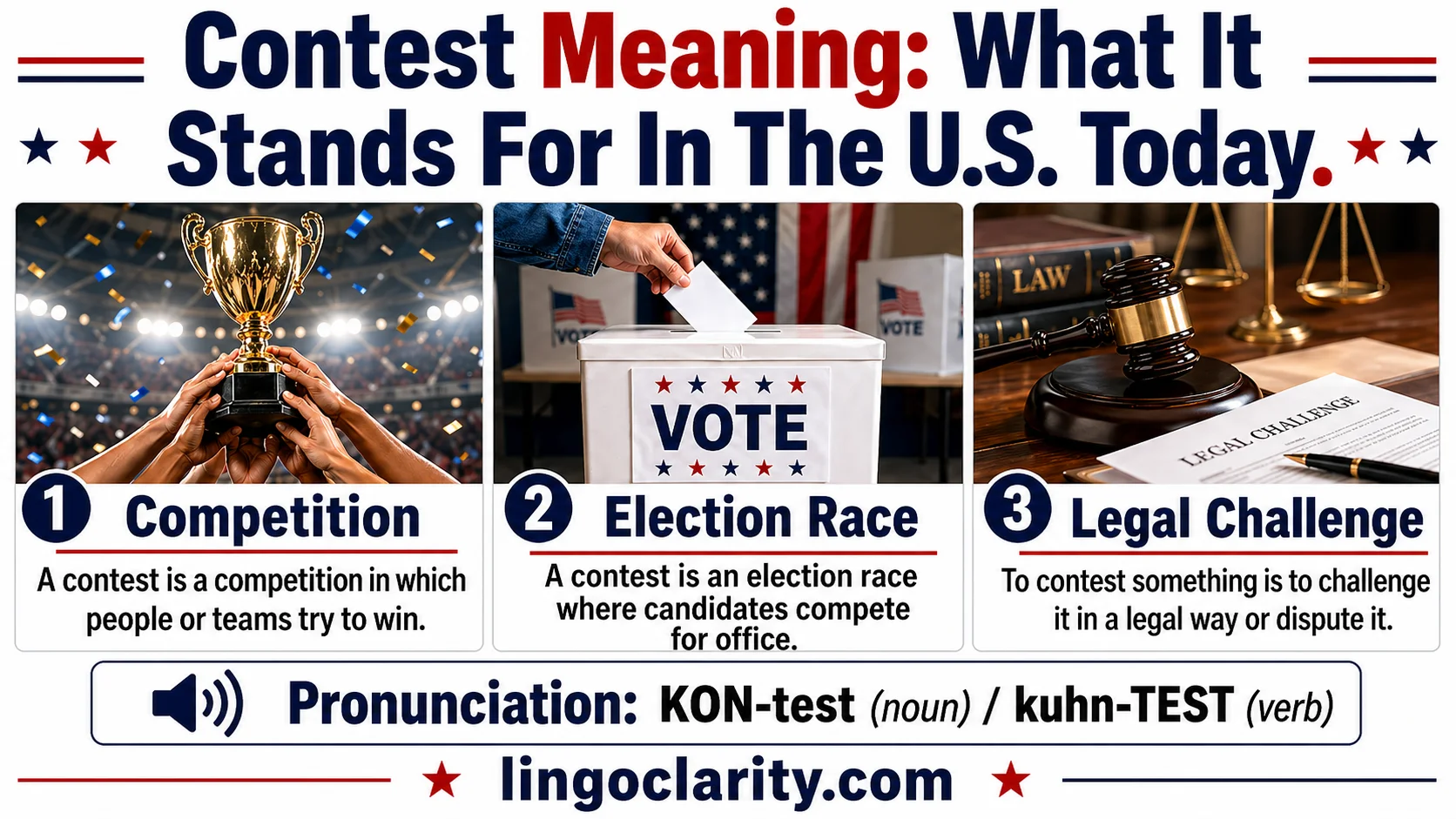
Contest Meaning refers to a competition that people try to win or, as a verb, the act of formally challenging something. A contest can be a spelling contest, photo contest, cooking contest, sports contest, talent contest, or election contest. In another context, someone may contest a ticket, decision, will, or election result.
Contest can also be a verb. To contest something means to challenge it, dispute it, or formally say that you do not accept it. A person might contest a parking ticket, a will, a decision, a claim, a charge, or election results.
The fastest way to remember it is this: a contest is something people try to win; to contest something is to challenge it.
Quick Answer
Contest has two main meanings in standard English.
As a noun, a contest is an event, race, match, or situation in which people compete to win.
As a verb, contest means to challenge, dispute, oppose, or argue against something, often through a formal process.
The pronunciation usually changes by part of speech. The noun is commonly pronounced CON-test. The verb is commonly pronounced con-TEST.
Contest As A Noun
As a noun, contest means a competition. People enter a contest because they want to win a prize, title, position, score, vote, or public recognition.
Examples:
- She entered a baking contest at the county fair.
- The school held an essay contest for eighth graders.
- The final game was a close contest between two strong teams.
- He won first place in the photography contest.
- The campaign became a serious contest for control of the Senate.
A contest can be friendly or serious. A Halloween costume contest is usually fun and informal. A championship contest is more competitive. A political contest can be intense because people are competing for power or office.
In this sense, contest is close to competition, but the two words are not always identical. Competition can describe the general act of competing, while contest often points to a specific event or struggle.
For example:
- Correct: The students entered a science contest.
- Correct: There was strong competition for the scholarship.
The first sentence names a specific event. The second describes a broader situation where many people want the same thing.
Contest As A Verb
As a verb, contest means to challenge or dispute something. This use is more formal than simply saying “argue about.”
Examples:
- The driver decided to contest the parking ticket.
- The family hired a lawyer to contest the will.
- The candidate contested the election results.
- Parents contested the board’s decision.
- The company contested the claim and asked for more evidence.
When you contest something, you usually believe it is wrong, unfair, invalid, unsupported, or not final. The word often appears in legal, political, academic, insurance, workplace, and official settings.
In casual conversation, people often choose simpler verbs such as challenge, fight, appeal, question, or dispute.
For example:
- Formal: She plans to contest the fee.
- Everyday: She plans to fight the fee.
- Formal: The decision was contested.
- Everyday: People challenged the decision.
Both versions can be correct. The best choice depends on tone.
Pronunciation Of Contest
The pronunciation of contest depends on whether the word is being used as a noun or a verb.
As a noun, the stress usually falls on the first syllable: CON-test.
As a verb, the stress usually falls on the second syllable: con-TEST.
Examples:
- Noun: The CON-test starts at noon.
- Verb: They will con-TEST the result.
This stress pattern helps listeners understand the meaning. English has many words that shift stress this way, especially when one form is a noun and the other is a verb.
Contest In Legal And Official Use
In legal or official contexts, contest usually means to dispute something through a recognized process. It does not mean to casually disagree.
Common legal and official phrases include:
- Contest a will: to challenge whether a will is valid.
- Contest a ticket: to challenge a traffic or parking ticket.
- Contest a charge: to dispute an accusation or fee.
- Contest a claim: to challenge whether a claim is true or payable.
- Contest a decision: to formally oppose a ruling or result.
Example:
- Her son contested the will because he believed it had been signed under pressure.
This does not mean he entered a competition. It means he challenged the will’s validity.
Contest In Politics
In politics, contest can be tricky because it has more than one possible meaning.
Sometimes, to contest an election means to participate in it as a candidate or party.
Example:
- Three candidates contested the mayoral election.
However, to contest the election or contest the results can also mean to challenge the outcome.
Example:
- The losing candidate contested the results after the vote count.
For general US readers, run for office is usually clearer when you mean someone is trying to get elected. Use contest the results when you mean someone is challenging the outcome.
Common Phrases With Contest
Beauty Contest
A beauty contest is a competition judged by appearance, presentation, performance, or related standards. In modern writing, beauty pageant may be more common in some contexts.
Example:
- She entered a local beauty contest when she was in college.
Talent Contest
A talent contest is a competition where people perform skills such as singing, dancing, acting, comedy, or playing music.
Example:
- The school talent contest included singers, magicians, and dancers.
Popularity Contest
A popularity contest is a situation where the person who wins is the person people like most, not necessarily the person with the best skills or strongest qualifications.
Example:
- The vote turned into a popularity contest instead of a serious discussion of experience.
No Contest
No contest has two common meanings.
In everyday speech, no contest means one person or thing is clearly better than another.
Example:
- When it comes to homemade pie versus frozen pie, it is no contest.
In US legal use, no contest can refer to a plea where a person does not admit guilt but also does not fight the charge.
Example:
- He pleaded no contest to the charge.
Because the legal meaning is specific, do not use it casually when legal accuracy matters.
Contest Winner
A contest winner is the person or group that wins a contest.
Example:
- The contest winner received a scholarship and a certificate.
Will Contest
A will contest is a legal challenge to a will.
Example:
- The will contest delayed the distribution of the estate.
Word Forms Related To Contest
Contest can appear in several related forms.
- Contest: noun or verb.
- Contests: plural noun or present-tense verb.
- Contested: past tense, past participle, or adjective.
- Contesting: present participle.
- Contestant: a person who enters or participates in a contest.
- Contestable: able to be challenged or disputed.
- Uncontested: not challenged or disputed.
Examples:
- The contestant answered every question correctly.
- The election was hotly contested.
- The divorce was uncontested.
- The claim may be contestable if the paperwork is incomplete.
Synonyms For Contest
The best synonym depends on whether contest is a noun or a verb.
For the noun meaning, useful synonyms include:
- competition
- match
- race
- tournament
- rivalry
- struggle
- showdown
- game
Examples:
- The chess contest lasted three hours.
- The chess match lasted three hours.
For the verb meaning, useful synonyms include:
- challenge
- dispute
- oppose
- question
- appeal
- fight
- argue against
- call into question
Examples:
- She contested the charge.
- She disputed the charge.
- She challenged the charge.
These words are close, but they are not always interchangeable. Question can be mild. Contest sounds stronger and more formal. Appeal usually means asking a higher authority to review a decision. Dispute focuses on disagreement. Challenge is broader and works in many everyday situations.
Antonyms For Contest
For the verb meaning, common antonyms include:
- accept
- agree to
- concede
- support
- approve
- allow
- admit
Examples:
- He contested the result.
- He accepted the result.
For the noun meaning, there is no perfect everyday opposite. The opposite idea depends on the context. If a contest is a competition, the opposite might be cooperation. If it is a conflict, the opposite might be peace or agreement.
Contest Vs. Competition
Contest and competition are closely related, but they are not always used the same way.
A contest is often a specific event with a winner.
Example:
- She entered a poster contest.
Competition can mean a specific event, but it can also mean the general pressure of trying to beat others.
Example:
- There is heavy competition for jobs in that field.
Use contest when you want to talk about a clear event, prize, race, match, or challenge. Use competition when you want a broader word.
Contest Vs. Context
Do not confuse contest with context.
A contest is a competition or formal challenge.
A context is the situation, background, or surrounding information that helps explain something.
Examples:
- Correct: She entered a writing contest.
- Correct: The teacher explained the historical context of the speech.
- Incorrect: She entered a writing context.
The words look similar, but their meanings are completely different.
Common Mistakes With Contest
Using “Make A Contest” Instead Of “Hold A Contest”
In natural US English, people usually say hold a contest, run a contest, host a contest, or enter a contest.
Weak: The school made a contest.
Better: The school held a contest.
Better: The school hosted a contest.
Using “Contest” For Every Argument
Do not use contest as a casual replacement for every disagreement.
Awkward: They contested about dinner.
Natural: They argued about dinner.
Natural: They disagreed about dinner.
Use contest when someone is challenging a result, decision, charge, claim, rule, or official action.
Forgetting The Verb Meaning
Some learners only know the noun meaning. But contest is also a verb.
Noun: She entered the contest.
Verb: She contested the result.
The first sentence means she joined a competition. The second means she challenged the outcome.
Assuming “Contest An Election” Has Only One Meaning
This phrase can mean to run in an election or to challenge an election, depending on context. To avoid confusion, use more specific wording.
Clear: She is running for mayor.
Clear: She is contesting the election results.
Everyday Example Sentences
She entered a short story contest.
The students won the robotics contest.
The debate became a contest of ideas.
The final round was a close contest.
The company ran a customer video contest.
The winner of the contest received a cash prize.
The lawyer helped the family contest the will.
You can contest the ticket if you believe it was issued by mistake.
The board’s decision was contested by several parents.
The insurance company contested the claim.
The election was bitterly contested.
No one expected the race to become such a serious contest.
FAQ
What does contest mean?
Contest means either a competition or a formal challenge. As a noun, it means an event people try to win. As a verb, it means to dispute, challenge, or oppose something.
How do you pronounce contest?
As a noun, contest is usually pronounced CON-test. As a verb, it is usually pronounced con-TEST.
Is contest a noun or a verb?
Contest can be both. In “She entered the contest,” it is a noun. In “She contested the decision,” it is a verb.
What is an example of contest as a noun?
“She won the school spelling contest” uses contest as a noun because it names a competition.
What is an example of contest as a verb?
“He decided to contest the parking ticket” uses contest as a verb because it means he challenged the ticket.
What is the difference between contest and competition?
A contest is usually a specific event or struggle with a winner. Competition can mean a specific contest, but it can also describe the general act or pressure of competing.
What does no contest mean?
In everyday speech, no contest means one side is clearly better. In US legal language, it can refer to a plea where a person does not admit guilt but does not fight the charge.
What is the opposite of contest?
For the verb, opposites include accept, agree to, concede, and support. For the noun, there is no single perfect opposite; the opposite idea may be cooperation, peace, or agreement, depending on the sentence.
Conclusion
Contest is a useful word with two main meanings. As a noun, it means a competition that people try to win. As a verb, it means to challenge or dispute something, usually in a formal or serious way.
Use contest for competitions such as essay contests, talent contests, photo contests, and sports contests. Use contest as a verb when someone challenges a decision, ticket, claim, will, rule, charge, or result.
