
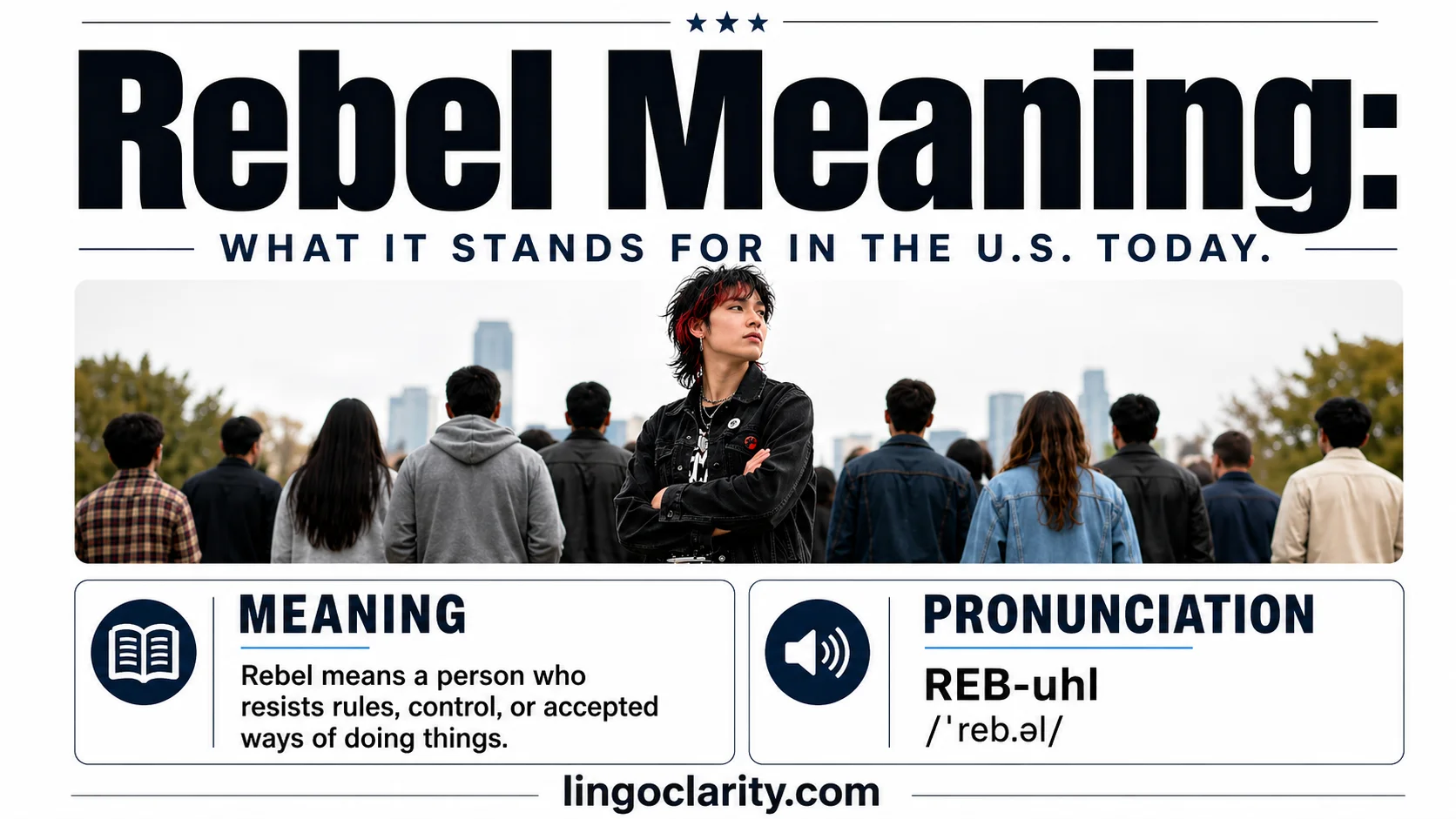
Rebel meaning is simple: a rebel is a person who resists authority, rules, control, or accepted expectations. As a verb, to rebel means to push back, refuse to obey, or rise up against a person, system, law, tradition, or idea.
In simple words, a rebel is someone who does not quietly accept being controlled. Instead, a rebel challenges something they believe is unfair, limiting, outdated, or wrong. However, the word does not always describe violence. It can refer to a political fighter, a teenager who rejects strict family rules, a worker who challenges a bad policy, or an artist who refuses to follow traditional styles.
Pronunciation also matters. As a noun or adjective, rebel is usually pronounced REB-uhl. As a verb, it is pronounced ri-BEL. Therefore, “a rebel” and “to rebel” sound different in natural English.
Quick Answer: What Does Rebel Mean?
Rebel means a person who opposes authority, rules, or accepted standards. As a verb, it means to resist, defy, or rise up against control.
For example, a rebel may fight against a government. However, a rebel may also be someone who refuses to follow social pressure. In addition, the word can describe someone with an independent personality who dislikes being told what to do.
A rebel does not simply disagree. Instead, a rebel pushes back in a visible way. That resistance may be serious, like joining an uprising, or personal, like refusing to follow a family expectation.
Rebel As A Noun
As a noun, rebel means a person who resists authority, control, rules, or accepted standards.
A rebel can be political, social, personal, or cultural. For example, in news and history, a rebel may be part of an organized movement against a government. Meanwhile, in everyday conversation, a rebel may be someone who rejects family expectations, school rules, fashion trends, or workplace traditions.
Examples:
“She was known as a rebel in high school.”
“The rebel leader called for new elections.”
“He became a rebel in the art world because he rejected old methods.”
In many sentences, rebel suggests courage and independence. However, it can also suggest disobedience, conflict, or recklessness. Therefore, the tone depends on the situation. A person who resists an unfair law may be admired. In contrast, a person who breaks reasonable rules only to cause trouble may be criticized.
Rebel As A Verb
As a verb, rebel means to resist or fight back against authority, rules, pressure, or control.
The most common pattern is rebel against. Because the verb describes action, it is stronger than simply “disagree.” A person may disagree silently. However, a person who rebels usually shows resistance through words, behavior, protest, refusal, or organized action.
Examples:
“The workers rebelled against the unfair schedule.”
“She rebelled against her parents’ expectations.”
“Citizens rebelled against the harsh government.”
“Some students rebel when rules feel unreasonable.”
In most cases, the verb is followed by against when you name the thing being resisted. Therefore, “rebel against a rule” sounds more natural than “rebel a rule.”
Rebel As An Adjective
Rebel can also work as an adjective before a noun. In this use, it describes a person, group, force, movement, style, or attitude connected with rebellion.
Political Uses
In political writing, rebel can describe groups, leaders, forces, or movements that oppose an established government or authority.
Examples include rebel forces, a rebel movement, an opposition army, a resistance leader, and an anti-authority group.
Although these phrases may look similar, they do not always carry the same tone. For example, “rebel forces” often sounds like a news or military phrase. Meanwhile, “a resistance leader” may sound more sympathetic, depending on the context.
Everyday Uses
In casual writing, rebel can describe a person’s style, attitude, or personality when they resist normal expectations.
Examples include a defiant attitude, an independent spirit, a rule-breaking style, a rebel streak, and a rebel personality.
In everyday English, the adjective often sounds bold or creative. However, it can sound negative if the person refuses to follow reasonable rules. Therefore, the sentence should make clear whether the writer admires the rebellion or criticizes it.
Pronunciation Of Rebel
The pronunciation of rebel changes by part of speech.
As a noun or adjective, say REB-uhl.
Example: “The REB-uhl refused to leave.”
As a verb, say ri-BEL.
Example: “They ri-BEL against unfair rules.”
This stress change helps listeners understand your meaning. Therefore, if you are talking about the person, use REB-uhl. However, if you are talking about the action, use ri-BEL.
Plain-English Definition Of Rebel
A rebel is someone who refuses to accept control without question.
However, a rebel is not just someone who is different. A person can be different without resisting anything. Instead, a rebel actively pushes back against a rule, authority, tradition, system, or expectation.
For example, someone who quietly dislikes a school rule is not necessarily a rebel. However, someone who openly challenges that rule, refuses to follow it, or encourages others to oppose it may be called a rebel.
In short, a rebel stands against something. Because of that, the word usually carries more force than “independent,” “different,” or “unusual.”
Different Meanings Of Rebel By Context
The word rebel changes slightly depending on where and how it is used. Therefore, context is important.
Political Meaning
In politics, a rebel is a person or group that opposes a government, ruler, or official authority. This is one of the strongest meanings of the word.
Examples:
“The rebel group controlled part of the region.”
“Rebel fighters rejected the peace deal.”
“The government agreed to meet with rebel leaders.”
Because political rebellion can involve violence, this use often sounds serious. However, not every political rebel is described the same way. Some may be called freedom fighters by supporters and rebels by opponents. Therefore, viewpoint matters.
Social Meaning
In social life, a rebel is someone who rejects common expectations or traditions.
Examples:
“She was a rebel who refused to dress like everyone else.”
“He rejected the idea that success had to mean getting a corporate job.”
“The musician became famous as a cultural rebel.”
In this context, rebel often sounds more positive. It may suggest originality, confidence, or independence. However, it can still sound negative if the person is seen as disrespectful or reckless.
Family Or School Meaning
In family or school situations, a rebel is often someone who resists rules or authority figures.
Examples:
“My brother was a teenage rebel.”
“The students pushed back against the strict phone policy.”
“She resisted when her parents tried to choose her career.”
This meaning is common in everyday English. However, it can be playful, critical, or sympathetic depending on the speaker.
Workplace Meaning
At work, a rebel may be someone who challenges leadership, questions outdated systems, or refuses to accept unfair treatment.
Examples:
“The team objected to the impossible deadline.”
“She was a workplace rebel who pushed for better policies.”
“He challenged the old process, but he was a useful rebel.”
In business contexts, rebel can sometimes be positive. After all, companies often need people who question weak systems. However, the word can become negative if the person refuses teamwork or creates conflict without offering solutions.
Creative Or Cultural Meaning
In art, music, fashion, writing, and business, a rebel is often someone who breaks old rules.
Examples:
“The designer became a fashion rebel.”
“The filmmaker ignored Hollywood formulas.”
“Her brand appeals to people with an independent spirit.”
In this sense, rebel usually suggests originality. Moreover, it often describes someone who creates change by refusing to copy what everyone else is doing.
Is Rebel Positive Or Negative?
Rebel can be positive, negative, or neutral.
It is positive when it suggests courage, independence, creativity, or resistance to injustice.
Example: “She was a rebel who stood up for workers’ rights.”
It is negative when it suggests recklessness, violence, selfishness, or pointless disobedience.
Example: “He acted like a rebel, but he was really just ignoring safety rules.”
It is neutral when it simply describes opposition.
Example: “The opposition faction voted against the party leader.”
Therefore, the meaning depends on what the person is resisting and why. If the rule is unfair, the rebel may seem brave. However, if the rule is reasonable, the rebel may seem difficult.
Rebel Vs. Rebellious
Rebel is usually a noun or verb. Rebellious is an adjective.
Use rebel when naming the person:
“She is a rebel.”
Use rebel when naming the action:
“They rebelled against the rule.”
Use rebellious when describing behavior, mood, or personality:
“He has a rebellious attitude.”
“She went through a rebellious phase.”
Therefore, a rebel is the person, while rebellious describes the person’s attitude or behavior. In addition, rebellious often focuses more on personality or mood than on an organized act of resistance.
Rebel Vs. Revolutionary, Insurgent, Maverick, And Nonconformist
Several words are close to rebel, but they are not exactly the same. Therefore, choosing the right synonym depends on context.
A rebel resists authority, rules, or expectations.
A revolutionary wants major political, social, or cultural change. Therefore, this word often sounds larger and more historical.
An insurgent is usually part of an armed movement against a government. Because of that, it sounds more military and formal.
A maverick is an independent person who thinks or acts differently from a group. However, it often sounds more positive and less aggressive.
A nonconformist refuses to follow social customs or common expectations. In contrast, this word is usually more personal or cultural than political.
For example, a student who refuses to follow a dress code may be a rebel or nonconformist. However, that student is not an insurgent. Likewise, a person trying to overthrow a government may be a rebel, insurgent, or revolutionary, depending on the situation.
Common Grammar Patterns With Rebel
The most useful phrase is rebel against, especially when naming the rule, person, system, or expectation being resisted.
Examples:
“Students may challenge authority when rules feel unfair.”
“Citizens sometimes resist the government during periods of corruption or oppression.”
“Artists often reject tradition to create something new.”
“People can push back against social pressure when they choose a different path.”
“Workers may oppose unfair rules if leaders ignore their concerns.”
You can also use rebel at, although it is less common in everyday American English.
Example: “She rebelled at the injustice of the decision.”
However, for most modern writing, rebel against is the clearest and most natural choice when using rebel as a verb.
Synonyms For Rebel
The best synonym depends on the context. Therefore, avoid choosing a replacement word without checking the meaning of the sentence.
Synonyms For A Person Who Resists Authority
Good options include dissenter, resister, defier, rule-breaker, nonconformist, and maverick.
These words work well when the meaning is personal, social, or cultural. However, they may be too weak for military or political contexts.
Synonyms For A Political Rebel
Good options include insurgent, revolutionary, revolter, uprising member, and anti-government fighter.
These words are stronger and more specific. However, they can also sound more formal, political, or violent.
Synonyms For The Verb Rebel
Good options include resist, defy, oppose, revolt, mutiny, rise up, and push back.
Again, these words are not always interchangeable. For example, mutiny usually refers to rebellion by soldiers, sailors, or people under command. Meanwhile, push back is more casual and less intense.
Antonyms For Rebel
Common antonyms include loyalist, supporter, follower, conformist, and obedient person.
For the verb, useful opposites include obey, comply, submit, accept, and conform.
A loyalist supports an existing authority. A conformist follows accepted rules or customs. A follower goes along with others. Therefore, each antonym highlights a different opposite of rebellion.
Word Forms Related To Rebel
The word rebel has several common forms. In addition, knowing these forms helps you use the word more naturally.
Rebel can be a noun, verb, or adjective.
Rebels can be a plural noun or present-tense verb.
Rebelled is the past tense verb.
Rebelling is the present participle or gerund.
Rebellion is a noun for the act or movement of resisting authority.
Rebellious is an adjective for defiant behavior or attitude.
Examples:
“The rebels entered the city.”
“She rebelled against the decision.”
“They are rebelling against the policy.”
“The rebellion lasted for months.”
“He had a rebellious personality.”
As a result, you can avoid repeating rebel too often by using the form that best fits the sentence.
Common Phrases With Rebel
Rebel Against
To resist or oppose something.
“She rebelled against the pressure to be perfect.”
Rebel Forces
Armed forces resisting a government or authority.
“Rebel forces advanced toward the capital.”
Teenage Rebel
A young person who rejects rules or expectations.
“He acted like a teenage rebel for most of high school.”
Rebel At Heart
Someone with a naturally independent spirit.
“She follows the rules at work, but she is a rebel at heart.”
Rebel Without A Cause
A person who resists authority without a clear reason or purpose.
“He was not fighting injustice; he was just a rebel without a cause.”
Example Sentences With Rebel
“The rebel leader called for new elections.”
“She was a quiet rebel who challenged unfair rules without making a scene.”
“He has a rebel streak, especially when people underestimate him.”
“The rebel group agreed to talks after months of fighting.”
“The artist became famous as a rebel who rejected traditional style.”
“Some students push back when rules feel unfair or unclear.”
“He likes to think of himself as a rebel, but he follows most rules.”
“The movie follows a young rebel who challenges a corrupt system.”
These examples show that rebel can appear in serious, casual, political, and creative contexts. Therefore, the best meaning depends on the sentence around it.
Common Mistakes With Rebel
Using One Pronunciation For Every Form
Many learners pronounce the noun and verb the same way. However, natural English usually changes the stress.
Correct: “The REB-uhl refused to leave.”
Correct: “They ri-BEL against unfair laws.”
Thinking Rebel Always Means Violent
A rebel can be violent in political or military contexts. However, the word can also describe personal, social, creative, or cultural resistance.
Using Rebel When You Only Mean Different
Different does not always mean rebellious. For example, someone may have unusual taste without resisting anything. However, someone who rejects a rule, custom, or expectation may be a rebel.
Choosing The Wrong Synonym
Do not use insurgent for a casual rule-breaker. Likewise, do not use nonconformist when you mean an armed fighter. Instead, choose a synonym that fits the situation.
FAQ
What does rebel mean in simple words?
A rebel is someone who refuses to obey authority, rules, or expectations. As a verb, to rebel means to resist, defy, or rise up against something.
How do you pronounce rebel?
As a noun or adjective, rebel is pronounced REB-uhl. As a verb, it is pronounced ri-BEL. Therefore, the stress changes depending on the part of speech.
Is rebel a positive or negative word?
It can be either. Rebel sounds positive when it means brave, independent, or original. However, it sounds negative when it means reckless, violent, or pointlessly disobedient.
What does rebel against mean?
Rebel against means to resist or oppose something. For example, people can rebel against a government, a rule, a tradition, a leader, or a social expectation.
What is the difference between rebel and rebellious?
A rebel is a person who resists authority or rules. However, rebellious is an adjective that describes a person’s attitude or behavior.
Final Meaning
Rebel means a person who resists authority, rules, control, or accepted expectations. As a verb, it means to resist, defy, or rise up against something.
The word can describe a political fighter, a social nonconformist, a difficult teenager, a creative rule-breaker, or anyone who pushes back against control. However, the tone depends on context. A rebel may be brave, reckless, principled, dangerous, original, or simply unwilling to follow the crowd.
Ultimately, the key difference is simple: a REB-uhl is the person, while to ri-BEL is the action. In addition, the most natural phrase is rebel against, especially when naming the rule, person, system, or expectation being resisted.
