
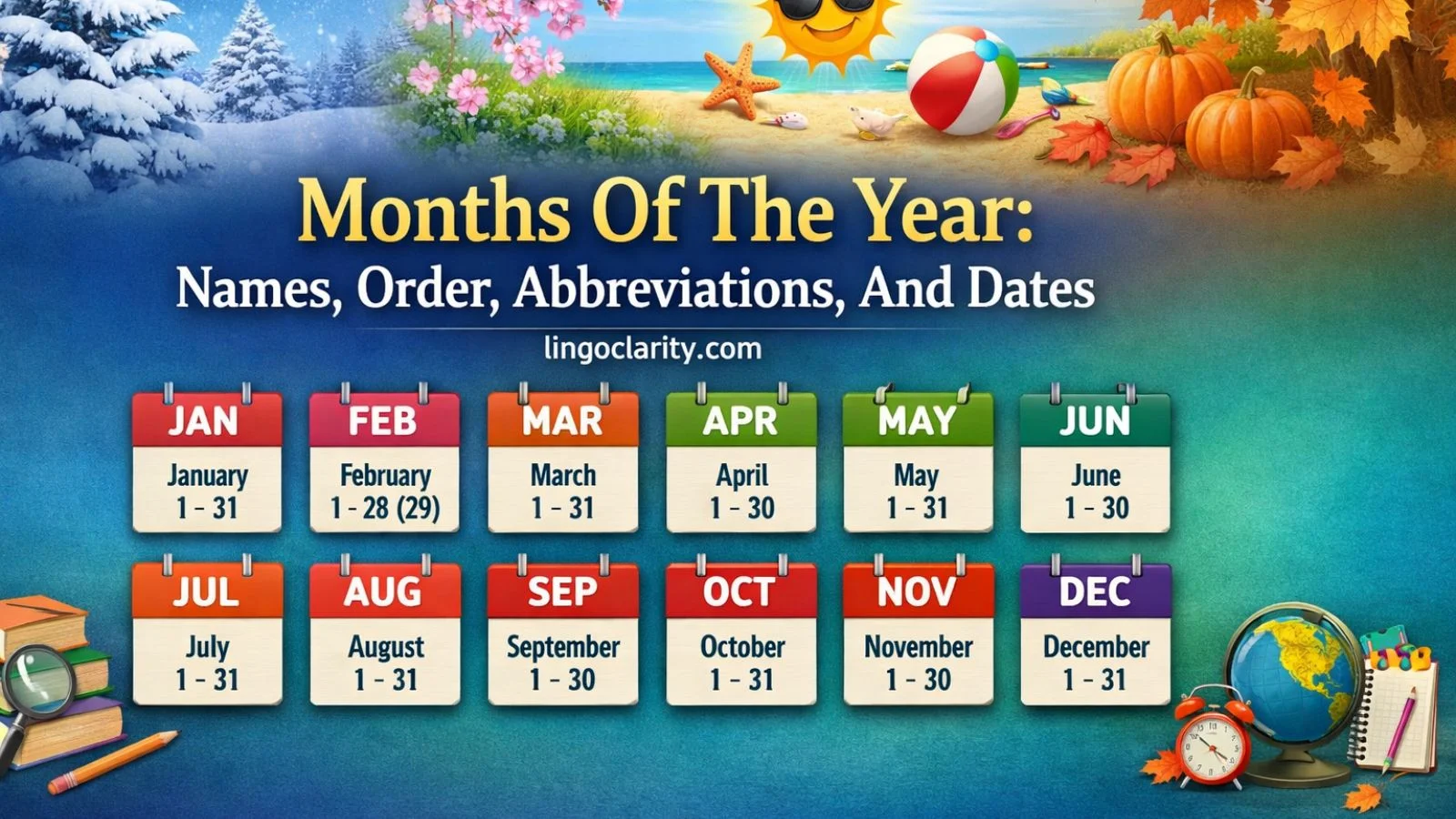
Quick answer: There are 12 months of the year, in this order: January, February, March, April, May, June, July, August, September, October, November, and December. Capitalize every one of them. In American English, write dates month-day-year — September 11, 2026 — and abbreviate only Jan., Feb., Aug., Sept., Oct., Nov., and Dec.
That last rule surprises people, so here’s the short version before the details: five months are never abbreviated in news style, two competing abbreviation systems are both correct in the right place, and the comma in a written date has a job most writers guess at. Below you’ll find the full list, where each name came from, and the date rules that actually get flagged in editing.
What Are the 12 Months of the Year in Order?
The modern Gregorian calendar runs January through December. Here they are with both common abbreviations and their length:
| # | Month | Short form | AP style | Days |
|---|---|---|---|---|
| 1 | January | Jan | Jan. | 31 |
| 2 | February | Feb | Feb. | 28 (29 in a leap year) |
| 3 | March | Mar | March | 31 |
| 4 | April | Apr | April | 30 |
| 5 | May | May | May | 31 |
| 6 | June | Jun | June | 30 |
| 7 | July | Jul | July | 31 |
| 8 | August | Aug | Aug. | 31 |
| 9 | September | Sep | Sept. | 30 |
| 10 | October | Oct | Oct. | 31 |
| 11 | November | Nov | Nov. | 30 |
| 12 | December | Dec | Dec. | 31 |
Month names are proper nouns, so they take a capital letter wherever they appear — mid-sentence, in a list, in a text message. Days of the week follow the same rule. Seasons do not: you write “last October” but “last winter.”
A pronunciation note, since two months cause most of the trouble. February is commonly said FEB-yoo-ary, and Merriam-Webster lists that pronunciation alongside the spelling-faithful FEB-roo-ary [link to Merriam-Webster entry for “February”]. Both are accepted in speech; only one spelling is accepted in writing. Wednesday has the same gap between letters and sound, which is why both words are perennial spelling-test material.
Where Do the Names of the Months Come From?
Almost every name traces back to Roman religion, Roman politics, or plain Latin counting.
- January — Janus, the Roman god of doorways and beginnings, pictured with two faces.
- February — Februa, a Roman purification festival held in the middle of the month.
- March — Mars, god of war. This was the first month of the early Roman year.
- April — uncertain. The most widely cited explanation links it to Latin aperire, “to open,” for opening buds.
- May — Maia, a Roman goddess associated with growth.
- June — Juno, queen of the Roman gods, though some sources point instead to iuniores, “younger men.”
- July — Julius Caesar, who was born in the month then called Quintilis, “fifth.”
- August — Augustus, the first Roman emperor, honored with the month formerly called Sextilis, “sixth.”
- September through December — Latin septem, octo, novem, and decem: seven, eight, nine, ten.
That last group explains an oddity people notice and can’t account for. September sits ninth, not seventh, because the Roman year originally began in March. Two months were added at the front, the numbering slid, and the names stayed put.
How Do You Abbreviate the Months of the Year?
Two systems are in circulation, and mixing them is the single most common error in dated copy.
The three-letter system clips every month to its first three letters: Jan, Feb, Mar, Apr, May, Jun, Jul, Aug, Sep, Oct, Nov, Dec. Use it in tables, spreadsheets, calendar apps, filenames, and anywhere column width matters. Periods are optional and usually dropped.
AP style, the standard for US news and most marketing copy, is stricter. The Associated Press abbreviates only Jan., Feb., Aug., Sept., Oct., Nov., and Dec., and only when a specific date follows. March, April, May, June, and July are always spelled out — their names are already short [link to AP Stylebook].
| Situation | AP style | Three-letter system |
|---|---|---|
| With a specific date | Sept. 11, 2026 | Sep 11, 2026 |
| With a year only | September 2026 | Sep 2026 |
| Standing alone | September | Sep |
| Short-name months | June 5, 2026 | Jun 5, 2026 |
Note the split on September: AP uses four letters (Sept.), while the three-letter system uses Sep. Both are right in their own context, and neither is right in the other’s.
The Chicago Manual of Style takes a third position for books and academic work — spell months out in running text, and reserve abbreviations for notes, tables, and bibliographies [link to Chicago Manual of Style, chapter 10]. Pick the guide your publication uses and stay inside it.
How Do You Write Dates Correctly in American English?
Seven rules cover nearly everything a US writer needs:
- Capitalize the month. Always, no exceptions.
- Use month-day-year order. September 11, 2026.
- Put a comma between the day and the year — and another after the year if the sentence continues: The contract began on September 11, 2026, and runs two years.
- Drop the comma for a month and year alone. September 2026, not September, 2026.
- Skip ordinals in formal writing. Write September 11, not September 11th, even though you say “September eleventh” out loud.
- Day-month-year order takes no commas. 11 September 2026 is standard in British, military, and much international writing.
- Be careful with all-numeral dates. In the US, 9/11/2026 means September 11. Nearly everywhere else, it means November 9. For an international audience, spell the month out or use the ISO 8601 format, 2026-09-11, which sorts correctly and can’t be misread.
Common Mistakes With Months and Dates
| Wrong | Right | Why |
|---|---|---|
| see you in september | see you in September | Months are proper nouns |
| March 4th, 2026 | March 4, 2026 | No ordinals in formal dates |
| June, 2026 | June 2026 | No comma without a day |
| Sep. 11 (news copy) | Sept. 11 | AP uses four letters for September |
| Jun. 5 (news copy) | June 5 | AP never abbreviates June |
| three January’s in a row | three Januarys in a row | Plural, not possessive |
| Febuary | February | Keep the first r |
The apostrophe error is worth a second look. January’s is possessive — January’s sales figures. The plural is Januarys, formed like any other noun. The same logic gives you the 1990s, not the 1990’s.
Related Terms That Trip People Up
- Bimonthly — ambiguous, and dictionaries record both senses: every two months and twice a month. Say which you mean.
- Semimonthly — twice a month, unambiguously. Reach for this one instead.
- Biannual vs. biennial — biannual is twice a year; biennial is every two years. One letter, a four-fold difference in frequency.
- Quarter — a three-month block. A calendar year’s Q1 is January through March; a company’s fiscal year may start in any month, so its Q1 can land anywhere.
- Leap year — a year with a 29th day in February, added roughly every four years to keep the calendar aligned with Earth’s orbit.
Frequently Asked Questions
What are the 12 months of the year in order?
January, February, March, April, May, June, July, August, September, October, November, and December. Seven have 31 days, four have 30, and February has 28 or 29.
Do you capitalize months of the year?
Yes. Month names are proper nouns and are capitalized in every position, including mid-sentence and in informal writing. Seasons like spring and summer stay lowercase.
Is it “Sept.” or “Sep.”?
Both, depending on the style. AP style uses Sept. with a period. The three-letter system used in tables, spreadsheets, and software uses Sep. Don’t mix them inside one document.
Should you write “September 11” or “September 11th”?
Write September 11 in formal writing. The ordinal form is how you say the date aloud, not how you write it, though “the 11th of September” is correct when the day comes first.
Which months have 30 days?
April, June, September, and November. The rest have 31, except February, which has 28 days and 29 in a leap year.
Getting the month right is the easy half. Getting the punctuation and the abbreviation system right is what separates copy that reads as edited from copy that reads as typed — so decide which style guide governs your document before you write the first date, not after someone flags the twelfth one.
