
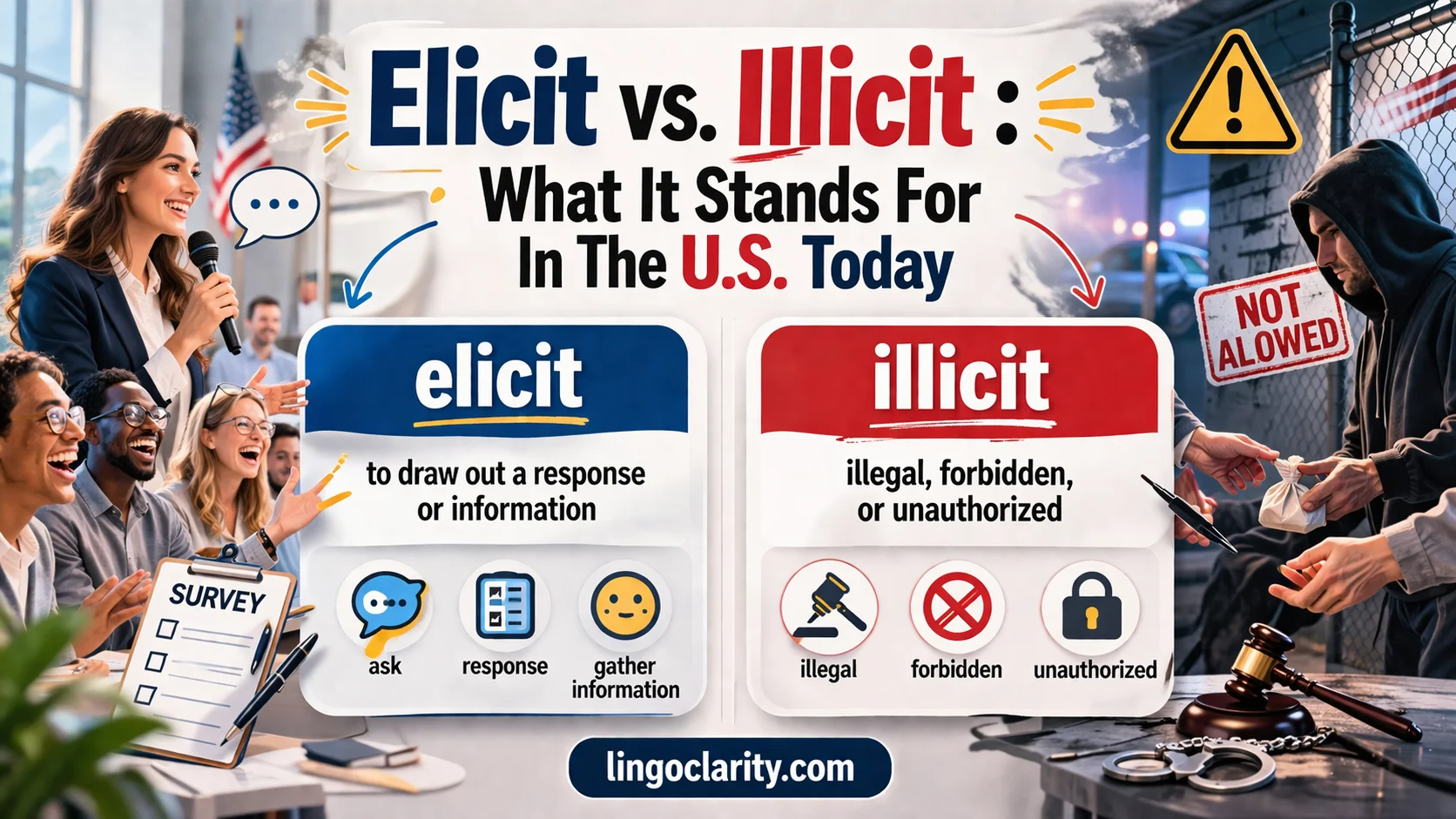
If you mean draw out a response, use elicit. If you mean illegal, forbidden, or not allowed, use illicit. That is the whole difference in one line: elicit is a verb, while illicit is an adjective.
The Quick Answer
Writers mix up elicit and illicit because the words look similar and are often pronounced the same or almost the same, depending on accent and dictionary treatment. But they do completely different jobs in a sentence.
- Elicit means to draw out, bring forth, or get a reaction, answer, or piece of information.
- Illicit means unlawful, forbidden, unauthorized, or socially disapproved.
A survey can elicit honest feedback.
A black-market operation is illicit.
Those meanings are not interchangeable.
What Elicit Means
Elicit is a verb. Standard dictionaries define it as getting or producing something, especially a response, information, support, or a reaction. Cambridge labels it as formal, which helps explain why it often appears in academic, legal, medical, journalistic, and business writing rather than casual conversation.
In plain English, elicit means to bring something out.
You usually use it when one thing causes another thing to be expressed, revealed, or felt.
Examples:
- The interviewer asked follow-up questions to elicit more detail.
- The joke elicited laughter from the audience.
- The teacher used discussion prompts to elicit student responses.
- The ad was designed to elicit sympathy.
A helpful pattern to remember is that elicit usually takes an object. You elicit a response, elicit information, elicit support, elicit laughter, or elicit a confession. That collocation pattern is common across dictionary examples and grammar guides.
What Illicit Means
Illicit is an adjective. Dictionaries define it as not permitted by law, rules, custom, or accepted standards. That is important: the word often overlaps with illegal, but it can also describe something morally, socially, or institutionally forbidden even when the context is not strictly criminal.
In plain English, illicit means not allowed.
Examples:
- The investigation uncovered an illicit payment scheme.
- Police seized illicit goods at the port.
- The story centered on an illicit relationship.
- The company denied involvement in illicit trade.
That last example matters because illicit often appears in serious or formal contexts: law, regulation, crime reporting, ethics, compliance, and public policy. It tends to sound stronger and more precise than words like wrong or improper.
The Core Difference in One Sentence
Use elicit when something draws out a response.
Use illicit when something breaks a rule or falls outside what is allowed.
That difference is both semantic and grammatical:
- Elicit = verb
- Illicit = adjective
Once you notice the part of speech, the choice usually becomes easy.
Why People Confuse Them
The confusion comes from three things.
First, the spellings are extremely close.
Second, many dictionaries and usage guides treat them as homophones or near-homophones. LanguageTool gives both as /ɪˈlɪsɪt/, Grammarly presents the same pronunciation, and Collins gives the same IPA for both entries. Merriam-Webster also notes the similarity directly.
Third, they appear in more formal writing than in casual speech. That means many people see them less often, which makes them easier to swap accidentally.
Pronunciation, Grammar, And Memory Tricks
The safest way to keep the two straight is not pronunciation, because pronunciation does not reliably separate them. Grammar does.
Here is the fastest test:
- If the word needs to do something, choose elicit.
- If the word needs to describe something, choose illicit.
Try this memory aid:
- Elicit = Evoke
- Illicit = Illegal
It is not a perfect definition, but it is an effective shortcut. The first pair shares the idea of drawing something out. The second pair shares the idea of something forbidden. Competitor pages use this kind of mnemonic often because it works.
How To Use Elicit Correctly
Use elicit when a person, question, event, statement, image, or experience causes a reaction or reveals information.
Common examples include:
- elicit a response
- elicit feedback
- elicit laughter
- elicit support
- elicit information
- elicit a confession
Sample sentences:
- The moderator asked a sharper question to elicit a more honest answer.
- The film’s final scene elicited tears from the audience.
- The product team ran interviews to elicit customer pain points.
- Her comment elicited a strong reaction online.
Notice the pattern: something prompts, draws out, or produces a response.
How To Use Illicit Correctly
Use illicit when you are describing conduct, goods, relationships, markets, funds, substances, or activity that is not allowed.
Common pairings include:
- illicit drugs
- illicit trade
- illicit activity
- illicit funds
- illicit relationship
- illicit payments
Sample sentences:
- Investigators traced the cash flow to an illicit network overseas.
- Customs officers found illicit cigarettes hidden in the shipment.
- The company denied authorizing any illicit payments.
- The scandal involved an illicit affair, not a criminal charge.
That last example shows why illicit is broader than illegal. Some uses point to lawbreaking. Others point to conduct considered forbidden, improper, or socially unacceptable.
Side-By-Side Comparison
Here is the distinction in practical terms:
- A question can elicit an answer.
- A speech can elicit applause.
- A survey can elicit feedback.
But:
- A smuggling network is illicit.
- An unauthorized payment can be illicit.
- A forbidden affair may be called illicit.
A useful sentence that shows both words together is this:
The audit elicited evidence of an illicit payment scheme.
That sentence works because elicited shows what the audit brought out, while illicit describes the scheme itself.
Common Mistakes And How To Fix Them
The most common mistake is using illicit where the sentence needs a verb.
Wrong: The documentary illicit strong reactions.
Right: The documentary elicited strong reactions.
Another common mistake is using elicit where the sentence needs an adjective.
Wrong: They were accused of elicit activity.
Right: They were accused of illicit activity.
A third mistake is assuming illicit only applies to crimes. That is too narrow. A dictionary-based explanation is more accurate: illicit can mean unlawful, unauthorized, or socially disapproved, depending on context.
A Quick Self-Check Before You Publish
When you are unsure, ask two questions:
- Am I talking about getting a reaction, answer, or information?
Use elicit. - Am I describing something forbidden, improper, or unlawful?
Use illicit.
If you can replace the word with evoke, draw out, or bring forth, you probably want elicit.
If you can replace it with illegal, forbidden, unauthorized, or improper, you probably want illicit.
Elicit Vs. Illicit Vs. Illegal
This is where many grammar articles stop too early.
Illegal almost always points directly to what violates the law.
Illicit can do that too, but it can also carry a broader sense of being forbidden by custom, ethics, policy, or accepted norms. That is why phrases like illicit affair sound natural, even though an affair is not usually a criminal offense. Multiple dictionaries explicitly include this broader meaning.
So:
- Every illegal act is unlawful.
- Many illicit acts are illegal.
- But some things described as illicit are better understood as improper, forbidden, or taboo rather than strictly criminal.
That nuance makes your writing more precise.
The Rare Opposite: Licit
One useful word most articles barely mention is licit.
Licit means lawful, permissible, or not forbidden by law. Merriam-Webster notes that it is much less common than illicit, but it does exist and is especially used in legal or regulatory contexts.
You do not need licit in everyday writing, but knowing it helps reinforce the meaning of illicit:
- licit = allowed
- illicit = not allowed
Origins And Word History
The two words are not different forms of the same term. They come from different Latin roots, which helps explain why their meanings split.
Merriam-Webster traces elicit to roots tied to drawing forth or luring out, while illicit is tied to what is permitted or not permitted. Collins and Merriam-Webster both support that distinction in their etymology notes.
That history also gives you a better memory hook:
- Elicit is about pulling something out.
- Illicit is about crossing a line of permission.
Why This Difference Matters In Real Writing
This is not a tiny spelling issue. Swapping these words changes both the grammar and the meaning of the sentence.
Compare:
- The prosecutor tried to elicit the truth.
- The prosecutor uncovered illicit payments.
The first sentence is about obtaining information. The second is about describing wrongdoing.
In professional writing, that difference matters. In journalism, legal writing, academic work, business reports, and even polished email communication, using the wrong word makes the sentence look careless. Worse, it can distort the meaning entirely.
FAQ
What is the difference between elicit and illicit?
Elicit means to draw out a response, reaction, or information. Illicit means illegal, forbidden, unauthorized, or socially disapproved. Elicit is a verb; illicit is an adjective.
Are elicit and illicit pronounced the same way?
Often yes. Many modern guides treat them as the same pronunciation or close enough that context does the real work. That is one of the main reasons people confuse them.
Is illicit the same as illegal?
Not always. Illicit often means illegal, but it can also mean forbidden by rules, custom, ethics, or social standards. An illicit affair is the clearest example.
Can elicit be used as an adjective?
No. In standard modern English, elicit is used as a verb, not as an adjective. If you need an adjective, you almost certainly do not want elicit.
What is an easy way to remember elicit vs. illicit?
Use this shortcut: Elicit = Evoke and Illicit = Illegal. It is fast, memorable, and accurate enough for everyday writing.
Can you use both words in the same sentence?
Yes: The interview elicited evidence of an illicit scheme. That works because elicited describes what the interview brought out, while illicit describes the scheme.
The Bottom Line
Choose elicit when something brings out a response, answer, emotion, or piece of information.
Choose illicit when something is forbidden, unlawful, unauthorized, or socially out of bounds.
If you remember just one line, make it this:
Elicit draws something out. Illicit describes something that should not be allowed.
