
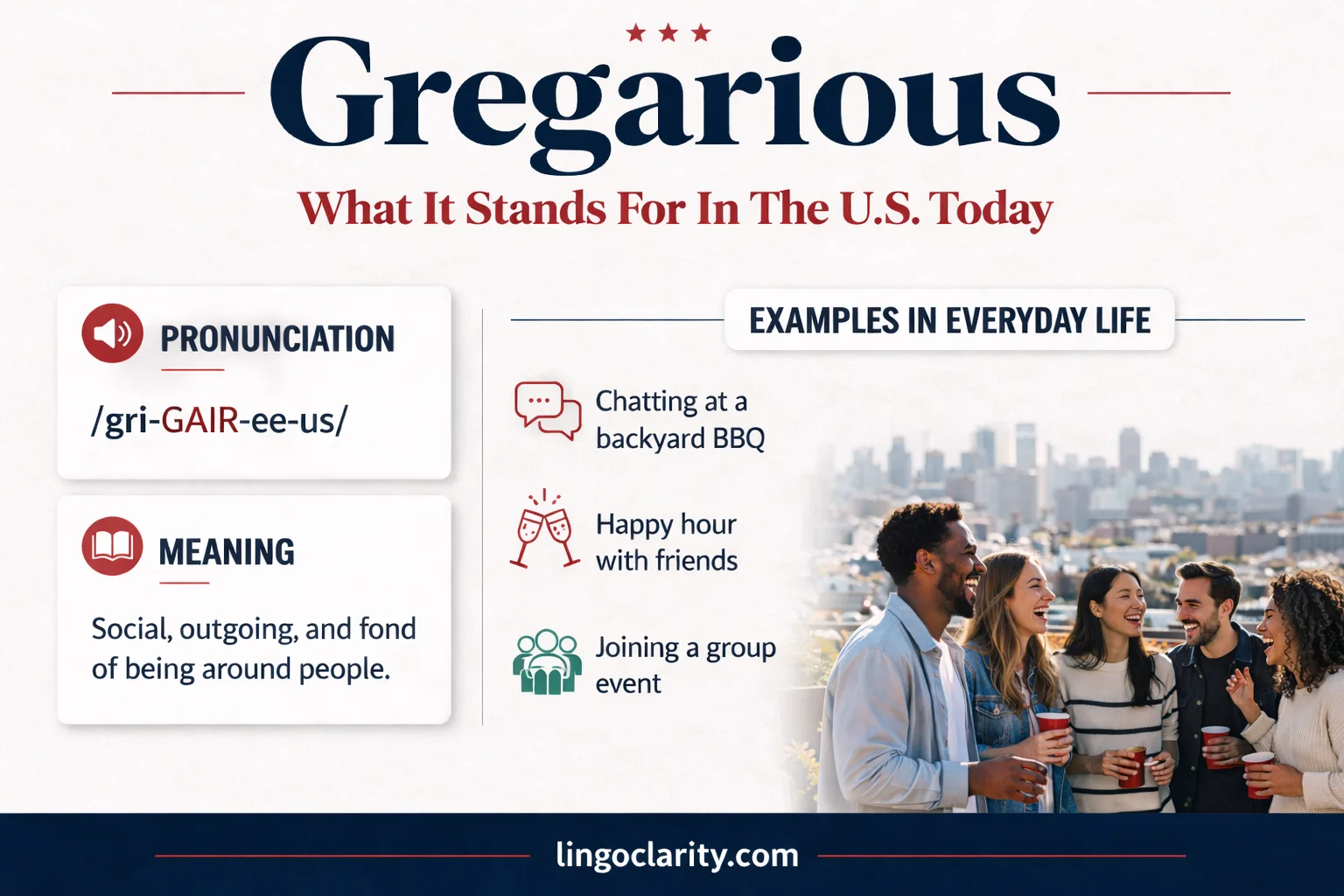
Gregarious means sociable and fond of other people’s company. It usually describes someone who enjoys conversation, group settings, and social interaction. It can also describe animals that naturally live, move, or feed in groups.
That is the core meaning, but the word is more useful than its short definition suggests. It is one of those vocabulary words that sounds sharper and more precise than basic alternatives like friendly or social. When used well, it tells the reader more than simple politeness. It suggests a person who is naturally at ease around others and often energized by being with them.
In this guide, you will learn exactly what gregarious means, how to pronounce it, how to use it in real sentences, when it fits, when it does not, and how it differs from similar words. By the end, the word should feel easy, natural, and practical to use.
Quick Answer
Gregarious is an adjective that means enjoying the company of other people or living in groups. It most often describes a social, outgoing person, but it can also describe animals such as birds, fish, or mammals that tend to gather together.
What Does Gregarious Mean?
At its simplest, gregarious means very social. A gregarious person enjoys being around others, talking with people, joining group activities, and meeting new faces. The word often suggests comfort, ease, and energy in social settings.
For example, if someone walks into a room full of strangers and quickly starts connecting with people, that person may be described as gregarious. If a host keeps a dinner party lively and makes everyone feel included, gregarious is a natural word choice.
The word also has a long-standing biology meaning. In that context, gregarious describes animals that live, travel, or feed in groups. Penguins, dolphins, and many herd animals are common examples.
So the main idea is simple: gregarious points to a strong social tendency.
Definition In Plain English
In plain English, gregarious means someone likes being around people.
It is not just about being nice. A person can be kind, polite, and warm without being especially gregarious. The difference is that a gregarious person usually seems to enjoy social interaction as part of their nature. They often seek out company rather than merely tolerate it.
That is why the word is useful. It says more than friendly. It tells you the person is not only pleasant but socially inclined.
Pronunciation
The word gregarious is commonly pronounced like this:
gri-GAIR-ee-us
The stress falls on the second syllable.
A simple way to remember it is to say it slowly first:
grih-GAIR-ee-us
Then say it naturally at normal speed:
gri-GAIR-ee-us
Some speakers pronounce the middle sound slightly differently depending on accent, but the most important point is the stress. Do not put the stress on the first syllable. The word sounds most natural when the emphasis lands in the middle.
Part Of Speech And Word Forms
Gregarious is an adjective, which means it describes a noun.
Examples:
- a gregarious neighbor
- a gregarious teacher
- a gregarious species
Related forms include:
- Gregariously — adverb
She greeted the new team gregariously and made them feel welcome. - Gregariousness — noun
His gregariousness made him a strong fit for client-facing work.
For most readers, the key form to remember is the adjective gregarious.
How To Use Gregarious Correctly
You can use gregarious before a noun or after a linking verb.
Examples:
- Lena is gregarious and rarely avoids a social event.
- He has a gregarious personality.
- Dolphins are highly gregarious animals.
The word works best when you want to show more than one moment of friendliness. It usually describes a lasting trait, habit, or tendency.
That distinction matters. Someone might act friendly at work because the situation requires it. A gregarious person tends to enjoy connection more broadly and more naturally.
When To Use Gregarious
Use gregarious when you want a word that clearly signals a strong social side.
It fits especially well in:
- personality descriptions
- workplace communication
- academic writing
- character analysis
- social event descriptions
- biology and animal behavior
It is especially effective when you want a more polished or precise alternative to social or outgoing.
For example:
- The candidate’s gregarious manner helped her build trust quickly.
- The novel presents its lead character as witty, ambitious, and deeply gregarious.
- Many seabirds are gregarious during nesting season.
When Not To Use Gregarious
Do not use gregarious for every pleasant or helpful person.
A person may be thoughtful, warm, and considerate without enjoying lots of social interaction. In that case, friendly, kind, or approachable may be more accurate.
You should also avoid forcing the word into very casual conversation if it sounds unnatural for the audience. It is a standard everyday English word, but it still sounds more polished than friendly or social. In informal speech, people often choose the simpler option unless they want a more exact tone.
Gregarious In People And In Animals
With people, the word usually means sociable, outgoing, and happy in company.
Examples:
- Marcus is so gregarious that he can make friends almost anywhere.
- Her gregarious nature made her a natural event organizer.
With animals, the word means living or behaving in groups.
Examples:
- Penguins are gregarious birds that often gather in large colonies.
- These fish are gregarious and swim together for protection.
- Elephants are highly gregarious and maintain strong herd bonds.
This biological use is not secondary or unusual. It is an important part of the word’s meaning and one reason the term feels richer than simple social vocabulary.
Why Gregarious Is More Precise Than Friendly
This is one of the most important distinctions.
Friendly focuses on how a person treats others.
Gregarious focuses on how much a person enjoys being with others.
A friendly person may smile, help, and speak kindly. A gregarious person usually goes further. They often enjoy conversation, group dynamics, and regular social contact.
That is why these two examples do not mean the same thing:
- The receptionist was friendly.
- The receptionist was gregarious.
The first sentence tells you the receptionist was pleasant. The second tells you the receptionist likely enjoys interacting with lots of people.
Gregarious Vs. Sociable, Outgoing, And Extroverted
These words overlap, but each has its own shade of meaning.
Gregarious Vs. Sociable
These are very close. In many sentences, sociable is the nearest substitute for gregarious. The difference is that gregarious often sounds a little stronger and more vivid. It suggests a more noticeable or natural pull toward company.
Gregarious Vs. Outgoing
Outgoing often highlights confidence, openness, and ease around strangers. A person can be outgoing in style without being deeply gregarious in habit. Gregarious is more about enjoying social contact itself.
Gregarious Vs. Extroverted
Extroverted is broader. It is usually treated as a personality label. Gregarious is narrower and more behavioral. It focuses on enjoyment of people and group interaction.
That makes gregarious especially useful when you want to describe visible social energy without making a broad psychological claim.
Synonyms Of Gregarious
Useful synonyms include:
- sociable
- outgoing
- social
- convivial
- companionable
- warm
- extroverted
These are not perfect substitutes in every sentence, but they all overlap with the idea of openness to people and company.
Among them, sociable is usually the closest everyday match.
Antonyms Of Gregarious
Common antonyms or near-opposites include:
- reserved
- reclusive
- unsociable
- aloof
- solitary
- introverted
Be careful with introverted. It is not always a clean opposite. An introverted person may still be warm, engaging, and socially skilled. They may simply prefer less stimulation or smaller doses of social interaction.
In many everyday contexts, reserved is the safest opposite.
Natural Sentence Examples
Here are some strong, realistic examples of gregarious in use:
- Ava’s gregarious personality made her a natural fit for public relations.
- He was charming but not truly gregarious; he liked attention more than company.
- The host’s gregarious style made even first-time guests feel comfortable.
- Their new manager is gregarious enough to keep the team connected without overwhelming anyone.
- At college, her gregarious nature helped her build a wide circle of friends in just a few weeks.
- Dolphins are gregarious mammals that often travel in pods.
- The camp counselor was upbeat, funny, and naturally gregarious with the kids.
- Although she is friendly, she is not especially gregarious and prefers smaller groups.
- The novel’s hero is brave, witty, and almost excessively gregarious.
- Many grazing animals are gregarious because group living offers protection.
These examples show that the word works well in both formal and everyday writing.
Common Contexts Where The Word Appears
You are likely to see gregarious in these kinds of contexts:
Personality Descriptions
- He is bright, gregarious, and easy to talk to.
Workplace Writing
- We are looking for a gregarious candidate who can build strong client relationships.
Social Situations
- Her gregarious energy changed the tone of the whole event.
Academic And Literary Writing
- The author presents the character as ambitious, restless, and unusually gregarious.
Biology
- This species is gregarious during migration.
These are the settings where the word feels most natural and most useful.
Word Origin
The word gregarious comes from a Latin root connected to the idea of a flock or herd.
That origin helps explain the meaning perfectly. Whether the word is applied to people or animals, the central image is the same: a tendency to belong with others, move with others, or prefer company over isolation.
That also makes the word easier to remember. If you connect gregarious with group-oriented, the meaning tends to stick.
Common Mistakes
A few mistakes show up again and again.
Using It As A Noun
Wrong: She is a gregarious.
Correct: She is gregarious.
Using It As A Fancy Version Of Friendly
Not every kind person is gregarious. The word implies a stronger social tendency.
Using It For Someone Who Is Only Talkative
A talkative person may talk a lot without truly enjoying other people’s company. Gregarious is about social inclination, not just verbal energy.
Overusing It In Casual Speech
The word is standard English, but it is more polished than friendly or social. Use it when precision helps.
Gregarious Vs. Egregious
This is a common mix-up because the words look similar, but they mean completely different things.
Gregarious means social, sociable, and fond of company.
Egregious means shockingly bad or extremely wrong.
Examples:
- She is gregarious and loves meeting new people.
- The company made an egregious error in the report.
If you confuse these two words, the sentence can become accidentally absurd. It is an easy difference to learn and worth remembering.
Is Gregarious A Positive Word?
Most of the time, yes.
Calling someone gregarious usually sounds positive. It often suggests warmth, energy, confidence, and ease with people. In personality descriptions, it is usually praise.
Still, context matters. In the wrong setting, the word could suggest too much social intensity or a person who is rarely comfortable alone. That is not the most common reading, but tone always depends on the sentence around it.
In normal use, though, gregarious is usually favorable.
Is Gregarious Formal Or Informal?
Gregarious is a standard English vocabulary word. It is not slang, and it is not overly academic.
You can use it in:
- essays
- articles
- workplace writing
- profiles
- presentations
- normal conversation
That said, it sounds slightly more polished than the most common everyday alternatives. If you want a plain, simple word, social or friendly may feel more casual. If you want a more exact and expressive word, gregarious is stronger.
Why This Word Is Useful
A good vocabulary word does not just sound smarter. It does a better job.
That is why gregarious is useful. It gives a cleaner, richer meaning than several simpler alternatives. It helps the writer show that someone is not just pleasant but genuinely socially engaged.
That can matter in all kinds of writing:
- resumes and bios
- character descriptions
- school assignments
- workplace communication
- personal essays
- language learning
It is one of those words that can make a sentence more exact without making it harder to understand.
FAQ
What does gregarious mean?
It means sociable and fond of other people’s company. It can also describe animals that live or move in groups.
Is gregarious a positive word?
Usually, yes. It often sounds warm, approving, and complimentary, especially when used to describe a person’s social nature.
Can gregarious describe animals?
Yes. In biology, it often describes animals that gather, travel, feed, or live in groups.
Is gregarious the same as friendly?
No. Friendly focuses on kindness and pleasant behavior. Gregarious focuses on enjoying company and social interaction more strongly.
What is the opposite of gregarious?
Common opposites include reserved, reclusive, unsociable, and sometimes introverted, depending on context.
How do you pronounce gregarious?
A simple guide is gri-GAIR-ee-us, with stress on the second syllable.
Is gregarious slang?
No. It is a normal English dictionary word used in writing and speech.
What is the difference between gregarious and extroverted?
Gregarious focuses on enjoying the company of others. Extroverted is broader and describes a wider personality style.
Conclusion
Gregarious means sociable, outgoing, and naturally drawn to other people’s company. It is most often used for people who enjoy social interaction, but it also has an important biology meaning for animals that live or move in groups.
It is a strong word because it is more precise than friendly and more vivid than social. When you want to describe someone who genuinely likes being around others, gregarious is one of the best words you can choose.
