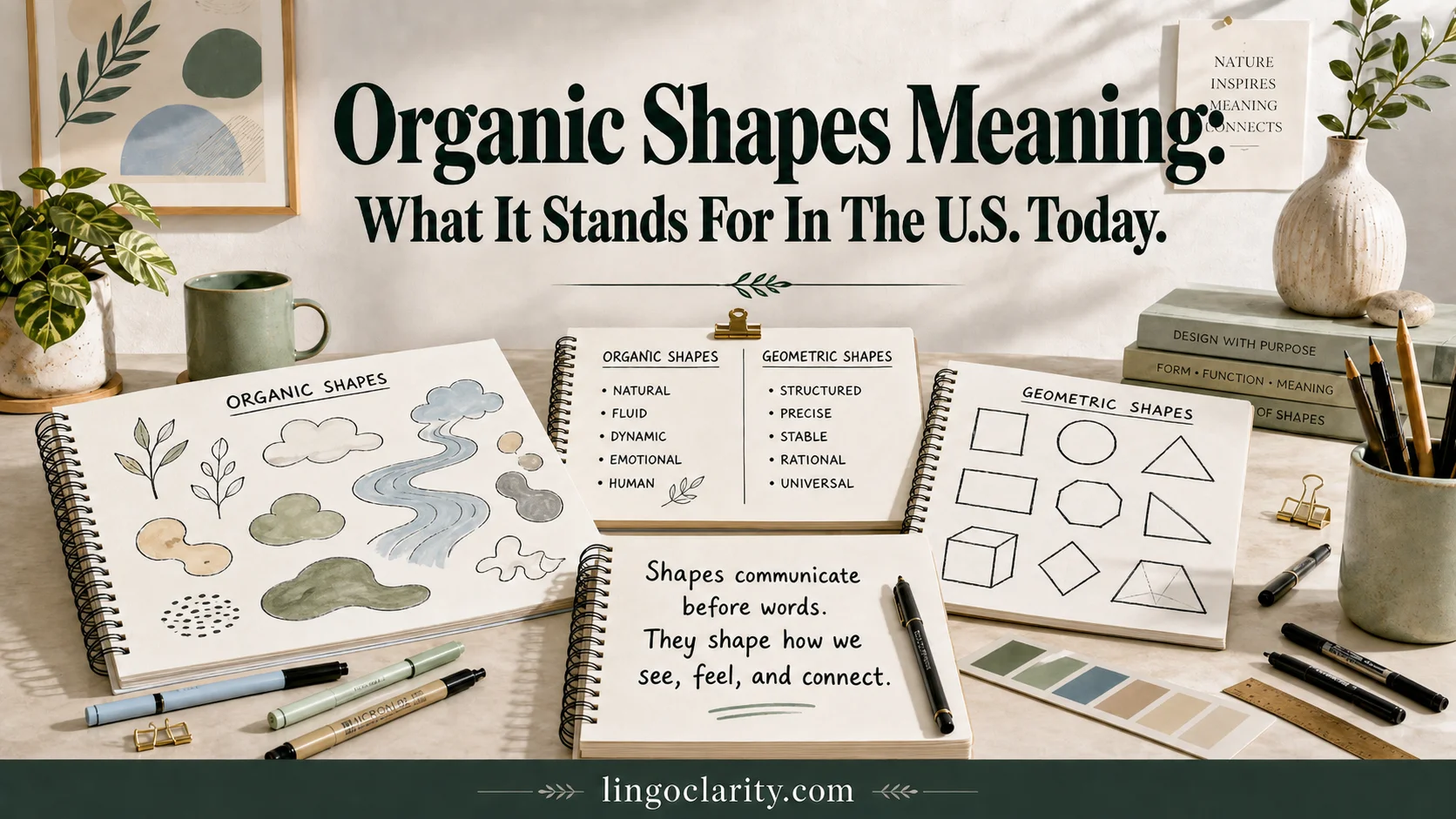
Organic Shapes meaning is simple: they are freeform, irregular shapes that often look like forms found in nature. They may remind you of leaves, clouds, puddles, rocks, flowers, waves, rivers, shells, tree branches, or the outline of the human body. Unlike geometric shapes, organic shapes usually do not have perfect sides, equal angles, or strict symmetry.
In art and design, the word “organic” does not mean organic food. It means natural-looking, flowing, uneven, or life-like. A square, triangle, or perfect circle usually feels geometric. A wobbly leaf outline, loose blob, river curve, or cloud shape usually feels organic..
Quick Definition Of Organic Shapes
Organic shapes are natural-looking shapes with irregular, freeform outlines. They are often curved, uneven, asymmetrical, or flowing. Artists and designers use them to create movement, softness, variety, and a connection to nature.
Simple examples include:
- A leaf
- A cloud
- A puddle
- A wave
- A flower petal
- A rock
- A tree branch
- A river bend
- A shell
- A human body outline
Organic shapes can be realistic or abstract. A carefully drawn leaf is an organic shape, but so is a loose hand-drawn blob if it feels natural, irregular, and freeform.
What Organic Shapes Mean In Art
In art, a shape is a flat, enclosed area. It has height and width, but it does not have real depth. A circle drawn on paper is a shape. A ball you can hold is a form.
Organic shapes are one major type of shape. They are different from geometric shapes because they do not rely on exact measurements. Instead, they often look like they were shaped by nature, movement, growth, erosion, water, or the human hand.
For example, think about the edge of a leaf. It has a clear outline, but that outline is not perfectly straight or evenly measured. It may curve, taper, ripple, or bend. That outline is an organic shape.
Now think about a puddle. It has a boundary, but the boundary is loose and uneven. It spreads in a way that feels natural rather than planned. That is also an organic shape.
Organic shapes help artwork feel less rigid. They can make a composition feel calm, playful, alive, emotional, mysterious, or natural, depending on how the artist uses them.
Organic Shapes Vs. Geometric Shapes
Organic shapes and geometric shapes are often taught together because the contrast makes both easier to understand.
| Feature | Organic Shapes | Geometric Shapes |
|---|---|---|
| Outline | Irregular, loose, flowing, or uneven | Clean, regular, measured, or precise |
| Symmetry | Often asymmetrical | Often symmetrical |
| Common Lines | Curved, wavy, varied, hand-drawn | Straight, smooth, controlled, exact |
| Examples | Leaves, clouds, rocks, waves, bodies | Squares, circles, triangles, rectangles |
| Visual Feeling | Natural, soft, active, relaxed, expressive | Stable, ordered, structured, formal |
| Common Uses | Nature drawing, abstract art, branding, decor | Math diagrams, icons, grids, architecture |
| Tools | Often drawn freehand | Often made with rulers, grids, or compasses |
A geometric shape follows clearer rules. Squares have four equal sides. Rectangles have four right angles. Triangles have three sides. A perfect circle has an even curve all the way around.
An organic shape is looser. It may have curves, bumps, uneven edges, or a hand-drawn quality. It does not need to be random, but it should feel less mechanical than a geometric shape.
Easy Examples Of Organic Shapes
Organic shapes are easy to recognize once you start looking for natural outlines.
Organic Shapes In Nature
Nature is full of organic shapes. These include the outline of a leaf, the edge of a rock, the curve of a wave, the shape of a cloud, the path of a river, the branching of a tree, the edge of a mountain ridge, and the spiral of a shell.
These shapes rarely look perfect or mathematically exact. Even when they have patterns, they usually include variation.
Organic Shapes In Art Class
In an art classroom, students often use organic shapes when drawing landscapes, plants, animals, people, still life objects, or abstract designs.
A landscape drawing might include organic shapes in the hills, trees, clouds, water, and rocks. A figure drawing might use organic shapes to block in the head, torso, arms, and legs. A collage might use cut-paper blobs, leaf shapes, or flowing forms to create movement.
Organic Shapes In Graphic Design
Graphic designers use organic shapes to soften layouts and make designs feel more human. A website might place a soft blob behind a headline. A wellness brand might use leaf-like shapes in its logo. A poster might use flowing shapes to guide the viewer’s eye from the title to the main image.
Organic shapes can make a design feel friendly, calm, creative, natural, or approachable. However, they still need structure. If every part of a layout is freeform, the design can start to look messy.
Organic Shapes In Everyday Objects
You can also find organic shapes in furniture, rugs, ceramics, jewelry, clothing patterns, garden paths, mirrors, lamps, and home decor. A wavy mirror, pebble-shaped table, floral rug, or curved ceramic bowl may use organic shape language.
These shapes often feel softer than sharp corners and strict grids.
How To Identify Organic Shapes
Use this simple checklist:
- Does the shape look natural or freeform?
- Does it have an uneven or irregular outline?
- Does it avoid perfect sides and exact angles?
- Does it look hand-drawn, flowing, soft, or asymmetrical?
- Could it remind you of something from nature?
- Does it feel less mechanical than a square, triangle, or perfect circle?
If most answers are yes, it is probably an organic shape.
Why Artists Use Organic Shapes
Artists use organic shapes because they add life, movement, and variety to a composition. They can make an artwork feel more natural, expressive, or emotional.
Organic shapes can guide the viewer’s eye. For example, a winding river shape can pull the eye through a landscape. Curving plant shapes can create rhythm. Overlapping leaf shapes can create depth. A large irregular shape can become the main focal point of an abstract painting.
They also create contrast. A soft organic shape placed next to a hard geometric shape can make both shapes more noticeable. For instance, a flowing vine beside a square window creates a clear contrast between nature and structure.
Organic shapes are also useful for mood. Rounded, flowing shapes often feel calm or gentle. Jagged, irregular organic shapes can feel wild, tense, or energetic. The meaning depends on the shape’s size, placement, color, texture, and surrounding elements.
How Designers Use Organic Shapes
Designers use organic shapes when they want a layout or object to feel less stiff.
In branding, organic shapes can suggest growth, nature, care, comfort, creativity, or wellness. That is why they often appear in logos for skincare brands, food brands, health companies, environmental groups, yoga studios, and children’s products.
In web design, organic shapes can break up rigid rectangles. A freeform background shape can highlight a callout, separate sections, or add visual interest without using a hard box.
In packaging, organic shapes can make a product feel handmade, natural, gentle, or premium. A label with flowing plant shapes usually sends a different message from a label built only from sharp lines and strict grids.
In interior design, organic shapes can soften a room. Curved sofas, rounded tables, irregular rugs, and wavy decor can make a space feel warmer and more relaxed.
When To Use Organic Shapes
Use organic shapes when you want to create:
- A natural feeling
- A relaxed mood
- A sense of movement
- A handmade or artistic look
- A soft, friendly layout
- A connection to plants, water, bodies, or landscapes
- Contrast against strict geometric elements
They work especially well in nature art, abstract art, wellness branding, children’s design, handmade product packaging, posters, murals, textiles, and home decor.
When Not To Use Organic Shapes
Organic shapes are not always the best choice. Avoid relying on them when the design needs exact measurement, technical clarity, or strict structure.
For example, a floor plan, engineering diagram, math worksheet, road sign, data chart, or app icon system may need geometric shapes because they communicate order and precision.
Too many organic shapes can also create visual clutter. If a page has irregular shapes everywhere, the reader may not know where to look. The best designs often balance organic shapes with clear spacing, alignment, and structure.
Organic Shape Vs. Organic Form
Organic shape and organic form are related, but they are not the same.
An organic shape is flat and two-dimensional. It has height and width. A leaf outline drawn on paper is an organic shape.
An organic form is three-dimensional. It has height, width, and depth. A real leaf, rock, shell, sculpture, or curved chair is an organic form.
In simple terms:
- Shape is flat.
- Form has depth.
- Organic shape is a flat natural-looking outline.
- Organic form is a three-dimensional natural-looking object.
This distinction matters in art because shape is usually discussed in drawing, painting, collage, printmaking, and graphic design. Form is more important in sculpture, ceramics, architecture, product design, and 3D modeling.
Are Organic Shapes Always From Nature?
No. Organic shapes often look like nature, but they do not have to come directly from nature.
An artist can invent an organic shape. A designer can draw a freeform blob on a screen. A painter can create an abstract shape that does not represent any real object. It still counts as organic if it has a natural, irregular, flowing, or asymmetrical quality.
That means organic shapes can be realistic or abstract.
A realistic organic shape might look like a flower petal. An abstract organic shape might look like a soft, uneven blob that suggests movement without showing a specific object.
Is A Circle An Organic Shape?
A perfect circle is usually a geometric shape because it is even, measured, and mathematically regular.
However, a wobbly circle can feel organic. If the outline is uneven, hand-drawn, or slightly irregular, it may no longer feel strictly geometric.
For example:
- A perfect circle made with a compass is geometric.
- A hand-drawn uneven circle may feel organic.
- A pebble-shaped oval is organic.
- A clean app icon circle is geometric.
Context matters. The more exact and regular the shape looks, the more geometric it feels. The more irregular and natural it looks, the more organic it feels.
Related Terms For Organic Shapes
Several art and design terms are closely related to organic shapes.
Freeform Shapes
Freeform shapes do not follow strict rules. They are drawn or created freely instead of being built from exact measurements.
Irregular Shapes
Irregular shapes have uneven sides, varied outlines, or unexpected proportions. Many organic shapes are irregular.
Natural Shapes
Natural shapes look like forms found in nature, such as leaves, clouds, waves, rocks, animals, and plants.
Curvilinear Shapes
Curvilinear shapes are made mostly from curved lines. Many organic shapes are curvilinear, although not every curved shape is organic.
Biomorphic Shapes
Biomorphic shapes are abstract shapes that suggest living things. They may look like cells, plants, bodies, shells, or microorganisms without representing them exactly.
Amorphous Shapes
Amorphous shapes do not have a clear or fixed structure. A blob, puddle, or cloud-like form may be described as amorphous.
Common Mistakes About Organic Shapes
One common mistake is thinking organic shapes mean shapes made from organic materials. In art, the word “organic” refers to the look of the shape, not what it is made from.
Another mistake is thinking all curved shapes are organic. A perfect circle is curved, but it is usually geometric because it is exact and regular.
Some people also assume organic shapes must be realistic. They do not. Abstract organic shapes are common in modern art, graphic design, and decoration.
Another mistake is confusing shape with form. A shape is flat. A form is three-dimensional. A drawn rock outline is an organic shape. A real rock is an organic form.
Finally, some beginners think geometric shapes are “better” because they are neater. In reality, neither type is better. Organic and geometric shapes do different jobs. Strong artwork often uses both.
Organic Shapes In A Sentence
Here are simple ways to use the phrase correctly:
- The artist used organic shapes to make the landscape feel natural.
- The poster combines geometric text boxes with soft organic shapes.
- The leaf outline is an organic shape because it is irregular and natural-looking.
- The logo uses organic shapes to suggest growth and wellness.
- The painting feels calm because of its flowing organic shapes.
- The student drew clouds, rocks, and waves as examples of organic shapes.
FAQ
What does organic shapes mean?
Organic shapes are freeform, irregular shapes that often look like forms found in nature. They may look like leaves, clouds, rocks, waves, puddles, flowers, shells, rivers, or bodies.
What is the definition of organic shapes?
Organic shapes are natural-looking shapes with uneven, flowing, or irregular outlines. They usually do not follow strict mathematical rules like squares, triangles, rectangles, or perfect circles.
What are examples of organic shapes?
Examples of organic shapes include leaves, clouds, puddles, rocks, waves, flowers, shells, tree branches, mountain ridges, river bends, and human body outlines. A loose abstract blob can also be an organic shape.
What is the difference between organic and geometric shapes?
Organic shapes are irregular, freeform, and natural-looking. Geometric shapes are more precise, regular, and rule-based. A leaf is organic. A square is geometric. A wobbly hand-drawn circle may feel organic, but a perfect circle is usually geometric.
Are organic shapes 2D or 3D?
Organic shapes are usually two-dimensional. They have height and width but no real depth. A three-dimensional natural-looking object is better called an organic form.
Why do artists use organic shapes?
Artists use organic shapes to create movement, softness, rhythm, contrast, emotion, and a natural feeling. Organic shapes can also make a composition feel more alive and less mechanical.
Can organic shapes be abstract?
Yes. Organic shapes can be abstract. They do not need to show a real leaf, rock, cloud, or body. A freeform shape can be organic if it feels irregular, flowing, natural, or life-like.
Is a blob an organic shape?
A blob can be an organic shape if it has an irregular, freeform outline. Many abstract organic shapes look like blobs, puddles, cells, clouds, or soft flowing forms.
Is a circle an organic shape?
A perfect circle is usually geometric. A wobbly, uneven, or hand-drawn circle can feel organic because it no longer looks perfectly measured.
What is the opposite of organic shapes?
The most practical opposite of organic shapes is geometric shapes. Geometric shapes include squares, rectangles, triangles, circles, and other regular shapes with clearer mathematical structure.
Conclusion
Organic shapes are natural-looking, irregular, freeform shapes. They often look like leaves, clouds, rocks, waves, puddles, shells, rivers, flowers, or living forms. In art and design, they create softness, movement, variety, and a sense of life.
The easiest way to remember the meaning is to compare a leaf with a square. The leaf feels organic because its outline is uneven and natural. The square feels geometric because its sides and angles are regular. Both types of shapes are useful, but they create very different visual effects.

1 thought on “Organic Shapes Meaning: Definition, Usage, and Examples”
Comments are closed.