
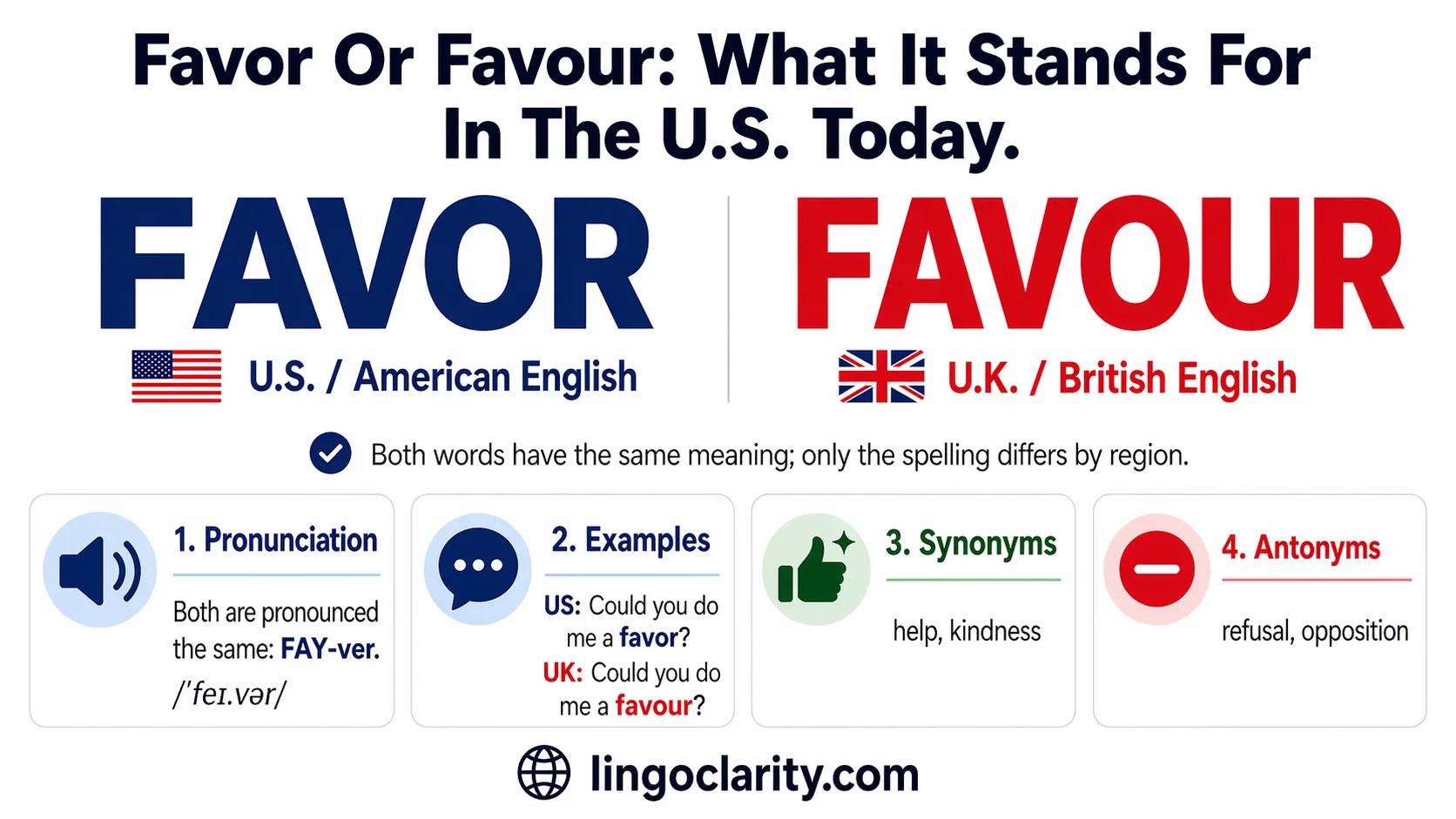
Wondering whether to write favor or favour?
For US English, the correct choice is favor. Favour is the standard British English spelling. Both words mean the same thing, but they belong to different regional spelling systems.
So, if your readers are in the United States, write:
“Can you do me a favor?”
Use favour when writing for a British or Commonwealth audience, quoting a source that uses British spelling, or following a style guide that requires British English.
Quick Answer
Use favor in US English.
Use favour in British English.
Both spellings are correct, and both mean the same thing. The difference is regional spelling, not meaning. For American readers, schools, businesses, websites, and publications, favor is the standard choice.
Favor Vs. Favour At A Glance
| Context | Best Spelling | Why |
|---|---|---|
| US school paper | Favor | This is the standard American spelling. |
| US business writing | Favor | It matches normal US workplace style. |
| US website or blog | Favor | It fits American search intent and reader expectations. |
| UK publication | Favour | This is the standard British spelling. |
| Australian or New Zealand audience | Favour | These varieties usually follow British-style spelling. |
| Canadian audience | Often favour | Canadian English often keeps the British-style form, though style guides vary. |
| Direct quote from a British source | Favour | Keep the original spelling inside the quotation. |
| Direct quote from a US source | Favor | Preserve the source’s spelling. |
| Mixed international content | Follow one style guide | Consistency matters more than personal preference. |
Are Favor And Favour The Same Word?
Yes. Favor and favour are the same word with two accepted spellings.
As a noun, the word can mean a kind act, approval, support, preference, advantage, or special treatment. For example, someone might ask for a favor, win favor with a group, or receive a decision in their favor.
As a verb, it can mean to prefer, support, approve of, treat more gently, or give special advantage to someone or something. For instance, a manager may favor one proposal, a policy may favor small businesses, or an injured athlete may favor one leg.
The spelling does not change the meaning. Instead, it signals the variety of English being used.
US English:
“The committee voted in favor of the proposal.”
British English:
“The committee voted in favour of the proposal.”
Both sentences say the same thing. However, each one fits a different audience.
Why The Spelling Difference Exists
The difference between favor and favour is part of a larger American-versus-British spelling pattern.
Many words that end in -our in British English end in -or in American English. Therefore, American writers usually use favor, color, honor, labor, and neighbor. British writers, meanwhile, usually use favour, colour, honour, labour, and neighbour.
This pattern developed as American English became more standardized. Over time, US spelling moved toward shorter forms in many common words. British English kept many of the older -our endings.
As a result, neither spelling is more “correct” in every context. The correct choice depends on which spelling system you are using.
Which Spelling Should You Use In US English?
For US English, choose favor.
That applies to school assignments, college applications, business emails, news articles, legal summaries, marketing pages, product descriptions, and everyday communication. Although American readers will usually understand favour, the spelling may look British or inconsistent in a US document.
Correct for US English:
“Can you do me a favor and review this file?”
“The judge ruled in favor of the tenant.”
“Most employees favor a flexible schedule.”
“The update received favorable feedback.”
In contrast, favour can look out of place if the rest of the document uses American spellings such as color, behavior, center, analyze, and traveled.
For that reason, US writers should normally avoid favour unless they are quoting a source, discussing spelling differences, or using an official title that contains the British form.
When Should You Use Favour?
Use favour when you are writing in British English or following a British-style spelling system.
That includes many UK, Australian, and New Zealand contexts. It may also apply in Canadian English, depending on the publication, organization, or style guide.
Examples:
“Could you do me a favour?”
“The council voted in favour of the plan.”
“The policy fell out of favour after the review.”
“Many readers favour the shorter version.”
In addition, keep favour when it appears in a direct quote from a British or Commonwealth source.
Correct:
The report stated, “The board voted in favour of the proposal.”
Do not silently change the spelling inside a quotation just because your article uses American English. Instead, preserve the original wording unless your publication has a clear editorial policy for adapting quoted text.
What If Your Audience Is International?
For an international audience, consistency becomes especially important.
If the site is US-first, use favor. If the brand is UK-first, use favour. When a company has a global audience, the best choice is usually the one listed in its style guide.
In practice, global brands often create separate localized versions of the same page. A US page might use favor, favorite, and favorable. A UK page, however, might use favour, favourite, and favourable.
This approach helps readers feel that the content was written for their region. It also prevents awkward mixtures such as:
“Our customers favor clear pricing and favourable return policies.”
That sentence mixes American and British spelling. A cleaner US version would be:
“Our customers favor clear pricing and favorable return policies.”
A British version would be:
“Our customers favour clear pricing and favourable return policies.”
Common Phrases With Favor And Favour
The same phrases exist in both spelling systems. Only the spelling changes.
US English uses:
“do someone a favor”
“return the favor”
“in favor of”
“in your favor”
“out of favor”
“without fear or favor”
“curry favor”
“find favor with”
British English uses:
“do someone a favour”
“return the favour”
“in favour of”
“in your favour”
“out of favour”
“without fear or favour”
“curry favour”
“find favour with”
For US writing, the phrase should be in favor of, not in favour of.
Examples:
“The committee voted in favor of the change.”
“The delay may work in our favor.”
“The candidate fell out of favor with voters.”
“She tried to curry favor with the board.”
These expressions are common in business, legal, academic, and everyday writing. Therefore, using the regional spelling consistently makes the whole piece feel more polished.
Related Words: Favorite, Favorable, Favored, And Favoring
The spelling choice also affects related words.
In US English, use:
favor
favorite
favorable
favorably
favored
favoring
disfavor
unfavorable
In British English, use:
favour
favourite
favourable
favourably
favoured
favouring
disfavour
unfavourable
This is one of the easiest places to make a mistake. A writer may use favor in one sentence and favourable in the next. However, that creates an inconsistent spelling system.
Inconsistent:
“My favorite option received a favourable review.”
Consistent US English:
“My favorite option received a favorable review.”
Consistent British English:
“My favourite option received a favourable review.”
If you choose American English, use the American forms throughout. Likewise, if you choose British English, keep the British forms throughout.
Favor As A Noun
As a noun, favor can refer to a helpful act.
Example:
“Can you do me a favor and call the client?”
It can also mean approval or support.
Example:
“The revised proposal gained favor with the board.”
In another sense, favor can mean advantage.
Example:
“The evidence worked in her favor.”
Sometimes, the word suggests bias or special treatment.
Example:
“The process should not show favor to internal candidates.”
All of these meanings use favor in American English. In British English, the spelling changes to favour, but the meaning remains the same.
Favor As A Verb
As a verb, favor often means to prefer or support.
Example:
“I favor the simpler design.”
It can also mean to give an advantage to someone or something.
Example:
“The new policy favors larger companies.”
In medical or physical contexts, favor may mean to protect or avoid putting pressure on an injured body part.
Example:
“He was favoring his left ankle after the game.”
Additionally, favor can mean to resemble a family member.
Example:
“She favors her mother.”
Because the word has several meanings, context matters. Still, the US spelling stays the same: favor, favors, favored, and favoring.
Common Mistakes To Avoid
Mixing Favor And Favour
The most common mistake is switching between spellings in the same document.
Incorrect for US English:
“Can you do me a favour? I returned the favor last week.”
Correct for US English:
“Can you do me a favor? I returned the favor last week.”
Correct for British English:
“Can you do me a favour? I returned the favour last week.”
Assuming Favour Has A Different Meaning
Some writers think favour sounds more formal or more polite. However, it does not have a different meaning from favor. It is simply the British spelling.
Forgetting Related Forms
Another common issue is using American spelling for the main word but British spelling for a related word.
Incorrect for US English:
“The proposal received a favourable response.”
Correct for US English:
“The proposal received a favorable response.”
Changing Quoted Material
Do not change favour to favor inside a direct quote unless your style guide specifically allows that kind of change. Otherwise, you may alter the source text.
Relying Only On Spellcheck
Spellcheck depends on language settings. Therefore, favour may be flagged in a US English document, while favor may be flagged in a UK English document. The tool is not judging meaning. It is applying a regional spelling rule.
Examples In Real Writing Contexts
Business Writing
US:
“Could you do me a favor and send the revised deck before noon?”
UK:
“Could you do me a favour and send the revised deck before noon?”
Academic Writing
US:
“The results appear to favor the second hypothesis.”
UK:
“The results appear to favour the second hypothesis.”
Legal Writing
US:
“The court ruled in favor of the property owner.”
UK:
“The court ruled in favour of the property owner.”
Marketing Copy
US:
“Customers favor brands that make returns simple.”
UK:
“Customers favour brands that make returns simple.”
Everyday Conversation
US:
“I need one small favor.”
UK:
“I need one small favour.”
These examples show why audience matters. The word does not change meaning, but the spelling changes the regional feel of the sentence.
SEO Guidance For Favor Or Favour
For SEO, match the spelling to the audience you want to reach.
A US-focused article should use favor as the primary spelling in the title, headings, body copy, internal links, and image alt text. However, it can still mention favour naturally because many users search for the comparison.
A strong US-focused title would be:
“Favor Or Favour: Which Spelling Fits US English Today?”
A weaker keyword-stuffed title would be:
“Favor Or Favour Meaning, Favor Vs Favour Difference, Favor Or Favour Examples”
The better title sounds natural, answers the query, and avoids repetition. In addition, it makes the regional focus clear.
For a UK-focused page, the priority would change. The page might use favour as the main spelling while explaining that favor is the American form.
Simple Memory Trick
For American English, remember that favor is shorter. American spellings often use the shorter -or form.
For British English, remember that favour contains u, and UK starts with U.
This trick is not a full grammar rule, but it is useful for the main distinction:
US = favor
UK = favour
Final Rule
Use favor for US English.
Use favour for British English.
Both spellings are correct, but they are not equally suitable in every context. Therefore, the best choice depends on your audience and style guide. For a US reader, publication, school, client, or website, favor is the spelling that fits best.
FAQ
Is favor or favour correct?
Both spellings are correct. Favor is standard in American English, while favour is standard in British English. The meaning is the same.
Which spelling should I use for US readers?
Use favor for US readers. It is the expected spelling in American schools, workplaces, publications, websites, and everyday writing.
Is favour wrong in American English?
Favour is not wrong as a word, but it is not the normal US spelling. In American English, it usually looks British or off-style.
Do favor and favour mean the same thing?
Yes. They mean the same thing. The only difference is regional spelling.
Is it in favor of or in favour of?
Use in favor of in American English. Use in favour of in British English.
Is favorite related to favor?
Yes. In American English, use favorite, favorable, favored, and favoring. In British English, use favourite, favourable, favoured, and favouring.
Should I use favor or favour for SEO?
Use the spelling your target audience expects. For a US-focused page, make favor the primary spelling. However, you can mention favour when explaining the difference.
Can I use both spellings in one article?
You can use both spellings when comparing them or quoting sources. Otherwise, choose one spelling system and stay consistent.
What spelling does Canada use?
Canadian English often uses favour, although some organizations may choose favor for US-facing content. Therefore, follow the relevant Canadian style guide when one is available.
What spelling does Australia use?
Australian English usually uses favour. The related forms are typically favourite, favourable, favoured, and favouring.
Why does American English drop the u?
American English standardized many shorter -or spellings, while British English kept many -our spellings. That is why US English uses favor, color, and honor, while British English uses favour, colour, and honour.
