
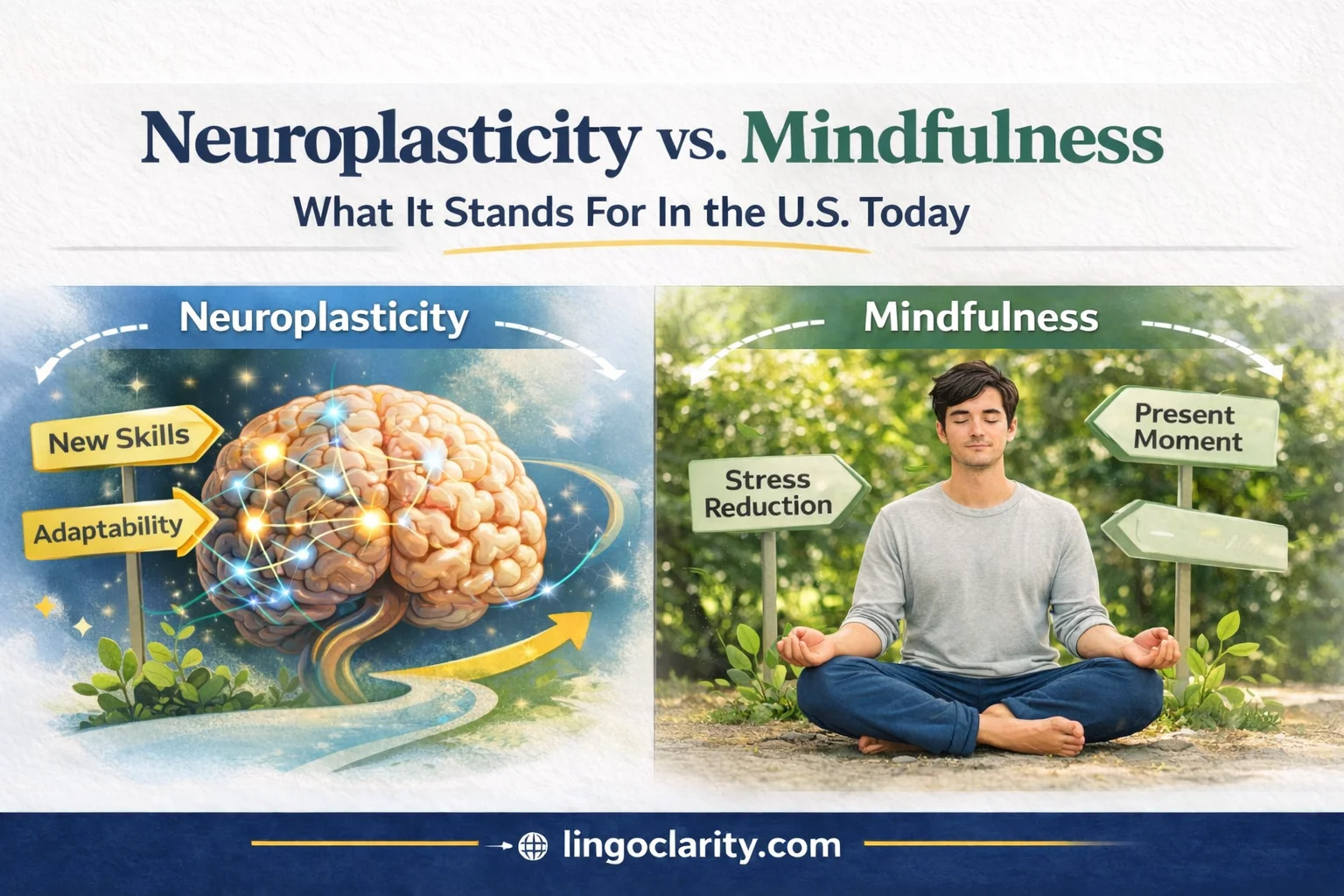
When people search neuroplasticity vs. mindfulness, they are usually trying to answer three practical questions: Are these terms the same, how are they different, and when should each one be used? The answer is straightforward. Neuroplasticity is the brain’s ability to change, adapt, and reorganize itself through learning, repetition, and experience. Mindfulness is the practice or state of paying attention to the present moment with awareness and without harsh judgment.
The confusion around neuroplasticity vs. mindfulness happens because the two terms often appear together in conversations about mental health, stress, focus, habit change, and healing. Articles commonly explain that mindfulness may support changes in the brain, so readers start to assume the words are interchangeable. They are not. One refers to a biological process in the brain. The other refers to a mental skill or practice a person can develop.
If you remember one line, make it this: mindfulness is something you practice, while neuroplasticity is something the brain does. That simple distinction makes neuroplasticity vs. mindfulness much easier to understand in health writing, therapy discussions, education, and everyday conversation.
Quick Answer
In neuroplasticity vs. mindfulness, use neuroplasticity when you mean the brain’s ability to change, build new pathways, adapt after experience, or reorganize through learning and recovery.
Use mindfulness when you mean present-moment awareness, focused attention, or a practice that helps someone notice thoughts, emotions, and sensations with more calm and less automatic reaction.
They are not interchangeable. Mindfulness is a practice or mental state. Neuroplasticity is a brain process. In some cases, mindfulness practice may support neuroplastic changes over time, but the two words still do different jobs.
What Neuroplasticity Means
Neuroplasticity is the brain’s capacity to change throughout life. For years, many people assumed the brain became mostly fixed after childhood. That idea is outdated. The brain can keep adapting in response to learning, repetition, environment, habits, and injury. It can strengthen certain neural connections, weaken others, form new patterns, and reorganize how some functions are carried out.
That is why neuroplasticity matters in so many fields. In education, it helps explain why practice improves skill. In rehabilitation, it helps explain why targeted therapy can support recovery after stroke or brain injury. In psychology, it helps explain how repeated behavior and thought patterns can become more deeply wired over time.
Neuroplasticity is also broader than self-help language often makes it sound. It does not mean “positive change” by default. The brain can adapt in helpful ways, but it can also reinforce unhealthy patterns. Repeated stress responses, destructive habits, and chronic pain patterns can also become more ingrained. So when writers use neuroplasticity, the best choice is precision, not hype.
In plain English, neuroplasticity means the brain is not static. It changes in response to what we do, think, learn, repeat, and experience.
What Mindfulness Means
Mindfulness means paying attention to the present moment in a deliberate and aware way. It often includes noticing thoughts, emotions, body sensations, and surroundings without instantly judging them or reacting on autopilot.
That definition sounds simple, but it covers two related ideas. Mindfulness can describe a momentary state of awareness, such as noticing your breathing before responding in anger. It can also describe an intentional practice, such as sitting quietly for a few minutes and bringing attention back to the breath whenever the mind wanders.
This is why mindfulness shows up in therapy, stress management, schools, wellness programs, and daily routines. It is practical. A person can use mindfulness before a hard conversation, during a stressful commute, or while trying to settle racing thoughts before bed.
Mindfulness is not the same as “thinking positively,” and it is not the same as emptying the mind. It usually means noticing what is happening right now with more clarity and less automatic judgment. That makes it useful, but it also means the word should be used carefully. Not every quiet moment is mindfulness, and not every wellness habit qualifies as a mindfulness practice.
The Main Difference
The clearest way to separate these terms is this:
- Neuroplasticity is a capacity of the brain.
- Mindfulness is a state or practice of awareness.
That is the real answer behind neuroplasticity vs. mindfulness. One term belongs mainly to neuroscience, psychology, learning, and rehabilitation. The other belongs mainly to attention training, mental well-being, emotional regulation, and meditation-related practice.
If your sentence is about the brain physically or functionally adapting, neuroplasticity is the right word. If your sentence is about paying attention, noticing thoughts, or staying present, mindfulness is the right word.
A simple test helps. If you could replace the word with “brain adaptation” or “brain rewiring,” choose neuroplasticity. If you could replace it with “present-moment awareness” or “attention practice,” choose mindfulness.
How Neuroplasticity And Mindfulness Are Related
Although the terms are different, they are not unrelated. This is where many readers get mixed up. Mindfulness is a practice. Neuroplasticity is one way researchers describe how the brain may change in response to repeated experience, including certain mental practices.
That means mindfulness may be discussed as one possible influence on neuroplasticity. For example, if someone practices mindfulness regularly, that repeated training in attention and emotional regulation may be associated with changes in how the brain responds over time. In other words, mindfulness is not neuroplasticity itself, but mindfulness practice may be one experience that contributes to neuroplastic change.
This relationship matters because it explains why the terms often appear in the same article. A wellness or psychology article may say that mindfulness can help reshape patterns of attention or stress response. That statement blends both concepts. Mindfulness names the practice. Neuroplasticity names the brain’s capacity to change.
Still, careful writing should avoid overpromising. It is more accurate to say mindfulness may support beneficial changes than to say mindfulness magically rewires the brain in a guaranteed way. Serious writing respects both the promise and the limits of the idea.
Why People Confuse Neuroplasticity vs. Mindfulness
The confusion around neuroplasticity vs. mindfulness usually comes from repeated exposure to both words in the same context. They often appear together in articles about therapy, trauma recovery, meditation, self-regulation, and brain health. Readers start seeing them side by side and assume they are near-synonyms.
They are not.
A typical example sounds like this: “Mindfulness can help reshape the brain.” That sentence contains both concepts. Mindfulness is the practice. Reshaping the brain points to neuroplasticity. But once readers start hearing those ideas together again and again, they begin to blur them.
Another source of confusion is the rise of social media explanations. Online content often compresses complex ideas into catchy one-liners. “Use mindfulness to rewire your brain” sounds simple and memorable, but it skips the distinction between the practice and the mechanism. That shortcut may be good for a headline, but it is not good for accuracy.
Mindfulness Is Not The Same As Meditation
One more important clarification: mindfulness is not identical to meditation. Meditation is a structured activity or exercise. Mindfulness is the broader quality of awareness.
A person can practice mindfulness through meditation, but mindfulness can also happen outside formal meditation. You can be mindful while walking, listening, eating, stretching, or taking a breath before answering a difficult message. Meditation is one common way to train mindfulness, not the only way to express it.
That distinction helps because many people hear “mindfulness” and picture a formal seated breathing exercise. That is one version of it, but not the whole concept.
When To Use Neuroplasticity
Use neuroplasticity when the sentence is about:
- brain adaptation
- learning and memory
- habit formation
- skill development
- rehabilitation after injury
- neural pathways
- repeated behavior changing the brain over time
Examples:
A teacher might say, “Repetition supports learning because of neuroplasticity.”
A rehab specialist might say, “Recovery depends partly on neuroplasticity and consistent therapy.”
A health writer might say, “Exercise, novelty, and learning can all support neuroplasticity.”
In each example, the focus is the brain changing or adapting.
When To Use Mindfulness
Use mindfulness when the sentence is about:
- awareness of the present moment
- focused attention
- noticing thoughts and emotions
- breath awareness
- meditation or reflective practice
- staying grounded during stress
Examples:
A therapist might say, “Try a short mindfulness exercise before bed.”
A manager might say, “Mindfulness can help you pause before reacting in a tense meeting.”
A parent might say, “Mindfulness helps me notice when I am getting overwhelmed.”
In each example, the focus is awareness, attention, or practice.
When Both Words Belong In The Same Sentence
Sometimes the best sentence uses both terms because both ideas are relevant. That is often the best approach in clear writing about neuroplasticity vs. mindfulness.
For example:
“Mindfulness practice may support neuroplasticity over time.”
That sentence works because each word keeps its own role. Mindfulness is the activity. Neuroplasticity is the brain’s potential response to repeated experience.
Another example:
“Therapists sometimes use mindfulness techniques while explaining how the brain can change through neuroplasticity.”
Again, the distinction stays clear. The therapist teaches a practice, and the brain process is described separately.
Common Mistakes And Quick Fixes
One common mistake is using mindfulness to mean brain rewiring.
Quick fix: switch to neuroplasticity if your point is about neural change.
Another common mistake is using neuroplasticity to describe a breathing exercise or awareness habit.
Quick fix: switch to mindfulness if your point is about the practice itself.
A third mistake is assuming neuroplasticity always means improvement.
Quick fix: treat it as a neutral term for change, not automatic progress.
A fourth mistake is assuming mindfulness only applies to formal meditation.
Quick fix: remember that mindfulness can also describe awareness during ordinary daily activities.
Everyday Examples
A student says, “I use mindfulness before exams so I do not spiral.”
That sounds natural because the point is attention and emotional steadiness.
A coach says, “Drills matter because neuroplasticity helps the brain and body adapt through repetition.”
That works because the point is learned adaptation.
A counselor says, “Mindfulness can help you notice the feeling before you react to it.”
That fits because the focus is awareness.
A neurologist says, “After injury, neuroplasticity can help explain why targeted therapy matters.”
That fits because the focus is how the brain changes.
A careful health article might say, “Mindfulness is not the same as neuroplasticity, but repeated mindfulness practice may support neuroplastic changes in attention and emotional regulation.”
That is a strong example because it keeps the meanings separate and connected.
Which Choice Sounds Better In Context
If you are writing for a neuroscience, rehab, or educational audience, neuroplasticity will often be the stronger and more precise term. It sounds technical because it is technical.
If you are writing for therapy, stress management, wellness, or everyday life, mindfulness will often sound more natural because it refers to something people can practice directly.
That does not mean mindfulness is casual or vague, and it does not mean neuroplasticity is always too formal. It just means the words live in different parts of the conversation. Good writing chooses the one that matches the point.
Conclusion
The best way to understand neuroplasticity vs. mindfulness is to stop treating them like competing labels. They describe different things. Neuroplasticity is the brain’s ability to change through experience, repetition, learning, and recovery. Mindfulness is the practice or state of paying attention to the present moment with awareness.
Use neuroplasticity when the topic is brain change. Use mindfulness when the topic is attention and present-moment awareness. Use both only when you are clearly describing how a mindfulness practice may relate to changes in the brain over time.
That is the simplest, clearest, and most accurate way to write about them.
FAQ
Is neuroplasticity the same as mindfulness?
No. Neuroplasticity is the brain’s ability to adapt and change. Mindfulness is a mental state or practice of present-moment awareness. One describes a brain process. The other describes a human practice or skill.
Can mindfulness affect neuroplasticity?
It may. Mindfulness is often discussed as one practice that can support changes in attention, emotional regulation, and stress response over time. But mindfulness itself is not the same thing as neuroplasticity.
Which word should I use in a sentence?
Use neuroplasticity if your sentence is about the brain changing through learning, repetition, recovery, or experience. Use mindfulness if your sentence is about awareness, attention, meditation, or staying present.
Is mindfulness just meditation?
No. Meditation is one formal way to practice mindfulness, but mindfulness can also happen during ordinary daily life, such as walking, listening, eating, or pausing before reacting.
Is neuroplasticity always positive?
No. Neuroplasticity means change, not automatic improvement. The brain can reinforce helpful patterns, but it can also strengthen unhealthy ones.
Why do people confuse neuroplasticity and mindfulness?
People confuse them because the terms often appear together in therapy, wellness, and brain-health content. Mindfulness may be discussed as one practice that supports change in the brain, so readers sometimes mistake the practice for the brain process itself.
