
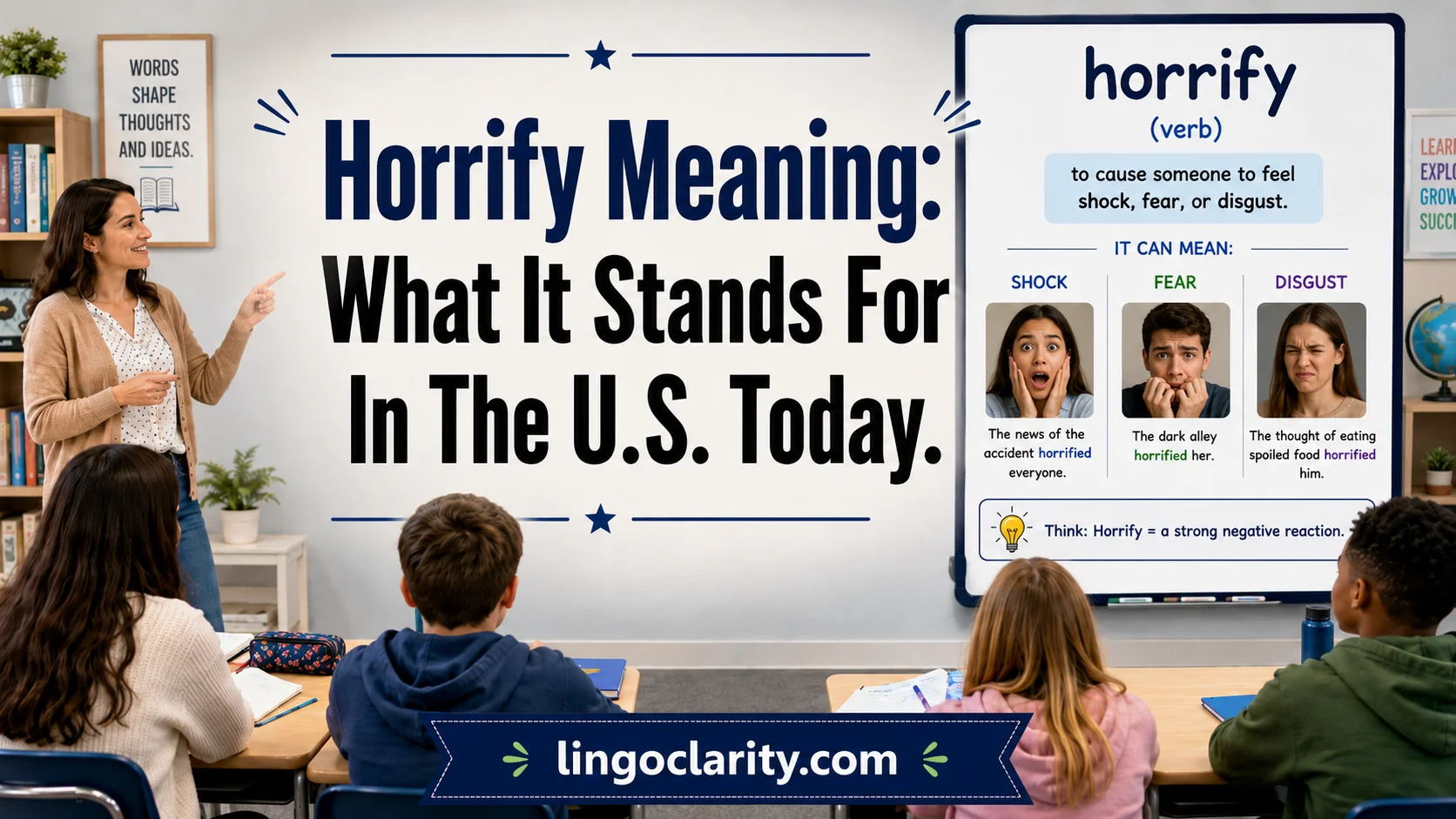
Horrify meaning is simple: to make someone feel deeply shocked, frightened, disgusted, or disturbed. The word is stronger than surprise and usually more serious than upset, so it fits situations that cause a strong negative reaction.
You may see this word in books, news reports, movie reviews, school reading, and serious conversations. This guide explains the meaning of horrify, how to pronounce it, how to use it in sentences, and how it differs from words like terrify, shock, appall, and disgust.
Quick Answer
Horrify is a verb that means to cause someone to feel strong shock, fear, disgust, or horror. Use it when something creates a serious negative reaction. For example, “The unsafe conditions horrified the workers” means the conditions deeply shocked or disturbed them.
Key Points
- Horrify is a verb.
- It means to deeply shock, scare, disgust, or disturb someone.
- The past tense is horrified.
- Horrified describes the person’s reaction.
- Horrifying describes the thing that causes the reaction.
- The word is standard English, not slang.
- It is stronger than surprise or upset.
What Does Horrify Mean?
To horrify someone means to make that person feel a strong negative emotion, usually shock, fear, disgust, or horror. The word often describes a reaction to something disturbing, cruel, dangerous, graphic, or morally wrong.
Examples:
- The violent scene horrified the audience.
- The cruel joke horrified her friends.
- The unsafe building conditions horrified the inspector.
- The amount of waste in the river horrified local residents.
The word can connect to scary situations, but it is not only about fear. Something can horrify you because it is disgusting, shocking, unfair, unsafe, or deeply disturbing.
Horrify Definition In Plain English
In plain English, horrify means to make someone feel very shocked, scared, or disgusted.
Think of the sentence pattern like this:
Something horrifies someone.
Examples:
- The news horrified me.
- The smell horrified the guests.
- The mistake horrified the manager.
- The discovery horrified the family.
In each sentence, one thing causes a strong emotional reaction in a person or group.
How To Pronounce Horrify
In American English, horrify is commonly pronounced:
HOR-uh-fy
It has three syllables:
hor-ri-fy
The stress is on the first syllable: HOR.
A common learner mistake is stressing the middle syllable.
Incorrect: hor-REE-fy
Correct: HOR-uh-fy
You may hear small differences in American accents, but the first syllable should stay clear and strong.
Is Horrify A Verb?
Yes. Horrify is a verb. More specifically, it is usually a transitive verb, which means it commonly takes an object.
Example:
- The report horrified the parents.
In this sentence:
- The report = the thing causing the reaction
- horrified = the verb
- the parents = the people receiving the reaction
Another example:
- The broken safety rules horrified the supervisor.
The rules caused the supervisor to feel shocked, disturbed, or alarmed.
Horrify Word Forms
| Word Form | Part Of Speech | Use | Example |
|---|---|---|---|
| horrify | verb | Base form | The story may horrify some readers. |
| horrifies | verb | Present tense | The cruelty horrifies her. |
| horrified | verb/adjective | Past tense or feeling | We were horrified by the scene. |
| horrifying | adjective/verb form | Thing causing shock | It was a horrifying mistake. |
| horrifyingly | adverb | In a horrifying way | The plan was horrifyingly careless. |
| horror | noun | The feeling or genre | His face showed horror. |
Horrified Vs Horrifying
Horrified describes the person who feels shocked, scared, or disgusted.
Examples:
- I was horrified by the news.
- The guests looked horrified.
- She felt horrified after seeing the damage.
Horrifying describes the thing that causes the feeling.
Examples:
- The news was horrifying.
- It was a horrifying accident.
- The photos showed horrifying conditions.
Use this simple rule:
| Use | Correct Word | Example |
|---|---|---|
| Person feels the reaction | horrified | I was horrified. |
| Thing causes the reaction | horrifying | The scene was horrifying. |
Incorrect: I was horrifying by the news.
Correct: I was horrified by the news.
Incorrect: The movie was horrify.
Correct: The movie was horrifying.
How To Use Horrify In A Sentence
The most common sentence pattern is:
Something horrifies someone.
Examples:
- The crime horrified the neighborhood.
- The test results horrified the doctor.
- The spoiled food horrified everyone at lunch.
You can also use horrified with common prepositions and infinitives.
| Pattern | Example |
|---|---|
| horrified by | She was horrified by the damage. |
| horrified at | They were horrified at the cost. |
| horrified to see | I was horrified to see the mess. |
| horrified to learn | He was horrified to learn the truth. |
| horrified that | We were horrified that no one checked the door. |
| it horrifies someone that | It horrifies me that people ignored the warning. |
Do not write “I horrified” when you mean your feeling.
Incorrect: I horrified after watching the video.
Correct: I was horrified after watching the video.
When To Use Horrify
Use horrify when the reaction is strong, serious, and negative. It works well when something causes fear, disgust, moral shock, or deep concern.
Good contexts include:
- dangerous events
- cruel behavior
- disturbing news
- graphic scenes
- unsafe conditions
- shocking mistakes
- disgusting sights or smells
- serious moral wrongdoing
Examples:
- The missing safety checks horrified the new supervisor.
- The animal abuse case horrified the community.
- The final medical report horrified the family.
- The polluted beach horrified the volunteers.
Do not use horrify for small surprises or mild problems.
Too strong: The late bus horrified me.
Better: The late bus annoyed me.
Too strong: The birthday gift horrified her.
Better: The birthday gift surprised her.
Horrify Examples In Everyday English
Here are natural examples of horrify in modern English.
| Context | Example |
|---|---|
| News | The details of the case horrified the public. |
| School | The teacher’s story horrified the class. |
| Movies | The ending horrified some viewers. |
| Work | The missing records horrified the accountant. |
| Food | The smell from the fridge horrified everyone. |
| Safety | The loose wires horrified the inspector. |
| Family | My messy room would horrify my parents. |
| Humor | My search history would horrify my English teacher. |
| Travel | The hotel’s condition horrified the guests. |
| Environment | The trash on the beach horrified volunteers. |
The humorous examples work because the speaker is exaggerating. In serious writing, save horrify for truly strong reactions.
Horrify Vs Terrify, Shock, Appall, And Disgust
These words are related, but they do not mean exactly the same thing.
| Word | Main Meaning | Best Use |
|---|---|---|
| horrify | to cause shock, fear, disgust, or horror | Strong negative reactions |
| terrify | to make someone very afraid | Fear and danger |
| shock | to strongly surprise or upset someone | Sudden emotional reaction |
| appall | to deeply shock because something seems wrong or immoral | Moral outrage |
| disgust | to cause strong dislike, sickness, or revulsion | Bad smell, behavior, taste, or sight |
Examples:
- The threat terrified the children.
- The news shocked the family.
- The cruelty appalled the judge.
- The smell disgusted the guests.
- The whole scene horrified the witnesses.
Use terrify when fear is the main feeling. Use horrify when the reaction may include fear, disgust, shock, and moral disturbance together.
Synonyms Of Horrify
Good synonyms for horrify depend on the exact meaning.
| Synonym | Best For | Example |
|---|---|---|
| shock | a strong surprise | The news shocked us. |
| terrify | intense fear | The storm terrified the campers. |
| appall | moral shock | The unfair treatment appalled her. |
| disgust | revulsion | The smell disgusted everyone. |
| disturb | emotional discomfort | The image disturbed him. |
| repel | strong dislike or disgust | The behavior repelled the audience. |
| dismay | worry or distress | The decision dismayed the team. |
Do not choose a synonym only because it sounds similar. Choose the word that matches the emotion.
Antonyms Of Horrify
There is no perfect opposite for every use of horrify, but these words often work:
| Antonym | Meaning | Example |
|---|---|---|
| reassure | to remove fear or worry | The update reassured the parents. |
| comfort | to make someone feel better | Her words comforted him. |
| calm | to make someone less upset | The explanation calmed the crowd. |
| please | to make someone happy | The result pleased the team. |
| delight | to make someone very happy | The surprise delighted the children. |
Choose the opposite based on the sentence. If something horrifies people by scaring them, reassure may fit. If it horrifies them by upsetting them, comfort may work better.
Common Mistakes With Horrify
Using Horrify For A Mild Surprise
Incorrect: The pop quiz horrified me.
Better: The pop quiz surprised me.
Better: The pop quiz stressed me out.
Use horrify only when the reaction is intense.
Using Horrify Instead Of Horrified
Incorrect: I horrify by the news.
Correct: I was horrified by the news.
Use horrified when you describe how someone feels.
Using Horrified For The Thing
Incorrect: The accident was horrified.
Correct: The accident was horrifying.
The person is horrified. The thing is horrifying.
Forgetting The Object After Horrify
Incorrect: The report horrified.
Correct: The report horrified the parents.
Because horrify is usually transitive, it often needs someone or something after it.
Confusing Horrify With Terrify
Incorrect: The bad smell terrified me.
Better: The bad smell horrified me.
Better: The bad smell disgusted me.
Use terrify mainly for fear. Use horrify for shock, fear, disgust, or horror.
Mini Quiz
Choose the best answer.
- What does horrify mean?
A. To make someone laugh
B. To make someone deeply shocked, scared, or disgusted
C. To make something clean - Which sentence is correct?
A. I horrified by the news.
B. I was horrified by the news.
C. I was horrify by the news. - Which word describes a person’s feeling?
A. horrified
B. horrify
C. horror - Which word describes something that causes shock?
A. horrifying
B. horrified
C. comforted - Is horrify slang?
A. Yes
B. No
Answer Key:
- B
- B
- A
- A
- B
FAQs About Horrify
What does horrify mean?
Horrify means to cause someone to feel strong shock, fear, disgust, or horror. It is used when something creates a serious negative reaction.
Is horrify a verb?
Yes. Horrify is a verb. It usually means that something causes someone to feel shocked, frightened, disgusted, or deeply disturbed.
What is the past tense of horrify?
The past tense of horrify is horrified. You can say, “The news horrified us” or “We were horrified by the news.”
What is an example of horrify in a sentence?
A simple example is: “The violent scene horrified the audience.” This means the scene deeply shocked, scared, or disturbed the audience.
What is the difference between horrify and terrify?
Terrify focuses mainly on fear. Horrify can include fear, but it can also include shock, disgust, horror, or moral outrage.
Is horrify a slang word?
No. Horrify is not slang. It is a standard English word that can appear in school writing, news reports, reviews, books, and everyday speech.
What is another word for horrify?
Possible synonyms include shock, terrify, appall, disgust, disturb, and dismay. The best choice depends on the exact feeling in the sentence.
Conclusion
Horrify means to make someone feel deeply shocked, frightened, disgusted, or disturbed. It is a strong verb, so use it for serious reactions, not small surprises.
For correct usage, remember this simple rule: a person is horrified, but the thing that causes the reaction is horrifying. For example, “I was horrified by the horrifying scene.”
