
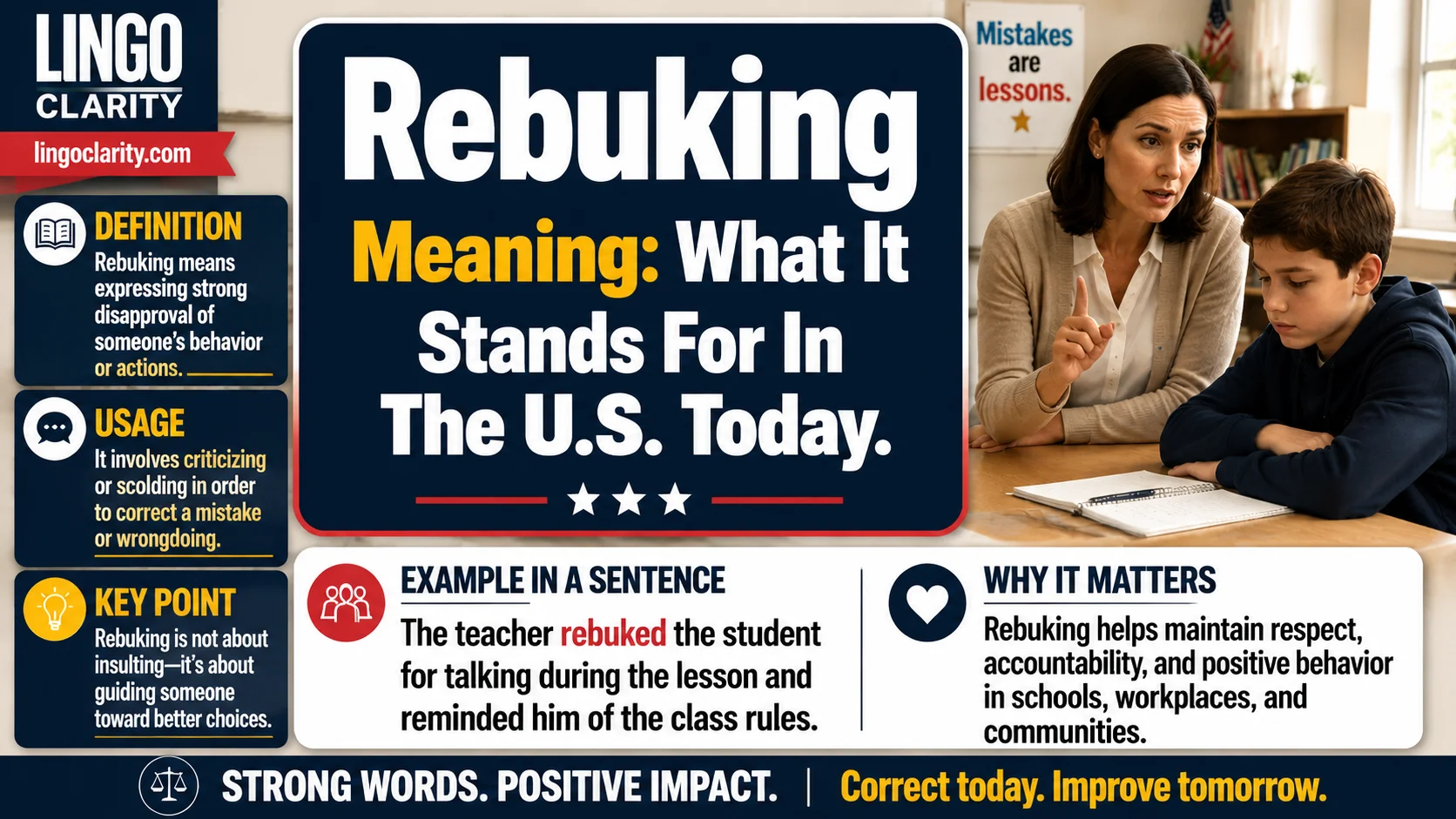
Rebuking meaning is simple: it means strongly criticizing or seriously correcting someone because they did or said something wrong. You may see this word in books, news reports, school reading, workplace writing, and serious conversations.
However, rebuking is stronger than simple advice. When someone is rebuking another person, they are showing clear disapproval, not just offering a gentle reminder. Therefore, the word often sounds formal and serious.
In this guide, you will learn the meaning of rebuking in plain English. You will also see its pronunciation, grammar role, examples, synonyms, opposites, and common mistakes.
Quick Answer
Rebuking meaning sharply criticizing or seriously correcting someone for wrong behavior, poor judgment, or unacceptable words. It is the -ing form of the verb rebuke. Because the word has a formal tone, it fits news, essays, reports, and serious conversations better than casual everyday speech.
What Does Rebuking Mean?
Rebuking meaning speaking strongly to someone because you disapprove of their action, words, or decision. In simple terms, it means calling out wrong behavior in a serious way.
For example, a teacher may rebuke a student for bullying. A judge may rebuke a lawyer for disrespectful comments. Likewise, a manager may rebuke an employee for ignoring company rules.
Someone can rebuke another person calmly. Even so, the message is still strong because the speaker is saying that something was wrong and should not happen again.
A simple way to remember it is this:
Rebuking = serious criticism + clear disapproval.
Pronunciation Of Rebuking
Rebuking is pronounced ri-BYOO-king.
Break it into three sounds:
- ri
- BYOO
- king
The stress is on BYOO. That middle sound rhymes with few, new, and view.
Do not pronounce it like ree-BUCK-ing. Instead, say ri-BYOO-king. This helps learners avoid guessing the wrong sound.
Is Rebuking A Verb?
Yes, rebuking is usually the present participle of the verb rebuke. It often shows an action happening now or around a certain time.
Examples:
- The coach is rebuking the players for ignoring safety rules.
- The supervisor was rebuking the employee for rude behavior.
- The article described officials rebuking the decision.
In each sentence, rebuking shows an action. Someone is strongly criticizing a person, group, action, or decision.
The main forms are:
| Form | Example |
|---|---|
| rebuke | They rebuke unfair behavior. |
| rebukes | She rebukes rude comments. |
| rebuked | He rebuked the employee. |
| rebuking | The manager is rebuking the team. |
Can Rebuking Be A Noun?
Yes. Rebuking can also work as a gerund. A gerund is an -ing word that acts like a noun.
Examples:
- Rebuking people in public can embarrass them.
- Constant rebuking can hurt team morale.
- His rebuking of the policy was direct and public.
In these sentences, rebuking names the action itself. As a result, it works like a noun.
However, this use sounds more formal. In casual speech, many Americans would use simpler wording, such as “calling someone out” or “criticizing someone.”
How To Use Rebuking In A Sentence
The most common pattern is rebuking someone for something.
Examples:
- The teacher was rebuking Jake for interrupting the class.
- The boss was rebuking Mark for arriving late.
- The judge was rebuking the lawyer for disrespectful remarks.
Another common pattern is rebuking someone for doing something.
Examples:
- The officer rebuked him for driving recklessly.
- The editor rebuked the writer for copying text.
- The parent rebuked the child for lying.
You may also see rebuking someone over something.
Example:
- Lawmakers were rebuking the agency over the failed plan.
Overall, use rebuking when the criticism feels serious, direct, and disapproving.
Rebuking Vs Correcting Vs Scolding
These words are related, but they do not have the same tone.
Correcting means fixing a mistake or giving the right answer. It can be gentle and neutral.
Example:
- The teacher corrected my spelling.
Scolding means criticizing someone, often in a personal or emotional way. It is more common in everyday speech.
Example:
- His mother scolded him for shouting.
Rebuking is stronger and more formal. It suggests serious disapproval.
Example:
- The principal rebuked the students for bullying.
Reprimanding is close to rebuking, but it often sounds official. For instance, a boss, school leader, or court may reprimand someone for misconduct.
Therefore, choose the word based on tone. Use correcting for small mistakes, scolding for everyday personal criticism, rebuking for serious criticism, and reprimanding for official correction.
When Should You Use Rebuking?
Use rebuking when someone strongly criticizes behavior that seems wrong, harmful, rude, dishonest, careless, or unacceptable.
Good situations include a judge rebuking a lawyer for interrupting, a coach rebuking players for unsafe behavior, a manager rebuking an employee for disrespect, or a public official rebuking a harmful policy.
By contrast, avoid rebuking for tiny mistakes. If someone fixes a spelling error, gives gentle advice, or reminds you about a deadline, correcting is usually better.
For example, “The teacher corrected my answer” sounds natural. However, “The teacher rebuked my answer” sounds too strong unless the situation involved serious wrongdoing.
Common Contexts For Rebuking
Rebuking often appears in formal writing and serious situations. However, the exact feeling depends on the context.
In the workplace, a manager may rebuke an employee for breaking a rule. This suggests the employee did something unacceptable.
In school, a principal may rebuke students for cheating, bullying, or damaging property. Meanwhile, a teacher may simply correct students for small errors.
In news and politics, writers often use rebuke when criticism is public. For example, officials may rebuke a policy, a company, or another leader’s statement.
In family life, rebuking can happen when a parent strongly addresses bad behavior. Still, many people would say scolding in casual conversation.
Is Rebuking Slang?
No, rebuking is not slang. It is a standard English word with formal tone.
You can use it in essays, reports, news summaries, official writing, and serious speech. However, it may sound too heavy in relaxed conversation.
Casual:
- My boss got mad at me.
More formal:
- My boss rebuked me for being late.
Very formal:
- The official statement rebuked the board’s actions.
In everyday speech, words like scolding, criticizing, correcting, or telling off may sound more natural. Nevertheless, rebuking is a strong choice when you want to show serious disapproval.
Synonyms For Rebuking
Several words are close to rebuking, but each one has a slightly different tone.
Reprimanding is one of the closest synonyms because it often means official criticism from someone in authority. Scolding is more common and personal, while criticizing is broader and can be mild or strong.
Chiding is milder and can sound gentle or old-fashioned. Meanwhile, admonishing means warning or correcting someone seriously. Berating is much harsher because it suggests angry, repeated criticism.
Condemning is stronger and more public. Therefore, do not replace rebuking automatically. Instead, choose the word that matches the situation.
Antonyms For Rebuking
The opposite of rebuking is a word that shows approval instead of disapproval.
Common antonyms include praising, complimenting, approving, commending, supporting, and encouraging.
Examples:
- Instead of rebuking the student, the teacher praised her honesty.
- The manager commended the team for finishing early.
- His parents approved of his responsible choice.
In short, rebuking points out something wrong, while praising points out something good.
Correct Spelling: Rebuking Or Rebukeing?
The correct spelling is rebuking. The incorrect spelling is rebukeing.
This mistake happens because the base word rebuke ends in e. However, many English verbs drop the final e before adding -ing.
Examples:
- make → making
- write → writing
- rebuke → rebuking
Therefore, write “The coach is rebuking the players,” not “The coach is rebukeing the players.”
Common Mistakes With Rebuking
One common mistake is using rebuking for every correction.
Weak:
- The teacher rebuked me for one spelling mistake.
Better:
- The teacher corrected my spelling.
Another mistake is using rebuking when praise is meant.
Incorrect:
- She rebuked him for his excellent work.
Correct:
- She praised him for his excellent work.
A third mistake is making the word too casual.
Awkward:
- My friend rebuked me for eating the last cookie.
More natural:
- My friend scolded me for eating the last cookie.
Overall, rebuking works best when the situation is serious.
Clear Examples Of Rebuking
- The judge rebuked the lawyer for interrupting the witness.
- The coach rebuked the players for ignoring safety rules.
- A manager rebuked the employee for speaking rudely to a customer.
- One article rebuked officials for delaying the investigation.
- She regretted rebuking her son in front of his friends.
FAQs
What does rebuking mean?
Rebuking meaning strongly criticizing someone because they did or said something wrong. It often shows sharp disapproval. For example, a principal may rebuke students for bullying.
What does it mean to rebuke someone?
To rebuke someone means to speak to that person seriously about wrong behavior, poor judgment, or unacceptable words. The speaker is not just giving advice; instead, they are showing clear disapproval.
Is rebuking a formal word?
Yes, rebuking is usually formal or serious. It fits essays, reports, news, and serious conversations. In casual speech, people often use scolding, correcting, criticizing, or telling off instead.
What is another word for rebuking?
A close word is reprimanding. Other possible words include scolding, reproving, chiding, admonishing, criticizing, berating, and condemning. However, the best choice depends on tone.
What is the opposite of rebuking?
The opposite can be praising, approving, complimenting, or commending. These words show approval instead of disapproval. For example, a teacher may praise a student for honesty.
Conclusion
Rebuking meaning strongly criticizing or seriously correcting someone because they did or said something wrong. It is the -ing form of rebuke, and it usually sounds formal.
Use rebuking when the tone is serious, sharp, or public. For softer situations, use correcting, advising, or reminding. For everyday personal criticism, scolding often sounds more natural.
