
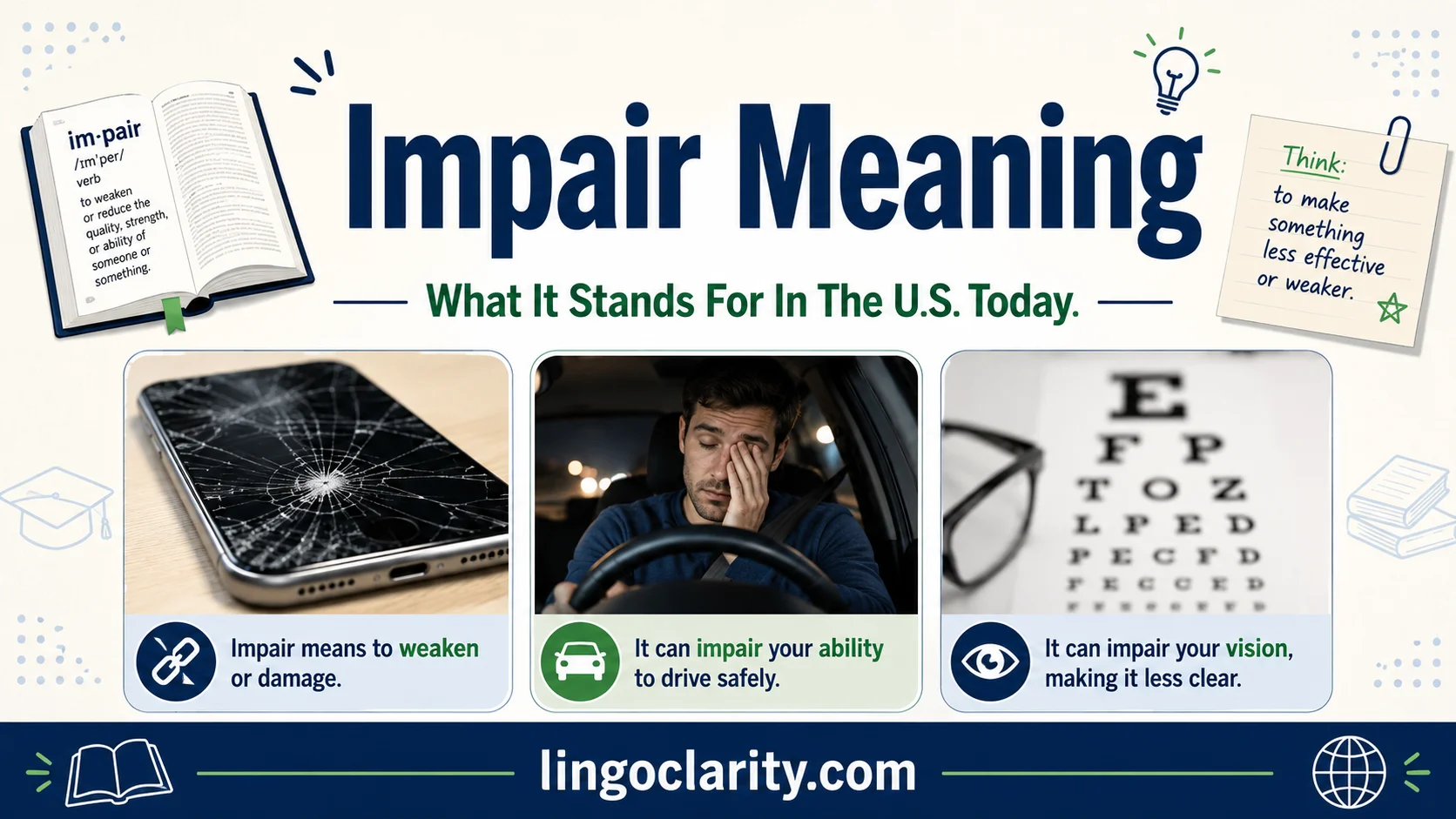
Impair meaning is simple: to impair something means to make it weaker, worse, or less effective. You may see the word impair in health articles, school assignments, workplace reports, safety warnings, legal documents, and news stories. For example, a doctor may say that an injury can impair movement. A driving warning may say that alcohol can impair judgment. Similarly, a teacher may explain that stress can impair learning.
At first, the word may sound formal or difficult. However, the idea is easy to understand. Impair does not usually mean that something is completely destroyed. Instead, it means that something still exists or still works, but it does not work as well as before.
This guide explains impair meaning in plain English. You will learn the definition, pronunciation, grammar, word forms, common examples, synonyms, antonyms, and mistakes to avoid. You will also see the difference between impair, impaired, and impairment.
Quick Answer
Impair meaning is to weaken, damage, or make something less effective. It usually describes a reduced ability, function, quality, value, or chance.
Example:
Lack of sleep can impair your memory.
This means lack of sleep can make your memory work less well. However, it does not mean your memory is gone completely.
What Does Impair Mean?
Impair means to make something weaker, worse, less useful, or less able to work properly. In many cases, it describes a problem that lowers performance or function.
For example, heavy fog can impair visibility. As a result, drivers may not see the road clearly. Loud noise can impair hearing over time. Likewise, pain can impair concentration because it makes focusing harder.
The word often sounds more serious than hurt or affect. Therefore, it appears often in formal writing. You may see it in medical, legal, safety, business, and academic contexts.
Even so, the idea behind the word is easy. When something impairs a thing, it makes that thing work less well.
Impair Definition In Plain English
In plain English, impair means to make something work less well than normal.
You can use it when a person, object, process, or ability becomes weaker. For instance, poor sleep can impair focus. A broken speaker can impair sound quality. In addition, stress can impair decision-making.
The word is especially useful when something still works but has become less effective. A person may still see, but their vision may be impaired. A team may still make progress, but delays may impair its results.
Simple examples:
- Heavy rain can impair visibility.
- Stress can impair judgment.
- A knee injury can impair movement.
- Poor internet can impair communication.
- Lack of training can impair job performance.
Pronunciation Of Impair
Impair is pronounced im-PAIR.
The stress falls on the second part: PAIR.
It sounds like:
im + pair
In American English, impair rhymes with words such as care, fair, share, and chair.
Examples:
- The medicine may impair balance.
- Bright glare can impair vision.
- The injury impaired his movement.
Word Forms Of Impair
The word impair has several common forms. Each form has a different job in a sentence.
| Word Form | Part Of Speech | Example |
|---|---|---|
| impair | verb | Lack of sleep can impair focus. |
| impairs | verb | Alcohol impairs judgment. |
| impaired | verb/adjective | His hearing was impaired. |
| impairing | verb form | The storm is impairing visibility. |
| impairment | noun | The test showed a mild hearing impairment. |
Because these forms are related, learners often confuse them. However, the difference becomes clear when you look at how each word works.
How Impair Works In Grammar
Impair is mainly a verb. More specifically, it is usually a transitive verb. That means it normally needs an object.
The basic pattern is:
impair + object
The object is the thing that becomes weaker or less effective.
Examples:
- Noise can impair hearing.
- Alcohol can impair judgment.
- Illness may impair performance.
- Fog can impair visibility.
- Stress can impair learning.
Do not use impair alone in most sentences. Instead, say what becomes weaker.
Incorrect:
The injury impaired.
Correct:
The injury impaired her movement.
This corrected sentence works because movement is the object.
How To Use Impair In Sentences
Use impair when you want to describe reduced ability, lower quality, weaker performance, or limited function. Since the word sounds formal, it works well in serious writing.
Common patterns include:
Can Impair + Noun
- Lack of sleep can impair memory.
- Loud noise can impair hearing.
- Fog can impair visibility.
May Impair + Noun
- This medicine may impair balance.
- Stress may impair judgment.
- Poor lighting may impair video quality.
Impair Someone’s Ability To + Verb
- Alcohol can impair a driver’s ability to react quickly.
- Pain can impair a student’s ability to focus.
- A hand injury may impair her ability to write.
Be Impaired By + Cause
- Visibility was impaired by fog.
- His movement was impaired by pain.
- Communication was impaired by a weak signal.
These patterns help you use the word naturally and correctly.
Common Contexts For Impair
You will often see impair in health, safety, school, workplace, technology, and legal writing. Although the word has one main meaning, the exact object changes by context.
| Context | Example | Meaning |
| Health | The injury impaired his balance. | His balance became weaker. |
| Driving | Alcohol can impair reaction time. | Reactions may become slower. |
| Weather | Fog impaired visibility. | People could not see clearly. |
| School | Anxiety impaired her focus. | She could not concentrate well. |
| Work | Delays impaired progress. | Progress became weaker or slower. |
| Technology | The outage impaired service. | The service worked less well. |
| Legal | The change impaired the contract’s value. | The value became weaker. |
Because impair sounds precise, writers use it when they want to describe a real reduction in function or quality.
Impair In Health And Safety Writing
Health and safety writing often uses impair because the word clearly describes reduced function.
For example, alcohol can impair judgment. Certain medicines may impair alertness. Also, loud sounds can impair hearing, especially after repeated exposure.
In safety warnings, the word often appears with driving, tools, machines, reaction time, coordination, and attention.
Examples:
- Fatigue can impair safe driving.
- Some medications may impair coordination.
- Bright glare can impair a driver’s vision.
- Poor sleep can impair reaction time.
These sentences warn readers that something may become less safe or less reliable.
Impair In School And Workplace Writing
In school and workplace writing, impair often describes reduced performance, learning, focus, teamwork, or communication.
Examples:
- Stress can impair test performance.
- Constant noise can impair concentration.
- Poor instructions may impair teamwork.
- Technical problems impaired the presentation.
- A lack of training can impair job performance.
In these examples, impair sounds more formal than mess up or make worse. Therefore, it fits essays, reports, emails, research papers, and professional documents.
However, in casual speech, simpler wording may sound more natural.
Formal:
The injury impaired his mobility.
Casual:
The injury made it harder for him to move.
Impair, Impaired, And Impairment
These three words are closely related, but they do not work the same way.
Impair
Impair is the verb. It describes the action of making something weaker or less effective.
Example:
Lack of oxygen can impair brain function.
Impaired
Impaired can be the past tense of the verb. It can also work as an adjective.
Example as a verb:
The accident impaired his vision.
Example as an adjective:
His vision was impaired after the accident.
Impairment
Impairment is the noun. It means the condition, problem, or result of being impaired.
Example:
The test showed a mild hearing impairment.
Use these forms carefully, especially when talking about people. When possible, choose specific and respectful language. For example, some people prefer Deaf, hard of hearing, blind, low vision, or another term that matches their identity or condition.
Synonyms Of Impair
Several words can replace impair, but the best choice depends on the sentence.
Common synonyms include:
- weaken
- damage
- harm
- reduce
- lessen
- worsen
- hinder
- undermine
- compromise
- diminish
However, these words do not always mean exactly the same thing.
Use weaken when strength becomes lower.
Example:
The illness weakened his body.
Use damage when real harm happens.
Example:
The fall damaged the screen.
Use reduce when an amount, level, or ability becomes lower.
Example:
Fog reduced visibility.
Use hinder when something slows progress.
Example:
Bad weather hindered travel.
Use impair when you want to focus on function, ability, quality, or effectiveness.
Example:
The injury impaired his ability to walk.
Antonyms Of Impair
The opposite of impair depends on context. Still, several words often work well.
Common antonyms include:
- improve
- strengthen
- help
- support
- repair
- restore
- enhance
Examples:
- Rest can improve focus.
- Exercise can strengthen muscles.
- Treatment may restore movement.
- Better lighting can improve visibility.
- A technician can repair the device.
Be careful with repair. It works for objects, machines, and physical damage. However, you usually improve focus, restore movement, or strengthen performance.
Impair Vs Damage
Impair and damage are related, but they are not always the same.
Damage often means real harm, especially physical harm.
Example:
The fire damaged the building.
Impair focuses on reduced function or effectiveness.
Example:
The smoke impaired visibility.
A thing can be impaired without being fully damaged. For example, a cracked phone screen may not destroy the phone, but it can impair your ability to use it easily.
Impair Vs Hinder
Impair means to make something weaker or less effective.
Hinder means to slow something down or make progress harder.
Examples:
- Lack of sleep can impair memory.
- Heavy traffic can hinder travel.
Use impair for ability, function, quality, or performance. Use hinder when something blocks or delays progress.
Common Mistakes To Avoid
One common mistake is thinking impair means destroy. Usually, it means something becomes weaker, not completely gone.
Incorrect:
The rain impaired the road.
Better:
The rain impaired visibility.
Another mistake is using impair without an object.
Incorrect:
The medicine may impair.
Better:
The medicine may impair balance.
Also, avoid using impair when a simpler word fits better. In everyday speech, make worse, hurt, or weaken may sound more natural.
Mini Quiz
Choose the best answer.
- What does impair mean?
A. To improve
B. To make weaker or less effective
C. To explain - Which sentence is correct?
A. Fog can impair visibility.
B. Fog can impair quickly.
C. Fog can impair happy. - What is the noun form of impair?
A. Impairment
B. Impairly
C. Impairful - Which word is closest to impair?
A. Strengthen
B. Weaken
C. Celebrate
Answer key: 1-B, 2-A, 3-A, 4-B
FAQs About Impair Meaning
What does impair mean in simple words?
Impair means to make something weaker, worse, or less effective. For example, lack of sleep can impair focus.
Is impair a verb?
Yes, impair is a verb. It usually needs an object, such as judgment, memory, vision, hearing, or performance.
What is an example of impair in a sentence?
A clear example is: Alcohol can impair judgment. This means alcohol can make judgment weaker or less reliable.
What is another word for impair?
A good synonym for impair is weaken. Other choices include damage, harm, reduce, worsen, and hinder.
What is the opposite of impair?
The opposite can be improve, strengthen, restore, repair, or help. The best word depends on the sentence.
What is the difference between impair and impaired?
Impair is the verb. Impaired often describes the result. For example, medicine may impair balance, and a person’s balance may be impaired.
Is impair a slang word?
No, impair is not slang. It is a standard English word, but it often sounds formal.
Final Thought
Impair meaning is easy to understand: it means to make something weaker, worse, or less effective. The word is useful when you describe reduced ability, function, quality, safety, value, or performance.
Use impair in formal or serious writing, especially in health, safety, school, workplace, and legal contexts. However, for casual speech, simpler words such as weaken, hurt, reduce, or make worse may sound more natural.
