
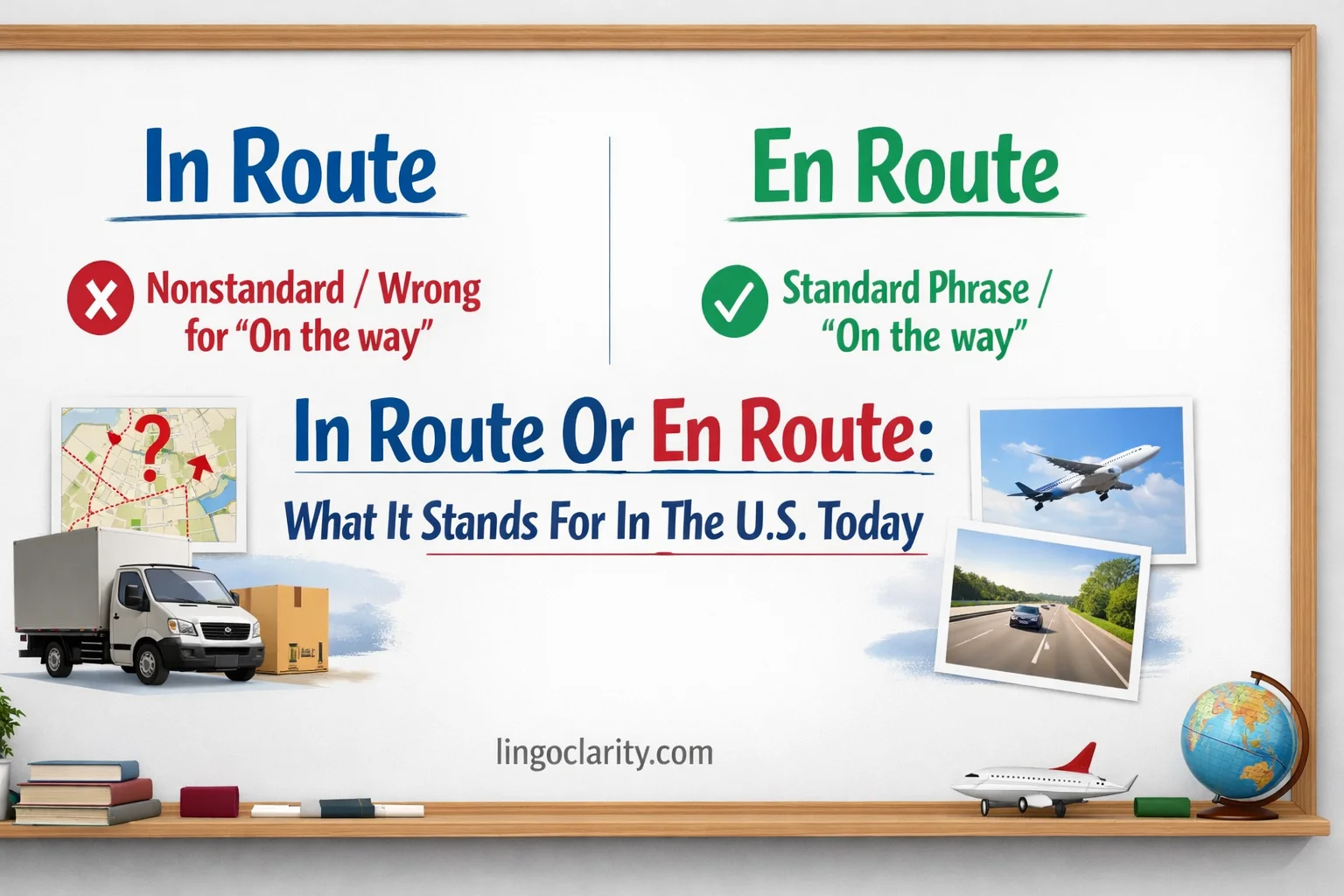
Writers often hesitate over this pair because one version looks more familiar at first glance. Even so, standard US English is clear: when you mean on the way or in transit, the accepted expression is en route. Major dictionary sources define it that way and treat it as an established part of English, not as an odd or overly foreign phrase.
The other form usually appears when someone spells the expression by sound instead of by standard written form. That mistake is understandable, especially in fast writing, but it is still best corrected in edited American English. Once you understand the pattern, the choice becomes easy and consistent.
Quick Answer
Use en route when you mean on the way, in transit, or along the way. That is the standard expression in US English. Merriam-Webster and Cambridge both define it with that meaning, and Cambridge’s American entry shows it in ordinary examples such as an ambulance traveling to a hospital.
Use in route only when in and route are functioning as separate ordinary words in a different sentence structure, such as a problem in route planning or improvement in route efficiency. In those cases, you are not using the fixed expression at all. The noun route has its normal dictionary meaning, and in is simply a preposition.
Why Writers Mix Them Up
This mistake happens for a few very human reasons. First, the accepted expression was borrowed from French, so its spelling does not look as immediately familiar as a fully native-looking English phrase. Merriam-Webster notes that it is a French borrowing that has long been used in English.
Second, pronunciation plays a big role. Cambridge’s pronunciation entry shows common American pronunciation close to on root, which makes it easy for a writer to assume the spelling should look more English than it actually does. That sound-based confusion explains the error, but it does not change the standard written form.
A third reason is speed. In texts, captions, shipping notes, and quick workplace messages, people often type what sounds right in their heads. That is why the nonstandard spelling appears often online, even though it still looks incorrect in polished US writing.
What The Standard Expression Means
The accepted phrase means on the way, along the way, or in transit. It is commonly used when someone or something is traveling toward a destination, or when an event happens during a journey. Dictionary entries support both the travel sense and the broader idea of something happening before arrival.
That meaning gives it a wide range of everyday uses. You can use it for a person, a package, a flight, a bus, a medical team, or even a sports result. American English speakers use it naturally in sentences like these:
I’m en route now and should be there by six.
The shipment is en route to your address.
We stopped for coffee en route to the game.
The rescue team is en route from the airport.
These are all ordinary, idiomatic uses of the standard form.
How It Works Grammatically
This expression most often functions as an adverb, which means it modifies the action in a sentence:
We stopped en route.
She called me en route to the office.
Merriam-Webster also notes that it can sometimes work adjectivally, as in phrases like en route delays. That matters because some writers think it only works after a verb, but standard usage is a little more flexible than that.
The nonstandard version is different. When people write it as a substitute for the accepted phrase, readers usually see it as an error. But when the two words are genuinely separate, the grammar changes completely:
The company invested in route optimization software.
We saw better results in route planning this quarter.
Here, route is simply a noun, and in is doing its normal job as a preposition. This is not a spelling variant of the travel expression. It is a separate construction with a separate meaning. Cambridge’s definition of route as a way, direction, or transport path supports that distinction.
The Real Difference Between The Two Forms
This is not a case where both versions are equally acceptable and you simply choose based on style. The real difference is much sharper:
- en route = the standard fixed expression meaning on the way
- in route = usually a mistake when that same meaning is intended
- in + route as separate words = sometimes fine, but only in a different grammatical structure
That is why a sentence like The courier is in route to your office should usually be revised, while a sentence like The analyst found an error in route design may be perfectly fine.
Once you separate the fixed expression from the ordinary noun phrase, the confusion almost disappears.
Which One Should You Use In Everyday US Writing?
For almost every practical situation, choose the standard form. It works smoothly in business writing, customer updates, text messages, journalism, school assignments, and general web content. Dictionaries do not present it as rare or outdated. They present it as normal English.
That means it is appropriate in sentences such as these:
Your driver is en route.
The doctor is en route to the clinic.
We were delayed en route from Boston to New York.
She answered emails en route.
In each case, a plain-English substitute like on the way would also make sense, which is a useful clue. If on the way fits naturally, the standard travel expression probably does too.
A Simple Rule That Almost Always Works
Use this fast test:
If you can replace the phrase with “on the way,” choose the standard form.
That rule works because the accepted expression is defined that way by major dictionaries. So if your sentence means traveling toward a place or happening during the trip, you are almost certainly dealing with the standard expression, not with separate ordinary words.
For example:
We are on the way to the airport.
We are en route to the airport.
Both sentences carry the same basic meaning.
But look at this one:
The team has confidence in route planning software.
You cannot replace that with on the way planning software, so this is clearly not the fixed travel expression. That is your signal that the words are functioning separately.
Common Mistakes Writers Make
One common mistake is using the nonstandard spelling before to:
We are in route to Dallas.
The ambulance is in route to the hospital.
Those should be revised because the intended meaning is clearly on the way. Cambridge’s example sentence for the accepted expression uses exactly this kind of structure: The ambulance is en route to the hospital.
Another common mistake is assuming the expression always needs a destination after it. It does not. The phrase can stand on its own:
Your order is en route.
We stopped twice en route.
That pattern is fully normal because dictionaries define it broadly as on the way or along the way, not only as on the way to a named place.
A third mistake is avoiding the standard phrase because it feels too formal. In reality, it is common in everyday American English, especially in travel, delivery, news, and workplace contexts. It may sound slightly more polished than on the way, but it does not sound unnatural.
Everyday Examples In Natural US English
Here are clear examples that sound normal and current:
I’m en route now, so I should arrive in fifteen minutes.
The package is en route and will be delivered this afternoon.
We stopped for lunch en route to Chicago.
The pilot reported weather issues en route.
The team scored twice en route to a comfortable win.
The nurse was en route from one clinic to another when the call came in.
Our guests got stuck in traffic en route to the wedding.
She finished the report en route home on the train.
Now compare those with forms that should usually be edited:
I’m in route now.
The package is in route.
The pilot was in route to Denver.
Our guests were in route to the wedding.
Those versions are not standard in polished US writing when the meaning is on the way.
Pronunciation Help
American dictionaries and pronunciation guides show that the accepted expression is often pronounced in a way that sounds close to on root. Cambridge lists US pronunciation along those lines, which helps explain why so many writers reshape the spelling into something that feels more familiar.
Still, pronunciation does not control spelling here. English contains many borrowed expressions that sound one way and are written another. This is one of them. So even if a casual spoken form sounds like it could be written differently, the correct written version remains the same.
Tone, Formality, And Style
This phrase sits comfortably in neutral to professional English. It sounds slightly cleaner and more polished than on the way, but it is not stiff. That makes it especially useful in these contexts:
- delivery notifications
- travel updates
- customer service messages
- workplace communication
- news-style writing
- sports summaries
For very conversational writing, on the way may sound a little warmer or simpler:
I’m on the way now.
For more compact writing, the standard expression can sound sharper:
I’m en route now.
Both are correct. The difference is mainly tone, not correctness.
A Brief Note On History
Merriam-Webster dates the phrase in English to the eighteenth century and describes it as a borrowing from French. That long history matters because it shows this is not a new usage trend or a temporary style preference. It has been part of English long enough to be fully established.
By contrast, the competing spelling is better understood as a later sound-based reshaping in everyday writing, not as an equally accepted standard form. That is why edited American English still treats the standard version as the correct one.
When Separate Words Are Fine
It is worth repeating one subtle point: the words in and route can sit next to each other without creating an error. What matters is whether they are being used as the fixed expression or as ordinary parts of a different sentence.
These are fine:
The director noticed a flaw in route selection.
The company invested heavily in route analytics.
We saw measurable gains in route efficiency.
The consultant specializes in route design.
These are not using the travel expression at all. They simply contain the noun route, which dictionaries define in the usual way as a way, path, or line of travel.
Conclusion
If your meaning is on the way, the correct choice in US English is en route. Major dictionary sources define it that way, show it in ordinary American usage, and treat it as an established English expression.
The look-alike version usually appears because writers spell the phrase by sound. That mistake is common, but it is still best corrected in edited writing. The practical rule is simple: if on the way fits, use the standard expression. If in and route are doing separate grammatical jobs, then you are dealing with a different sentence structure altogether.
Once you keep that distinction in mind, the choice becomes easy, natural, and consistent.
FAQs
Is “in route” ever correct?
Yes, but only when in and route are separate words in a different grammatical structure, such as an issue in route planning. If you mean on the way, the standard expression is en route.
Is “en route” too formal for everyday writing?
No. It can sound slightly more polished than on the way, but dictionaries treat it as a normal English expression, and it works naturally in messages, updates, and general writing.
Do I always need to use “to” after it?
No. You can write We stopped en route or We are en route to Seattle. Both patterns fit the dictionary meaning of on the way or along the way.
Why do people spell it the wrong way so often?
Mostly because the accepted expression is often pronounced in a way that sounds close to a more familiar English-looking form. Cambridge’s pronunciation guidance helps explain why that confusion happens in casual writing.
Should I use this expression or just say “on the way”?
Both are correct when the meaning fits. Choose on the way for a plainer, more conversational tone, and choose the standard expression when you want a slightly neater or more compact phrasing.
