Many writers stop and second-guess themselves when choosing between verbage and verbiage. The two forms sound close enough in speech that they seem like they could be interchangeable. That is exactly why this word-choice issue keeps showing up in emails, reports, website copy, contracts, and classroom writing.
The confusion becomes even stronger because verbiage is used in more than one way. Some people use it negatively to mean too many words or bloated language. Others use it in a neutral way to mean wording, phrasing, or the language used in a document. When people hear that neutral business-style use, they may assume verbage is just a simpler spelling of the same word.
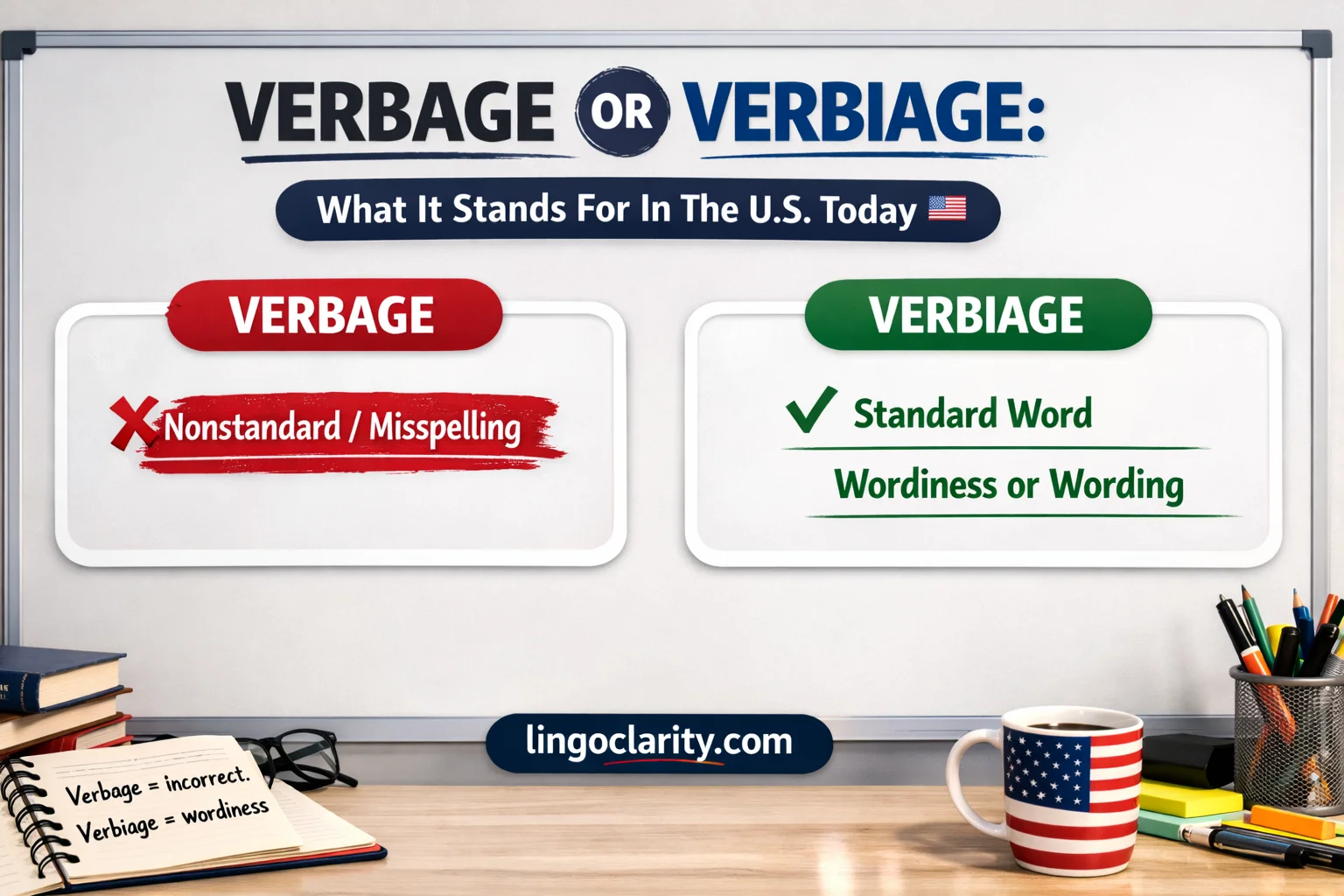
In standard US English, though, these are not equal choices. Verbiage is the established form recognized by major dictionaries, while verbage is still widely viewed as nonstandard in edited writing. At the same time, modern dictionaries also confirm that verbiage can carry both a negative sense and a neutral sense, which is an important nuance many quick grammar guides miss.
Quick Answer
Use verbiage in standard US English. Avoid verbage in formal, academic, business, or edited writing.
Here is the short rule:
- Correct standard form: verbiage
- Avoid in polished writing: verbage
- Meaning of verbiage: either wordiness or wording/diction, depending on context
- Plain-English alternative: wording is often the clearest choice
Why People Confuse Verbage And Verbiage
This confusion is mostly caused by sound. In everyday speech, verbiage is often pronounced in a way that makes the middle i easy to miss. A listener may hear something close to VUR-bee-ij and naturally assume the spelling should be verbage.
The second reason is visual logic. To many people, verbage looks simpler and more intuitive. Since English already has words built around verb, some writers assume verbage is the more natural form. But English spelling does not always follow what looks simplest, and in this case the standard word is still verbiage.
The third reason is usage context. In offices and organizations, people often say things like:
- “Please update the verbiage on the form.”
- “Legal approved the verbiage.”
- “We need consistent verbiage across the site.”
When writers hear that neutral sense often enough, they may think both spellings are acceptable. That is where many polished drafts go wrong.
What Verbiage Means In Modern English
A lot of bad advice on this topic comes from oversimplifying the meaning of verbiage. In reality, standard dictionaries recognize more than one sense.
Merriam-Webster defines verbiage both as a profusion of words usually of little or obscure content and as a manner of expressing oneself in words, which supports the neutral wording sense. American Heritage also gives two meanings: an excess of words and the manner in which something is expressed in words. Dictionary.com likewise includes both wordiness and wording/style of expression.
That means verbiage can function in two accepted ways:
Negative Sense
In its traditional critical sense, verbiage means language that is overly long, padded, or unnecessarily complicated.
Examples:
- The article was buried in technical verbiage.
- His presentation had plenty of verbiage but not much insight.
- The report needs less verbiage and more evidence.
In this sense, the word often overlaps with wordiness, verbosity, or long-windedness.
Neutral Sense
In many modern professional settings, verbiage simply means wording, phrasing, diction, or the exact language used.
Examples:
- Please keep the same verbiage in all three policy sections.
- The client approved the final verbiage for the landing page.
- We should simplify the verbiage on the registration screen.
This neutral use is sometimes criticized by people who prefer the older negative sense, but it is recognized by major dictionaries and cannot fairly be called nonstandard.
Is Verbage Ever Standard?
In polished US English, verbage is not the standard form. That is the safest editorial answer.
However, there is one nuance worth knowing. The Oxford English Dictionary records verbage as a real form with its own entry, which shows that it has appeared in actual use rather than being a brand-new typo. Still, the existence of a historical record does not make it the preferred spelling in present-day edited American prose. For most readers, verbage still looks like a misspelling of verbiage.
That distinction matters. A form can exist in usage history and still be the wrong choice for a clean, professional draft.
Key Differences At A Glance
| Context | Best Choice | Why |
|---|---|---|
| Edited US writing | verbiage | Standard spelling readers expect |
| Academic papers | verbiage | Verbage looks like a mistake |
| Business writing | verbiage or wording | Both can work, but wording is often clearer |
| Legal or policy language | verbiage | Common and accepted in formal contexts |
| Talking about bloated language | verbiage | Established negative sense |
| Simple everyday communication | wording | Cleaner and more natural tone |
| Polished draft using verbage | Avoid | Most readers will view it as nonstandard |
Which Word Should You Use?
The best editorial rule is simple:
Use verbiage when you deliberately want that standard noun. Use wording when you want a plainer, more natural alternative. Do not use verbage in polished US writing.
That practical rule works because it solves both the correctness issue and the style issue.
For example:
- Correct but formal: Please review the verbiage in section four.
- Correct and plainer: Please review the wording in section four.
Both are acceptable, but the second one is often easier on the reader. That is why many editors prefer wording unless the sentence specifically benefits from the more formal tone of verbiage.
Tone, Context, And Formality
Tone matters here almost as much as spelling.
Verbiage can sound formal, corporate, legal, or bureaucratic. In the wrong setting, it may come across as heavier than necessary. If a sentence is meant to sound direct and friendly, wording is often the better choice.
Compare these pairs:
- We need to update the verbiage on the pop-up.
- We need to update the wording on the pop-up.
- The report is full of unnecessary verbiage.
- The report is too wordy.
In the first pair, both work, but wording feels more natural. In the second pair, verbiage gives the sentence a more formal editorial tone, while wordy sounds simpler and more conversational.
Verbage, by contrast, usually creates the wrong impression in professional writing. Instead of sounding polished, it tends to undermine reader confidence because many people will assume it is an error.
When Verbiage Sounds Wrong
Even the correct form can be the wrong stylistic choice.
For example, this sentence is grammatically acceptable:
- Can you update the verbiage in the signup email?
But depending on the audience, it may sound too formal or too corporate. In a casual team message, wording may be better:
- Can you update the wording in the signup email?
So there are really two levels of judgment here:
- Correctness: choose verbiage, not verbage
- Style: decide whether verbiage or wording fits the tone better
That distinction helps writers move beyond “right vs. wrong” and make stronger editorial decisions.
Common Mistakes And Smart Fixes
Treating Verbage And Verbiage As Equal Variants
This is the most common mistake. In standard US editing, they are not equal variants. Change verbage to verbiage, or change it to wording if that sounds cleaner.
- Nonstandard: The contract verbage needs revision.
- Better: The contract verbiage needs revision.
- Best plain-English option: The contract wording needs revision.
Assuming Verbiage Is Always Negative
This is another frequent mistake. Many people were taught that verbiage always means excessive wording, but modern dictionaries also recognize the neutral sense of wording or diction. So it is inaccurate to claim that every neutral use is wrong.
Using Verbiage When A Simpler Word Would Do
A sentence can be correct and still not be the strongest choice.
- Acceptable: The verbiage on the sign needs work.
- Cleaner: The wording on the sign needs work.
When the audience is broad and readability matters, the simpler option usually wins.
Calling Excess Verbiage Always Redundant
Some people object to the phrase excess verbiage because verbiage can already mean excessive wording. But once you remember that verbiage can also mean wording or diction, the phrase is not automatically redundant. In context, it can simply mean too much wording. Merriam-Webster specifically notes that this criticism is not always justified.
Everyday Examples
These examples show the difference in natural, modern sentences:
- The legal team removed some of the dense verbiage from the agreement.
- That memo has too much verbiage and not enough useful direction.
- Please keep the same verbiage across the website and app.
- Marketing changed the homepage wording, but the old verbiage still appears in the email flow.
- The intern wrote verbage in the final draft, and the editor corrected it.
- I understand what she meant by verbage, but I would still replace it in a client document.
- For a friendlier tone, I would change verbiage to wording in that sentence.
- The policy verbiage is accurate, but it could be easier for customers to understand.
Grammar And Word Class
Both terms are treated as nouns, not verbs.
- Verbiage is a standard noun.
- Verbage is a nonstandard noun form in current edited usage.
Neither works as a standard verb in careful US English. You would not normally write to verbiage something. If you need a verb, choose one that says exactly what you mean, such as reword, rewrite, phrase, or edit.
Useful Synonyms
When verbiage means excessive language, useful substitutes include:
- wordiness
- verbosity
- long-windedness
- prolixity
- verbal excess
When verbiage means wording or phrasing, useful substitutes include:
- wording
- phrasing
- language
- diction
- text
- copy
Merriam-Webster’s thesaurus reflects both clusters by listing entries such as wordiness, diction, and wording among related terms.
Word History And Editorial Takeaway
The historical picture explains why people still write verbage. The OED records both verbiage and verbage, which means the nonstandard-looking form is not just a random internet invention. But present-day editorial standards still strongly favor verbiage. That is the form recognized broadly in dictionaries and expected by readers in professional US contexts.
So the safest conclusion is current rather than historical:
- Verbiage is the standard modern form.
- Verbage may appear in real use, but it is not the preferred choice for polished writing.
- Wording is often the clearest plain-English substitute.
Frequently Asked Questions
Is verbage a real word?
It has appeared in real-world usage and is recorded historically, but it is not the preferred standard form in polished US English. In careful writing, use verbiage instead.
Is verbiage the same as wordiness?
Sometimes, yes. Verbiage often means excessive or unnecessary wording. But it can also mean wording or diction in a neutral sense. Context determines which meaning is intended.
Why do people use verbiage to mean wording?
Because that neutral sense is established in modern dictionary treatment and is common in professional, legal, and business contexts. It is not just a recent mistake.
Should I use verbiage in business writing?
You can, especially when referring to the wording of a document, form, or interface. But wording is often clearer and less corporate-sounding, so it is usually the better choice for plain-English business prose.
Can I use verbage in informal writing?
You can write it informally if you choose, and many readers will still understand what you mean. But because so many people see it as a misspelling, it is usually better to avoid it even in casual professional communication.
Conclusion
For standard US English, the correct choice is verbiage.
Use verbiage when you mean either wordiness or wording, depending on context. Avoid verbage in polished writing because most readers will treat it as nonstandard. And when clarity matters more than formality, choose wording instead.
That is the cleanest editorial takeaway: verbiage is standard, verbage is not, and wording is often the strongest plain-English alternative.ten the smartest choice.

5 thoughts on “Verbage Or Verbiage: Which Form Is Standard In US English?”
Comments are closed.