Reviewed by the Lingoclarity editorial team · Last updated: August 2026
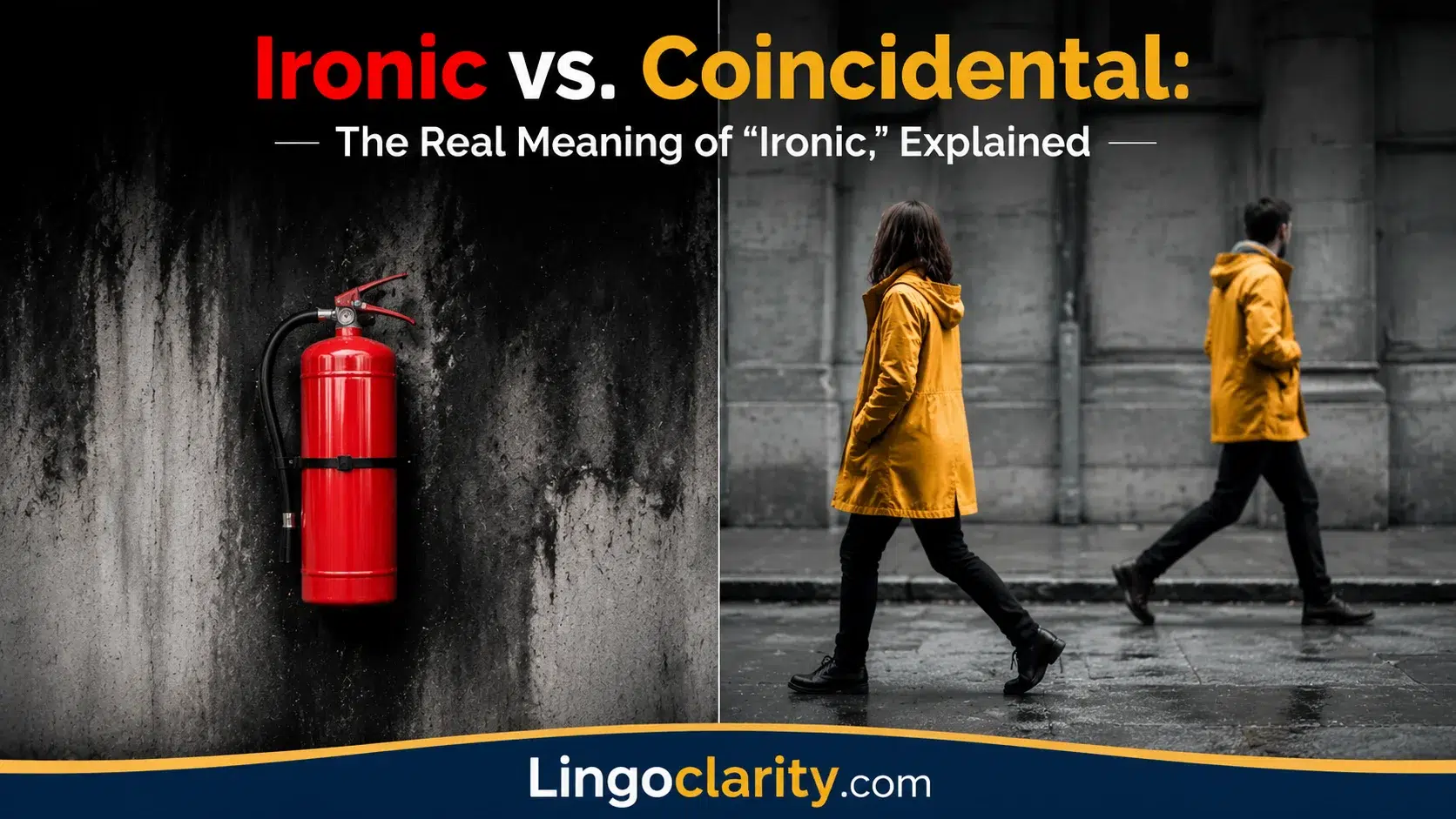
Quick answer: Something is ironic when the outcome flips the expectation — a fire station burns down. Something is coincidental when two unrelated things simply line up in time — you and a stranger share a birthday. Irony needs a reversal; coincidence only needs timing. That single difference settles almost every argument about the word.
The ironic vs. coincidental problem isn’t that people don’t know what irony is. It’s that English handed one word two jobs, and the second job — describing life’s strange turns — keeps drifting into territory that belongs to coincidence. Merriam-Webster has recorded that looser sense for decades, which is why the strict speaker and the casual speaker can both claim they’re right. Below is the dividing line, a test you can run in your head, and a straight answer on when you’ll get corrected.
Table of Contents
- Ironic vs. Coincidental: The Quick Comparison
- What Does “Ironic” Actually Mean?
- Where Do “Irony” and “Coincidence” Come From?
- What Counts as a Coincidence Instead?
- How Do You Tell Ironic From Coincidental in Five Seconds?
- How Do You Use “Ironic” Correctly?
- Is Alanis Morissette’s “Ironic” Actually Ironic?
- What Are the Most Common Mistakes With “Ironic”?
- What’s the Difference Between Ironic, Sarcastic, and Paradoxical?
- Frequently Asked Questions
- One Test Worth Remembering
<a id=”quick-comparison”></a>
Ironic vs. Coincidental: The Quick Comparison
| Ironic | Coincidental |
|---|---|
| Needs a setup and a reversal of that setup | Needs only that two things overlap |
| The outcome contradicts what was expected or intended | The events are unrelated; they just land together |
| Carries a point, a joke, or a lesson | Carries no point — it’s chance |
| A marriage counselor files for divorce | Two guests show up in the same dress |
| Adjective; the noun is irony, the adverb ironically | Adjective; the noun is coincidence |
| First recorded in English in 1576 (irony, 1502) | First recorded in English in 1605 |
One line to hold onto: a coincidence surprises you, while irony contradicts you.
<a id=”what-does-ironic-mean”></a>
What Does “Ironic” Actually Mean?
Ironic (adjective) · eye-RON-ik · /ˌī-ˈrä-nik/ · adverb: ironically · noun: irony
Merriam-Webster dates ironic to 1576 and defines it as relating to, containing, or constituting irony — or, in a second sense, as being given to irony, the way you’d describe someone’s dry sense of humor (Merriam-Webster, “ironic”). That definition only helps once you know which kind of irony is in play, because the word covers several.
Verbal Irony
You say the opposite of what you mean and trust the listener to catch it. Standing in a downpour and calling it “lovely weather” is verbal irony. This is the oldest sense, and it’s the one that most cleanly matches the word’s roots.
Situational Irony
The result is the reverse of what anyone expected. A pickpocket gets robbed. An anti-virus company’s website is the one that spreads malware. This is the sense at the center of every argument about the word, and it’s where the confusion with coincidental lives.
Dramatic Irony
The audience knows something a character doesn’t. Romeo believes Juliet is dead; everyone watching knows she isn’t. Merriam-Webster files dramatic irony as a sub-sense of situational irony, since the incongruity is still between what’s expected and what’s real.
Socratic Irony
Feigned ignorance used to expose someone else’s, named for Socrates and his habit of asking naive-sounding questions until the other person’s argument fell apart. You’ll meet this one mostly in philosophy classes.
<a id=”etymology”></a>
Where Do “Irony” and “Coincidence” Come From?
Irony traces back to Greek eirōneia, from eirōn, “dissembler” — someone who pretends. It passed through Latin ironia and shows up in English by 1502, with ironic following in 1576. That origin explains a lot. The word started life meaning pretending, which is exactly what verbal irony does: you say one thing and mean another.
Coincidence has a completely separate history. It comes from Medieval Latin coincidentia, built on coincidere, “to fall upon together.” English picked it up around 1605, and the first sense was literal — two things occupying the same space or time. The familiar meaning, a striking chance overlap, grew out of that (Merriam-Webster, “coincidence”).
The two words never shared a root. Their overlap is a modern, social development, not a historical one — which is worth knowing when someone insists the “real” meaning has been lost. What’s actually happened is that one sense of irony expanded. Merriam-Webster’s own usage note records the looser application and dates it to roughly a century of use, citing an example from F. Scott Fitzgerald in 1939 (Merriam-Webster, “irony”).
<a id=”what-counts-as-coincidence”></a>
What Counts as a Coincidence Instead?
A coincidence has three tells:
- Nobody set an expectation. No promise, prediction, or plan was in place to be overturned.
- Nobody intended anything. Chance did the work.
- The events don’t comment on each other. Put them side by side and neither one changes how you read the other.
Run those against a few everyday cases. You bump into a neighbor in a train station four thousand miles from home — coincidence. Two friends text you the same joke within a minute — coincidence. Rain falls on your wedding day — bad luck, and not even a coincidence, just weather.
Here’s the part most explainers skip, though. Any of those can become ironic the moment an expectation gets attached. If you’re a meteorologist who moved the wedding date twice around your own forecast and it still rained, that’s ironic: your expertise was the thing that failed. Same rain, different setup.
<a id=”the-test”></a>
How Do You Tell Ironic From Coincidental in Five Seconds?
Ask three questions, in order. All three have to land.
- Was an expectation actually set? Someone predicted, promised, planned, or the situation clearly implied an outcome. If nothing was expected, nothing can be reversed — you have a coincidence.
- Did the result reverse that expectation, or just disappoint it? A traffic jam when you’re late is disappointing. A traffic jam caused by a rally for smoother traffic flow reverses it. Failure isn’t irony; contradiction is.
- Does the reversal make a point? Irony reads like a joke told by circumstance. If you explain it and the response is “…and?”, you had chance, not irony.
Two out of three isn’t enough. The reason “so ironic” gets misapplied so often is that step one gets skipped — people feel the surprise, which is real, and reach for the strongest word available.
<a id=”how-to-use”></a>
How Do You Use “Ironic” Correctly?
These cover a text message, professional writing, spoken dialogue, and literary analysis.
- Text message: “The fire alarm failed inspection because the alarm didn’t go off. Ironic.”
- Workplace email: “It’s ironic that the software we bought to save the team time has cost us three weeks of it.”
- Dialogue: “The ethics officer got caught padding her expenses?” “Ironic, isn’t it.”
- Verbal irony in speech: “Nice of you to show up,” she said ironically, as he walked in an hour late.
- Literary analysis: Romeo and Juliet runs on dramatic irony — the audience knows Juliet is alive while Romeo does not.
And the contrast case, so the line stays visible: “We booked the same flight without knowing — what a coincidence.” Nothing was reversed there, so coincidence is the accurate word, and it’s the more interesting one anyway.
<a id=”alanis-morissette”></a>
Is Alanis Morissette’s “Ironic” Actually Ironic?
This is the argument that keeps the question alive, thirty years on. “Ironic” was released in February 1996 from Jagged Little Pill and peaked at No. 4 on the Billboard Hot 100 — Morissette’s highest-charting US single. It also became the most-cited example of the word’s misuse in modern English.
The complaint is straightforward. Rain on your wedding day, a free ride when you’ve already paid, a traffic jam when you’re already late: those are bad luck and awkward timing. No expectation gets flipped, so under the strict definition, none of them qualify.
A couple of lines do hold up better than their reputation. A death-row pardon that arrives two minutes too late reverses the entire purpose of a pardon, and that’s a real reversal, not a coincidence. Which is part of why the debate never fully closes.
Morissette has addressed it more than once. She’s acknowledged early embarrassment about the lyrics, and she’s also pointed out that the definition of irony has broadened since 1996 in a direction that’s friendlier to what she wrote. In 2015 she performed a rewritten version with James Corden that included the line about singing “Ironic” when there are no ironies.
The fair verdict is the one people reach for as a joke and rarely examine: the most ironic thing about “Ironic” is that it contains almost no irony. A song named for a concept it fails to demonstrate has a setup, a reversal, and a point. That’s the definition, met.
<a id=”common-mistakes”></a>
What Are the Most Common Mistakes With “Ironic”?
| What people write | Why it misses | Better choice |
|---|---|---|
| “So ironic — I was just thinking about you and you called.” | Nothing was expected, so nothing was reversed. | “What a coincidence.” |
| “Ironic that it rained on my wedding day.” | Bad luck without a setup. | “Of all days.” |
| “He was being ironic about her cooking.” (meaning cutting) | Sarcasm is irony sharpened into a weapon. | “Sarcastic.” |
| “Ironicly” | Misspelling. | “Ironically.” |
| “That’s ironical.” | Not wrong, just dated. | “That’s ironic.” |
Two of those deserve a closer look.
Ironic vs. Sarcastic
Sarcasm is a subset of verbal irony. Both say the opposite of what’s meant; sarcasm adds intent to mock or wound. All sarcasm is ironic. Very little irony is sarcastic.
Is “Ironical” Still Acceptable?
Dictionaries, including Merriam-Webster, still list ironical as a variant, along with ironicalness. It isn’t an error. It reads as old-fashioned to most American readers, though, and ironic is the standard modern form — so choose ironical only if you want that flavor on purpose.
A Note on Register
In a group chat, on social media, or in casual speech, the loose sense of ironic is completely normal and nobody will stop you. Formal writing is a different room. Hold to the strict sense in a cover letter, an academic paper, a legal brief, or anything an editor will touch — there, a loose ironic reads as imprecision, and precision is usually the whole reason you reached for a specific word.
<a id=”related-words”></a>
What’s the Difference Between Ironic, Sarcastic, and Paradoxical?
- Sarcastic — verbal irony with an edge. The point is to mock.
- Coincidental — chance overlap. No setup, no reversal, no point.
- Serendipitous — a coincidence that happens to work out well. The lucky sibling of coincidental.
- Paradoxical — self-contradictory yet somehow true. Irony is about outcomes; paradox is about logic.
- Incongruous — mismatched or out of place, but without the expectation being overturned. The raw material of irony, minus the flip.
- Poetic justice — an outcome that feels deserved. Related to irony, but morally weighted in a way irony doesn’t have to be.
- Fitting or apt — the opposite of ironic, and sometimes the word people actually want when something lines up too neatly.
<a id=”faq”></a>
Frequently Asked Questions
Is “ironic” the same as “sarcastic”?
No. Sarcasm is one kind of verbal irony, sharpened to mock or wound someone. All sarcasm is ironic, but most irony isn’t sarcastic. Dramatic and situational irony involve no speaker’s tone at all.
Most of it isn’t. Rain on your wedding day and a traffic jam when you’re late are bad luck, not reversals. A pardon arriving two minutes too late does qualify. The song’s title is the most ironic thing about it.
Yes. Merriam-Webster lists ironical as a variant of ironic, along with the noun ironicalness. It’s dated rather than incorrect, and ironic is the standard form in modern American English.
Yes. The loose sense has been in use for roughly a century and dictionaries record it. Save the strict definition for formal or edited writing, where a precise ironic carries more weight than a casual one.
If an expectation was set and the outcome reversed it, it’s ironic. If two unrelated things simply happened at the same time, it’s a coincidence. Surprise alone doesn’t make something ironic — the surprise has to contradict something.
<a id=”takeaway”></a>
One Test Worth Remembering
Before you type “so ironic,” ask whether something actually flipped, or whether two things just happened to land in the same moment. If nothing flipped, coincidence is the stronger word anyway — it names chance out loud instead of dressing it up. Keep ironic for the moments the world contradicts itself, and it holds its punch.
