
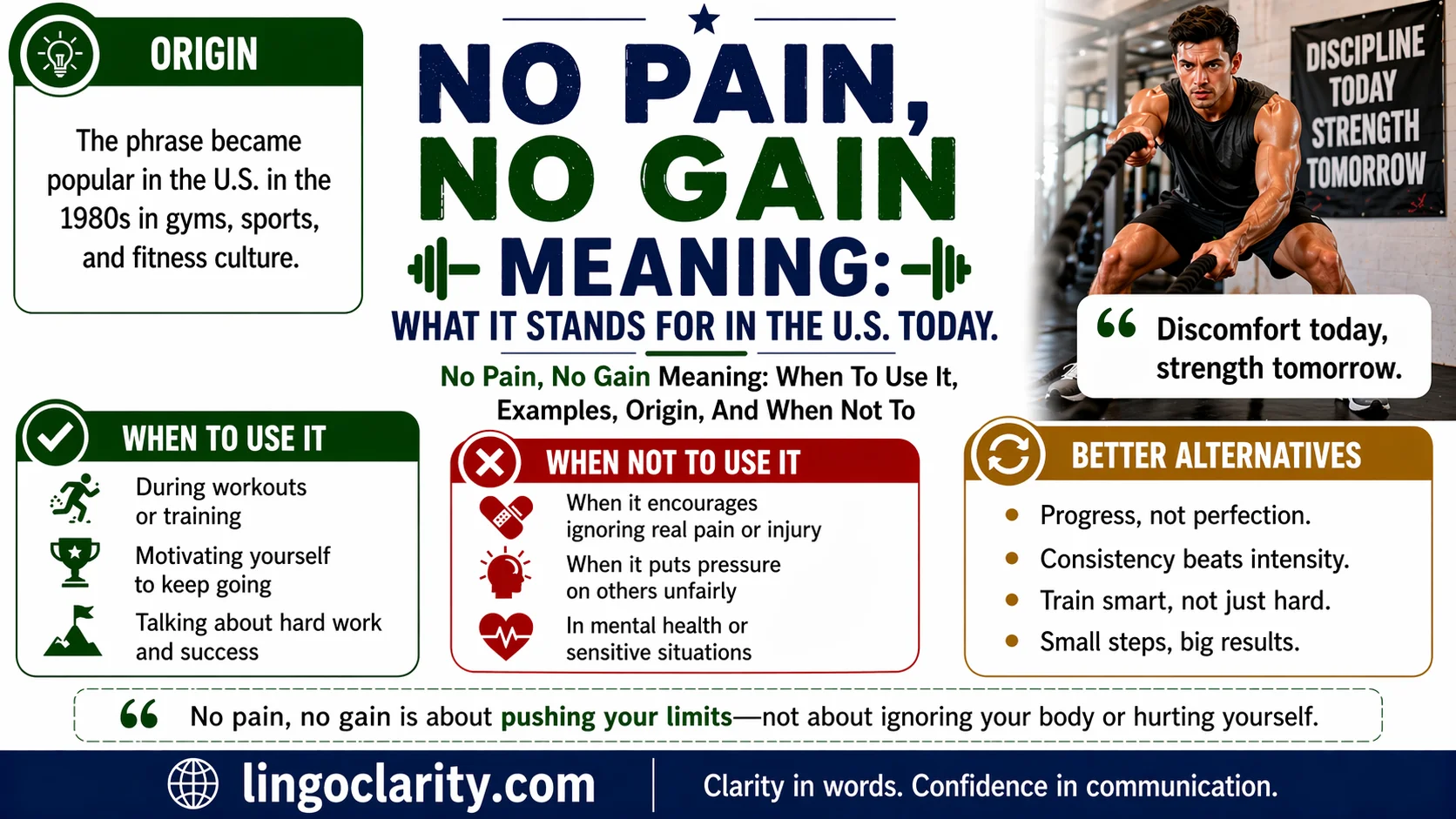
You have probably heard the phrase “no pain, no gain” at the gym, in sports, during exam season, or whenever someone is pushing toward a difficult goal. It is a common English saying people use to mean that progress usually takes effort, discipline, and some level of discomfort before results appear.
The phrase is simple, but it is also easy to misuse. In the right context, it can sound motivating and encouraging. In the wrong context, it can sound harsh, outdated, or even unsafe, especially if someone is dealing with real pain or injury.
That is why understanding the phrase properly matters. In this guide, you will learn exactly what “no pain, no gain” means, when it sounds natural, when you should avoid it, how it is used in real-life English, and what to say instead when a softer or clearer phrase works better.
Quick Answer
“No pain, no gain” means that progress usually requires hard work, effort, sacrifice, or temporary discomfort before you see results. It is an informal motivational saying commonly used in fitness, sports, study, work, and self-improvement. In modern use, it usually refers to effort, not actual injury.
What “No Pain, No Gain” Means
At its core, the phrase says that worthwhile results often require effort before reward. The “pain” is often figurative. It can mean hard practice, mental strain, frustration, discipline, or giving up comfort in the short term so you can improve in the long term.
That is why people use it in many different situations. Someone might say it during a hard workout, while studying for an exam, when learning a new skill, or while pushing through a demanding project. The message is simple: growth is not always comfortable.
Is It An Idiom, A Proverb, Or Slang?
The best label is informal proverb or fixed saying. It expresses a general truth in a compact form, which is what proverbs do. Some dictionaries and learning sites also call it an idiom, and that is common enough in real-world usage, but “proverb” is often the more precise label because the phrase gives advice rather than simply standing in for another meaning. It is not slang. Slang is usually more casual, group-specific, or short-lived; this phrase is widely understood and has been around for centuries in different forms. Merriam-Webster also marks it as informal.
What The Phrase Usually Sounds Like
In tone, “no pain, no gain” is usually:
- motivational
- informal
- blunt
- sometimes cliché
It can sound energetic and encouraging in the right setting. It can also sound old-fashioned, pushy, or insensitive if used at the wrong moment. Poem Analysis notes that the phrase is extremely well known and somewhat overused, which matters because overused sayings can lose force or sound generic.
Where People Commonly Use It
The phrase is most natural when the difficulty is expected and temporary.
A few common contexts:
- Fitness: “My last set was brutal, but no pain, no gain.”
- Sports: “Preseason practice is rough. No pain, no gain.”
- Study: “This exam prep is exhausting, but no pain, no gain.”
- Work: “We’re putting in extra hours this week. No pain, no gain.”
- Skill-building: “Learning guitar hurts my fingertips at first. No pain, no gain.”
What makes these examples work is that the speaker is talking about effort leading to improvement. The phrase sounds most natural when the struggle has a clear purpose and a believable payoff.
What It Does Not Mean
This is the part many weaker articles gloss over: “no pain, no gain” does not mean you should ignore actual injury.
In exercise and rehabilitation contexts, there is a real difference between normal exertion or mild soreness and warning-sign pain. Cleveland Clinic notes that low-level soreness after a workout can be normal, while sudden, strong, sharp, or persistent pain is a concern. Harvard Health also says the old “no pain, no gain” idea does not apply to physical therapy. In other words, the phrase works as a motivational metaphor, not as medical advice.
That distinction matters outside the gym too. You should not use this phrase to brush off burnout, grief, illness, anxiety, or serious emotional distress. In those moments, people usually need empathy, rest, treatment, or support, not a slogan.
When To Use “No Pain, No Gain”
Use it when all of the following are true:
- the effort is real but expected
- the discomfort is temporary
- the tone is casual or motivational
- the goal is clear
- you are not dismissing harm
Good examples:
“Training for my first 10K is hard, but no pain, no gain.”
“I’m tired of practicing presentation skills, but no pain, no gain.”
“We’ve been revising this report for days. No pain, no gain.”
These sound natural because they link present effort with future improvement.
When Not To Use It
Avoid the phrase when someone is:
- injured
- sick
- overwhelmed
- grieving
- visibly burned out
- asking for help rather than hype
Bad example: “Your knee is swelling? No pain, no gain.”
Better: “Stop for now. That sounds like something you should check.”
Bad example: “You’ve been working 14-hour days for weeks? No pain, no gain.”
Better: “That sounds unsustainable. You may need a break.”
The phrase fails when it minimizes risk or treats suffering as automatically virtuous.
Real Pain Vs. Normal Discomfort
One reason this expression causes confusion is that English uses the word pain loosely. In ordinary conversation, people use it for everything from sore muscles to deep frustration. But in real life, not all “pain” is equal.
In fitness, normal effort can include fatigue, burning muscles during a hard set, heavy breathing, or mild soreness later. Cleveland Clinic describes delayed onset muscle soreness as common after intense or unfamiliar exercise and notes it should improve within a few days. Sharp pain, worsening pain, or pain that lingers can point to injury instead.
That is why a better modern reading of the phrase is this: progress usually takes effort, not recklessness.
Better Alternatives Depending On The Situation
Sometimes “no pain, no gain” is fine. Sometimes a better phrase sounds smarter, kinder, or more precise.
Use these instead when needed:
- Hard work pays off — clearer and less harsh
- Trust the process — common in sports and long-term goals
- Consistency beats intensity — useful when talking about habits
- Progress takes practice — good for learning and improvement
- Listen to your body — best when safety matters
- Work smarter, not harder — useful when effort alone is not the point
These alternatives help because they let you match tone to context instead of forcing one slogan into every situation.
Common Mistakes People Make With The Phrase
Taking It Too Literally
The phrase usually does not mean real physical pain is required. In most modern contexts, it points to effort, strain, or sacrifice.
Using It As A Universal Rule
Not every good result comes from pushing harder. Sometimes rest, better strategy, patience, or consistency matter more than brute force.
Using It In Sensitive Moments
The phrase can sound cold if someone is injured, burned out, or emotionally overwhelmed. Motivational language only works when the person is actually in a place to receive it.
Using It In Very Formal Writing
You can use it in journalism, blog writing, speeches, or conversational copy, but in highly formal writing, a clearer phrase often sounds better.
Origin And History
The idea behind “no pain, no gain” is older than the exact modern wording. Dictionary.com notes that the saying dates to the 1500s and appeared in John Ray’s 1670 proverb collection as “Without pains, no gains.” Other historical forms include Robert Herrick’s “No pains, no gains” in Hesperides (1650) and Benjamin Franklin’s “There are no gains without pains.”
The modern phrase became much more strongly associated with exercise culture in the 1980s. Multiple references tie its rise in popular fitness language to Jane Fonda’s aerobics videos, where “No pain, no gain” and “Feel the burn” became recognizable workout-era catchphrases.
So the cleanest way to explain the history is this: the underlying idea is old, the English proverb forms are centuries old, and the modern gym slogan version became culturally prominent much later.
Pronunciation
A simple pronunciation guide is: noh payn, noh gayn. Poem Analysis gives the phrase in that same sound-based form.
Natural Examples In Everyday English
Here are a few examples that sound more natural than textbook filler:
At the gym: “These lunges are awful, but no pain, no gain.”
During exam prep: “I’ve been reviewing all weekend. No pain, no gain.”
At work: “We’re under pressure now, but if we finish strong, no pain, no gain.”
Learning a skill: “My first few coding projects were frustrating. No pain, no gain.”
Used jokingly: “I dragged myself out of bed for the 6 a.m. class. No pain, no gain, I guess.”
Notice that the phrase often works best as a short side comment, not a long speech.
How To Sound More Natural When You Use It
If you want the phrase to sound human rather than robotic, use it lightly.
Natural:
“This week has been rough, but no pain, no gain.”
Less natural:
“As the saying goes, no pain, no gain, which means that suffering is necessary for progress.”
Also, not every situation needs the full phrase. Sometimes the better move is to echo the idea without using the cliché:
“This part is hard, but it’ll pay off.”
“It’s uncomfortable now, but that’s part of getting better.”
“You’re doing the hard part first.”
Those options often sound fresher.
FAQ
What does “no pain, no gain” mean?
It means progress usually takes effort, struggle, sacrifice, or temporary discomfort. In everyday use, it usually refers to hard work paying off, not to ignoring injury.
Is “no pain, no gain” an idiom?
Many people call it an idiom, and some dictionaries do. But it is often more precise to describe it as an informal proverb or fixed saying because it expresses a general truth or piece of advice.
Is “no pain, no gain” slang?
No. It is informal, but it is not slang. It is a long-established saying that is widely understood across standard English.
Is the phrase only about exercise?
No. It is common in fitness and sports, but people also use it for studying, work, business, and skill-building.
When should you avoid saying it?
Avoid it when someone may be injured, burned out, sick, grieving, or in genuine distress. It can sound dismissive, and in exercise settings it can be unsafe if it encourages someone to push through warning-sign pain.
What is a better alternative to “no pain, no gain”?
That depends on the situation. “Hard work pays off” is softer and clearer. “Trust the process” works for long-term improvement. “Listen to your body” is better when safety matters.
Conclusion
“No pain, no gain” is a familiar English saying with a simple core meaning: good results often require effort first. That is why it works in workouts, studying, career goals, and skill-building. But modern readers also need the missing nuance: effort and improvement are not the same as injury, burnout, or needless suffering.
Use the phrase when you mean temporary struggle in service of progress. Skip it when care, safety, or empathy should come first. That is the difference between sounding motivating and sounding careless.
