
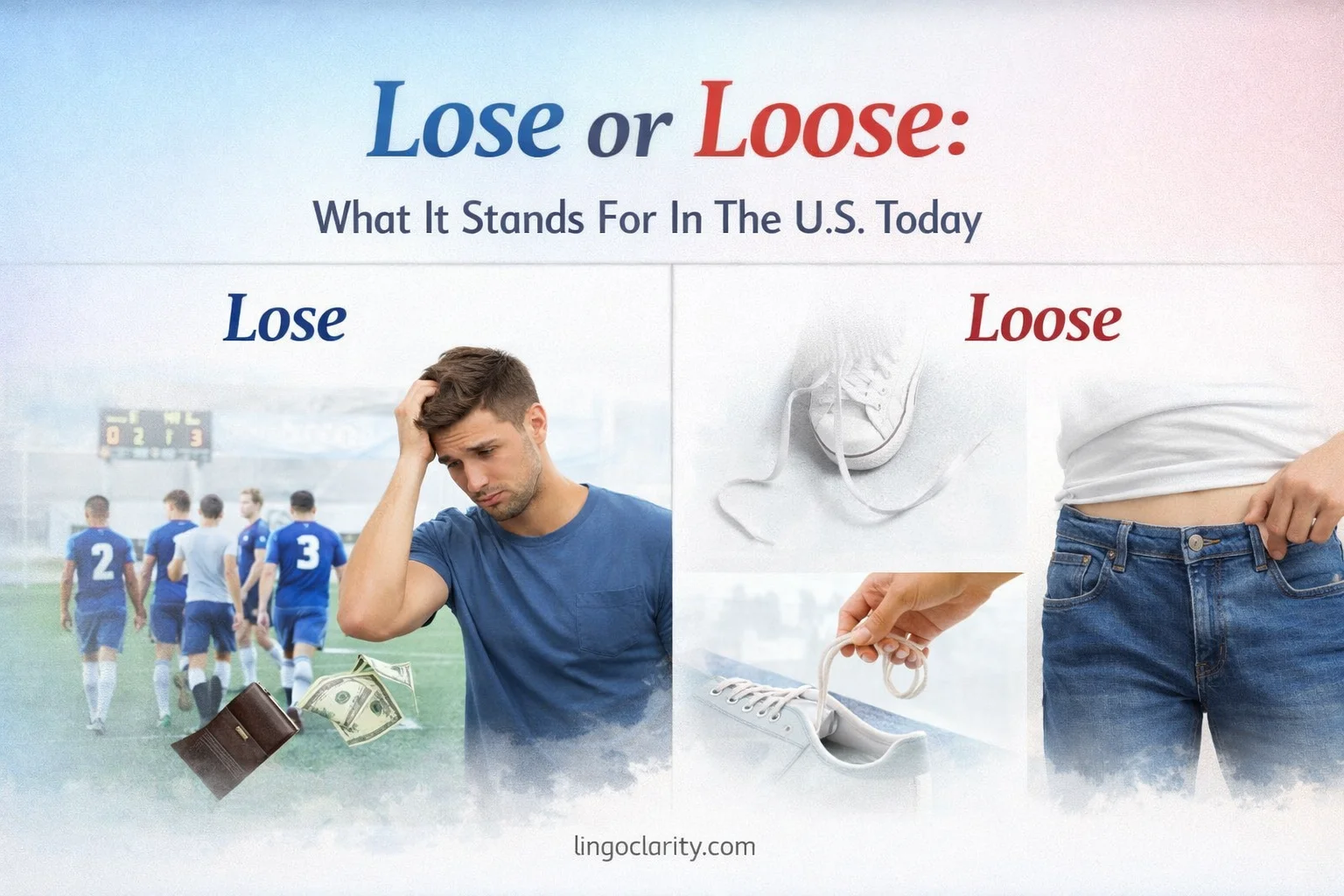
Lose and loose are easy to mix up because they look almost identical at first glance. However, they do not mean the same thing, and they do not do the same job in a sentence. That is exactly why this pair causes so many mistakes in school assignments, emails, work messages, and everyday writing.
In standard English usage, lose is usually a verb connected to not keeping, not finding, or not winning something. Loose, by contrast, is usually an adjective that describes something not tight, not firmly attached, or free to move. In other words, one word is mainly about loss, while the other is mainly about looseness. That basic contrast is the key to using them correctly.
Because the spellings are so close, many writers choose the wrong form by habit. Still, once you see the pattern, the confusion becomes much easier to fix. In this guide, you will learn the difference in meaning, grammar, pronunciation, and usage. You will also see real-life examples, common mistakes, quick memory tricks, synonyms, opposites, and a final rule you can remember fast.
Quick Answer
Use lose when you mean misplace something, fail to win, stop having something, or get rid of something.
Use loose when you mean not tight, not secure, not fixed in place, or free to move.
So, for example:
- You lose your keys.
- Your shoelace is loose.
- A team can lose a game.
- A button can feel loose.
As a result, the easiest test is simple: if the meaning is about something being gone, choose lose. If the meaning is about something having extra movement or extra room, choose loose.
Simple Definition
A simple definition helps this pair make sense right away.
Lose means to no longer have something, to be unable to find it, to fail to keep it, or to fail to win.
Loose means not tightly fitted, not firmly fastened, not secure, or free from restraint.
In plain English, lose is about something slipping away from you, while loose is about something not being held tightly in place. That difference may seem small on the page, but in real writing, it changes the meaning completely. Merriam-Webster, Cambridge, and Oxford all reflect that same core distinction in their dictionary entries.
Why People Confuse Lose And Loose
There are two main reasons people mix up these words. First, the spellings differ by only one extra o. Second, both words share the same long oo vowel sound. Because of that, they can sound close enough in everyday speech to blur together.
Even so, there is a helpful clue in pronunciation. Lose ends with a z sound, while loose ends with an s sound. So lose sounds like “looz,” and loose sounds like “looss.” Once you hear that ending clearly, the spelling usually becomes easier to remember.
Another reason for the confusion is that the two words are historically related. Etymonline traces lose back to Old English and loose to early Middle English, with related Germanic roots behind both words. Still, modern English treats them as separate words with separate meanings, so their shared history does not change the rule you use today.
Key Differences At A Glance
Here is the fastest side-by-side comparison:
| Situation | Correct Word | Why |
|---|---|---|
| You cannot find your wallet | lose | It means misplace or no longer have |
| Your team did not win | lose | It means suffer defeat |
| You want to drop ten pounds | lose | It means reduce or get rid of |
| Your sweater is not tight | loose | It means not fitted closely |
| A screw is not secure | loose | It means not firmly attached |
| A dog escaped its leash | loose | It means free or not restrained |
In short, lose usually names an action or result, while loose usually describes a condition. That is why one often works like a verb and the other often works like an adjective.
What Lose Means And How To Use It
In most everyday writing, lose is a verb. It often appears in several common meanings.
First, it can mean misplace something:
- I do not want to lose my phone.
- She always loses one glove in winter.
Second, it can mean fail to win:
- We might lose the match.
- They lost the final round.
Third, it can mean no longer have something:
- He could lose his job.
- The company lost money last year.
- She does not want to lose her chance.
In addition, lose can mean reduce something in phrases like lose weight, lose interest, or lose speed. Merriam-Webster and Oxford both include meanings tied to failing to keep, failing to win, and no longer having something. That is why lose is the correct choice in phrases like lose a game, lose your keys, lose control, and lose weight.
What Loose Means And How To Use It
Loose is usually an adjective. Instead of showing loss, it describes something that is not tight, not fixed, or free.
For example, you use loose for clothing:
- These jeans feel too loose.
- She wore a loose sweater to class.
You also use loose for things that are not firmly attached:
- The handle is loose again.
- There may be a loose wire behind the desk.
In addition, loose works for things that are free or not restrained:
- The dog got loose and ran into the yard.
- A few loose papers fell out of the folder.
Cambridge defines loose around the idea of not being firmly held or fastened in place, and Oxford similarly gives meanings such as not securely fixed and able to become separated. That is why loose tooth, loose screw, loose clothing, and on the loose are all standard uses.
Can Loose Be A Verb?
Yes, loose can also be a verb. However, that use is much less common in everyday American writing than the adjective use.
As a verb, loose can mean release, untie, detach, or let fly. For example:
- The guards loosed the dogs.
- He loosed the knot.
- The archers loosed their arrows.
That usage is correct, and Merriam-Webster and Oxford both record it. Even so, many modern readers find release, untie, or loosen more natural in ordinary sentences. So while loose the knot is valid, loosen the knot often sounds more familiar in daily writing. This rare verb sense is also the reason some writers think loose my keys might be acceptable. In normal usage, though, that phrase is still wrong because the intended meaning is not “release my keys.” It is “misplace my keys,” so the correct form is lose.
Pronunciation Difference
Pronunciation is one of the best memory tools for this pair.
- lose = /luːz/
- loose = /luːs/
So, although the vowel sound is the same, the final consonant changes. Lose ends in a voiced z sound, while loose ends in an unvoiced s sound. As a result, lose sounds close to choose, and loose sounds close to goose. That contrast may be small, but it helps many writers remember which spelling fits which word.
Real-Life Examples
These examples show how the pair works in everyday situations.
At School
A student might lose a notebook, lose points on an assignment, or lose track of time while studying. Meanwhile, a backpack strap might feel loose, a binder ring might come loose, or a page might slip loose from the folder.
At Work
In an office, a company can lose a client, lose data, or lose momentum on a project. At the same time, a desk handle might be loose, a cable might hang loose, or a stack of loose papers might need organizing.
At Home
At home, someone can lose the TV remote, lose patience, or lose an important receipt. By contrast, a cabinet door can feel loose, a shoelace can come loose, and a pet might get loose if the gate is left open.
In Sports And Fitness
A team can lose a game, a player can lose balance, and a person can try to lose weight. On the other hand, a jersey can feel loose, a helmet strap can come loose, and a wheel can turn loose after rough use.
These examples show the pattern clearly: lose works when something is not kept, not won, or no longer held, while loose works when something lacks tightness or restraint.
Synonyms And Opposites
Synonyms depend on context, but a few patterns are especially useful.
Lose — Synonyms
Depending on the sentence, lose may be close in meaning to:
- misplace
- forfeit
- miss
- drop
- surrender
- give up
Lose — Opposites
Common opposites include:
- find
- keep
- retain
- win
- gain
Loose — Synonyms
Depending on context, loose may be close to:
- slack
- unsecured
- unfastened
- detached
- relaxed
- free
Loose — Opposites
Common opposites include:
- tight
- secure
- firm
- fastened
- fitted
- restrained
Merriam-Webster’s thesaurus reflects these general synonym and antonym patterns for both words. Still, exact replacements depend on the sentence, so it is always better to check the context before swapping one word for another.
Sentence Usage
Here are clear example sentences you can model in your own writing.
Using Lose
- Be careful not to lose your passport.
- We cannot afford to lose another customer.
- She started to lose confidence before the interview.
- They might lose the election by a narrow margin.
- He hopes to lose ten pounds by summer.
Using Loose
- The button on my coat is loose.
- She prefers loose clothing in hot weather.
- One tile has come loose in the hallway.
- The dog is still loose in the neighborhood.
- A few loose papers were scattered across the desk.
Because these example patterns match standard dictionary meanings, they are safe models for school, work, and daily writing.
Common Mistakes
One common mistake is using loose any time a writer hears the long oo sound. That is why errors like loose my keys, loose the game, and loose weight appear so often. In reality, if the meaning is about misplacing, failing, or reducing, the correct word is lose.
Another common mistake is using lose for physical fit or attachment. For example, writers may type my shirt is lose or there is a lose screw. Those are incorrect because the idea is not loss. Instead, the meaning is “not tight” or “not secure,” so the correct form is loose.
A third mistake is confusing lose with the noun loss. In standard English, the noun form is usually loss, not lose. So you write financial loss, weight loss, or loss of confidence. You do not normally write a big lose in formal edited English. Oxford and Merriam-Webster both treat loss as the regular noun connected to lose.
Easy Memory Tricks
A good memory trick can fix this mistake fast.
First, notice the number of o’s:
- lose has one o
- loose has two o’s
That helps because loose looks like it has extra space built into it. So if something has extra room, extra movement, or extra slack, loose makes sense.
Another trick is to use meaning:
- If something is gone, you lose it.
- If something is not tight, it is loose.
You can also remember the word families:
- lose, losing, lost
- loose, looser, loosest
Once those patterns become familiar, the right spelling usually comes more naturally.
Word History
The history behind these words is interesting because it helps explain why they still look related. Etymonline traces lose back to Old English losian, while loose comes into English through early Middle English from Old Norse lauss. Their roots are historically connected, which is one reason they still resemble each other today. Even so, modern English separates them clearly by meaning and grammar. So, although the history is linked, current usage is not interchangeable.
Conclusion
In the end, the difference between lose and loose is simple once you focus on meaning.
Use lose when the sentence is about not keeping, not finding, not winning, or no longer having something.
Use loose when the sentence is about something not tight, not firmly attached, or free to move.
So:
- You lose your keys.
- Your shoelace is loose.
- You lose a game.
- Your shirt is loose.
- You lose weight.
- A button comes loose.
That is the clearest rule to remember: lose is about loss, while loose is about looseness.
FAQs
What is the difference between lose and loose?
Lose is usually a verb that means to misplace something, fail to win, or no longer have something. Loose is usually an adjective that means not tight, not secure, or free to move.
Which is correct: lose weight or loose weight?
The correct phrase is lose weight because the meaning is to reduce weight, not to make it slack. Merriam-Webster includes this reduction meaning under lose.
Which is correct: loose tooth or lose tooth?
The correct phrase is loose tooth because the word describes the tooth’s condition. It means the tooth is not firmly attached. Oxford and Cambridge both support that use of loose.
Can loose be a verb?
Yes. Loose can be a verb meaning release, untie, detach, or let fly. However, that use is much less common in everyday writing than the adjective use.
Why do people confuse lose and loose?
People mix them up because the spellings are very close and both words share the same long oo vowel sound. The main pronunciation difference is the final sound: lose ends in z, while loose ends in s.
What is the noun form of lose?
The regular noun form is loss, not lose. For example, you say a loss of confidence, financial loss, or weight loss.
