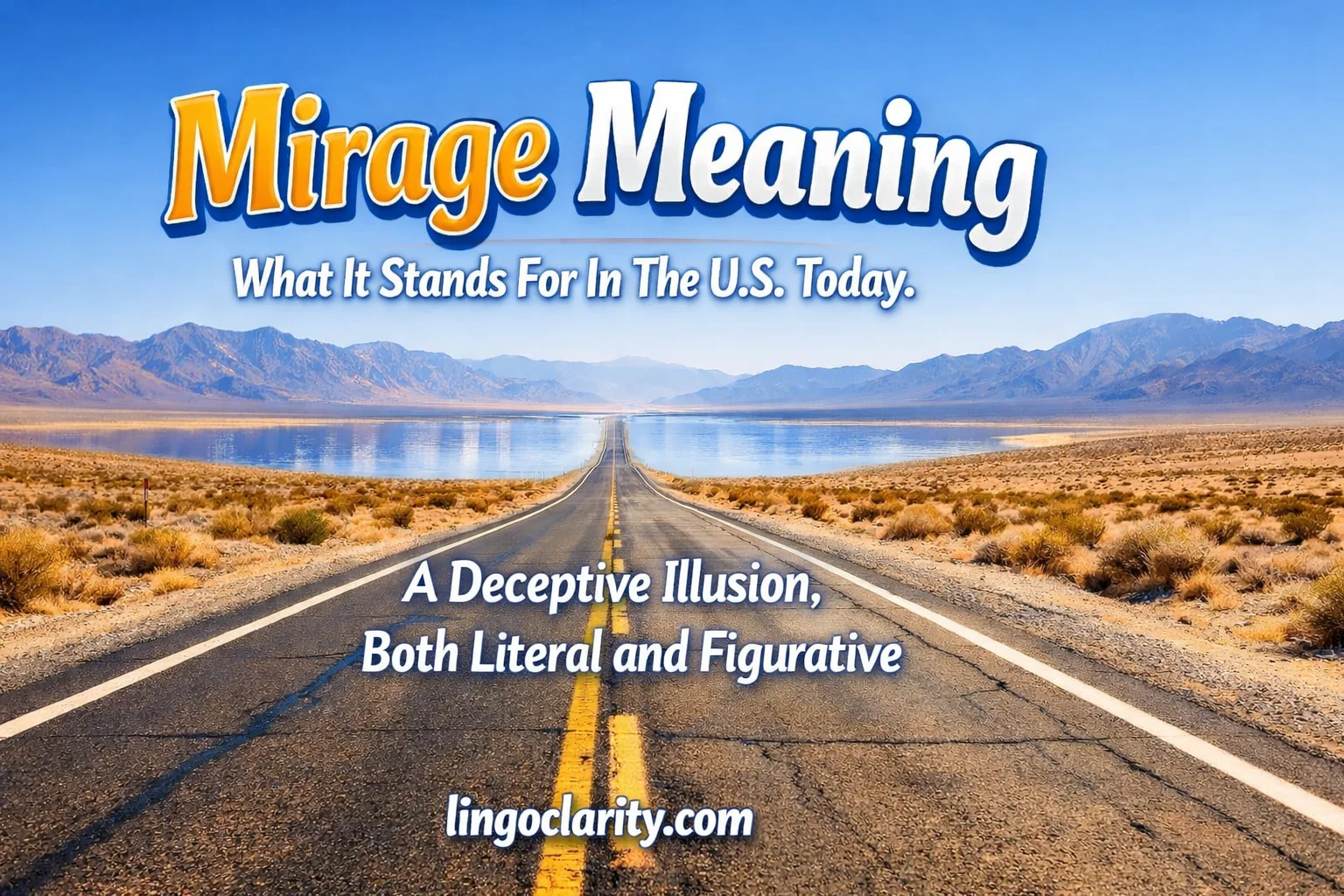
People encounter the word mirage in novels, news coverage, weather discussions, and everyday conversation. Sometimes it refers to a real optical effect, such as the water-like shimmer you seem to see on a hot road. Other times it describes something less physical but just as deceptive: a promise, hope, or opportunity that appears real until you get closer and realize it will not hold up. Major dictionaries recognize both meanings, which is why the word works so well in both literal and figurative English.
Because mirage carries both scientific and metaphorical force, it is a useful word to understand well. Used correctly, it can make writing sharper, more precise, and more memorable. Used loosely, it can sound vague or overly dramatic. This guide explains what mirage means, how to pronounce it in US English, when to use it, when not to use it, and how to choose it over similar words like illusion or hallucination.
Quick Answer
A mirage is something that seems real but is not what it appears to be. In its literal sense, it is an optical effect caused by the bending of light through layers of air with different temperatures or densities. In its figurative sense, it means an attractive but unreal hope, dream, or promise.
In practical American English, the safest short definition is this: a mirage is a false appearance. That core idea works whether you are describing shimmering “water” on a highway or a plan that looked achievable until reality set in.
Key Takeaways
- Mirage is primarily a noun.
- It has both a literal meaning and a figurative meaning.
- In US English, it is commonly pronounced muh-RAHZH.
- The standard plural form is mirages.
- It works best when something looks convincing at first but proves unreal.
What Does Mirage Mean?
At its most basic level, mirage means an appearance that deceives you. That deception can happen in two ways. First, it can happen physically, when light and heat create an image that looks like water or a reflected object in the distance. Second, it can happen figuratively, when a person, plan, or promise seems real and attainable but turns out to be empty. Both Merriam-Webster and Cambridge include these two core senses.
A simple memory trick helps: a mirage seems solid from far away, but fades on closer inspection. That is the thread connecting the science meaning and the everyday figurative meaning. In both cases, what matters is not total fantasy, but misleading appearance.
Definition In Plain English
In plain English, a mirage is something that looks real even though it is misleading.
On a hot day, you may think you see water on the road ahead. That is the literal sense. In daily speech or writing, you might describe a “guaranteed shortcut to success” as a mirage if it looked promising but never truly existed. That is the figurative sense.
Here are two easy examples:
- The driver slowed down because the road ahead looked wet, but it was only a mirage.
- The promise of instant wealth turned out to be a mirage.
These examples work because the word always carries the same core idea: appearance without reliable reality.
How To Pronounce Mirage
In American English, mirage is commonly pronounced muh-RAHZH. Dictionary transcriptions show it as /məˈrɑʒ/ in American English and mə-ˈräzh in Merriam-Webster’s style. The stress falls on the second syllable, and the final sound is the soft zh sound you hear in words like measure.
A quick pronunciation guide:
- Correct: muh-RAHZH
- Not standard: MY-rage
- Not standard: mih-RAG
One of the most common mistakes is using a hard g sound at the end. In standard US pronunciation, the ending is soft, not like the word rag.
Part Of Speech And Forms
Mirage is a countable noun. Major dictionaries list it as a noun, and standard usage treats it that way in both literal and figurative writing. The plural form is mirages.
That means these forms are natural:
- a mirage
- the mirage
- two mirages
- several mirages
Examples:
- We saw a mirage above the highway at noon.
- The explorers reported several mirages that afternoon.
- For investors, the “easy fix” was a mirage from the start.
In creative writing, you may occasionally see unusual experiments with the word, but for standard American English, the safe rule is simple: treat mirage as a noun.
Literal Meaning In Weather And Science
In its literal sense, a mirage is a real optical phenomenon, not an imaginary invention. Britannica describes it as the deceptive appearance of a distant object caused by the bending of light rays in layers of air with different densities. Merriam-Webster similarly explains that it appears over places such as deserts, seas, or hot pavement and results from light bending or reflecting through heated air layers.
This matters because people often assume a mirage is “just in your head.” It is not. The phenomenon is real; what is misleading is your interpretation of what you are seeing. On a hot road, for example, the surface may look wet even though there is no water there. According to Britannica, this happens because the light reaching your eye has been bent by layers of air with different temperatures, creating the appearance of reflection.
That is why sentences like this are accurate:
- The highway looked flooded in the distance, but it was only a mirage.
- From far away, the desert appeared to contain a lake, but the “water” was a mirage.
Literal use tends to appear in weather writing, travel writing, science education, and vivid scene-setting in fiction.
Figurative Meaning In Everyday English
The figurative meaning of mirage is just as common in polished writing. Merriam-Webster defines this extended sense as something illusory and unattainable, while Cambridge includes the meaning of a hope or wish with no real chance of being achieved.
That figurative use gives the word much of its power. It does more than say something was false. It suggests that the thing looked persuasive, desirable, or close enough to reach. A mirage is not merely an error. It is a misleading appearance that invites belief.
For example:
- Their dream of overnight success was a mirage.
- The ceasefire looked near, but peace proved to be a mirage.
- For burned-out workers, the promise of “doing more with less” can feel like a mirage.
This is why the word works especially well in editorials, analysis pieces, essays, and literary nonfiction. It carries a sense of disappointment, but also of seduction: something drew people toward it before it vanished.
How To Use Mirage Naturally In Sentences
The easiest way to use mirage well is to keep its central image in mind: something that appears convincing until reality changes the view. Once you remember that, sentence-building becomes straightforward.
Some natural sentence patterns include:
- a mirage on/in/over
We saw a mirage on the highway. - was a mirage
The early optimism was a mirage. - proved to be a mirage
The supposed breakthrough proved to be a mirage. - a mirage of + noun
The ad sold a mirage of easy wealth.
You can also use the word in more developed sentences:
- From inside the car, the shimmering pavement ahead looked like a mirage of water.
- What seemed like a stable solution was really a mirage created by short-term gains.
- The campaign offered voters a mirage of quick change without hard trade-offs.
The most natural uses share one feature: the thing being described looked credible at first.
When To Use Mirage
Use mirage when you want to emphasize false appearance, especially when that appearance is visually strong or emotionally persuasive.
It is a good choice when:
- something looks real from a distance
- a plan or promise seems achievable but is not
- you want a more vivid alternative to a flat word like falsehood
- you want writing that feels precise but still memorable
For example, compare these two sentences:
- The plan failed.
- The plan was a mirage from the beginning.
The second sentence carries more meaning. It suggests that the plan did not simply fail. It attracted belief before collapsing.
When Not To Use Mirage
Do not use mirage for every mistake, setback, or disappointment. The word works best when there was a meaningful element of deceptive appearance.
Avoid it when:
- you simply mean error
- you simply mean lie
- nothing ever looked real or promising in the first place
- you are referring to a medical or sensory experience better described by another term
For example, this is weak:
- I forgot my keys. My morning routine was a mirage.
That use sounds forced because nothing in the situation involved a false appearance. A better use would be:
- My hope of getting to work early was a mirage by 8:00 a.m.
Now the word fits because the expectation briefly seemed possible before reality disproved it.
Mirage Vs. Illusion, Delusion, And Hallucination
These words overlap, but they are not interchangeable in tone or meaning. Merriam-Webster groups mirage, illusion, delusion, and hallucination together as words for something believed to be real but actually false, then distinguishes them by usage. It notes that mirage in its extended sense applies to an illusory vision, dream, hope, or aim; illusion is broader; and hallucination points to impressions produced by disordered senses.
Here is the practical difference:
- Mirage: best when something looks real or attainable but fades on closer approach
- Illusion: broader and more general; often the safest substitute
- Delusion: stronger and more psychological; usually tied to a false belief
- Hallucination: not the same as a mirage; it refers to sensory perception without an actual external stimulus, often in medical, psychological, or drug-related contexts
Examples:
- The “perfect market” was a mirage.
- The feeling of control was an illusion.
- He remained under the delusion that nothing had changed.
- The patient reported visual hallucinations.
If you are choosing between mirage and illusion, ask one question: Do I want the image of something that looked real from a distance and then disappeared? If yes, mirage is usually the better choice.
Common Contexts Where Mirage Appears
You will most often see mirage in four kinds of writing.
Weather And Science
In this context, the word keeps its literal meaning. It refers to the optical effect seen over hot surfaces, deserts, or other atmospheric conditions that bend light.
Journalism And Commentary
Writers often use mirage to criticize promises that looked serious but lacked substance.
Example:
The budget surplus turned out to be a mirage once the hidden costs appeared.
Literature And Creative Nonfiction
The word is useful in descriptive prose because it carries both image and emotion.
Example:
Hope rose before him like a desert mirage, bright and unreachable.
Business, Politics, And Self-Improvement Writing
This is where the figurative sense appears most often: quick success, easy balance, effortless reform, and other attractive but unstable ideas.
Example:
For many founders, “instant scale without risk” is a mirage.
Common Mistakes With Mirage
A few mistakes show up again and again.
Mispronouncing The Ending
The final sound is soft, like the sound in measure, not a hard g. In US English, the standard pronunciation is muh-RAHZH.
Using It For Any Small Disappointment
A missed bus, a bad lunch, or a minor scheduling issue is usually not a mirage. Save the word for something that only appeared real or promising.
Using It As A Verb In Ordinary Writing
Standard usage treats mirage as a noun. In everyday edited prose, avoid constructions like “the idea miraged away.” They sound forced.
Confusing It With Hallucination
A mirage is an optical phenomenon or an extended metaphor for false hope. A hallucination is a different concept altogether, tied to perception without an actual external stimulus.
Overusing It In Casual Conversation
Mirage is clear and common enough, but it has a more literary tone than words like fake, false promise, or illusion. In very casual speech, a simpler word may sound more natural.
Origin Of The Word Mirage
The word mirage entered English around 1800, according to Merriam-Webster. Its etymology traces it to French mirer, meaning “to look at” or “gaze at,” which in turn goes back to the Latin mirari, meaning “to wonder at” or “to look with wonder.” That history fits the word well: a mirage is something seen in a way that invites belief and amazement before the truth becomes clear.
Etymology does not change how you use the word day to day, but it reinforces the core image behind it. Mirage has always been tied to seeing, looking, and being misled by what appears before the eye.
FAQ
What does mirage mean?
Mirage means something that seems real but is not what it appears to be. Literally, it refers to an optical effect caused by atmospheric conditions. Figuratively, it means a false hope, dream, or promise.
Is mirage a noun?
Yes. Standard dictionaries list mirage as a noun, and common edited English treats it as a countable noun. The plural form is mirages.
How do you pronounce mirage?
In US English, the common pronunciation is muh-RAHZH. Dictionaries show it as /məˈrɑʒ/ or mə-ˈräzh, with stress on the second syllable.
Is a mirage real or imaginary?
A mirage is a real optical phenomenon. The misleading part is not that the event is imaginary, but that the eye interprets the image as something else, such as water on the road.
Can mirage be used figuratively?
Yes. Major dictionaries include a figurative sense in which mirage means something illusory or unattainable, such as a hope or promise that never becomes real.
What is the difference between mirage and illusion?
Illusion is the broader word. Mirage is more specific and usually suggests something that looked real or close enough to reach before it vanished or proved deceptive. Merriam-Webster’s usage notes distinguish mirage as an illusory vision, dream, hope, or aim.
What is the difference between mirage and hallucination?
A mirage is tied to atmospheric optics or, figuratively, false hope. A hallucination is a sensory perception that occurs without an actual external stimulus. They are not the same kind of experience or the same kind of word.
What is the origin of the word mirage?
Merriam-Webster traces mirage to French mirer and ultimately to Latin mirari. It also records the word’s first known use in English as 1800.
Mini Quiz
- Is mirage usually a noun or a verb?
- Which sounds more natural: a mirage on the highway or a mirage homework?
- Does mirage have only a literal meaning?
- Which pronunciation is more natural in US English: muh-RAHZH or MY-rage?
Answer Key
- Noun
- A mirage on the highway
- No. It also has a figurative meaning.
- muh-RAHZH
Final Takeaway
Mirage is one of those words that becomes easy to use once you lock onto its central idea: false appearance. In literal contexts, it names a real optical phenomenon created by atmospheric conditions. In figurative contexts, it describes an appealing vision that seems close, convincing, or attainable until reality strips the illusion away.
That double function is what makes the word so useful. It can sharpen science writing, enrich descriptive prose, and strengthen commentary when you want more than a flat word like mistake or failure. The next time you see mirage in a sentence, ask whether it points to heat on the horizon, false hope in human plans, or both at once. That is where the word does its best work.
